
Saudi Arabia’s Oil Journey: How the Kingdom Became an Oil Power1938
Saudi Arabia is now one of the world’s most important oil-producing countries. But the story of Saudi oil did not begin with a giant oil field or a successful drilling rig.
It began millions of years ago, when parts of the Arabian Peninsula were covered by ancient seas.
The modern oil story began much later — in the 1930s — when geologists started searching the Saudi desert for signs of petroleum.
After years of exploration, failed wells and difficult drilling, Saudi Arabia finally found commercial quantities of crude oil in 1938.
That discovery changed the country’s economic history.
The Oil Story Started Millions of Years Ago
Long before modern Saudi Arabia existed, the region went through major geological changes.
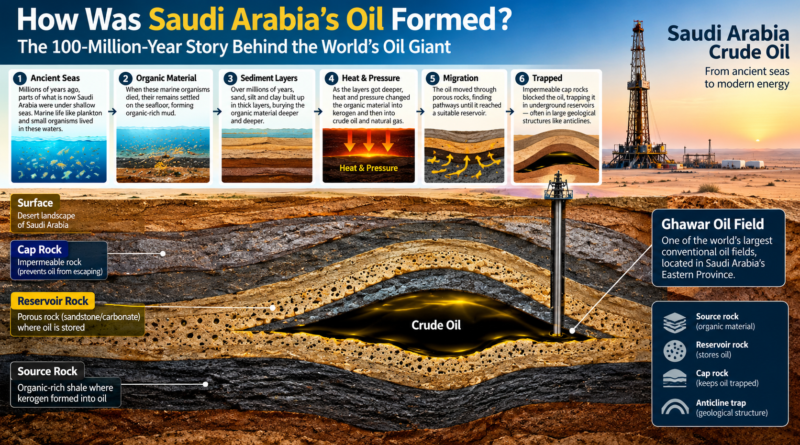
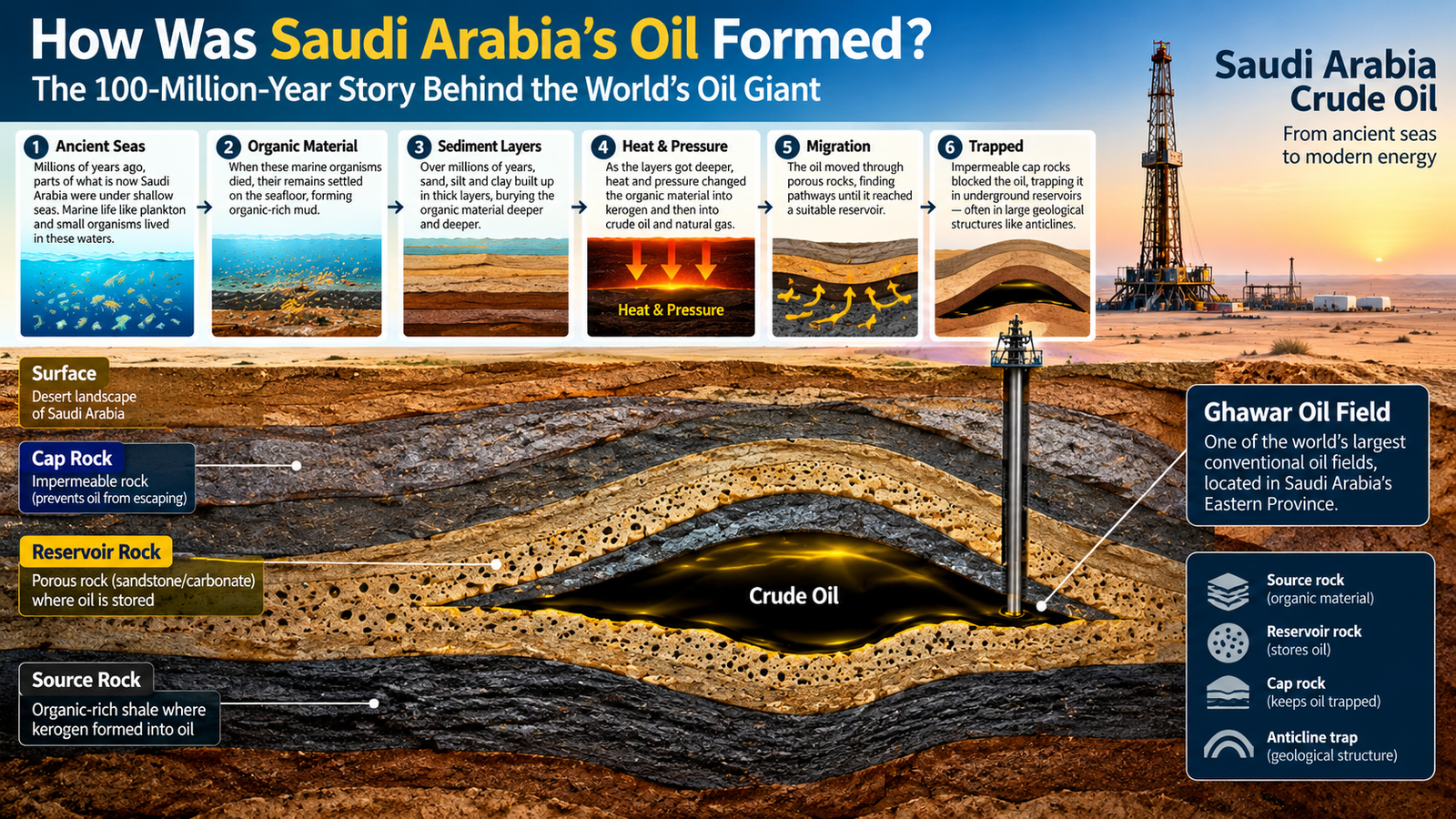
Ancient seas covered parts of what is now the Arabian Peninsula. Marine organisms and other organic material accumulated on the sea floor.
Over very long periods, layers of sediment covered that organic material.
As the material was buried deeper, heat and pressure changed it over geological time. Under the right conditions, some of that organic material eventually became petroleum.
The oil then moved through porous rocks until geological structures trapped it beneath impermeable rock.
In simple terms:
Ancient seas → organic material → sediment → heat and pressure → petroleum → migration → underground reservoir
This process took millions of years.
The oil was not sitting in a giant underground lake. Much of it became trapped inside tiny spaces within reservoir rocks, somewhat like water held inside a sponge.
Saudi Arabia Begins Looking for Oil
The modern search for oil began in the early 1930s.
In 1933, Saudi Arabia signed an oil concession agreement with Standard Oil of California, later known as SoCal. The California Arabian Standard Oil Company, or CASOC, was created to manage the exploration work.
Geologists began studying the land, especially in the Eastern Province.
They were looking for geological structures that could indicate the presence of petroleum underground.
This was not an easy job.
The teams had to work in a huge desert environment where transportation, water, heat and drilling equipment created major challenges.
The first wells did not immediately deliver the expected result.
The First Drilling Attempts Were Not Easy
Drilling began at Dammam Well No. 1 in 1935.
The well showed some signs of gas and oil, but it did not produce the commercial quantities the explorers were looking for.
Other wells followed.
Dammam Wells No. 2, 3, 4, 5 and 6 were drilled as exploration continued.
The problem was simple: finding signs of petroleum was one thing. Finding a large commercial reservoir was another.
The exploration team continued studying the geology and drilling deeper.
Then Came Dammam Well No. 7
The turning point came with Dammam Well No. 7.
The well was drilled in the Dhahran area of Saudi Arabia’s Eastern Province.
On March 4, 1938, the well began producing crude oil in commercial quantities at a depth of approximately 1,440 meters.
Its initial production was about 1,585 barrels per day.
Production soon increased further.
This was the breakthrough Saudi Arabia had been waiting for.
The well later became known as the “Prosperity Well.”
It was not simply another oil well.
It marked the beginning of Saudi Arabia’s modern oil era.
Why Dammam No. 7 Was So Important
The discovery proved that Saudi Arabia had commercially valuable petroleum resources.
That changed the direction of exploration.
Geologists now had stronger evidence that the geological structures they were studying could contain major oil reservoirs.
Exploration expanded.
New fields were discovered.
Infrastructure began to grow around the oil industry.
Pipelines, storage facilities, ports and production facilities became increasingly important.
Saudi Arabia was moving from oil exploration to an oil economy.
The First Saudi Oil Exports
Finding oil was only the beginning.
The country also needed a way to move crude oil from the fields to international markets.
Pipelines and export facilities were developed.
Saudi sources note that oil shipments to Bahrain began in 1938, while the first official tanker shipment from Ras Tanura took place on May 1, 1939.
The tanker was the D.G. Scofield.
King Abdulaziz attended the event and operated the valve used to load the first official tanker shipment from Ras Tanura.
That moment became one of the most important events in Saudi Arabia’s early oil history.
Oil Exploration Expands Across Saudi Arabia
The discovery of Dammam No. 7 did not end exploration.
It accelerated it.
In 1940, the Abqaiq oil field was discovered.
More exploration followed.
Saudi Arabia’s oil industry began to develop a much larger network of fields, wells, pipelines and export facilities.
In 1944, CASOC was renamed the Arabian American Oil Company, or Aramco.
The company would eventually become one of the world’s most important energy companies.
Ghawar Changed the Scale of the Story
One of the biggest discoveries came in 1948, when exploration led to the discovery of the Ghawar field.
Aramco describes Ghawar as the largest crude oil field in the world at the time of its discovery.
Ghawar is located in Saudi Arabia’s Eastern Province.
Its importance went far beyond a single successful well.
The field demonstrated the enormous scale of Saudi Arabia’s petroleum geology.
Later drilling and production showed that the region contained huge quantities of oil trapped in underground reservoir rocks.
The important point is that the oil was not simply “under the desert.”
It was held within a complex geological system involving source rocks, reservoir rocks, geological traps and cap rocks.
How Does an Underground Oil Reservoir Work?
Think of the underground structure like a natural container.
At the bottom or deeper level, source rocks contain organic material from which petroleum formed over geological time.
Oil can then migrate through suitable rocks.
A porous reservoir rock can hold the oil in its tiny pore spaces.
Above it, a less-permeable cap rock can prevent the oil from escaping.
A geological structure, such as an anticline, can create a trap where oil accumulates.
A simplified picture looks like this:
Surface
↓
Cap Rock
Blocks oil from escaping
↓
Reservoir Rock
Tiny pores contain crude oil
↓
Source Rock
Organic-rich rock associated with petroleum generation
The drilling well passes through these layers and reaches the reservoir.
That is how an underground oil field can be developed.
Saudi Oil Production Grows Quickly
After the major discoveries, Saudi oil production increased rapidly.
Aramco’s historical timeline shows that Saudi crude production reached about 500,000 barrels per day in 1949.
Production passed 1 million barrels per day in 1958 and exceeded 2 million barrels per day in 1965.
The scale of the industry was changing quickly.
Saudi Arabia needed larger pipelines, export terminals, storage facilities and production systems.
The country was becoming a major supplier to the global oil market.
The Trans-Arabian Pipeline
Infrastructure became a critical part of the oil story.
In 1950, the Trans-Arabian Pipeline, commonly known as Tapline, was completed.
The pipeline stretched approximately 1,212 kilometers and connected oil-producing areas in eastern Saudi Arabia with the Mediterranean region.
It reduced the time and cost involved in moving oil toward European markets.
This shows an important lesson from Saudi Arabia’s oil history:
Finding oil is only half the job.
A country also needs wells, pipelines, ports, storage, refineries, tankers and international customers.
Safaniyah Adds Offshore Oil
Saudi exploration did not remain limited to land.
In 1951, the Safaniyah field was discovered offshore in the Arabian Gulf.
Aramco describes Safaniyah as the world’s largest offshore oil field discovered at that time.
Offshore exploration opened another major chapter in Saudi Arabia’s petroleum industry.
The country’s oil resources were not limited to one field or one region.
Saudi Arabia Takes Greater Control
The relationship between Saudi Arabia and the oil companies also changed over time.
In 1973, the Saudi government acquired an initial 25% participating interest in the concession.
That share increased to 60% in 1974.
By 1980, the Saudi government had increased its participation to 100% in Aramco’s crude oil concession rights, production and facilities.
In 1988, Saudi Aramco was officially established.
This marked another major stage in the country’s oil history.
From Desert Exploration to Global Energy Power
The transformation was enormous.
In the early 1930s, geologists were exploring an enormous desert looking for signs of petroleum.
In 1939, Saudi Arabia began major tanker exports.
During the following decades, discoveries such as Abqaiq, Ghawar and Safaniyah expanded the country’s oil industry.
Pipelines connected production areas with export routes.
Ports became major energy hubs.
Production rose from hundreds of thousands of barrels per day to millions.
Saudi Arabia became one of the central players in the global oil market.
Why Saudi Oil Matters to the United States
Saudi oil is not only a Saudi story.
It is also part of the history of the global energy market.
Crude oil is used to produce gasoline, diesel, jet fuel, petrochemicals and many other products.
When global oil supply changes, prices can affect transportation, manufacturing, inflation and household costs.
That is why developments involving major oil-producing countries can be closely watched by investors, businesses and policymakers in the United States.
For American consumers, the connection can eventually appear at the gas pump.
For investors, it can appear through energy companies, transportation costs, inflation expectations and broader financial markets.
The Bigger Lesson From Saudi Arabia’s Oil Story
Saudi Arabia’s oil journey was not simply a story about discovering a resource.
It was a combination of geology, exploration, drilling, engineering, infrastructure and global trade.
The oil itself took millions of years to form.
But the modern oil industry took decades to build.
The journey can be summarized simply:
Ancient seas
↓
Organic material buried under sediments
↓
Heat and pressure over geological time
↓
Petroleum formed
↓
Oil moved through underground rocks
↓
Geological traps held the oil
↓
Geologists identified promising structures
↓
Drilling began
↓
Dammam No. 7 found commercial oil in 1938
↓
Saudi Arabia began exporting crude oil
↓
Major fields such as Ghawar expanded production
↓
Pipelines, ports and energy infrastructure grew
↓
Saudi Arabia became a major global oil producer
The Story Behind Every Barrel
When people hear that Saudi Arabia produces crude oil, it is easy to think only about wells, tankers and pipelines.
But every barrel has a much longer story.
It begins with geological processes that happened millions of years ago.
It continues with scientists studying rocks, engineers drilling through the desert, workers building pipelines and ports, and companies developing fields.
And it ends, for the moment, when that crude oil enters the global energy market.
The discovery of Dammam No. 7 in 1938 was therefore more than the discovery of oil in one well.
It was the beginning of a transformation that reshaped Saudi Arabia’s economy and helped make the Kingdom one of the most important countries in the global petroleum industry.
Saudi Arabia’s oil story started underground millions of years ago. Its modern economic story began when people learned how to find, produce and move that oil to the world.
In the next episode, we’ll follow the journey of Saudi Arabia’s crude oil tankers — from the oil fields to the ports, and from the ports to markets around the world.
And if you want to understand the story behind oil prices, global markets and the U.S. economy in simple language, subscribe to New York Finance Think now and turn on notifications so you don’t miss the next episode.
There’s much more to this oil story — and we’re going to follow it step by step.
Subscribe to New York Finance Think, and join us for the next chapter.
Thanks for watching. We’ll see you in the next episode.
