
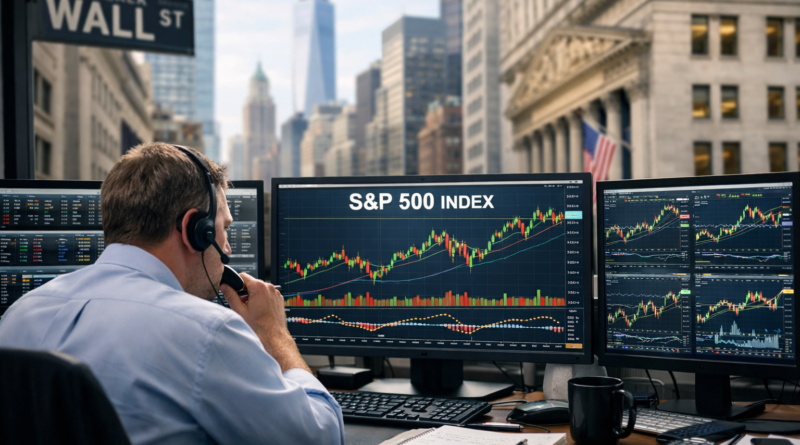
S&P 500 Today: October 7, 2026 — Deep Market Analysis, Trading Guide and Investor Outlook
By NYFT Markets Desk | New York Finance Think
Published: October 7, 2026
Updated: October 7, 2026
Market: U.S. Stock Market
Focus: S&P 500 Today, S&P 500 Analysis, S&P 500 Trading, S&P 500 Investing
Market disclaimer: This article is for general educational and informational purposes. It is not personalized investment, trading, tax or financial advice. Stock-market investments involve risk, including the possible loss of principal.
S&P 500 Today: What Investors Need to Know
The S&P 500 entered Wednesday, October 7, 2026, after closing at another record high on Tuesday. The mood changed quickly in early trading as Treasury yields and crude oil prices moved higher, putting pressure on U.S. stocks.
At the start of Wednesday’s session, the S&P 500 was down about 0.56%, while the Nasdaq Composite fell about 0.85% and the Dow Jones Industrial Average declined about 0.92%. The market was also watching the Federal Reserve’s September meeting minutes, scheduled for release on October 7.
The market’s central question is no longer simply whether stocks can reach another record.
The bigger question is whether corporate earnings and economic growth can continue to justify elevated stock valuations while Treasury yields, oil prices and inflation pressures remain high.
That question is particularly important because the S&P 500 is heavily influenced by its largest companies. S&P Dow Jones Indices lists 503 constituents, while the 10 largest companies represented approximately 37.8% of the index as of August 31, 2026.
This means investors should look beyond the headline index.
The S&P 500 can rise even when a large number of individual stocks are under pressure.
It can also fall even when many companies continue to report healthy fundamentals.
For today’s market, traders and investors need to monitor several connected forces:
- Treasury yields
- crude oil
- Federal Reserve policy
- inflation expectations
- corporate earnings
- artificial intelligence investment
- semiconductor stocks
- market breadth
- small-cap performance
- U.S. economic growth
- geopolitical developments
The result is a market that remains bullish in some areas but increasingly sensitive to changes in interest rates and inflation.
S&P 500 Today: Market Snapshot
| Indicator | October 7, 2026 Market Situation |
|---|---|
| S&P 500 | Pulling back from record territory |
| Nasdaq Composite | Under pressure |
| Dow Jones | Lower |
| 10-Year Treasury Yield | Around 5.3% |
| 30-Year Treasury Yield | Around 5.7% |
| Brent Crude | Above $100 per barrel |
| WTI Crude | Around $90 per barrel |
| VIX | Rising from previous session |
| Federal Reserve | September meeting minutes due |
| Earnings | Q3 earnings season approaching |
| AI Trade | Major market leadership theme |
| Market Breadth | Negative in early trading |
Charles Schwab’s October 7 market update showed the previous session’s S&P 500 close at 7,818.93, up 0.58%, while the 10-year Treasury yield was around 5.34% and WTI crude around $90.12.
Reuters subsequently reported that the S&P 500 fell about 0.56% in early trading Wednesday as yields and oil moved higher.
What Is the S&P 500?
The S&P 500 is one of the world’s most widely followed stock-market indexes.
It measures the performance of large U.S. companies and is widely used as a benchmark for the U.S. equity market.
S&P Dow Jones Indices describes the S&P 500 as a large-cap U.S. equity index and says it is weighted using float-adjusted market capitalization.
That weighting system is extremely important.
A company with a much larger market value receives a larger index weight.
Therefore, a $5 trillion company can have a much greater influence on the index than a company worth $50 billion.
This is why investors should never assume that the S&P 500 represents an equal performance of every company inside it.
How the S&P 500 Is Weighted
The S&P 500 is not an equal-weighted index.
It uses a float-adjusted market-capitalization methodology.
In simple language, larger companies generally have a greater influence on the index.
As of August 31, 2026, S&P Dow Jones Indices reported:
- 503 constituents
- 37.8% combined weight for the top 10 constituents
- 37.9% weight for Information Technology
- 12.3% weight for Financials
- 9.5% weight for Communication Services
- 9.3% weight for Health Care
- 9.1% weight for Consumer Discretionary
- 8.3% weight for Industrials
- 3.5% weight for Energy
The exact weights change over time as stock prices and index composition change.
This concentration is one of the most important issues for investors analyzing the S&P 500 today.
Why the S&P 500 Can Rise While Many Stocks Fall
This is one of the most important concepts for new investors.
Imagine the S&P 500 contains 500 companies.
Suppose several of the largest technology companies rise sharply.
At the same time, hundreds of smaller companies fall.
Because the largest companies have much larger index weights, the S&P 500 can still rise.
This is called narrow market leadership.
It does not automatically mean the market is unhealthy.
Strong leadership can persist for long periods.
But investors should know whether a rally is broad or concentrated.
S&P 500 Today: Market Breadth Is Important
Market breadth measures how many stocks participate in a market move.
A healthy broad rally usually involves many companies moving higher.
A narrow rally occurs when a relatively small group of large companies produces most of the index’s gains.
Reuters reported that declining stocks significantly outnumbered advancing stocks during Wednesday’s early session, while the equal-weight S&P 500 remained more than 5% below its record and the Russell 2000 was more than 8% below its all-time high.
That divergence deserves attention.
It tells investors that the headline S&P 500 number is not telling the entire story.
S&P 500 Today and Treasury Yields
Treasury yields are one of the biggest drivers of today’s market.
The 10-year Treasury yield was around 5.34% in Schwab’s October 7 market snapshot.
The 30-year Treasury yield also moved sharply higher, reaching levels not seen since 2002 according to Reuters.
Why does this matter?
Because stocks compete with bonds for investor capital.
When Treasury yields rise, investors can receive more income from relatively low-risk government securities.
At the same time, higher yields increase the discount rate used in many valuation models.
That can particularly affect growth stocks.
Why High Treasury Yields Can Pressure Technology Stocks
Technology companies often have valuations based heavily on expected future earnings.
Consider a hypothetical technology company expected to generate large profits many years from now.
If interest rates are low, those future profits can have a higher present value.
If interest rates rise substantially, the value assigned to those future profits can decline.
This does not mean the company’s business has suddenly become worse.
It means investors may be willing to pay less for the same expected future earnings.
This is why traders often watch Treasury yields alongside Nasdaq and S&P 500 technology stocks.
S&P 500 Today and the Federal Reserve
The Federal Reserve remains central to the market outlook.
On September 16, 2026, the Federal Open Market Committee raised the federal-funds target range by 25 basis points to 3.75%–4.00%. The Fed said economic activity was expanding at a solid pace but also stated that inflation remained elevated.
The Fed’s September meeting minutes are scheduled for release on October 7.
That makes today’s session particularly important.
Investors want to know how policymakers viewed:
- inflation
- employment
- economic growth
- financial conditions
- geopolitical uncertainty
- future rate increases
- the appropriate path of monetary policy
The minutes can influence interest-rate expectations even when they do not contain a completely new policy decision.
Why the Fed Minutes Matter for S&P 500 Investors
Stock markets trade on expectations.
Investors do not wait until the Fed actually changes rates.
They reposition portfolios based on what they think the Fed might do.
If the minutes appear more hawkish than expected, Treasury yields could rise.
If yields rise, expensive growth stocks may come under pressure.
If the minutes appear less hawkish, yields could stabilize or decline.
That could provide support to technology and other rate-sensitive stocks.
The relationship is not automatic, but it is important.
S&P 500 Today: Oil Prices Are Back in Focus
Oil is another major market driver.
Brent crude moved above $100 a barrel again as concerns about Middle East supply disruptions increased.
Higher oil prices matter because energy is embedded throughout the U.S. economy.
Oil affects:
- gasoline
- transportation
- shipping
- aviation
- manufacturing
- chemicals
- plastics
- logistics
- consumer prices
If energy prices remain high for an extended period, inflation could become harder to control.
That creates a difficult situation for the Federal Reserve.
Why Oil Can Create a Problem for the Fed
The Fed wants inflation to move toward its 2% goal.
But a major increase in energy prices can push headline inflation higher.
That creates a potential policy dilemma.
If economic growth remains strong while energy inflation increases, the Fed may have less room to ease monetary policy.
If the Fed keeps policy restrictive for longer, interest-sensitive sectors can remain under pressure.
This is one reason traders are watching oil so closely today.
S&P 500 and Inflation
Inflation remains one of the most important variables for the stock market.
Investors should distinguish between:
temporary inflation
and
persistent inflation.
A short-term increase in gasoline prices may not permanently change the economic outlook.
But sustained increases in energy, wages, housing and services can create broader inflation pressure.
That would be more important for monetary policy.
S&P 500 Today: The AI Trade
Artificial intelligence remains one of the strongest themes in the U.S. equity market.
The AI investment cycle has increased demand for:
- advanced semiconductors
- data centers
- networking equipment
- cloud computing
- electricity
- cooling infrastructure
- software
- cybersecurity
- enterprise AI services
The biggest question for investors is whether the enormous capital spending surrounding AI will eventually translate into equally strong corporate profits.
Nvidia and the S&P 500
Nvidia is one of the most important companies in today’s market.
S&P Dow Jones Indices lists Nvidia as the largest S&P 500 constituent by index weight as of August 31, 2026.
That makes Nvidia important not only because of its own business.
It is also a signal for the broader AI and semiconductor investment cycle.
When Nvidia rises strongly, investor confidence in AI infrastructure can strengthen.
When Nvidia falls sharply, investors may question whether AI valuations have become too aggressive.
On October 7, Reuters reported Nvidia lower in early trading while semiconductor stocks were among the market’s weaker areas.
Technology Stocks to Watch
Investors following the S&P 500 should pay attention to major technology and AI-linked companies including:
- Nvidia
- Microsoft
- Apple
- Amazon
- Alphabet
- Meta Platforms
- Broadcom
- Micron
- Tesla
These companies are not identical.
Their businesses have different exposure to:
- AI
- cloud computing
- advertising
- consumer demand
- semiconductors
- data centers
- electric vehicles
- enterprise software
The important point is that several of the largest companies have an outsized effect on index performance.
S&P 500 Earnings Are the Next Major Test
Third-quarter earnings season is approaching.
That could become the most important fundamental test for the market.
Reuters reported that analysts were expecting aggregate S&P 500 earnings growth of approximately 30.6% for the July-to-September quarter, with energy and technology among the strongest expected contributors.
This is a powerful bullish argument.
If companies deliver those results and maintain strong guidance, investors may become more comfortable with elevated valuations.
But expectations are already high.
That creates another risk.
Why Earnings Expectations Matter
A company can report excellent results and still see its stock fall.
Why?
Because investors may have expected even better results.
For example:
Expected earnings growth: 40%
Actual earnings growth: 30%
The company grew earnings strongly.
But the stock could still fall because expectations were even higher.
This is why investors should monitor:
- earnings surprises
- revenue growth
- margins
- free cash flow
- guidance
- capital expenditure
- customer demand
What Traders Should Watch Today
For short-term traders, the S&P 500 should be analyzed through several layers.
Price
Where is the index trading relative to the previous close?
Volume
Are buyers or sellers showing meaningful participation?
Breadth
Are most stocks moving with the index?
Treasury yields
Are yields rising or falling?
Oil
Is crude accelerating higher?
Technology
Are Nvidia and major technology stocks supporting the market?
Volatility
Is the VIX increasing?
Fed
Are investors changing their rate expectations?
The more signals that point in the same direction, the stronger the potential market signal.
S&P 500 Trading Strategy for Beginners
Beginners should not approach today’s market by trying to predict every short-term movement.
A better approach is to establish a framework.
Step 1: Determine the broader trend
Is the market above or below major moving averages?
Step 2: Identify key price levels
Mark previous highs, previous lows and important support areas.
Step 3: Check macro conditions
Look at Treasury yields, oil and the dollar.
Step 4: Check market breadth
Determine whether the move is broad.
Step 5: Watch volume
Strong volume can provide confirmation.
Step 6: Wait for confirmation
Avoid entering purely because of a headline.
Step 7: Define risk
Know where the trade becomes invalid.
Step 8: Control position size
Never allow one trade to determine your financial future.
S&P 500 Day Trading: What Matters Most
Day traders are generally focused on shorter-term price movements.
Important tools can include:
- opening range
- previous day’s high
- previous day’s low
- VWAP
- volume
- intraday support
- intraday resistance
- volatility
- market breadth
But technical indicators should not be treated as guarantees.
No indicator can predict the market with certainty.
S&P 500 Swing Trading
Swing traders operate on a longer timeframe than day traders.
They may hold positions for:
- several days
- several weeks
- sometimes longer
For swing traders, today’s decline matters because they want to know whether it represents:
- normal profit-taking,
- a consolidation,
- a trend reversal,
- or the beginning of a deeper correction.
The answer cannot be known from one trading session alone.
Long-Term S&P 500 Investors
Long-term investors should focus on different questions.
Instead of asking:
“Will the S&P 500 rise tomorrow?”
they can ask:
“Are U.S. companies likely to generate higher earnings over the next five to ten years?”
Other important questions include:
- Is the portfolio diversified?
- Is the investor appropriately exposed to equities?
- Is the time horizon long enough?
- Are fees reasonable?
- Is the investor prepared for a correction?
- Is the investor relying too heavily on one sector?
S&P 500 and Retirement Accounts
For 401(k) and IRA investors, daily market volatility can be emotionally difficult.
But retirement investing is generally a long-term process.
An investor with 25 years until retirement has a very different risk profile from someone retiring next year.
That does not mean risk should be ignored.
It means risk should be evaluated against the investor’s time horizon.
Should You Buy the S&P 500 Today?
There is no universal answer.
A person investing for decades may have a very different decision from a short-term trader.
A long-term investor may use regular contributions.
A trader may wait for a specific technical setup.
A person approaching retirement may prioritize capital preservation more heavily.
Therefore, the right question is not:
“Should everyone buy today?”
The better question is:
“Does this investment fit the investor’s time horizon, risk tolerance and financial plan
S&P 500 Index Funds
Many investors gain exposure to the S&P 500 through index funds and exchange-traded funds.
Examples include:
- SPY
- VOO
- IVV
These products are designed to provide exposure to the S&P 500, but investors should compare fees, structure, liquidity, tracking differences and tax considerations before choosing a fund.
The S&P 500 itself is an index.
An investor generally purchases an investment product that tracks the index rather than buying the index directly.
S&P 500 vs Equal-Weight S&P 500
This comparison is extremely useful today.
The traditional S&P 500 gives greater weight to larger companies.
The equal-weight version gives each constituent a much more balanced weight.
If the traditional index is rising while the equal-weight index is lagging, the market may be increasingly dependent on large companies.
Reuters reported that the equal-weight S&P 500 was more than 5% below its record on October 7.
That is an important breadth signal.
S&P 500 vs Russell 2000
The Russell 2000 represents smaller U.S. companies.
Comparing it with the S&P 500 can provide clues about investor appetite for risk.
Small-cap companies can be more sensitive to:
- borrowing costs
- bank lending
- domestic demand
- economic growth
- interest rates
Reuters reported that the Russell 2000 was more than 8% below its record high on October 7.
The divergence between large caps and small caps is therefore worth watching.
S&P 500 Sector Analysis
Information Technology
Technology represents the largest sector weight in the S&P 500, at approximately 37.9% based on S&P Dow Jones Indices’ August 31 data.
This makes technology crucial for the index.
AI, cloud computing, semiconductors and software remain major themes.
The risk is valuation.
High expectations can create sharp reactions when earnings disappoint.
Financials
Financial companies are influenced by:
- interest rates
- yield curves
- credit quality
- loan growth
- deposits
- capital markets
Banks may benefit from some aspects of higher rates, but higher borrowing costs can also create credit stress.
Health Care
Healthcare can sometimes provide defensive characteristics.
Investors should still examine:
- drug pricing
- regulation
- medical utilization
- earnings
- company-specific risks
Consumer Discretionary
Consumer discretionary companies are closely tied to household spending.
Investors should monitor:
- employment
- wages
- credit-card debt
- consumer confidence
- gasoline prices
Energy
Energy stocks can benefit when crude oil prices rise.
However, investors should remember that commodity prices are volatile.
Oil prices can rise rapidly and fall just as quickly.
Industrials
Industrials are sensitive to:
- capital spending
- manufacturing
- infrastructure
- transportation
- economic growth
The S&P 500 and the U.S. Consumer
Wall Street does not operate separately from American households.
Consumers influence corporate revenue.
Households buy:
- food
- vehicles
- electronics
- travel
- entertainment
- financial products
- healthcare services
If consumer spending remains strong, corporate revenue can remain resilient.
If households pull back, corporate earnings may weaken.
This is why investors should connect market analysis with economic data.
S&P 500 and the Labor Market
Employment is another critical market variable.
A strong labor market can support consumer spending.
But extremely strong wage growth can also contribute to inflation.
A weakening labor market can reduce inflation pressure but increase recession concerns.
The Fed therefore has to balance both sides of its mandate.
S&P 500 and Economic Growth
Investors generally want a combination of:
healthy growth + controlled inflation.
This is often described as a favorable environment for equities.
The more difficult combinations are:
weak growth + high inflation
or
strong inflation + restrictive monetary policy.
The market’s reaction depends heavily on how investors interpret the economic data.
Three Possible S&P 500 Scenarios
Bull Case
The bull case would involve:
- stable Treasury yields
- declining inflation pressure
- strong earnings
- healthy consumer spending
- strong AI investment
- stable oil prices
- less hawkish Fed expectations
Under that scenario, the S&P 500 could continue its broader upward trend.
Neutral Case
The neutral scenario would involve:
- elevated yields
- strong but slowing earnings
- mixed economic data
- oil remaining volatile
- continued AI leadership
- periodic profit-taking
The index could trade sideways while investors wait for additional earnings and economic information.
Bear Case
The bearish scenario would involve:
- significantly higher yields
- sustained oil inflation
- weaker corporate earnings
- declining market breadth
- worsening economic growth
- more aggressive Fed expectations
That combination could create a deeper market correction.
What Would Confirm a Stronger Bullish Trend?
Investors could watch for:
- improving market breadth
- stabilization in Treasury yields
- strong earnings surprises
- positive corporate guidance
- continued semiconductor strength
- improving small-cap participation
- lower inflation expectations
No individual signal guarantees a rally.
The strength comes from multiple indicators confirming the same story.
What Would Make the Market More Dangerous?
Several warning signals appearing together would deserve attention.
For example:
Oil rises
↓
Inflation expectations rise
↓
Treasury yields rise
↓
Fed becomes more hawkish
↓
Growth-stock valuations fall
↓
Technology stocks weaken
↓
S&P 500 breadth deteriorates
That is the type of chain reaction investors should understand.
Why Investors Should Not Panic Over a 0.5% Decline
The stock market moves every day.
A decline of roughly half a percent is normal volatility.
It should not automatically be called:
- a crash
- a bear market
- the end of the bull market
Investors need perspective.
The more important question is whether the decline changes the underlying fundamental trend.
What Is a Stock-Market Correction?
A correction is a significant decline from a recent high.
Corrections can occur even during long-term bull markets.
They can be caused by:
- profit-taking
- economic fears
- interest-rate changes
- geopolitical events
- earnings disappointments
- valuation concerns
A correction is not necessarily a financial crisis.
What Is a Bear Market?
A bear market is a much deeper and more sustained decline.
Investors should not confuse ordinary daily volatility with a bear market.
This distinction is particularly important when reading financial headlines.
S&P 500 Risk Management
Risk management is arguably more important than market prediction.
A trader should know:
- entry price
- stop level
- maximum acceptable loss
- position size
- expected reward
- market catalyst
Without those rules, emotions can take control.
Why Position Size Matters
Suppose a trader has $50,000.
If the trader places almost all of that money into one highly volatile position, a relatively small market move can create a devastating loss.
A disciplined investor considers how much capital should be exposed to any one position.
The exact appropriate amount depends on the individual’s circumstances.
Avoiding FOMO
FOMO means fear of missing out.
Record highs can create strong emotional pressure.
A trader may see:
S&P 500 hits record
and immediately buy.
But markets often experience pullbacks after strong rallies.
A better approach is to identify the setup before entering.
Avoiding Panic Selling
The opposite mistake is panic selling.
When prices decline, investors may assume the entire market is collapsing.
But a short-term decline can be caused by:
- profit-taking
- yield changes
- options positioning
- economic headlines
- temporary geopolitical news
Investors should distinguish between a temporary market event and a fundamental deterioration.
What Traders Should Watch Before the Close
Before the closing bell, traders should examine:
- S&P 500 price action
- Nasdaq performance
- Dow performance
- Russell 2000
- Treasury yields
- Brent crude
- WTI crude
- VIX
- market breadth
- semiconductor stocks
- megacap technology stocks
- Fed expectations
This produces a much stronger market picture than watching the S&P 500 alone.
What Investors Should Watch After the Close
Long-term investors should focus on developments that can change the fundamental outlook.
Those include:
- corporate earnings
- earnings guidance
- Fed policy
- inflation
- employment
- consumer spending
- capital investment
- AI monetization
- oil supply
- geopolitical risk
S&P 500 and Earnings Season
Earnings season may become the market’s next major catalyst.
Companies need to demonstrate that earnings can catch up with elevated stock prices.
The market will be watching:
Revenue
Are companies actually growing sales?
Margins
Are companies keeping more of each dollar of revenue?
Cash flow
Are profits translating into cash?
Capital spending
How much are companies spending on AI and infrastructure?
Guidance
What do management teams expect next quarter?
Why AI Capital Spending Matters
AI requires enormous investment.
Companies are spending on:
- chips
- data centers
- electricity
- networking
- cloud infrastructure
- software
- cooling
That creates revenue opportunities for suppliers.
But investors ultimately need evidence that these investments will produce sufficient returns.
The AI story is therefore moving from:
“How much are companies spending?”
toward:
“How much profit will those investments create?”
S&P 500 Today: The Big Investor Debate
The market’s central debate can be summarized in one sentence:
Can strong earnings and AI growth overcome high interest rates and elevated oil prices?
Bulls believe corporate America can continue growing profits.
Bears worry that inflation, yields and valuations are becoming increasingly difficult to ignore.
Both arguments have evidence.
That is why today’s market is so sensitive to new information.
What New Investors Should Learn From Today’s Market
The most important lesson is that markets are interconnected.
Oil affects inflation.
Inflation affects Fed policy.
Fed policy affects Treasury yields.
Treasury yields affect valuations.
Valuations affect technology stocks.
Technology stocks affect the S&P 500.
The S&P 500 affects investor sentiment.
Understanding this chain is more useful than memorizing isolated headlines.
S&P 500 Today: Trader Checklist
Before entering a trade, ask:
- What is the trend?
- What is the catalyst?
- Where is support?
- Where is resistance?
- What is volume doing?
- What are Treasury yields doing?
- What is oil doing?
- Is market breadth confirming?
- Are technology stocks participating?
- What is my maximum loss?
If the answers are unclear, waiting may be better than forcing a trade.
S&P 500 Today: Investor Checklist
For long-term investors:
- Review asset allocation.
- Review diversification.
- Review investment horizon.
- Review fees.
- Review risk tolerance.
- Review earnings trends.
- Review valuation.
- Avoid emotional decisions.
- Avoid reacting to every headline.
- Maintain a long-term framework.
Frequently Asked Questions
What is the S&P 500 today?
The S&P 500 was pulling back from a record close on October 7, 2026, as Treasury yields and oil prices rose. Reuters reported the index down about 0.56% in early trading.
Why is the S&P 500 down today?
Higher Treasury yields, higher crude oil prices and uncertainty around Federal Reserve policy were among the main pressures on the market.
What is the S&P 500?
The S&P 500 is a large-cap U.S. stock-market index weighted by float-adjusted market capitalization.
How many companies are in the S&P 500?
S&P Dow Jones Indices currently lists 503 constituents.
Why does Nvidia matter to the S&P 500?
Nvidia is currently the largest constituent by index weight according to S&P Dow Jones Indices’ August 31, 2026 data.
Why are Treasury yields important?
Higher Treasury yields can increase borrowing costs and affect how investors value future corporate earnings.
Why does oil matter?
Higher oil prices can increase inflation pressure and business costs, potentially affecting Federal Reserve policy and corporate profits.
What is market breadth?
Market breadth measures how widely a market move is distributed among individual stocks.
Should investors buy the S&P 500 today?
There is no universal answer. The appropriate decision depends on an investor’s financial objectives, risk tolerance, time horizon and overall portfolio.
Is today’s decline a crash?
No. A roughly half-percent decline is normal market volatility and does not by itself represent a stock-market crash.
What should traders watch today?
Traders should monitor price action, volume, Treasury yields, oil, market breadth, technology leadership, volatility and Federal Reserve expectations.
What should long-term investors watch?
Long-term investors should focus on earnings, economic growth, inflation, interest rates, valuation and portfolio risk.
Final S&P 500 Outlook
The S&P 500 enters October 7, 2026, at an important point.
The index recently reached record territory, supported by optimism about artificial intelligence and expectations for strong corporate earnings.
But the market is now facing a more difficult macroeconomic backdrop.
Treasury yields have moved sharply higher.
Brent crude has returned above $100.
The Federal Reserve has recently raised rates to 3.75%–4.00%.
Market breadth is weaker than the headline index suggests.
And investors are preparing for a new corporate earnings season.
That combination means the next phase of the market may be decided less by headlines and more by whether earnings can justify current valuations.
For traders, today’s market is about confirmation and risk management.
For long-term investors, the focus should remain on earnings, economic growth, valuation and diversification.
The most important question is not whether the S&P 500 moves higher or lower during one trading session.
The more important question is whether the fundamental conditions supporting the market are improving or deteriorating.
That is what investors should continue watching as October progresses.
S&P 500 Companies to Watch Today: Deep Analysis for Traders and Investors
The S&P 500 is not just a number on a market screen.
Behind the index are hundreds of companies competing across technology, financial services, health care, energy, consumer products, industrials and communications.
For investors trying to understand the S&P 500 today, looking at the largest and most influential companies can provide a much clearer picture of what is driving Wall Street.
This is especially important in 2026 because the index remains heavily influenced by a relatively small group of mega-cap companies.
S&P Dow Jones Indices’ latest available data lists Nvidia, Apple, Microsoft, Amazon, Alphabet, Broadcom, Meta Platforms, Micron Technology and Tesla among the largest S&P 500 constituents. The index had 503 constituents as of August 31, 2026.
That concentration means investors should ask two separate questions:
What is happening to the S&P 500?
And:
What are the largest companies inside the S&P 500 doing?
Those questions are related, but they are not exactly the same.
1. Nvidia — The Most Important AI Stock for the S&P 500
Ticker: NVDA
Nvidia has become one of the most important companies in the global technology industry.
Its importance comes primarily from artificial intelligence.
Modern AI systems require enormous amounts of computing power, and Nvidia’s processors have become central to many AI data-center architectures.
That makes Nvidia much more than a traditional semiconductor company.
The company is effectively positioned at the center of the AI infrastructure investment cycle.
S&P Dow Jones Indices currently lists Nvidia as the largest S&P 500 constituent by index weight in its August 31, 2026 data.
That gives Nvidia an unusually large influence on the benchmark.
Why Nvidia Matters Today
Nvidia matters for three reasons.
First, it influences the S&P 500 directly through its index weight.
Second, it influences the semiconductor sector.
Third, Nvidia’s earnings and guidance provide investors with information about the broader AI investment cycle.
If Nvidia reports strong demand for AI accelerators, investors may become more confident about the spending plans of cloud companies and other technology businesses.
If Nvidia warns that demand is slowing, investors may question the sustainability of the broader AI boom.
Nvidia and Today’s Market
Nvidia was under pressure during Wednesday’s early session.
Reuters reported Nvidia down approximately 0.7% while the Philadelphia Semiconductor Index fell about 2.3%.
This is important because semiconductor weakness can have a psychological impact well beyond Nvidia itself.
Investors may interpret chip weakness as:
- profit-taking
- valuation pressure
- concern about AI spending
- sensitivity to Treasury yields
- a temporary rotation out of technology
Traders should therefore watch Nvidia together with the broader semiconductor group rather than treating the stock in isolation.
What Investors Should Watch
For Nvidia, investors should focus on:
- AI accelerator demand
- data-center revenue
- gross margins
- hyperscaler spending
- new chip launches
- supply availability
- export restrictions
- capital expenditure by customers
- future earnings guidance
The biggest long-term question is simple:
Can AI infrastructure spending continue growing fast enough to support Nvidia’s valuation and earnings expectations?
2. Apple — Consumer Technology and Services Powerhouse
Ticker: AAPL
Apple is one of the world’s most recognizable companies and one of the most important stocks in the S&P 500.
Unlike Nvidia, Apple’s investment story is not primarily about selling AI infrastructure.
Apple’s business is built around a massive ecosystem of:
- iPhone
- Mac
- iPad
- Apple Watch
- AirPods
- services
- software
- subscriptions
That ecosystem gives Apple a unique relationship with consumers.
Why Apple Matters to the S&P 500
Apple’s enormous market capitalization means that changes in its stock price can influence major U.S. indexes.
For S&P 500 investors, Apple is therefore both an individual company and a market indicator.
When investors are confident about consumer technology spending, Apple can benefit.
When consumers become cautious, investors may worry about hardware demand.
The Services Business
One of Apple’s most important long-term developments has been the expansion of services.
Services can include:
- subscriptions
- cloud-related services
- digital content
- payments
- advertising
- app-related revenue
The services business is strategically important because recurring revenue can create a different financial profile from hardware sales.
What Investors Should Watch
Apple investors should monitor:
- iPhone demand
- services growth
- margins
- China exposure
- supply chains
- AI product development
- consumer spending
- capital returns
The major question is whether Apple can continue creating new growth opportunities while maintaining the strength of its existing ecosystem.
3. Microsoft — Cloud, Software and Artificial Intelligence
Ticker: MSFT
Microsoft is another central company in the S&P 500’s technology story.
Its businesses span:
- Windows
- Microsoft 365
- Azure
- enterprise software
- cybersecurity
- gaming
- cloud computing
- artificial intelligence
Microsoft’s importance has increased as corporations move more computing workloads to the cloud.
Microsoft and AI
Microsoft has invested heavily in artificial intelligence.
The company has integrated AI into its software ecosystem and has developed major relationships around AI infrastructure and applications.
For investors, this creates a potentially powerful combination:
cloud + enterprise software + AI.
Why Microsoft Matters Today
Microsoft provides investors with a way to evaluate whether AI is becoming a real enterprise business opportunity rather than simply a market theme.
Investors want evidence that companies will pay for AI services.
That means watching:
- Azure growth
- AI-related cloud demand
- enterprise software spending
- margins
- capital expenditures
- AI monetization
Risk
The major risk is capital intensity.
AI infrastructure requires enormous spending.
Investors therefore need to ask whether future AI revenue will justify today’s investment.
4. Amazon — E-Commerce, Cloud and AI Infrastructure
Ticker: AMZN
Amazon is another company that has evolved far beyond its original identity as an online retailer.
Its major businesses include:
- e-commerce
- Amazon Web Services
- advertising
- logistics
- digital services
AWS makes Amazon especially important for technology investors.
AWS and the AI Economy
Cloud computing is one of the foundations of the AI economy.
Companies need computing infrastructure to train and run AI systems.
That creates opportunities for Amazon’s cloud business.
At the same time, Amazon’s enormous retail operation gives investors exposure to the American consumer.
This makes Amazon particularly interesting because it combines:
technology + consumer spending + cloud infrastructure.
What Traders Should Watch
Amazon can respond to several market themes at once.
Investors should monitor:
- AWS growth
- cloud spending
- advertising revenue
- retail margins
- consumer demand
- logistics costs
- AI infrastructure investment
If consumers remain strong while AWS continues expanding, Amazon’s earnings outlook could remain attractive.
5. Alphabet — Search, Advertising and AI
Tickers: GOOGL, GOOG
Alphabet is the parent company of Google.
Its major businesses include:
- Google Search
- YouTube
- Google Cloud
- digital advertising
- Android
- AI products
- online services
Alphabet represents one of the most important intersections between traditional technology and artificial intelligence.
The Search Question
For investors, one of the biggest questions is how artificial intelligence will change internet search.
Google has spent years building its search ecosystem.
The rise of generative AI creates both a threat and an opportunity.
The threat is that users could eventually change how they search for information.
The opportunity is that Alphabet can integrate AI directly into its existing products.
Google Cloud
Cloud computing is another important growth area.
Alphabet’s cloud operation gives investors exposure to enterprise computing and AI infrastructure.
What Investors Should Watch
The important metrics include:
- advertising revenue
- Search growth
- YouTube performance
- Google Cloud growth
- AI monetization
- capital expenditure
- operating margins
Alphabet is therefore an important stock for investors who want to understand the future of digital advertising and AI.
6. Broadcom — Chips, Networking and AI Infrastructure
Ticker: AVGO
Broadcom has become an increasingly important company in the AI infrastructure ecosystem.
The company’s exposure includes semiconductor and infrastructure-related technology.
AI data centers need much more than processors.
They also need:
- networking
- connectivity
- specialized chips
- infrastructure software
This is where Broadcom becomes particularly important.
Why Broadcom Matters
The AI infrastructure boom is creating demand across the semiconductor supply chain.
That means investors should not focus exclusively on Nvidia.
Companies such as Broadcom can benefit from different parts of the infrastructure cycle.
What Investors Should Watch
For Broadcom, investors should focus on:
- AI-related revenue
- networking demand
- custom accelerator opportunities
- semiconductor margins
- infrastructure software
- data-center spending
The company is therefore one of the key stocks to watch when analyzing whether the AI investment cycle is broadening.
7. Meta Platforms — Digital Advertising and AI
Ticker: META
Meta operates some of the world’s largest social-media platforms, including Facebook, Instagram and WhatsApp.
Its primary economic engine remains digital advertising.
But artificial intelligence has become increasingly important to Meta’s strategy.
AI and Advertising
Meta uses AI in areas such as:
- content recommendations
- advertising targeting
- advertising optimization
- recommendation systems
- content moderation
- creator tools
Better AI can potentially improve user engagement and advertising efficiency.
That makes AI an important part of Meta’s financial story.
The Investment Question
Meta is also spending heavily on infrastructure.
Investors therefore need to balance:
higher AI spending
against
potentially higher revenue and profitability.
What to Watch
Investors should monitor:
- advertising revenue
- user engagement
- ad prices
- capital expenditures
- AI infrastructure spending
- operating margins
- Reality Labs losses
Meta is particularly important when evaluating whether AI spending is translating into stronger digital advertising economics.
8. Micron Technology — Memory Chips and AI Demand
Ticker: MU
Micron is a semiconductor company specializing in memory products.
Memory has become increasingly important as AI systems become more complex.
AI data centers require significant amounts of high-performance memory.
That gives Micron exposure to the broader AI infrastructure boom.
Why Micron Matters Today
Micron is more cyclical than many mega-cap technology companies.
Memory prices can change rapidly depending on supply and demand.
That means Micron can experience large swings in earnings expectations.
Reuters reported Micron down approximately 2.3% during Wednesday’s early session as semiconductor stocks came under pressure.
What Investors Should Watch
Important factors include:
- memory pricing
- AI server demand
- data-center investment
- supply conditions
- inventory levels
- margins
- capital expenditure
Micron is therefore useful for investors trying to understand the cyclical side of the AI semiconductor economy.
9. Tesla — Electric Vehicles, Energy and AI Ambitions
Ticker: TSLA
Tesla is one of the most heavily followed companies in the U.S. stock market.
Its business includes:
- electric vehicles
- energy storage
- charging infrastructure
- software
- autonomous-driving technology
Tesla is unusual because its valuation is influenced not only by its current automotive business but also by expectations surrounding future technologies.
Why Tesla Matters to the S&P 500
Tesla is one of the largest S&P 500 companies according to the latest S&P Dow Jones Indices constituent data.
Its stock can therefore influence the broader index.
But Tesla also represents an important test of investor appetite for high-growth companies.
What Investors Should Watch
Key issues include:
- vehicle deliveries
- automotive margins
- price reductions
- energy-storage growth
- autonomous-driving development
- software revenue
- global competition
- regulatory developments
Tesla can move sharply when investor expectations change.
That makes it important for both traders and long-term investors.
10. Berkshire Hathaway — A Different Kind of S&P 500 Leader
Ticker: BRK.B
Berkshire Hathaway provides a useful contrast to the technology-heavy companies dominating today’s market.
Its businesses and investments span multiple areas of the economy.
Berkshire is associated with:
- insurance
- railroads
- utilities
- industrial businesses
- consumer companies
- large equity investments
Why Berkshire Matters
Berkshire gives investors exposure to a diversified corporate structure rather than a single technology theme.
It can therefore provide useful information about:
- insurance conditions
- interest income
- economic activity
- corporate valuations
- capital allocation
The company is also closely watched because of its enormous balance-sheet resources and investment portfolio.
For investors concerned that the S&P 500 has become overly dependent on technology, Berkshire provides an important counterpoint.
11. JPMorgan Chase — The Financial-System Leader
Ticker: JPM
JPMorgan is one of the largest financial institutions in the United States.
Its businesses include:
- consumer banking
- commercial banking
- investment banking
- asset management
- credit cards
- payments
Financial companies behave differently from technology companies.
Their earnings can be influenced heavily by:
- interest rates
- loan growth
- credit losses
- investment banking activity
- trading revenue
- deposits
Why JPMorgan Matters Today
With Treasury yields elevated, investors need to understand how financial companies are responding to the interest-rate environment.
Higher rates can increase income on certain assets.
But they can also increase funding costs and create pressure on borrowers.
Therefore, the effect is not simply:
higher rates = better banks.
The broader economic environment matters.
12. Visa — Consumer Spending and Payments
Ticker: V
Visa provides exposure to digital payments.
Its business is closely connected to consumer spending.
When Americans spend more on:
- travel
- restaurants
- retail
- online purchases
- entertainment
payment networks can benefit from higher transaction volumes.
Visa therefore provides investors with another way to monitor the health of the U.S. consumer.
However, payment companies also face competition, regulation and changes in payment technology.
13. Eli Lilly — Health Care and the New Weight-Loss Economy
Ticker: LLY
Eli Lilly is one of the most important pharmaceutical companies in the market.
Its investment story has been strongly influenced by demand for medicines related to diabetes and obesity.
This creates a major long-term opportunity but also significant investor expectations.
Why Lilly Matters
Healthcare can provide diversification from technology.
At the same time, pharmaceutical companies face risks related to:
- drug pricing
- regulation
- competition
- clinical results
- patents
- manufacturing capacity
For investors, Lilly represents the growing influence of innovative healthcare companies within the broader U.S. market.
14. JPMorgan, Visa and Financial Stocks vs Technology
One useful way to understand the S&P 500 is to compare different sectors.
Technology depends heavily on:
- innovation
- capital expenditure
- cloud demand
- AI
- consumer electronics
Financials depend more heavily on:
- interest rates
- credit
- lending
- capital markets
- economic growth
Healthcare depends more heavily on:
- medical demand
- drug development
- regulation
- demographic trends
Energy depends more heavily on:
- oil
- natural gas
- global supply
- geopolitical developments
This diversity is one reason the S&P 500 remains such an important benchmark.
15. Semiconductor Companies: A Critical S&P 500 Signal
Semiconductors deserve their own category.
Important companies include:
- Nvidia
- Broadcom
- Micron
- AMD
- Intel
- Qualcomm
The semiconductor industry is important because AI, cloud computing, smartphones, automobiles and data centers all depend on chips.
The current market is particularly sensitive to semiconductor performance because AI investment has become a major driver of capital spending.
Reuters reported that semiconductor stocks led market losses on October 7, with the Philadelphia Semiconductor Index down about 2.3% in early trading.
That makes chip stocks an important short-term market signal.
16. The Magnificent Seven and the S&P 500
The phrase “Magnificent Seven” is commonly used for:
- Nvidia
- Apple
- Microsoft
- Amazon
- Alphabet
- Meta
- Tesla
These companies have played an enormous role in the performance of U.S. equity markets.
But investors should understand that the group is not a single business.
Each company has a different revenue model.
Nvidia depends heavily on semiconductor and AI infrastructure demand.
Apple depends heavily on its consumer ecosystem.
Microsoft is deeply exposed to enterprise software and cloud computing.
Amazon combines retail and cloud.
Alphabet combines advertising and cloud.
Meta is heavily dependent on digital advertising.
Tesla is centered on vehicles but also has ambitions around energy and autonomous technology.
This diversity means investors should analyze each company separately.
17. Why These Companies Matter More Than Their Stock Prices
A common mistake is to focus only on whether a stock is:
up 2%
or
down 3%.
Professional investors also ask why the move happened.
For example:
A stock may rise because earnings expectations increased.
Another may rise because Treasury yields fell.
Another may fall because management reduced guidance.
Another may fall because investors are taking profits.
The reason behind a move can be more important than the percentage itself.
18. Company Earnings vs S&P 500 Performance
The S&P 500 ultimately depends on the earnings power of its constituent companies.
That is why earnings season is so important.
Reuters reported that analysts were expecting roughly 30.6% year-over-year earnings growth for S&P 500 companies in the third quarter, with energy and technology expected to be among the strongest contributors.
If the largest companies meet or exceed expectations, the broader index can receive support.
If several major companies simultaneously reduce guidance, investors may reassess the market’s valuation.
19. What Traders Should Watch in These Companies Today
Traders should not attempt to follow every company equally.
A more useful watchlist could include:
AI and Semiconductors
NVDA
AVGO
MU
AMD
Mega-Cap Technology
MSFT
AAPL
AMZN
GOOGL
META
High-Growth Consumer Technology
TSLA
Financials
JPM
V
Healthcare
LLY
Diversified Corporate Exposure
BRK.B
This watchlist covers several major parts of the U.S. market.
20. What Long-Term Investors Should Watch
Long-term investors should focus on different metrics.
For technology companies:
Revenue growth + margins + free cash flow + AI monetization
For banks:
Net interest income + credit quality + loan growth + capital
For consumer companies:
Sales + consumer spending + margins + pricing power
For healthcare:
Pipeline + revenue growth + regulation + pricing
For semiconductor companies:
Demand + inventory + pricing + capacity + capital expenditure
This approach is much more useful than simply watching daily stock prices.
21. The Biggest Risk: Expectations
One of the most important lessons from the current market is that investors are buying expectations about future profits.
A company can be excellent.
Its technology can be excellent.
Its management can be excellent.
And its stock can still fall.
Why?
Because the stock may already price in extremely strong future growth.
That is why valuation matters.
22. The Biggest Opportunity: Earnings Growth
The opposite is also true.
If companies continue delivering stronger-than-expected earnings, today’s high valuations may become easier to justify.
That is why the next several earnings reports could be extremely important.
The market will be asking:
Is the earnings growth real?
Is it sustainable?
Is AI creating actual profits?
Are consumers still spending?
Can margins remain strong?
23. What the Company Group Tells Us About the S&P 500
Looking across the largest companies reveals an important picture.
The U.S. stock market is increasingly connected to:
- artificial intelligence
- cloud computing
- semiconductor infrastructure
- digital advertising
- consumer technology
- financial services
- healthcare innovation
This explains why the S&P 500 can behave differently from the broader U.S. economy on any single day.
The index is heavily influenced by large, highly profitable companies.
24. Company Analysis: Bullish Signals
Investors should generally become more constructive when they see:
- rising revenue
- expanding margins
- strong free cash flow
- increasing guidance
- strong demand
- healthy balance sheets
- sustainable capital spending
- improving productivity
For AI companies, investors should additionally look for evidence that AI investments are generating measurable economic returns.
25. Company Analysis: Warning Signals
Potential warning signs include:
- declining revenue
- falling margins
- rising inventories
- weaker guidance
- excessive capital expenditure
- slowing customer demand
- rising debt
- regulatory pressure
- heavy dependence on one product
Again, none of these automatically means a stock should be sold.
They are simply factors investors should investigate.
26. S&P 500 Company Watchlist for October 2026
| Company | Ticker | Main Theme | Why It Matters |
|---|---|---|---|
| Nvidia | NVDA | AI / Chips | AI infrastructure leader |
| Apple | AAPL | Consumer Tech | Huge ecosystem |
| Microsoft | MSFT | Cloud / AI | Enterprise technology |
| Amazon | AMZN | Cloud / Consumer | AWS + retail |
| Alphabet | GOOGL/GOOG | Search / AI | Advertising + cloud |
| Broadcom | AVGO | AI / Networking | Infrastructure |
| Meta | META | Advertising / AI | Digital advertising |
| Micron | MU | Memory / AI | AI memory demand |
| Tesla | TSLA | EV / AI | Growth and autonomy |
| Berkshire Hathaway | BRK.B | Diversified | Non-tech diversification |
| JPMorgan | JPM | Banking | Financial-system exposure |
| Visa | V | Payments | Consumer spending |
| Eli Lilly | LLY | Healthcare | Pharmaceutical growth |
The company list should be updated periodically because index membership and index weights change over time.
27. Final Company Analysis for S&P 500 Investors
The most important lesson is that investors should not treat the S&P 500 as one giant company.
It is a collection of hundreds of businesses with very different economic models.
Nvidia is an AI infrastructure company.
Apple is a consumer ecosystem.
Microsoft is an enterprise software and cloud company.
Amazon combines cloud computing and retail.
Alphabet is an advertising and technology company.
Broadcom is deeply connected to semiconductor and infrastructure demand.
Meta is a digital advertising platform using AI to improve its ecosystem.
Micron is exposed to memory cycles and AI demand.
Tesla combines automobiles with ambitious technology and energy projects.
Berkshire provides diversified corporate exposure.
JPMorgan represents financial services.
Visa reflects consumer payments.
Eli Lilly represents innovative healthcare.
When these companies move together, the S&P 500 can move dramatically.
When they move in different directions, sector rotation becomes more important.
That is why today’s S&P 500 analysis should always go deeper than the index’s percentage change.
For traders, the biggest companies can provide clues about market momentum.
For investors, they provide a window into corporate earnings, economic demand and long-term growth.
The market’s next major test will be whether these companies can continue producing strong earnings while investors face higher Treasury yields, elevated oil prices and an uncertain Federal Reserve outlook.
The answer will help determine whether the S&P 500’s record-setting run can continue.
Watch the companies, not just the index.
The S&P 500 is ultimately driven by corporate America.
Understanding the businesses behind the number is one of the most useful ways for a U.S. investor to understand what the stock market is actually doing.
Financial disclaimer: This company analysis is educational information, not individualized investment advice. Individual stocks can be highly volatile, and investors can lose money, including their principal.
NYFT Bottom Line
S&P 500 today: cautious after record highs.
Main bullish force: strong corporate earnings expectations and continued AI investment.
Main risks: Treasury yields, oil prices, inflation and Federal Reserve policy.
Main market warning: narrow participation and weaker small-cap performance.
Main upcoming catalyst: Federal Reserve meeting minutes and third-quarter earnings.
Trader focus: price, volume, breadth, yields, oil and volatility.
Investor focus: earnings growth, valuation, economic conditions and long-term portfolio construction.
The market does not need to rise every day to remain in a long-term uptrend.
Likewise, one red session does not prove that the bull market is over.
The evidence needs to be evaluated across multiple indicators and multiple timeframes.
Financial disclaimer: This article is intended for educational purposes only and does not constitute individualized investment advice. Investors should conduct their own research and consider consulting a qualified financial professional before making investment decisions.
