
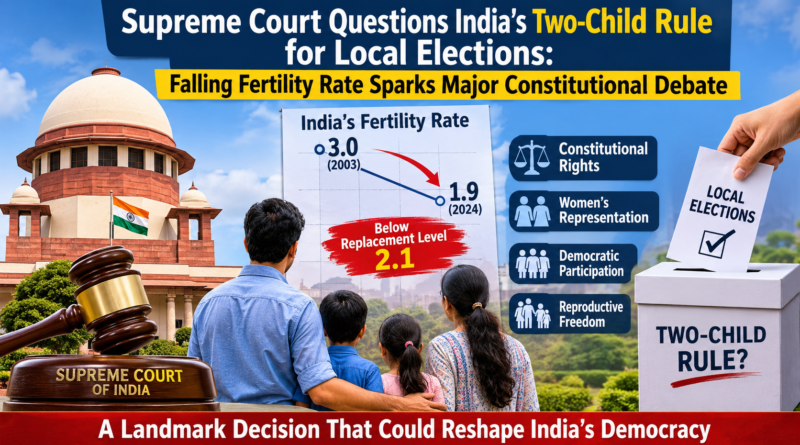
Supreme Court Questions India’s India’s two-child Rule for Local Elections: Falling Fertility Rate Sparks Major Constitutional Debate
Date: November 5, 2026
India News | Judiciary | Constitutional Affairs
By: NewYorkFinanceThink Editorial Team
The Supreme Court of India has raised important questions about the continued relevance of the two-child eligibility restriction for local elections, bringing renewed attention to the relationship between population policy, reproductive freedom and democratic representation. In a significant development on November 4, 2026, the Court referred the constitutional issue surrounding the restriction to a larger bench for reconsideration of an earlier judgment.
The case concerns a Maharashtra law that disqualifies certain elected local representatives if they have more than two children. The Supreme Court observed that India’s demographic circumstances have changed considerably since such restrictions were introduced. With fertility rates declining across the country, the Court questioned whether a policy originally justified as a population-control measure should continue to prevent citizens from participating in local democratic institutions.
The development is particularly important because it touches on more than election eligibility. It raises questions about reproductive autonomy, equality, women’s participation in public life and the constitutional limits of government intervention in private family decisions.
Why the Supreme Court Reconsidered the Two-Child Rule
The matter arose in Mangala Bhimrao Ingle v. The Additional Commissioner, Amravati Division. The appellant, a former Sarpanch of Kakoda Gram Panchayat in Maharashtra, faced disqualification under Section 14(1)(j-1) of the Maharashtra Village Panchayats Act, 1959, because she had more than two children.
The Bombay High Court had upheld the disqualification in August 2025. The matter subsequently reached the Supreme Court, where the judges considered whether the legal reasoning behind the two-child restriction remained appropriate in the country’s changing demographic circumstances.
The Supreme Court observed that population-control laws based on a two-child norm may have lost much of their relevance as India’s fertility rate has fallen significantly. The Court referred the issue to a larger bench, which will reconsider the earlier legal position established in the 2003 judgment in Javed v. State of Haryana.
This reference is an important judicial development, but it does not mean that all two-child restrictions across India have automatically been cancelled. The larger bench will have to examine the legal and constitutional questions before a final position can be established.
India’s Falling Fertility Rate Changes the Debate
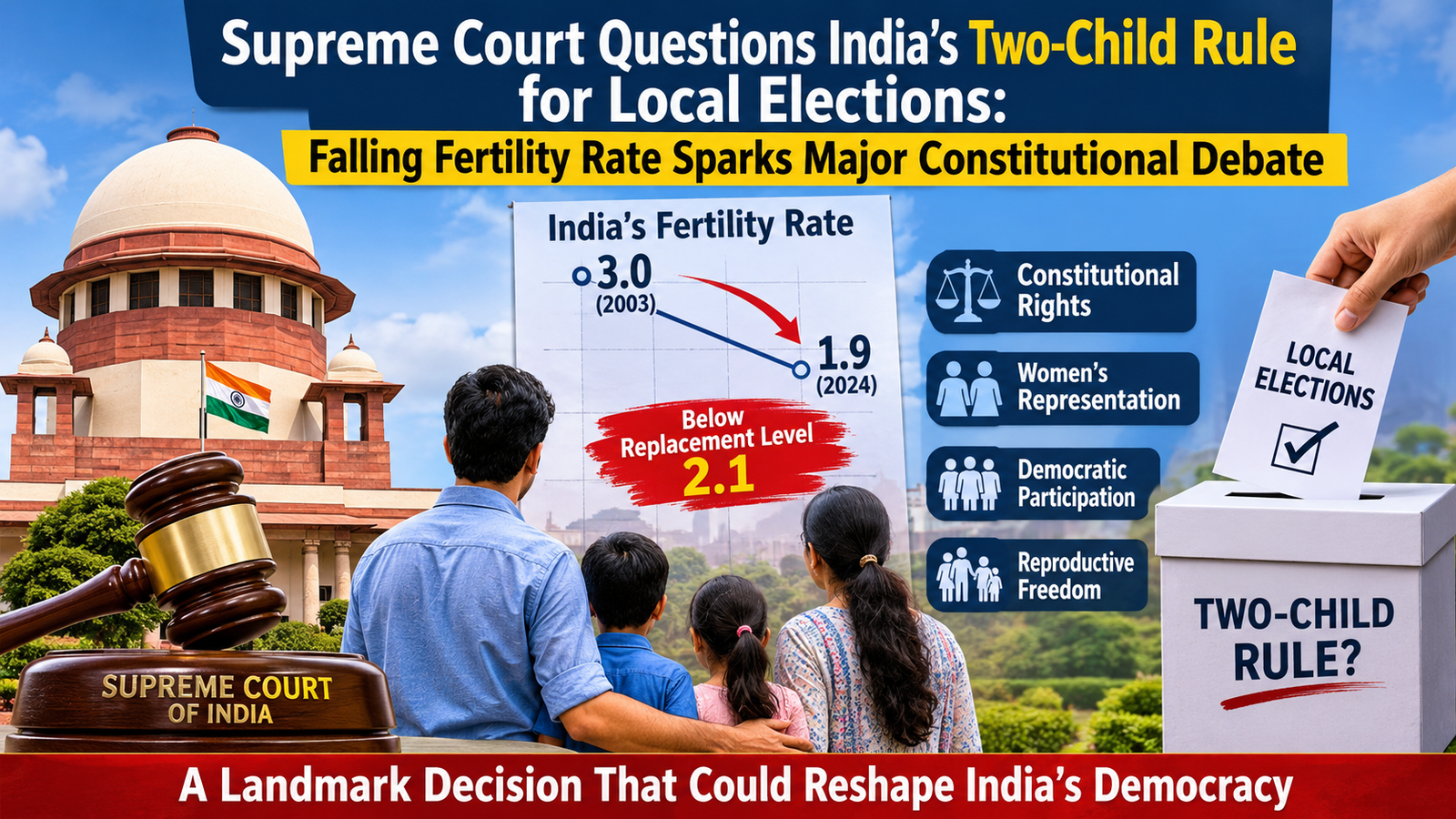
India’s demographic situation has changed substantially over the past two decades. The country’s total fertility rate has declined from approximately 3.0 children per woman in 2003 to around 1.9 in 2024, below the commonly cited replacement fertility level of approximately 2.1.
This decline reflects several long-term changes, including greater urbanisation, improved access to education, rising living costs, changing family preferences, delayed marriages and increased awareness of reproductive healthcare.
For many Indian households, raising children has become more expensive. Housing, education, healthcare, transportation and everyday living costs influence decisions about family size. In urban areas especially, families increasingly consider the financial responsibilities associated with raising children before deciding whether to have another child.
These developments have transformed the national population debate. When fertility rates were considerably higher, population-control policies were often defended as a response to concerns about rapid population growth. Today, however, the country faces a more complicated demographic picture, with falling fertility, regional differences and the prospect of an ageing population becoming increasingly important policy considerations.
Reproductive Freedom and Article 21
One of the most significant constitutional questions in the case concerns the relationship between population-control legislation and the right to personal liberty under Article 21 of the Indian Constitution.
Reproductive decisions are deeply personal. Decisions about whether to have children, how many children to have and when to have them can be influenced by health, family circumstances, economic conditions and individual preferences.
The Court’s observations have brought renewed attention to whether the state can impose electoral penalties based on the number of children a person has. A law may have a legitimate public-policy objective, but its continued use must also be examined in light of constitutional rights and changing social conditions.
The larger bench will have to consider how population-policy objectives should be balanced against individual liberty, equality and democratic participation.
Women’s Political Representation Is Also at Stake
The case has particular significance for women in rural India. Local governments are important institutions through which women participate in public decision-making, including village development, education, sanitation, public health and welfare programmes.
A disqualification based on family size can affect a woman’s opportunity to hold elected office. It may also create difficult choices for women whose family circumstances change after the birth of a child.
Critics of such restrictions have argued that these rules can place unequal pressure on women, particularly in communities where decisions about family size are not always made independently by women themselves.
The constitutional debate therefore extends beyond population statistics. It concerns whether electoral eligibility rules should penalise individuals for private family circumstances and whether those penalties disproportionately affect women.
What Happens Next?
The Supreme Court’s decision to refer the issue to a larger bench means that the legal questions will receive further examination. The larger bench will reconsider the earlier judgment in Javed v. State of Haryana and assess the constitutional validity and continuing relevance of the two-child restriction.
Until the larger bench decides the matter, it would be incorrect to assume that every two-child eligibility law in India has ceased to operate. The legal position will depend on the final judicial decision and the relevant legislation.
In the case before it, the Supreme Court continued interim protection for the appellant, allowing her to continue as Sarpanch until the appeal is disposed of.
Editorial Analysis: Population Policy Must Reflect Changing India
India’s population debate is entering a new phase. The country that once worried primarily about rapid population growth must now prepare for a future in which fertility is declining, the population is ageing in some regions and the economic consequences of demographic change are becoming more important.
Population policy cannot remain disconnected from these realities. Laws introduced under one set of demographic conditions may require reconsideration when society changes. A policy designed to encourage smaller families should be evaluated not only by its original intention but also by its present consequences.
The Supreme Court’s decision does not settle the constitutional question. However, it places an important issue before a larger bench: whether electoral disqualification based on family size remains a proportionate and constitutionally justified approach in modern India.
The outcome could influence the future relationship between local democracy, reproductive freedom and population policy. For millions of citizens, particularly women seeking political participation at the village level, the final decision may carry consequences far beyond the courtroom.
NewYorkFinanceThink Editorial Note: This report is based on the Supreme Court proceedings and publicly reported legal developments available as of November 5, 2026. The larger bench’s final decision will determine the future legal position.
Source: Mangala Bhimrao Ingle v. The Additional Commissioner, Amravati Division, 2026 INSC 1193; Supreme Court of India, November 4, 2026.
Disclaimer: This article is for general news and public-information purposes. It is not legal advice.
