

Why Housing Is Becoming Unaffordable for Many Americans in 2026
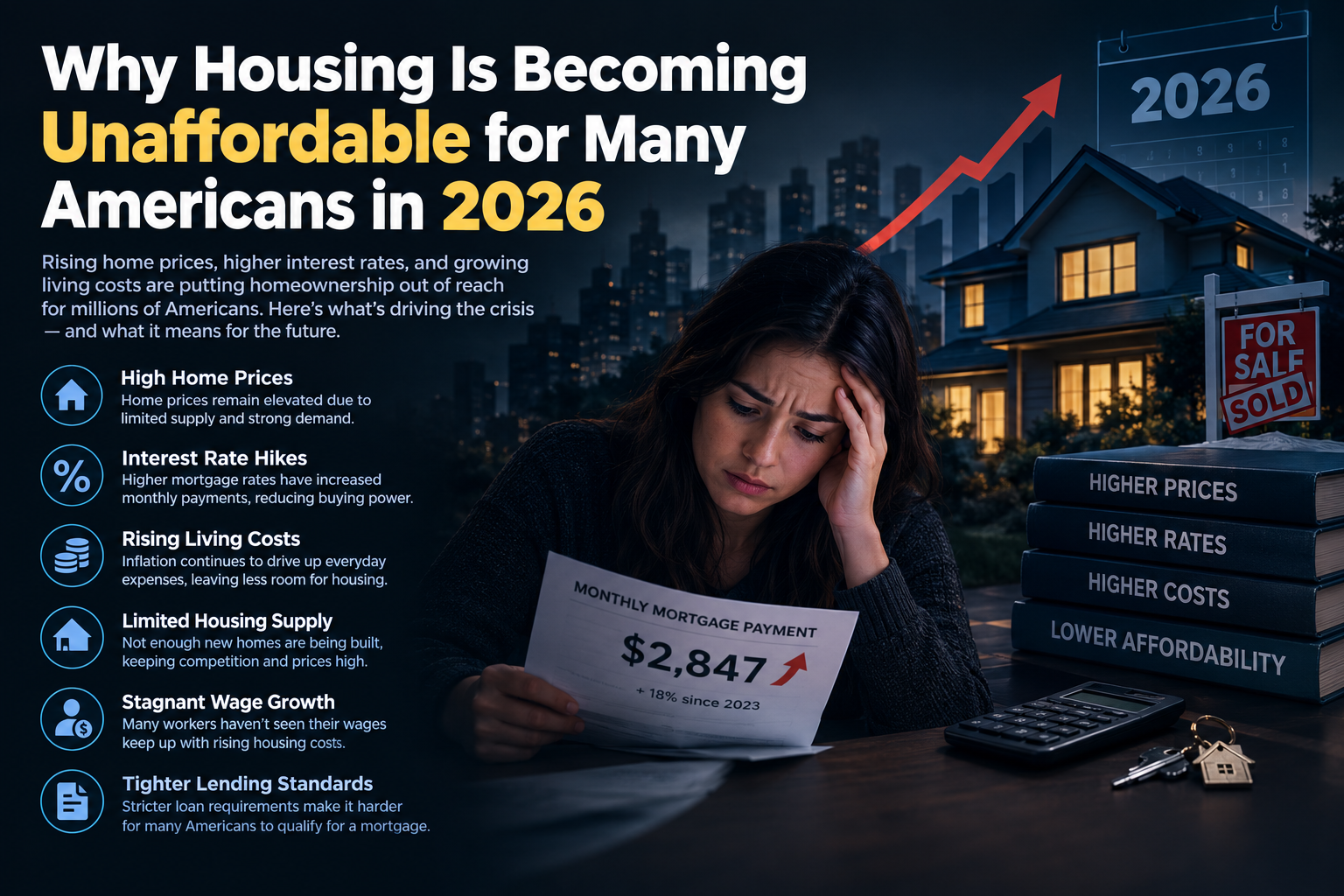
For many Americans, the biggest financial question is no longer whether they want to buy a home. It is whether they can realistically afford one.
A house that once looked like a normal part of middle-class life can now require a much larger income, a bigger down payment and a monthly budget that leaves little room for emergencies.
Renters are feeling the pressure too. In many parts of the country, finding a reasonably priced apartment can be difficult, especially for households whose wages have not increased as quickly as housing costs.
The problem is not caused by one thing.
Home prices are high. Mortgage rates are much higher than they were during the ultra-low-rate years. Insurance costs have increased in many markets. Property taxes add another bill. New construction remains limited in many communities. And rents, even where rent increases have slowed, remain expensive compared with household incomes.
That combination has changed the housing equation for millions of people.
The Federal Reserve’s latest household survey shows just how serious the pressure has become. In 2025, the median monthly mortgage payment reported by homeowners with mortgages was $1,600, up from $1,500 in 2024. For people who moved into their homes in 2024 or 2025, the median mortgage payment was $2,300.
At the same time, the Federal Reserve reported that 23% of renters had been behind on their rent at some point during 2025.
This is why housing affordability has become more than a real-estate issue. It is now a household-budget issue, a savings issue and, for many younger Americans, a question about when they will be able to buy their first home.
The Housing Problem Is Bigger Than the Price of a House
When people talk about expensive housing, they often look only at the selling price.
That can be misleading.
A $400,000 house does not really cost $400,000.
The buyer may need a down payment, mortgage interest, property taxes, homeowners insurance, maintenance, utilities and sometimes homeowners association fees.
The same is true for renters.
A $1,800 monthly rent is not necessarily a $1,800 housing budget. A renter may also pay for electricity, water, internet, parking, renter’s insurance and other fees.
This is one reason housing can become unaffordable even when headline home prices are not rising rapidly.
The total monthly cost matters more than the listing price.
And that total cost has become increasingly difficult for many households to manage.
The U.S. Bureau of Labor Statistics provides a useful picture of where household money goes.
In 2024, the average U.S. consumer unit spent $78,535 during the year. Housing accounted for $26,266, or 33.4% of total spending.
That works out to roughly $2,189 a month in average housing spending.
Housing was the largest spending category by a wide margin.
This matters because housing is not an expense most families can easily cut.
If groceries become expensive, a household can change brands, cook more meals at home or reduce restaurant visits.
If entertainment costs too much, people can cancel subscriptions.
Housing is different.
People still need somewhere to live.
A family cannot simply remove its rent or mortgage payment from the monthly budget.
That makes housing inflation especially painful.
Home Prices Are Still High
One of the biggest reasons buying a home has become difficult is simple: houses became much more expensive over the years leading into 2026.
The sharpest increases occurred during and after the pandemic.
Low mortgage rates helped create strong demand. At the same time, many homeowners were reluctant to sell, construction was disrupted and available homes became difficult to find.
Prices moved higher.
Mortgage rates later rose sharply.
That created an unusual situation.
Buyers were dealing with both expensive homes and expensive borrowing.
The Congressional Research Service noted in 2026 that house prices and rents remained significantly above their pre-pandemic levels, even though growth had moderated in some areas.
That distinction is important.
Slower price growth does not mean homes suddenly became affordable.
If a home became extremely expensive and then prices stopped rising quickly, the buyer still has to pay the higher price.
Mortgage Rates Changed the Monthly Payment
Mortgage rates are one of the clearest reasons housing affordability has changed.
During the pandemic years, many Americans were able to borrow at unusually low rates.
Those days changed.
Higher mortgage rates mean that the same house can cost substantially more each month even if the sale price does not change.
Consider a simple example.
Suppose two buyers purchase similar $400,000 homes.
One buyer gets a mortgage at a very low rate.
Another buyer gets a mortgage at a much higher rate.
The second buyer can end up paying hundreds of dollars more each month.
Over a 30-year mortgage, the difference can become enormous.
This is why simply saying “home prices have stopped rising” does not solve the affordability problem.
The interest rate attached to the mortgage matters just as much.
Federal Reserve Governor Michael Barr said in September 2026 that the combination of high home prices and mortgage rates was putting homeownership out of reach for many families. He cited an Atlanta Fed affordability index that reached 68 in July 2026, with 100 representing the threshold at which a median-income family could afford a median-priced home under the measure.
That is a powerful indication of how difficult the market has become.
The Down Payment Is Another Major Barrier
Even if a household can technically afford the monthly mortgage payment, there is another problem.
The down payment.
A home purchase often requires a significant amount of cash before the buyer even gets the keys.
For a $400,000 home:
- 5% down = $20,000
- 10% down = $40,000
- 20% down = $80,000
And that is before closing costs, moving expenses, repairs and other purchases.
For a household trying to save while paying high rent, building that amount of cash can take years.
This creates a difficult cycle.
A person rents because they cannot afford to buy.
Rent makes it harder to save a down payment.
The home price remains high.
The required down payment grows.
The person continues renting.
The Federal Reserve’s 2024 household survey found that 68% of renters who gave reasons for renting said they could not afford a down payment. Forty-nine percent said they could not afford the monthly mortgage payment, while 42% said they could not qualify for a mortgage.
So the problem is not simply “people don’t save enough.”
For many households, the numbers genuinely do not work easily.
Renters Are Feeling the Pressure Too
Buying a home is not the only challenge.
Renting has become expensive as well.
According to the Federal Reserve’s 2025 household survey, the median reported rent was $1,200. That figure was unchanged from the prior year, but remained much higher than earlier years.
More importantly, 23% of renters said they had been behind on rent at some point during the previous year.
That was higher than in 2024.
Lower-income renters were hit particularly hard. Nearly one-third of renters with family incomes below $50,000 reported being behind on rent, compared with 5% among renters with incomes of $100,000 or more.
This shows why national averages can sometimes hide the real problem.
A rent payment that looks manageable for a household earning $120,000 can be overwhelming for a household earning $40,000.
Housing affordability depends on income, not just prices.
Half of Renters Face a Cost Burden
Another useful way to understand the problem is through the concept of housing cost burden.
A household is commonly considered cost burdened when it spends at least 30% of its income on housing.
Severely cost-burdened households spend at least half of their income on housing.
In a September 2026 speech, Federal Reserve Governor Barr noted that about half of renters were cost burdened and roughly one-quarter spent at least half of their income on rent.
Imagine earning $4,000 a month after taxes and spending $2,000 on rent.
Half of your income is gone before buying groceries, paying for transportation, electricity, insurance, healthcare or anything else.
That leaves very little room for savings.
One unexpected car repair can create debt.
One medical bill can disrupt the budget.
One missed paycheck can turn into a serious problem.
This is why expensive housing has effects far beyond the housing market.
Rents Are Not Falling Back to Old Levels
There is another point that often gets lost in discussions about rent inflation.
A slowdown in rent increases is not the same as a return to old rents.
The Federal Reserve reported that the Consumer Price Index measure for primary residence rent in August 2026 was 34% higher than in December 2019.
Rent inflation had slowed considerably from its 2022–23 pace, but shelter prices were still increasing at an annual rate of about 2.75%.
This explains why renters may still feel financially squeezed even when news reports say rent inflation is cooling.
Suppose a rental unit cost $1,300 several years ago and later increased to $1,800.
If rent growth slows to 2% or 3%, the $1,800 rent does not automatically return to $1,300.
The higher price becomes the new starting point.
That is one of the most important facts for families trying to understand today’s housing market.
Homeowners Have Not Escaped the Problem
It might seem that homeowners are protected because they already own their houses.
That is only partly true.
Existing homeowners with older, low-rate mortgages may be in a better position than new buyers.
But homeowners still face property taxes, insurance, maintenance, utilities and repair costs.
Homeowners insurance has become a particularly important issue in some parts of the country.
The Federal Reserve reported that in 2025, 6% of homeowners went without homeowners insurance entirely, with cost being the main reason for a majority of those who lacked coverage.
Among homeowners who had insurance, 20% said they could not afford as much coverage as they wanted, while 14% said they struggled to afford premiums.
That creates a difficult situation.
A family may have purchased a home years ago at a reasonable price and locked in a favorable mortgage rate.
But the annual cost of keeping that home can still rise.
Insurance is one example.
Property taxes are another.
Maintenance is another.
A roof replacement, plumbing problem or heating-system failure can cost thousands of dollars.
Insurance Is Becoming a Bigger Part of the Housing Budget
Homeowners often focus on the mortgage payment.
That makes sense because the mortgage is usually the largest bill.
But insurance deserves more attention.
Insurance costs can vary dramatically depending on location.
Areas exposed to hurricanes, wildfires, floods or other natural hazards may face especially high premiums or limited availability.
When insurance becomes more expensive, the household’s total housing cost rises even if the mortgage payment stays exactly the same.
This can also affect potential buyers.
A house that looks affordable based on its sale price may become much less attractive once insurance costs are added.
In some markets, buyers need to think about insurance before making an offer.
Property Taxes Add Another Layer
Property taxes can also make a large difference.
Two homes with similar prices can have very different annual tax bills depending on where they are located.
That means comparing home prices alone is not enough.
A buyer should look at:
- Mortgage payment
- Property taxes
- Homeowners insurance
- HOA fees
- Utilities
- Maintenance
- Expected repairs
- Transportation costs
- Closing costs
The real cost of a house is the total cost of owning it.
This is particularly important for families moving from one state or city to another.
A cheaper house does not necessarily mean cheaper living.
If the new home is far from work, has high property taxes or requires expensive insurance, the household may not save money.
The Supply of Homes Matters
Another major reason housing has become expensive is supply.
When many people want homes but relatively few homes are available, buyers compete against each other.
Competition pushes prices higher.
The United States has faced housing shortages in many communities for years.
Building new homes can help, but construction takes time.
Developers need land, financing, labor, materials, permits and infrastructure.
Local rules can also influence what gets built and where.
In some cities, zoning restrictions make it difficult to build apartments, townhouses or smaller homes.
That can reduce the number of lower-cost options available to families.
The BLS reported that the number of active U.S. housing listings in the fourth quarter of 2024 remained below the level seen before the COVID-19 pandemic. The agency said supply and demand continued to create challenges for prospective buyers.
Why Building More Homes Takes Time
It is easy to say that America should simply build more houses.
In practice, it is complicated.
A new development may require years of planning.
A builder must purchase land.
Plans must be approved.
Roads and utilities may need to be expanded.
Workers have to be hired.
Materials have to be purchased.
Financing must remain available.
Then the homes have to be sold or rented.
That is why supply problems cannot always be solved quickly.
Even if construction increases today, it may take years before enough new housing reaches the market to make a major difference.
Construction Costs Matter Too
Building a home is expensive.
Labor costs matter.
Lumber and other materials matter.
Land prices matter.
Energy costs matter.
Insurance matters.
Permitting and financing costs matter.
When it costs more to build a house, builders have less ability to offer very cheap homes.
This is one reason the supply problem is difficult.
The country does not simply need more houses.
It needs more homes that ordinary households can afford.
Those are not always the same thing.
The Missing Middle of Housing
Many communities have a shortage of what housing experts often call “missing middle” housing.
These are homes between a large detached house and a large apartment building.
Examples include:
- Townhouses
- Duplexes
- Triplexes
- Small apartment buildings
- Cottage-style developments
- Smaller single-family homes
These types of homes can give buyers and renters more choices.
A young couple may not need a 2,500-square-foot house.
An older couple may not need a large yard.
A single worker may prefer a small apartment close to work.
But if local housing rules make smaller or denser homes difficult to build, buyers can end up competing for larger and more expensive properties.
Location Has Become a Major Part of Affordability
Housing affordability is not just about the house.
It is also about where the house is located.
A $300,000 home far from employment centers may not be cheaper in practice than a $400,000 home near work.
Why?
Transportation.
If a family needs two cars, drives long distances and spends hours commuting, the housing savings may disappear.
The BLS found that housing and transportation together represented more than half of average household spending in 2024. Housing accounted for 33.4% and transportation for 17.0%.
That is a powerful reminder that households should consider the entire cost of living.
A cheaper house with a two-hour daily commute may not be a cheaper lifestyle.
Transportation and Housing Are Connected
This is especially important for working families.
Suppose a family moves 30 miles farther from the city because homes are cheaper.
The mortgage may fall by $300 per month.
But the family may spend another $250 on gasoline, maintenance and additional vehicle costs.
The parents may also lose several hours each week commuting.
The cheaper house is no longer as cheap as it appeared.
This is why housing policy and transportation policy are closely connected.
Affordable housing near jobs, schools and public transportation can reduce the total cost of living.
Why Young Americans Are Struggling to Buy
Younger adults face a particularly difficult housing environment.
Many are entering the workforce with student loans, car payments and other financial obligations.
At the same time, they may be trying to build an emergency fund and save for a down payment.
Rent takes a large part of their income.
Home prices remain high.
Mortgage payments are expensive.
The result is delayed homeownership.
The Federal Reserve’s 2025 household report found that 49% of adults under 30 lived with a parent, up 6 percentage points from 2022 and 12 percentage points from 2019.
Living with parents is not automatically a sign of financial failure.
For many young adults, it can be a rational response to housing costs.
Staying with family may allow someone to save money, pay down debt or build a down payment.
But it also shows how housing costs can change major life decisions.
Marriage and Family Plans Can Be Affected
Housing costs can also influence decisions about marriage and children.
Starting a family often requires more space.
A one-bedroom apartment may be affordable for one person but difficult for two adults and children.
Moving to a larger home means taking on a larger rent or mortgage.
Childcare then adds another expense.
The Federal Reserve reported that one in four parents with children under age 13 used paid childcare in 2025. Among families paying for both childcare and housing, most spent at least half as much on childcare as they did on housing.
That combination can make family budgets extremely tight.
Housing Affordability Depends on Income
One of the biggest mistakes in the housing debate is treating affordability as a single national number.
The same house can be affordable for one family and impossible for another.
Income is critical.
So is debt.
So is household size.
So is location.
So is whether someone already owns a home.
A household earning $100,000 with no major debt has a very different housing situation from a household earning $55,000 while paying student loans and childcare costs.
That is why housing affordability should always be considered alongside household income.
Wage Growth Has Not Solved the Problem
Higher wages can help.
But housing costs have risen substantially over the past several years.
For some households, wage gains have not been enough to restore the buying power they had before the housing shock.
The Federal Reserve’s 2025 household report found that 58% of adults said changes in prices compared with the previous year had made their financial situation worse.
That does not mean every American is struggling.
Many households are financially comfortable.
But the data show that higher prices remain a major concern.
Why Existing Homeowners Have an Advantage
There is an important divide between existing homeowners and prospective buyers.
Someone who bought a house several years ago may have a much lower mortgage rate.
They may also have built substantial equity as home values increased.
A first-time buyer does not have that advantage.
The first-time buyer has to purchase at today’s price and borrow at today’s rate.
This creates what economists call a lock-in effect.
Homeowners with low-rate mortgages may be reluctant to sell because moving would mean giving up their cheap mortgage and taking on a much higher rate.
That can reduce the number of homes available for sale.
Fewer listings can keep supply tight.
The Federal Reserve has noted that this lock-in effect can contribute to housing-market tightness because fewer homeowners are willing to sell.
The Housing Market Can Become a Catch-22
This creates a difficult cycle.
High mortgage rates discourage homeowners from selling.
Fewer sellers mean fewer homes on the market.
Limited supply keeps competition strong for desirable properties.
Strong demand keeps prices elevated.
High prices make buying difficult.
High mortgage rates make buying even harder.
Potential buyers remain renters longer.
That keeps pressure on the rental market.
The result is a housing system where both renters and buyers can feel trapped.
Why the Midwest Can Look Different
Not every part of America faces the same housing problem.
Some markets are much more expensive than others.
The Federal Reserve’s 2025 data showed that median monthly mortgage payments differed significantly by region.
The overall median was $1,600.
It was $1,350 in the Midwest, $1,550 in the South, $1,669 in the Northeast and $1,975 in the West.
For people willing and able to move, regional differences can matter.
But moving is not always possible.
Jobs, family, schools, healthcare and social connections can keep people in expensive markets.
That means a national average cannot tell the full story.
California and Other High-Cost Markets
Some states face especially high housing costs.
The Census Bureau reported that in 2024, median monthly owner costs for homeowners with a mortgage reached $2,035 nationally.
The highest median monthly costs were reported in California, Hawaii, New Jersey, Massachusetts and Washington, D.C.
In these markets, a household may need a very high income simply to buy an ordinary home.
That can push workers farther away from employment centers.
It can also make it harder for businesses to attract workers.
Housing affordability therefore becomes an economic competitiveness issue.
What Happens When Workers Cannot Afford to Live Near Jobs?
Consider a city where teachers, nurses, police officers, restaurant workers and office employees cannot afford nearby housing.
They may commute from distant suburbs.
Some may leave the area entirely.
Employers then have a harder time finding workers.
Longer commutes increase traffic and transportation costs.
Families lose time.
Local businesses face higher labor costs.
The housing problem spreads into the broader economy.
This is why affordable housing is not only about helping individual buyers.
It can affect the functioning of an entire city.
Why Renters Sometimes Cannot “Just Move”
When rent becomes too expensive, people are often told to find a cheaper apartment.
That sounds simple.
In reality, moving has costs.
There may be a security deposit.
There may be application fees.
Moving trucks cost money.
New furniture may be required.
A cheaper apartment may be farther from work.
Children may have to change schools.
A family may lose access to nearby relatives who help with childcare.
So moving is not always a practical solution.
For some families, staying in an expensive apartment can actually be cheaper than moving immediately.
Housing Costs Affect Savings
The less money a household spends on housing, the more money it can potentially save.
That sounds obvious, but the long-term effect is important.
A household spending an extra $500 per month on housing is spending $6,000 a year.
Over five years, that is $30,000 before considering investment returns.
That money could otherwise be used for:
- Emergency savings
- Retirement
- Education
- Paying off debt
- A down payment
- Home repairs
- Starting a business
High housing costs therefore affect wealth building.
Housing and the Wealth Gap
Homeownership has historically been one of the major ways American families build wealth.
When a homeowner pays down a mortgage, part of the payment builds equity.
If the property increases in value, the household may gain additional wealth.
Renters do not receive that same direct housing equity.
That does not mean renting is always a bad financial decision.
Renting can provide flexibility and can sometimes be cheaper than buying.
But when homeownership becomes increasingly difficult for younger and lower-income households, the wealth-building path can become harder to access.
The Federal Reserve’s 2025 Survey of Consumer Finances found that the homeownership rate among families was 66%, about unchanged from 2022, while the median net housing value of homeowner families rose to $230,000 in 2025 from $218,900 in 2022.
Why Waiting for Prices to Crash Is Not a Plan
Some buyers are waiting for a major housing crash.
That is understandable.
But there is no guarantee that a large crash will happen.
And even if prices decline, mortgage rates could remain high.
For example, a 10% decline in the price of a house does not automatically make it affordable if borrowing costs remain expensive.
Employment conditions also matter.
A household that loses income during a recession may find it harder to qualify for a mortgage even if house prices fall.
Waiting can make sense for someone who needs more savings or a stronger financial position.
But trying to predict the exact bottom of the housing market is extremely difficult.
What Can Make Housing More Affordable?
There is no single solution.
Housing affordability is a supply problem, an income problem, a financing problem and, in many areas, an insurance and tax problem.
Several things can help.
Build More Homes
More housing supply can reduce competition.
That means encouraging construction where people actually want to live.
Build Smaller Homes
Not every household needs a large detached house.
Smaller homes can create more affordable choices.
Allow More Townhouses and Small Apartments
A wider mix of housing types can give buyers and renters more options.
Reduce Unnecessary Construction Delays
Long approval processes can add costs.
Faster, clearer rules can make construction easier.
Improve Transportation
Affordable housing farther from jobs becomes more practical when public transportation and roads are reliable.
Support First-Time Buyers Carefully
Down-payment assistance can help some households.
But assistance alone cannot solve a market where home prices are too high.
If supply remains limited, extra purchasing power can sometimes push prices higher.
Address Insurance Costs
In high-risk regions, insurance availability and cost have become major housing issues.
Protect Renters From Extreme Instability
Policies that improve the supply of affordable rental homes can help households avoid sudden housing crises.
What Families Can Do Right Now
Large housing-market problems require policy solutions, but families still have decisions they can make.
The first step is to calculate the true cost of housing.
Do not look only at rent or the mortgage.
Add:
- Property taxes
- Insurance
- Utilities
- HOA fees
- Maintenance
- Parking
- Transportation
- Repairs
Then compare the total with household income.
A home that looks affordable at first glance may not be affordable after everything is included.
A Simple Housing Budget Test
Before buying, a family can ask five basic questions.
1. What happens if one income disappears temporarily?
2. Can we still pay the mortgage if insurance rises?
3. Can we handle a major repair?
4. Will we have money left for retirement and emergencies?
5. Does this home force us to take on too much transportation debt?
If the answer to several of these questions is no, the house may be too expensive.
Renting Can Be a Rational Choice
There is no shame in renting.
For some households, renting is the better financial decision.
It can make sense when:
- The household expects to move soon.
- A down payment would drain emergency savings.
- Buying would require too much debt.
- Local home prices are extremely high.
- Maintenance costs would be difficult to manage.
- The household values flexibility.
The goal should not be to own a house at any cost.
The goal should be financial stability.
Buying a Home Should Not Destroy Your Emergency Fund
One of the most common mistakes first-time buyers can make is putting nearly all available cash into a down payment.
After closing, the family may have little money left.
Then something goes wrong.
The water heater fails.
The car needs repairs.
A medical bill arrives.
A job disappears.
The household is suddenly using credit cards to cover basic expenses.
A slightly smaller down payment can sometimes leave more cash available for emergencies, depending on the mortgage terms and the buyer’s circumstances.
The important thing is to look at the whole financial picture.
The Cheapest House Is Not Always the Best House
A low purchase price can be attractive.
But buyers should ask why the house is cheap.
Maybe it needs a new roof.
Maybe property taxes are high.
Maybe insurance is expensive.
Maybe the commute is terrible.
Maybe the neighborhood has limited services.
Maybe the house requires major repairs.
A home should be evaluated by total cost, not sticker price.
The Same Rule Applies to Renters
Renters should also look beyond the advertised rent.
A $1,600 apartment may have:
- $150 parking
- $100 utility fees
- $75 internet
- $30 renter’s insurance
- Additional service charges
Suddenly the real monthly cost is much higher.
Before signing a lease, renters should ask for a complete list of mandatory fees.
Housing Affordability Is About Choices
The deeper issue is that Americans need more choices.
A healthy housing market should offer different options for different incomes and life stages.
A young person should be able to find a small apartment.
A growing family should be able to find a reasonably priced townhouse.
An older couple should be able to downsize without leaving the community.
A worker should be able to live within a reasonable distance of a job.
A first-time buyer should have a realistic path into ownership.
When most available housing is either very expensive or very far away, affordability becomes a problem.
What the 2026 Data Tell Us
Several numbers help explain the current situation.
| Housing Measure | Recent Figure |
|---|---|
| Average U.S. housing spending, 2024 | $26,266 per year |
| Average monthly housing spending, 2024 | About $2,189 |
| Housing share of total spending, 2024 | 33.4% |
| Median monthly mortgage payment, 2025 | $1,600 |
| Median mortgage payment for recent movers, 2024–25 | $2,300 |
| Renters behind on rent in 2025 | 23% |
| Renters spending at least 30% of income on rent | About half |
| Renters spending at least 50% on rent | About one-quarter |
| Rent of primary residence increase from Dec. 2019 to Aug. 2026 | 34% |
Sources include the U.S. Bureau of Labor Statistics, U.S. Census Bureau and Federal Reserve.
These figures do not describe every American.
But they show the direction of the broader problem.
Housing Is Becoming Unaffordable for a Reason
It is tempting to blame one group.
Some people blame investors.
Others blame the Federal Reserve.
Some blame local governments.
Others blame builders.
There is truth in parts of several arguments, but the housing affordability problem is much bigger than one cause.
The United States is dealing with a combination of:
- High home prices
- Elevated mortgage rates
- Limited housing supply
- Expensive land
- Construction costs
- Insurance increases
- Property taxes
- Higher rents
- Income differences
- Limited affordable housing
- Down-payment barriers
- Transportation costs
These factors reinforce one another.
That is why the problem is so difficult to solve.
Why More Housing Supply Matters
The most basic economic principle is supply and demand.
When demand is strong and supply is limited, prices tend to remain high.
Building more homes does not guarantee that every house will suddenly become cheap.
But additional supply can give buyers and renters more choices.
It can reduce bidding pressure.
It can make it easier for households to find homes that fit their budgets.
And over time, more construction can reduce some of the pressure created by scarcity.
The Federal Reserve and other economic researchers have repeatedly pointed to housing supply as an important part of the affordability discussion.
The challenge is making that supply practical, affordable and located where people need it.
Why the Problem Will Not Disappear Overnight
Even if mortgage rates fall, housing affordability may remain difficult.
Lower rates can reduce monthly payments.
But lower rates can also bring more buyers into the market.
If there are not enough homes available, increased demand can push prices higher.
Similarly, building more homes takes years.
Insurance costs may not fall quickly.
Property taxes can remain high.
Rent levels may take time to adjust.
This means housing affordability is likely to remain an important issue even if some market conditions improve.
The Good News for Buyers
The situation is difficult, but it is not hopeless.
Housing markets are local.
Some cities are more affordable than others.
Some neighborhoods offer better value.
Some buyers can wait.
Some can choose smaller homes.
Some can consider condos or townhouses.
Some can move to less expensive regions.
Some renters can negotiate or find better deals when leases expire.
And mortgage rates can change.
The key is not to make a decision based entirely on fear or pressure.
Do Not Let the Market Rush You
Buying a home is one of the largest financial decisions most people will make.
That means buyers should be careful about becoming emotionally attached to a property they cannot comfortably afford.
A seller may say there are multiple offers.
A real-estate agent may say prices are going up.
Friends may say that waiting is a mistake.
None of that changes the household budget.
If the numbers do not work, the numbers do not work.
A house is not a good investment if the mortgage leaves the family unable to pay for basic needs or handle emergencies.
The Real Definition of Affordable Housing
Affordable housing should not simply mean a house with a low sticker price.
A truly affordable home is one where the household can pay for housing while still having enough money for:
- Food
- Transportation
- Healthcare
- Insurance
- Utilities
- Savings
- Debt payments
- Emergencies
- Family needs
That is the standard families should use.
Final Thoughts
Housing has become one of the biggest financial challenges facing American households in 2026.
The problem is not simply that houses cost more.
It is that several costs have increased at the same time.
Home prices remain elevated.
Mortgage rates are higher than the unusually low levels seen during the pandemic.
Rents remain well above their pre-pandemic levels.
Insurance has become a growing concern in many areas.
Property taxes and maintenance add to the cost of ownership.
And limited housing supply continues to make competition intense in many communities.
The numbers tell the story.
The average U.S. consumer unit spent $26,266 on housing in 2024, representing 33.4% of total annual spending.
In 2025, the median monthly mortgage payment among homeowners with mortgages was $1,600, while recent movers reported a median payment of $2,300.
Among renters, 23% reported being behind on rent during 2025.
Those figures show why housing is no longer just a real-estate conversation.
It is a household survival and financial-planning issue.
For families, the best response is to look at the complete cost of housing rather than focusing on one number.
For policymakers, the challenge is even larger: increase housing supply, encourage a wider range of home types, improve affordability for lower-income households and address the growing cost of insurance and other ownership expenses.
There is no single policy that will fix everything.
But more housing choices, healthier supply, sensible financing and stronger household incomes can make the market more manageable.
For individual Americans, the most important lesson is simple.
Do not buy a house just because you can qualify for the mortgage. Buy only when the complete cost fits comfortably within your financial life.
A home should provide stability.
It should not turn every month into a struggle.
And until housing becomes more closely aligned with what ordinary households can actually afford, the question of where Americans can live — and how much they have left after paying for it — will remain one of the country’s biggest economic challenges.
Official Sources
- U.S. Bureau of Labor Statistics — Consumer Expenditures 2024
BLS Consumer Expenditures 2024 Bureau of Labor Statistics - BLS — Housing and Transportation Spending
BLS Housing and Transportation Spending Bureau of Labor Statistics - Federal Reserve — Economic Well-Being of U.S. Households in 2025
Federal Reserve Housing Report Federal Reserve - Federal Reserve — 2025 Household Economic Survey
Federal Reserve SHED Federal Reserve - U.S. Census Bureau — Cost of Homeownership
U.S. Census Bureau Housing Costs Census.gov
