
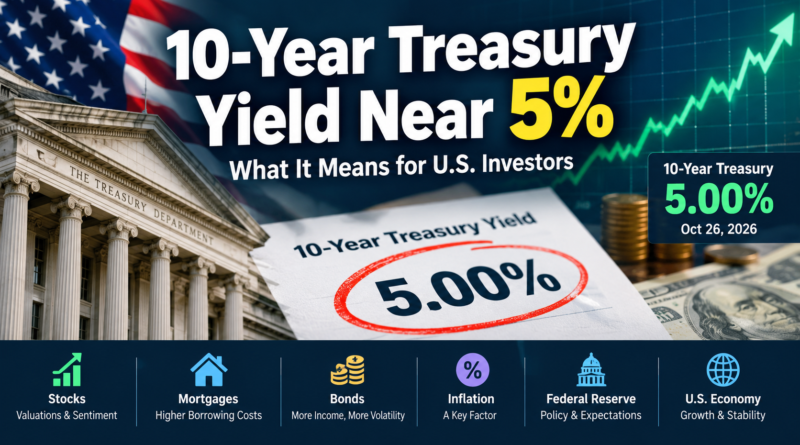
10-Year Treasury Yield Near 5%: Why Investors Are Watching the Bond Market

The U.S. bond market is once again becoming one of the biggest stories for investors.
The 10-Year Treasury yield is around 5.00%, a level that matters far beyond the bond market. The 10-year Treasury is widely used as a benchmark for borrowing costs across the U.S. economy, so movements in its yield can influence mortgages, corporate borrowing, stock valuations and investor sentiment.
According to the U.S. Treasury’s latest published daily data, the 10-year yield stood at 5.00% on October 26, 2026.
For investors, the important question is not simply whether the yield is at 5%. The bigger question is why yields are staying elevated and what that could mean for financial markets in the months ahead.
Why the 5% Level Matters
A 5% yield on the 10-year Treasury represents an important psychological level for financial markets.
When Treasury yields rise, newly issued government debt can offer investors more income. At the same time, higher Treasury yields can make other investments look less attractive on a relative basis.
This is particularly important for stocks whose valuations depend heavily on future earnings. When the risk-free rate rises, investors often demand more return from stocks before they are willing to pay higher prices.
That can put additional pressure on growth and technology shares.
The relationship is not automatic, however. Stocks can continue rising even when Treasury yields are high if corporate earnings, economic growth and investor confidence remain strong.
Treasury Yields and the Federal Reserve
The Federal Reserve remains an important part of the interest-rate story, but the 10-year Treasury yield does not simply follow the Fed’s policy rate.
The 10-year yield reflects a broader combination of factors, including expectations for inflation, economic growth, government borrowing and future interest rates.
Recent market commentary has highlighted concerns that inflation pressures and large government borrowing needs could keep longer-term yields elevated. Reuters also reported that investors were watching the possibility of significantly higher long-term yields as inflation and debt concerns remained important themes.
That means investors are paying close attention not only to the next Federal Reserve decision, but also to inflation data, employment reports, economic growth and Treasury auctions.
What a 5% Yield Means for Stock Investors
Higher Treasury yields can change the way investors value stocks.
When a Treasury security offers a relatively high yield, investors have an alternative to taking additional risk in equities.
This does not mean investors automatically sell stocks. Instead, the required return on riskier assets can increase.
Technology and other high-growth companies can be particularly sensitive because a larger portion of their expected value may come from earnings far in the future.
If bond yields rise sharply, those future earnings can become less valuable in today’s calculations.
This is one reason why investors often watch the 10-year Treasury whenever the Nasdaq and other growth-heavy indexes experience large swings.
The Housing Market Could Feel the Pressure
The impact of the 10-year Treasury yield is also important for American households.
Mortgage rates do not move one-for-one with the 10-year Treasury, but the Treasury market is an important reference point for longer-term borrowing costs.
When long-term Treasury yields remain high, borrowing costs can stay elevated as well.
For homebuyers, that can mean higher monthly payments.
For existing homeowners, higher rates can reduce refinancing opportunities.
For the broader housing market, expensive financing can make it harder for buyers to qualify for homes at the same prices they could afford when rates were lower.
This creates an important connection between Wall Street and Main Street: a move in the bond market can eventually affect household budgets.
Why Investors Are Watching Inflation
Inflation remains one of the biggest risks for long-term bonds.
If inflation stays higher than expected, investors may demand higher yields to compensate for the loss of purchasing power.
That can push Treasury yields higher.
On the other hand, if inflation continues to cool and investors become more confident that price pressures are easing, demand for Treasuries could improve and yields could move lower.
The latest direction will depend heavily on incoming economic data.
Government Borrowing Is Another Major Factor
The U.S. government regularly issues Treasury securities to finance federal spending and refinance existing debt.
When the amount of government debt being issued is large, investors naturally pay attention to whether demand is strong enough to absorb that supply without requiring substantially higher yields.
Treasury auctions therefore remain an important market event.
A strong auction can reassure investors that demand for government debt remains healthy. Reuters reported earlier in October that a strong $39 billion 10-year Treasury auction helped push yields lower after a period of market volatility.
This shows why Treasury auctions can sometimes have a direct impact on broader financial-market sentiment.
What It Means for Bond Investors
For bond investors, higher yields have two sides.
The positive side is that newly purchased bonds can provide higher income.
The difficult part is that existing bonds with lower coupon rates can lose market value when new bonds become more attractive.
This is particularly important for investors who own longer-duration bonds.
If yields rise, bond prices generally fall.
If yields decline, bond prices generally rise.
That inverse relationship is one of the most important concepts for anyone investing in fixed income.
Could the 10-Year Treasury Move Below 5%?
Yes.
A 5% yield is not a permanent ceiling or floor.
If inflation falls, economic growth slows or investors become more concerned about the outlook, demand for Treasuries could increase.
Higher demand can push bond prices higher and yields lower.
There have already been periods in October when Treasury yields moved sharply as investors reassessed economic and global risks. Reuters reported that Treasuries benefited from safe-haven demand during a market selloff linked to concerns about heavy AI-related capital spending.
This highlights an important point: Treasury yields can move for reasons that have little to do with one single economic report.
What Could Push Yields Above 5%?
Several factors could push the 10-year yield higher.
1. Persistent inflation
If inflation remains stubbornly high, investors could demand greater compensation for holding long-term bonds.
2. Strong economic growth
A stronger-than-expected economy can reduce expectations for aggressive monetary easing and increase bond yields.
3. Higher government borrowing
Heavy Treasury issuance could put upward pressure on yields if demand does not keep pace with supply.
4. Higher oil prices
Energy prices can influence inflation expectations. A sustained rise in oil prices could make investors more cautious about future inflation.
5. Expectations for fewer rate cuts
If markets conclude that interest rates will remain higher for longer, longer-term Treasury yields could remain under pressure.
What Could Bring Yields Lower?
The opposite forces could also become powerful.
A slowdown in the U.S. economy, weaker employment, falling inflation or increased demand for safe-haven assets could encourage investors to buy Treasuries.
A weaker economy can also increase expectations for lower interest rates in the future.
In that environment, the 10-year yield could move below the 5% threshold.
What Investors Should Watch Next
Investors following the 10-year Treasury should keep an eye on several indicators.
Inflation data: Measures such as CPI and PCE inflation can change expectations for future interest rates.
Employment data: A weaker labor market could strengthen expectations for monetary easing.
Economic growth: Strong economic activity can keep long-term yields elevated.
Treasury auctions: Auction demand provides a useful signal about appetite for U.S. government debt.
Oil prices: Energy prices can influence inflation expectations.
Federal Reserve communication: Officials’ comments can quickly change expectations for future policy.
Stock-market valuations: Higher bond yields can become more important when equity valuations are already stretched.
The Bigger Picture
The 10-Year Treasury yield near 5% is more than a number on a financial screen.
It is a signal about how investors view inflation, economic growth, government borrowing and future interest rates.
For stock investors, it can influence valuation.
For homebuyers, it can affect financing costs.
For bond investors, it changes the income available from new securities while affecting the value of existing bonds.
And for policymakers, it is another indication of how financial markets are responding to the economic environment.
The key issue now is whether the 5% area becomes a temporary stopping point or the beginning of another move higher.
For investors, watching the direction of the yield may be just as important as watching the exact number.
Bottom Line
With the 10-Year Treasury yield around 5.00%, the U.S. bond market remains an important factor for the broader financial system. Official Treasury data shows the benchmark at 5.00% on October 26, 2026.
The next major moves will likely depend on inflation, economic growth, Federal Reserve expectations, Treasury supply and investor demand.
For anyone following U.S. markets, the 10-year Treasury is a number worth watching every day.
