
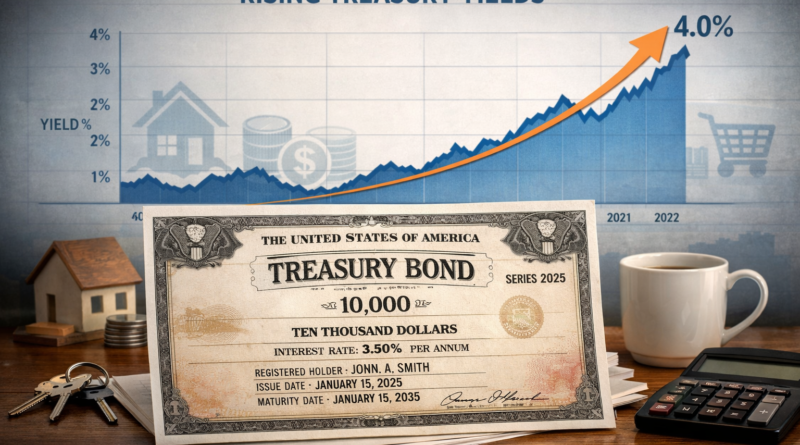
U.S. Treasury Yields 2026: What Treasury Rates Mean for Investors, the Economy, Mortgages and American Households
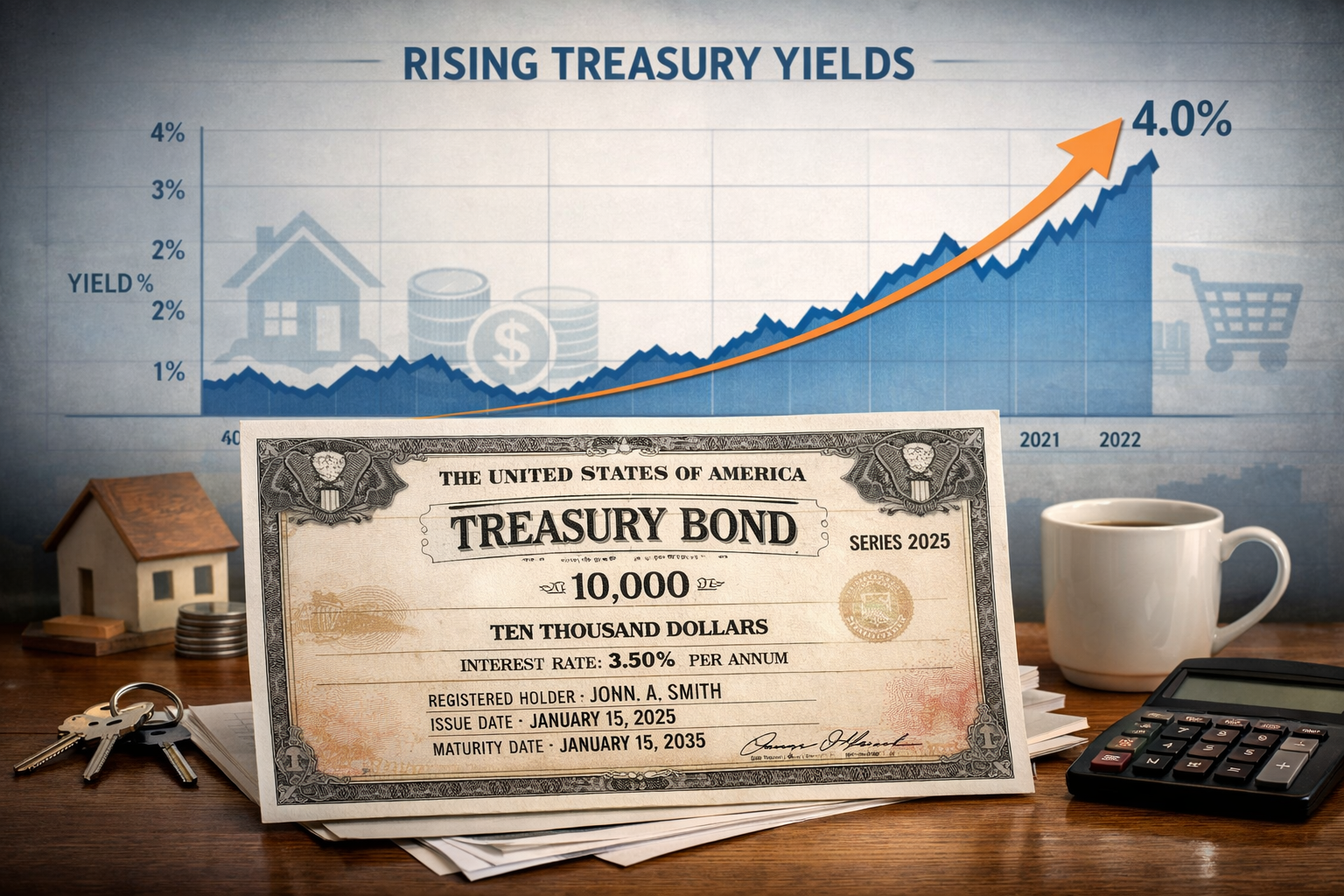
Part 5 of 6 — Fed & Interest Rates Series
Updated: October 8, 2026
By: NYFT News Desk
U.S. Treasury yields are among the most important numbers in global finance.
They influence bond prices, mortgage rates, corporate borrowing costs, stock valuations, the U.S. dollar, government financing costs and the return investors can earn from relatively low-risk government securities.
Yet Treasury yields can look confusing.
Why is the 10-year Treasury yield so important?
Why can the Federal Reserve raise or lower its policy rate while the 10-year Treasury moves in the opposite direction?
Why do investors sometimes buy Treasuries even when stocks are performing well?
And why does a change of just 0.25 percentage point in Treasury yields matter to millions of Americans?
This guide explains the Treasury market from the ground up.
The goal is not simply to tell investors where Treasury yields are. It is to explain why yields move, what the yield curve means, how inflation and Federal Reserve policy affect Treasury rates, and what changing yields can mean for households and financial markets.
As of October 2026, the Treasury market remains particularly important because inflation is still above the Federal Reserve’s 2% longer-run goal, the federal funds target range is 3.75%–4.00%, and long-term Treasury yields remain materially above short-term policy rates. The Federal Reserve’s September 2026 projections also showed a median federal funds rate of 4.1% for the end of 2026, while projecting PCE inflation of 3.7% for 2026.
Key Takeaways
- Treasury yields represent the interest rate investors demand to hold U.S. government debt.
- Bond prices and bond yields generally move in opposite directions.
- The 10-year Treasury yield is one of the most closely watched rates in the world.
- The Federal Reserve directly controls the federal funds target range, but it does not directly set the 10-year Treasury yield.
- Short-term Treasury yields are generally more sensitive to expectations about Federal Reserve policy.
- Long-term yields are influenced by inflation expectations, economic growth, future short-term rates, Treasury borrowing, investor demand and the term premium.
- The yield curve compares Treasury rates across different maturities.
- An inverted yield curve occurs when shorter-term yields are higher than longer-term yields.
- A steepening curve can signal changing expectations about growth, inflation or monetary policy.
- Higher Treasury yields can increase borrowing costs throughout the economy.
- Lower Treasury yields can support bond prices and potentially improve valuations for rate-sensitive assets.
- Treasury Inflation-Protected Securities, or TIPS, provide another way for investors to think about inflation protection.
- Real yields matter because they attempt to show the return available after accounting for expected inflation.
- Investors should avoid treating one Treasury yield as a complete economic forecast.
What Is a U.S. Treasury Yield?
A Treasury yield is essentially the return investors receive from owning a U.S. government Treasury security, expressed as an annual percentage rate.
The U.S. Treasury borrows money by issuing securities with different maturities.
These include:
- Treasury bills
- Treasury notes
- Treasury bonds
- Treasury Inflation-Protected Securities
- Floating Rate Notes
Treasury bills are short-term securities.
Treasury notes generally cover intermediate maturities.
Treasury bonds cover longer maturities.
The Treasury market therefore does not have one single interest rate.
It has a range of yields across different maturities.
For example, investors can look at:
- 3-month Treasury yield
- 6-month Treasury yield
- 1-year Treasury yield
- 2-year Treasury yield
- 5-year Treasury yield
- 10-year Treasury yield
- 20-year Treasury yield
- 30-year Treasury yield
Each maturity tells investors something slightly different about market expectations.
Why Are Treasury Yields So Important?
Treasury securities are considered among the most important benchmarks in global finance because they are obligations of the U.S. federal government.
Treasury yields therefore become reference points for many other financial products.
For example, changes in Treasury yields can influence:
- Mortgage rates
- Corporate bonds
- Auto loans
- Commercial loans
- Student loans
- Credit markets
- Bank funding costs
- Stock valuations
- Insurance portfolios
- Pension funds
- Money-market investments
This is why a Treasury market move can eventually reach an American household even if that household never buys a Treasury bond.
A homeowner may notice it through mortgage rates.
A business may notice it through borrowing costs.
An investor may notice it through stock valuations.
A saver may notice it through Treasury bills or other interest-bearing investments.
Treasury Yield vs. Federal Funds Rate
This distinction is extremely important.
The Federal Reserve controls the target range for the federal funds rate.
Treasury yields are determined in the market.
These two rates are connected, but they are not identical.
As of the September 15–16, 2026 FOMC meeting, the Federal Reserve set the federal funds target range at 3.75% to 4.00%.
But a 10-year Treasury can trade at a yield that is higher or lower than the federal funds rate.
Why?
Because the 10-year Treasury represents a much longer period.
An investor buying a 10-year Treasury is thinking about:
- Inflation over the next decade
- Economic growth
- Future Fed policy
- Government borrowing
- Demand for safe assets
- Global capital flows
- The term premium
- Future interest rates
The federal funds rate is an overnight rate.
The 10-year Treasury is a market price for lending to the U.S. government over roughly a decade.
That difference explains why the Fed and Treasury market can sometimes appear to be sending different signals.
How Treasury Yields Are Determined
Treasury yields are determined through supply and demand in the bond market.
When investors strongly want Treasury securities, their prices can rise.
When Treasury bond prices rise, yields generally fall.
When investors sell Treasuries, prices can fall.
When prices fall, yields generally rise.
This produces one of the most important relationships in fixed-income investing:
Bond prices and bond yields generally move in opposite directions.
A Simple Example
Imagine a Treasury bond that pays a fixed amount of interest.
Suppose an investor owns a bond with a fixed coupon.
Now imagine new Treasury securities enter the market offering higher interest rates.
The old bond becomes less attractive.
Its market price may fall.
Because the investor is now paying less for the same fixed interest payments, the effective yield on that bond rises.
The opposite can happen when market interest rates fall.
Existing bonds with higher coupons become more attractive.
Their prices can rise.
Their yields can fall.
This is why investors who own bonds should pay attention to both:
Income and price movement.
Why the 10-Year Treasury Is So Important
The 10-year Treasury is one of the most closely watched financial indicators in the world.
It is frequently used as a benchmark for:
- Mortgage rates
- Corporate borrowing
- Long-term investment decisions
- Stock valuation models
- Economic expectations
- Global fixed-income markets
The 10-year Treasury does not directly determine mortgage rates.
However, mortgage markets pay close attention to longer-term Treasury yields and related bond-market conditions.
That is why an American homeowner may hear financial news discussing the 10-year Treasury even when the story is about mortgages.
The 10-Year Treasury in October 2026
The Federal Reserve’s H.15 data showed the 10-year Treasury constant-maturity yield at approximately 5.27% on October 6, 2026. FRED identifies the source as the Federal Reserve Board’s H.15 release.
The same October 7 H.15 release showed:
| Treasury maturity | Oct. 7, 2026 yield |
|---|---|
| 1-month | 4.06% |
| 3-month | 4.21% |
| 6-month | 4.28% |
| 1-year | 4.46% |
| 2-year | 4.79% |
| 3-year | 4.88% |
| 5-year | 5.03% |
| 7-year | 5.15% |
| 10-year | 5.27% |
| 20-year | 5.68% |
| 30-year | 5.64% |
These are daily market yields and can change every trading session.
The important point is not just the individual number.
It is the shape of the curve.
What Is the Treasury Yield Curve?
The Treasury yield curve is a graph showing yields across different maturities.
At one end are short-term Treasury securities.
At the other end are long-term securities.
A simplified curve could look like this:
3-month → 1-year → 2-year → 5-year → 10-year → 30-year
Investors watch the curve because its shape can provide information about market expectations.
There are three major descriptions:
- Normal or upward-sloping
- Flat
- Inverted
What Is a Normal Yield Curve?
A normal yield curve generally slopes upward.
That means longer-term Treasury securities offer higher yields than shorter-term securities.
Why might investors demand higher yields for longer maturities?
Because they face more uncertainty.
Over 10 or 30 years, investors cannot know exactly what will happen to:
- Inflation
- Economic growth
- Government borrowing
- Interest rates
- Political conditions
- Global capital flows
Investors may therefore demand additional compensation for holding long-duration securities.
What Is an Inverted Yield Curve?
An inverted yield curve occurs when shorter-term Treasury yields are higher than longer-term yields.
Historically, investors have paid close attention to inversions because they have sometimes preceded U.S. recessions.
But an inversion is not a recession forecast by itself.
It is better understood as a market signal reflecting expectations.
For example, investors may believe:
- Current short-term rates are restrictive.
- The Fed will eventually lower rates.
- Economic growth could slow.
- Inflation may decline.
- Future short-term interest rates may be lower.
These expectations can push short-term yields above longer-term yields.
What Is a Steep Yield Curve?
A steep curve means there is a relatively large difference between short- and long-term yields.
A curve can steepen for different reasons.
For example:
Bear steepening
Long-term yields rise faster than short-term yields.
This may happen when investors demand more compensation for:
- Inflation
- Government borrowing
- Economic growth
- Term risk
Bull steepening
Short-term yields fall faster than long-term yields.
This can happen when markets expect easier Federal Reserve policy while longer-term inflation or borrowing concerns remain.
The words “bull” and “bear” describe the direction of yields and bond prices, not necessarily the overall stock market.
What Is the 2-Year Treasury Telling Investors?
The 2-year Treasury is often considered highly sensitive to expectations about Federal Reserve policy.
Why?
Because the market is constantly reassessing where short-term interest rates may be over the next several years.
If investors expect the Fed to keep rates high, 2-year yields can rise.
If investors expect significant rate cuts, 2-year yields can fall.
This is why financial journalists frequently compare:
2-year Treasury yield vs. federal funds rate.
It can provide a useful picture of how investors view future monetary policy.
What Is the 30-Year Treasury Telling Investors?
The 30-year Treasury is more heavily influenced by long-term expectations.
It reflects the market’s assessment of:
- Long-run inflation
- Long-run economic growth
- Federal borrowing
- Global demand
- Term premium
- Future interest rates
The 30-year yield can remain high even if markets expect the Fed eventually to lower short-term rates.
That is an important point.
Fed cuts do not automatically mean long-term Treasury yields will fall by the same amount.
Why Can Long-Term Treasury Yields Stay High After Fed Cuts?
This is one of the most misunderstood parts of monetary policy.
Imagine the Fed cuts its policy rate by 1 percentage point.
An investor might assume the 10-year Treasury should also fall by 1 percentage point.
There is no such rule.
The 10-year Treasury reflects expectations about many years of future conditions.
If investors believe:
- Inflation will remain elevated,
- government borrowing will remain large,
- economic growth will remain strong,
- or the term premium will increase,
long-term yields can remain high.
This creates a situation where:
Short-term rates fall while long-term yields remain elevated.
For households, that can mean mortgage rates do not fall as quickly as expected.
The Federal Reserve and Treasury Yields
The Federal Reserve influences Treasury yields through monetary policy.
But the relationship is indirect for longer maturities.
When the Fed changes the federal funds rate, it changes financial conditions.
That affects expectations.
Suppose the Fed raises rates.
Markets may initially expect:
- Higher borrowing costs
- Slower demand
- Lower inflation
- Slower economic growth
Short-term Treasury yields may respond quickly.
Longer-term yields depend on what investors think will happen after the initial policy change.
The Fed’s 2026 Projections Matter
At the September 2026 meeting, the Fed’s median projection for the federal funds rate was:
- 4.1% at the end of 2026
- 4.1% at the end of 2027
- 3.9% at the end of 2028
- 3.6% at the end of 2029
- 3.2% over the longer run
The median PCE inflation projection was:
- 3.7% in 2026
- 2.3% in 2027
- 2.1% in 2028
- 2.0% in 2029
These projections help investors understand how Fed officials viewed the likely path of policy and inflation at that particular meeting. They are not promises.
Inflation and Treasury Yields
Inflation is one of the most important drivers of Treasury yields.
Why?
Because investors care about their real purchasing power.
Suppose a Treasury provides a 5% nominal yield.
If inflation averages 4%, the investor’s approximate inflation-adjusted return is much smaller.
That is why higher inflation expectations can push nominal Treasury yields upward.
Investors may demand greater yields to compensate for the expected loss of purchasing power.
Nominal Yield vs. Real Yield
There are two important concepts:
Nominal yield
The stated market yield on a Treasury security.
Real yield
A yield adjusted for inflation expectations or derived from inflation-protected securities.
The difference is important.
An investor earning a high nominal yield may not be receiving a high real return if inflation is also high.
Treasury Inflation-Protected Securities
Treasury Inflation-Protected Securities, commonly known as TIPS, are designed to provide protection against inflation.
The principal value of TIPS adjusts based on changes in the Consumer Price Index.
That makes TIPS useful for investors who want to understand the relationship between:
- Nominal Treasury yields
- Real yields
- Inflation expectations
The Treasury market publishes daily real-yield information.
For example, the Treasury’s October 7, 2026 data showed a 10-year real yield of approximately 2.92%.
This is a very different concept from the 10-year nominal yield.
Why Real Yields Matter
Real yields can influence:
- Stock valuations
- Gold
- Growth stocks
- Real estate
- Consumer spending
- Investment decisions
When real yields rise, investors have a higher return available from relatively low-risk government securities.
That can make riskier investments less attractive at the margin.
For example, a high real Treasury yield can create more competition for:
- High-growth stocks
- Speculative assets
- Certain real-estate investments
This does not mean stocks must fall.
It means the required return investors demand may change.
Treasury Yields and Stock Valuations
Treasury yields are important to equity investors because stocks are valued partly against alternative investments.
Consider a simple question:
If a government bond offers a very low yield, investors may be more willing to accept lower expected returns from equities.
But if Treasury yields rise significantly, investors may demand more compensation for taking stock-market risk.
This can affect valuation multiples.
Why Growth Stocks Can Be Sensitive to Yields
Growth companies often derive a large portion of their expected value from profits that may arrive years in the future.
When interest rates rise, the present value of those future cash flows generally falls.
That can put pressure on valuation multiples.
This is one reason technology and other long-duration growth stocks can react strongly to Treasury-yield movements.
But the relationship is not mechanical.
Strong earnings growth can offset some of the pressure.
Treasury Yields and the S&P 500
The S&P 500 does not move only because of Treasury yields.
Stock prices also depend on:
- Earnings
- Revenue growth
- Profit margins
- Consumer spending
- Employment
- Inflation
- Federal Reserve policy
- Global growth
- Oil prices
- Geopolitical developments
Still, Treasury yields provide an important valuation benchmark.
When yields move sharply, investors often reassess what they are willing to pay for stocks.
Treasury Yields and Banks
Banks have a complicated relationship with Treasury yields.
Higher rates can increase interest income on certain assets.
But higher rates can also increase funding costs.
Banks must manage:
- Deposits
- Loans
- Treasury securities
- Mortgage-backed securities
- Credit risk
- Interest-rate risk
A rapid increase in yields can reduce the market value of existing bonds held by financial institutions.
This is why bond duration and interest-rate risk are important for banks.
Why Bond Prices Fall When Yields Rise
Imagine a bank owns a long-term bond paying a fixed coupon.
If market yields suddenly rise, new bonds offer higher returns.
The old bond is less attractive.
Its market value falls.
If the bank has to sell that bond before maturity, it may realize a loss.
This is called interest-rate risk.
The longer the bond’s duration, the more sensitive its price generally is to changes in yields.
What Is Bond Duration?
Duration is a measure of how sensitive a bond’s price is to changes in interest rates.
A simplified rule is:
Higher duration = greater price sensitivity.
Suppose yields rise significantly.
A short-term Treasury may experience a relatively small price decline.
A long-duration Treasury can experience a much larger price decline.
This is why two investors can both own U.S. government securities but experience very different price movements.
Treasury Yields and Mortgage Rates
This is one of the most important connections for American households.
Mortgage rates are not directly set by the Federal Reserve.
The Fed controls short-term monetary policy.
Mortgage rates are influenced by longer-term market rates, mortgage-backed securities and other market factors.
The 10-year Treasury is therefore often watched as a broad benchmark.
When the 10-year Treasury rises substantially, mortgage rates can face upward pressure.
When long-term yields decline, mortgage rates may have room to decline.
But the two rates do not move perfectly together.
Why Mortgage Rates Can Stay High
A homeowner may hear:
“The Fed is cutting rates.”
Then ask:
“Why isn’t my 30-year mortgage rate falling just as much?”
The answer is that mortgage rates depend heavily on longer-term market conditions.
The Fed can lower overnight rates while:
- Inflation expectations remain high
- 10-year Treasury yields remain elevated
- Mortgage spreads widen
- Investors demand higher compensation
As a result, mortgage rates can remain relatively high.
Treasury Yields and Auto Loans
Auto loan rates are also influenced by broader interest-rate conditions.
But unlike Treasury securities, auto loans include additional risk.
A lender considers:
- Borrower credit score
- Loan duration
- Vehicle value
- Down payment
- Default risk
- Dealer incentives
Therefore, a move in Treasury yields does not translate one-for-one into an auto-loan rate.
Still, Treasury yields form part of the broader financial environment.
Treasury Yields and Credit Cards
Credit-card rates are generally much more closely linked to short-term benchmark rates than to the 10-year Treasury.
This is an important distinction.
A household with variable-rate credit-card debt may feel changes in short-term rates faster than someone shopping for a 30-year mortgage.
That is why the Fed’s policy rate remains especially important for consumer borrowing.
Treasury Yields and Corporate Bonds
Companies also borrow money in bond markets.
A company generally has to pay more than the U.S. government because corporate bonds carry credit risk.
The difference is called the credit spread.
A simplified formula is:
Corporate borrowing yield = Treasury yield + credit spread
If Treasury yields rise, corporate borrowing costs can rise even if the company’s credit spread does not change.
If credit spreads also widen, borrowing costs can rise even more.
Treasury Yields and Corporate Profits
Higher borrowing costs can affect corporate earnings.
Companies may have to pay more when:
- Refinancing debt
- Issuing new bonds
- Financing acquisitions
- Building factories
- Expanding operations
Businesses with large amounts of debt can be particularly sensitive to higher interest rates.
Companies with strong cash balances and low debt may be less affected.
Treasury Yields and Small Businesses
Large companies can often access public bond markets.
Small businesses usually depend more heavily on:
- Bank loans
- Lines of credit
- Commercial real estate loans
- Equipment financing
Higher market rates can therefore filter through the banking system and affect small-business financing.
This can influence decisions about:
- Hiring
- Expansion
- Equipment purchases
- New locations
- Inventory
- Investment
Treasury Yields and Government Borrowing
The U.S. government is one of the world’s largest borrowers.
The Treasury regularly issues debt to finance government operations and refinance maturing securities.
This makes Treasury supply an important part of the bond market.
The Treasury announced in August 2026 that it expected approximately $739 billion in privately held net marketable borrowing during the July–September quarter and approximately $628 billion during October–December, assuming the stated cash-balance assumptions.
These borrowing estimates can change.
But they demonstrate the scale of Treasury issuance and why investors closely follow government financing plans.
Does More Treasury Supply Automatically Mean Higher Yields?
Not necessarily.
This is an important nuance.
Treasury securities are purchased by a wide range of investors, including:
- U.S. banks
- Mutual funds
- Pension funds
- Insurance companies
- Foreign governments
- Sovereign investors
- Individual investors
- Money-market funds
If demand is strong, large Treasury issuance can be absorbed without a dramatic increase in yields.
If demand is weaker than expected, the Treasury may need to offer more attractive yields to attract buyers.
Therefore:
Supply matters, but demand matters too.
The Treasury Auction Process
The U.S. Treasury sells securities through auctions.
Investors submit bids.
There are two broad categories:
Competitive bids
The investor specifies the yield they are willing to accept.
Noncompetitive bids
The investor agrees to accept the yield determined at auction.
The auction helps determine the price and yield at which the securities are sold.
Strong auction demand can be viewed as a sign that investors are willing to absorb Treasury supply at prevailing yields.
Weak demand can attract attention because it may suggest investors require greater compensation.
Why Treasury Auctions Matter to Markets
A Treasury auction can affect the broader bond market.
Suppose an auction receives weaker-than-expected demand.
Investors may interpret that as a signal that:
- Supply is becoming harder to absorb
- Investors want higher yields
- Term premiums may be increasing
Treasury yields can then move higher.
Strong demand can have the opposite effect.
The term premium is the additional compensation investors may demand for holding a longer-term bond instead of repeatedly investing in short-term securities.
It reflects uncertainty.
Investors do not know exactly what inflation, interest rates or economic conditions will look like ten or twenty years from now.
A higher term premium can push long-term Treasury yields higher even if expected future short-term rates do not change dramatically.
This is one reason long-term yields can behave differently from short-term rates.
Treasury Yields and Inflation Expectations
Suppose investors become worried that inflation will remain high for years.
They may demand higher nominal Treasury yields.
This can happen even if the Fed has not changed its policy rate.
That is because bond markets constantly price expectations.
In other words:
Treasury yields are forward-looking market prices.
They do not simply describe what is happening today.
They incorporate expectations about what might happen next.
Treasury Yields and Economic Growth
Strong economic growth can push Treasury yields higher.
Why?
Stronger growth can lead to:
- Higher investment
- Stronger consumer spending
- Higher demand for credit
- Higher inflation pressure
- Fewer expectations of rapid Fed cuts
But strong growth can also increase demand for Treasury securities under some circumstances.
Therefore, the relationship is not always simple.
Treasury Yields and Recession Expectations
During periods of economic fear, investors often seek highly liquid government securities.
That can increase Treasury demand.
When demand increases, bond prices can rise.
Yields can fall.
This is sometimes described as a flight to safety.
But recession expectations can affect different maturities differently.
If investors expect the Fed to cut rates sharply, short-term Treasury yields may decline especially quickly.
What Happens During a Financial Crisis?
During a severe financial crisis, investors may sell risky assets and move toward liquid government securities.
This can produce:
- Falling Treasury yields
- Rising Treasury prices
- Wider credit spreads
- Falling stock prices
- Higher demand for cash
However, crisis dynamics can vary.
If investors are worried about inflation or government financing at the same time, Treasury yields may not behave in the traditional way.
Treasury Yields and the U.S. Dollar
Treasury yields can influence the dollar.
Higher U.S. interest rates can make dollar-denominated assets more attractive to international investors.
If demand for dollar assets increases, the dollar may strengthen.
But currency markets consider many other factors:
- European interest rates
- Japanese monetary policy
- Global growth
- Geopolitical risk
- Trade flows
- Central-bank policy
- Relative economic performance
Therefore, higher Treasury yields do not guarantee a stronger dollar.
Treasury Yields and Gold
Gold does not pay interest.
Treasury securities do.
Therefore, when real Treasury yields rise, the opportunity cost of holding gold can increase.
This can create pressure on gold.
When real yields fall, gold can become relatively more attractive.
But gold is also influenced by:
- Inflation fears
- Central-bank purchases
- Geopolitical risk
- Currency movements
- Investor demand
So Treasury yields are only one part of the gold equation.
Treasury Yields and Bitcoin
Digital assets can also react to changes in liquidity and interest-rate expectations.
When yields rise, investors may become more selective about risk.
When financial conditions ease, speculative assets can sometimes benefit.
But Bitcoin and other digital assets are not simply functions of Treasury yields.
They have their own supply, demand, liquidity and market-structure drivers.
Investors should therefore avoid using Treasury yields as a single-variable explanation for crypto prices.
Why the Yield Curve Is More Useful Than One Number
Imagine someone says:
“The 10-year Treasury is at 5.27%.”
That is useful.
But it does not tell the whole story.
An investor should also ask:
- What is the 2-year yield?
- What is the 3-month yield?
- What is the 30-year yield?
- Is the curve steepening?
- Is it flattening?
- Are real yields rising?
- What is inflation doing?
- What is the Fed expected to do?
- Is Treasury issuance increasing?
- Is demand strong at auctions?
The curve provides context.
A Simple Treasury Yield Dashboard
For beginners, a useful daily dashboard can include:
| Indicator | Why watch it |
|---|---|
| 3-month Treasury | Short-term policy expectations |
| 2-year Treasury | Fed expectations |
| 5-year Treasury | Medium-term growth/inflation |
| 10-year Treasury | Long-term benchmark |
| 30-year Treasury | Long-term financing |
| 10-year real yield | Inflation-adjusted market rate |
| 2s10s spread | Yield-curve shape |
| Fed funds rate | Monetary-policy anchor |
| PCE inflation | Fed inflation measure |
| CPI inflation | Consumer-price measure |
This gives a much more complete picture than watching only the 10-year Treasury.
What Is the 2s10s Spread?
The 2s10s spread is:
10-year Treasury yield minus 2-year Treasury yield.
For example, if:
10-year = 5.27%
2-year = 4.79%
Then:
5.27 − 4.79 = 0.48 percentage point
or approximately 48 basis points.
That means the 10-year yield is about 48 basis points above the 2-year yield.
On October 7, 2026, the H.15 data showed approximately 4.79% for the 2-year and 5.27% for the 10-year.
Why Investors Watch 2s10s
The 2s10s spread can provide a quick picture of the relationship between short- and long-term rates.
If the spread becomes negative:
The curve is inverted.
If it becomes positive:
The long-term yield is higher.
But the spread should never be interpreted alone.
A curve can steepen because:
- Short-term yields fall
- Long-term yields rise
- Both move
- Inflation expectations change
- Growth expectations change
The reason behind the movement matters.
What Investors Should Watch in Late 2026
The Treasury market enters the final months of 2026 with several major variables in focus.
1. Inflation
Inflation remains critical.
The September Fed projections put 2026 PCE inflation at 3.7%, well above the Fed’s 2% longer-run goal.
Persistent inflation could keep pressure on yields.
2. Federal Reserve policy
The next scheduled FOMC meeting is October 27–28, 2026.
Markets will analyze:
- The rate decision
- Statement language
- Economic projections
- Press conference
- Future rate expectations
3. Treasury issuance
Government borrowing needs can affect Treasury supply.
The Treasury’s August estimates projected $628 billion in privately held net marketable borrowing for October–December 2026 under its stated assumptions.
4. Economic growth
Strong growth could keep long-term yields elevated.
Weak growth could increase demand for Treasuries and expectations of easier monetary policy.
5. Labor market
Employment data influence Fed expectations.
A weakening labor market could increase expectations for lower policy rates.
A strong labor market could reduce the urgency for cuts.
What Higher Treasury Yields Mean for Investors
Higher yields have both positive and negative consequences.
Positive
New Treasury investors can receive higher income.
Future bond purchases may offer better yields.
Savers may have access to attractive government-backed rates.
Negative
Existing bond prices may decline.
Long-duration bond funds can experience larger losses.
Stock valuations can face pressure.
Corporate borrowing costs may rise.
Mortgage rates may remain elevated.
Therefore, higher yields are not simply “good” or “bad.”
It depends on the investor’s position.
What Lower Treasury Yields Mean
Lower Treasury yields can also produce mixed effects.
Potential benefits
- Existing bond prices can rise.
- Long-duration bond investors may benefit.
- Mortgage rates may eventually decline.
- Corporate borrowing costs may ease.
- Growth-stock valuations may receive support.
Potential disadvantages
- New Treasury investors may receive lower income.
- Savers may earn less on newly purchased government securities.
- Lower yields may reflect weaker economic expectations.
Again, context matters.
Should Investors Buy Treasuries When Yields Are High?
There is no universal answer.
Investors need to consider:
- Investment horizon
- Income requirements
- Interest-rate expectations
- Tax considerations
- Portfolio diversification
- Inflation expectations
- Duration risk
- Liquidity needs
A high yield can be attractive.
But buying a long-duration Treasury just because its yield looks high can expose an investor to significant price volatility if yields rise further.
Treasury Bills vs. Treasury Notes vs. Treasury Bonds
A beginner can think about them this way:
Treasury bills
Short-term.
Often used for cash management.
Treasury notes
Intermediate-term.
Common maturities include 2, 3, 5, 7 and 10 years.
Treasury bonds
Long-term.
The 20-year and 30-year securities are examples.
The longer the maturity, generally the greater the sensitivity to changes in interest rates.
What Happens If You Hold a Treasury to Maturity?
If an investor holds a Treasury security to maturity, the price fluctuations along the way become less important to the final principal repayment, assuming the U.S. government meets its obligations.
But this does not mean there is no risk.
There can still be:
- Inflation risk
- Opportunity cost
- Reinvestment risk
- Tax considerations
And if the investor sells before maturity, market prices matter.
Reinvestment Risk
Suppose an investor owns a short-term Treasury yielding 5%.
It matures.
The investor wants to reinvest the money.
If market rates have fallen to 3%, the investor may no longer be able to earn 5%.
This is called reinvestment risk.
Longer-term bonds can lock in a rate for longer.
But they have greater price sensitivity.
This creates a trade-off.
Duration vs. Yield
Investors sometimes focus only on yield.
That can be dangerous.
Two Treasury securities may both offer attractive yields, but the longer-duration security may experience much larger price movements.
For a conservative investor who needs the money soon, a shorter maturity may be more appropriate.
For an investor with a long horizon, longer-duration securities may have a different role.
The correct choice depends on the investor’s objective.
Treasury ETFs and Bond Funds
Investors can obtain Treasury exposure through:
- Individual Treasury securities
- Treasury ETFs
- Bond mutual funds
- Treasury money-market funds
These products behave differently.
An individual Treasury held to maturity has a defined maturity date.
A bond fund generally does not.
A Treasury ETF can continue buying and selling securities as part of its portfolio.
Therefore, investors should understand what they actually own.
Why Bond Funds Can Fall Even When Treasuries Are Safe
This surprises many beginners.
A Treasury bond can be backed by the U.S. government.
But a Treasury bond fund still has market-price risk.
If interest rates rise, the bonds inside the fund can lose market value.
Therefore, the fund’s share price can decline.
“Government-backed” does not mean “price cannot fall.”
It primarily refers to the credit obligation of the U.S. government.
Treasury Yields and Retirement Investors
Treasury yields matter greatly for retirement portfolios.
Retirees may use government bonds for:
- Income
- Capital preservation
- Portfolio diversification
- Liquidity
- Reducing stock-market exposure
Higher yields can improve the income available from newly purchased Treasuries.
But retirees holding long-duration bond funds can experience substantial price volatility when yields rise.
A balanced retirement strategy therefore needs to consider both income and duration.
Treasury Yields and 401(k) Investors
Many 401(k) plans offer bond funds or stable-value investments.
Treasury yields can influence the performance of these investments.
A younger investor with decades before retirement may tolerate more bond-price volatility.
Someone close to retirement may have a different risk profile.
The key is to match duration and risk with the time horizon.
Treasury Yields and Emergency Savings
For emergency savings, liquidity is often more important than chasing the highest possible yield.
Short-term Treasury bills can be attractive to some investors because they combine:
- Short maturity
- High liquidity
- Government backing
But emergency savings should also be immediately accessible.
Investors should understand settlement times, account structures and liquidity before using any investment as an emergency fund.
Treasury Yields and Inflation
The biggest long-term question for fixed-income investors is purchasing power.
If an investor earns:
5% nominal yield
and inflation averages:
4%
the real return before taxes and other considerations is much smaller than 5%.
This is why inflation matters so much to bond investors.
What If Inflation Falls?
If inflation falls while Treasury yields remain high, real yields can become more attractive.
For example, suppose:
Nominal Treasury yield = 5%
Inflation expectations = 2%
The approximate real return becomes much more attractive than if inflation expectations were 4%.
This is why investors watch both nominal yields and inflation expectations.
Treasury Yields and the Fed’s Dual Mandate
The Federal Reserve has a dual mandate involving:
- Maximum employment
- Stable prices
Treasury markets watch both.
If inflation remains too high, investors may expect tighter policy.
If employment deteriorates sharply, investors may expect easier policy.
The Treasury market therefore continually reassesses the balance between inflation and employment.
Why One Fed Rate Cut Does Not Guarantee Lower Treasury Yields
This point deserves repetition.
The Fed controls the short-term policy rate.
Treasury yields are market determined.
Suppose the Fed cuts rates because the economy is weakening.
The 2-year Treasury might fall.
But suppose investors simultaneously become concerned about:
- Higher inflation
- Larger deficits
- Greater Treasury supply
- Higher term premiums
The 10-year Treasury might stay high.
Therefore:
Fed cuts and Treasury yields can move in different directions.
Why Investors Watch Treasury Yields Before the Stock Market Opens
Treasury yields trade continuously during major global market hours.
Before U.S. stocks open, investors can already see major moves in:
- 2-year yields
- 10-year yields
- 30-year yields
- Dollar
- Oil
- Global bonds
These moves can influence expectations for the stock market opening.
For example, a sudden jump in the 10-year Treasury may create pressure on growth stocks before the NYSE and Nasdaq open.
How NYFT Investors Can Read Treasury Markets
For a beginner, the process can be simple.
Every morning check:
Step 1
Look at the 2-year Treasury.
Step 2
Look at the 10-year Treasury.
Step 3
Calculate or observe the 2s10s spread.
Step 4
Check the 30-year yield.
Step 5
Check the 10-year real yield.
Step 6
Look at inflation data.
Step 7
Look at the latest Fed decision and expectations.
Step 8
Ask why yields moved.
That last question is the most important.
Do Not Treat Treasury Yields as a Simple Buy or Sell Signal
A rising 10-year yield does not automatically mean:
“Sell stocks.”
A falling yield does not automatically mean:
“Buy stocks.”
The reason behind the move matters.
For example:
Scenario A
Yields rise because growth is strong.
That may be relatively positive for economically sensitive companies.
Scenario B
Yields rise because inflation expectations are increasing.
That can be more challenging for valuations.
Scenario C
Yields fall because inflation is cooling.
That could support bonds and some growth stocks.
Scenario D
Yields fall because recession fears are increasing.
That may not be positive for corporate earnings.
The same yield movement can therefore have different implications depending on the underlying cause.
Treasury Yield Checklist for Investors
Before making an investment decision, ask:
- Are Treasury yields rising or falling?
- Which maturity is moving?
- Is the 2-year moving more than the 10-year?
- Is the curve steepening or flattening?
- What is inflation doing?
- What is the Fed signaling?
- Are Treasury auctions showing strong demand?
- Are real yields rising?
- Is the dollar strengthening?
- Are credit spreads widening?
- Is economic growth accelerating or slowing?
- Is the labor market strengthening or weakening?
This framework can prevent investors from making decisions based on a single headline.
Treasury Yields and the 2026 Investment Outlook
The Treasury market is entering a period where investors have to balance several competing forces.
On one side:
- The Fed’s policy rate remains restrictive relative to its longer-run projection.
- Inflation is still above target.
- Treasury borrowing remains substantial.
- Long-term yields are elevated.
On the other side:
- The Fed’s September projections showed lower federal funds rates over the longer run.
- Inflation was projected to decline toward 2%.
- Economic growth was projected to remain positive.
- Unemployment projections remained relatively stable.
That creates uncertainty.
The market is effectively asking:
Will inflation fall enough for rates to decline, without economic growth weakening sharply?
The answer will influence the Treasury curve.
The October 2026 FOMC Meeting
The next scheduled FOMC meeting is October 27–28, 2026.
Treasury investors will pay close attention to:
- The policy decision
- Fed language
- Inflation assessments
- Employment assessments
- Economic projections
- Press-conference comments
- Changes in market expectations
The bond market may react not only to the decision itself but to how the decision compares with what investors had already priced in.
What Investors Should Watch After the Fed Meeting
Do not focus only on the headline rate decision.
Watch:
2-year Treasury
This can show how markets interpret the expected path of short-term rates.
10-year Treasury
This provides a broader view of inflation, growth and long-term financing expectations.
30-year Treasury
This can reveal changes in long-term risk premiums and government financing expectations.
Real yields
These help investors understand inflation-adjusted returns.
Yield curve
This shows how expectations are changing across maturities.
The Most Important Lesson About Treasury Yields
Treasury yields are not just numbers on a financial website.
They are market prices that connect:
Federal Reserve policy → inflation → government borrowing → bond markets → mortgages → corporate credit → stocks → household finances.
That is why investors should learn to read them.
The Treasury market can sometimes provide information that the stock market has not fully reflected.
And sometimes the stock market moves first.
The goal is not to predict every move.
The goal is to understand the financial system well enough to recognize what a yield movement could mean.
Frequently Asked Questions
What is a Treasury yield?
A Treasury yield is the annualized return associated with a U.S. Treasury security at its current market price.
What is the 10-year Treasury yield?
It is the market yield on a U.S. Treasury security with approximately 10 years until maturity and is one of the most widely followed long-term interest rates.
Does the Fed set the 10-year Treasury yield?
No. The Federal Reserve sets the federal funds target range, while Treasury yields are determined by market conditions.
Why do Treasury yields rise?
They can rise because of higher inflation expectations, stronger economic growth, expectations for higher interest rates, increased Treasury supply, weaker demand or higher term premiums.
Why do Treasury yields fall?
They can fall when investors expect lower inflation, weaker growth, lower future interest rates or stronger demand for Treasury securities.
Why are Treasury yields important for stocks?
Higher yields can raise the return available from relatively low-risk assets and can increase discount rates used in valuing future corporate earnings.
Why does the 10-year Treasury matter for mortgages?
Mortgage rates are influenced by longer-term market rates and mortgage-backed securities. The 10-year Treasury is an important benchmark for understanding that environment.
Are Treasury bonds risk-free?
Treasuries have very low U.S. government credit risk, but they are not free of investment risk. Investors can face interest-rate risk, inflation risk, reinvestment risk and market-price risk.
Can Treasury prices fall?
Yes. When market yields rise, existing Treasury bond prices generally fall.
Can Treasury yields and stock prices rise together?
Yes. Markets can see rising yields alongside rising stocks when stronger economic growth improves corporate earnings expectations.
Can Treasury yields fall while stocks also fall?
Yes. Falling yields can reflect recession fears or financial stress, which may hurt corporate earnings and stock prices.
What is the yield curve?
The yield curve shows Treasury yields across different maturities.
What is an inverted yield curve?
It occurs when shorter-term Treasury yields are higher than longer-term yields.
What is the 2s10s spread?
It is the difference between the 10-year Treasury yield and the 2-year Treasury yield.
What are TIPS?
Treasury Inflation-Protected Securities are Treasury securities whose principal adjusts with inflation as measured by the Consumer Price Index.
What is a real yield?
A real yield attempts to measure the return after accounting for inflation expectations or inflation adjustments, depending on the measure being used.
Should beginners invest in Treasuries?
Treasuries can play a role in many portfolios, but the appropriate maturity and investment vehicle depend on the investor’s goals, time horizon, liquidity needs and risk tolerance.
Final Takeaway
The Treasury market is one of the foundations of the U.S. financial system.
When Treasury yields move, the impact can spread far beyond Wall Street.
A higher 10-year yield can influence mortgage rates, corporate borrowing, stock valuations and investment decisions.
A lower yield can support existing bond prices and potentially ease some financial conditions, but it may also reflect weaker economic expectations.
The most important lesson for investors is therefore not to memorize one Treasury yield.
Instead, learn to read the relationship between yields, inflation, Federal Reserve policy, economic growth, Treasury supply and investor demand.
As of early October 2026, the U.S. Treasury market is reflecting a complicated combination of elevated inflation, restrictive monetary policy, substantial government borrowing and expectations for eventual changes in the Federal Reserve’s policy path. The September 2026 Fed projections showed a median federal funds rate of 4.1% for year-end 2026 and 3.2% over the longer run, while the 10-year Treasury yield was around 5.27% on October 6.
That gap is exactly why Treasury yields deserve attention.
The Fed controls the short end of the interest-rate system.
The market determines the rest.
And investors are constantly trying to understand where rates, inflation and the economy could be heading next.
NYFT Editorial Data Policy
New York Finance Think uses official government and Federal Reserve data whenever possible for interest-rate and financial-market reporting.
Treasury yield figures can change throughout the trading day. Historical and daily reference figures should therefore be checked against the latest Federal Reserve H.15 release, U.S. Treasury data or FRED before publication or investment decisions.
Economic projections are estimates, not guarantees.
Market commentary is for educational and informational purposes.
Financial Disclaimer
This article is for general educational and informational purposes only. It is not investment, financial, tax or legal advice.
Treasury securities, bonds, bond funds, ETFs and other investments involve risks, including interest-rate risk, inflation risk, market risk and potential loss of principal when securities are sold before maturity.
Investors should conduct their own research and consider speaking with a qualified financial professional before making investment decisions.
New York Finance Think does not guarantee investment results.
Official Sources
- Federal Reserve H.15 Selected Interest Rates
- Federal Reserve FOMC statements and projections
- U.S. Department of the Treasury
- Treasury Daily Treasury Rates
- Federal Reserve Bank of St. Louis FRED
- U.S. Treasury auction and borrowing information
Bilkul. U.S. Treasury Yields 2026 article ke liye 30 strong source links de raha hoon. Maine official U.S. government/Federal Reserve/FRED sources ko priority di hai. Treasury ki official yield-curve data daily update hoti hai, aur FRED ka 10-year series Federal Reserve data par based hai. (U.S. Department of the Treasury)
30 Source Links —
- U.S. Treasury — Interest Rate Statistics
- U.S. Treasury — Daily Treasury Par Yield Curve Rates
- U.S. Treasury — 2026 Daily Treasury Rates
- U.S. Treasury — October 2026 Yield Curve
- U.S. Treasury — Daily Treasury Bill Rates
- U.S. Treasury — 2026 Treasury Bill Rates
- U.S. Treasury — Daily Treasury Real Yield Curve
- U.S. Treasury — 2026 Real Yield Rates
- U.S. Treasury — Long-Term Treasury Rates
- U.S. Treasury — 2026 Long-Term Rates
- U.S. Treasury — Interest Rate FAQs
- U.S. Treasury — Treasury Yield Curve Methodology
- U.S. Treasury — Treasury Securities
- U.S. Treasury — Treasury Auctions
- Federal Reserve — Monetary Policy Report July 2026
- Federal Reserve — Monetary Policy Report, Financial Conditions
- Federal Reserve — Monetary Policy Report Statement
- Federal Reserve — Financial Stability Report May 2026
- Federal Reserve — 2026 Financial Stability Report PDF
- Federal Reserve — 2026 Stress Test Scenarios
- FRED — 10-Year Treasury Yield DGS10
- FRED — 10-Year Treasury Yield Data Table
- FRED — 10-Year Treasury Yield Download
- FRED — 2-Year Treasury Yield DGS2
- FRED — 5-Year Treasury Yield DGS5
- FRED — 30-Year Treasury Yield DGS30
- FRED — 3-Month Treasury Yield DGS3MO
- FRED — 10-Year Treasury Inflation-Indexed Yield DFII10
- Freddie Mac — Primary Mortgage Market Survey
- FHFA — House Price Index
Part 5 of 6 — Fed & Interest Rates Series
Next: Part 6 — What Federal Reserve Policy Means for Americans: Mortgages, Credit Cards, Jobs, Savings, Businesses and the U.S. Economy
