
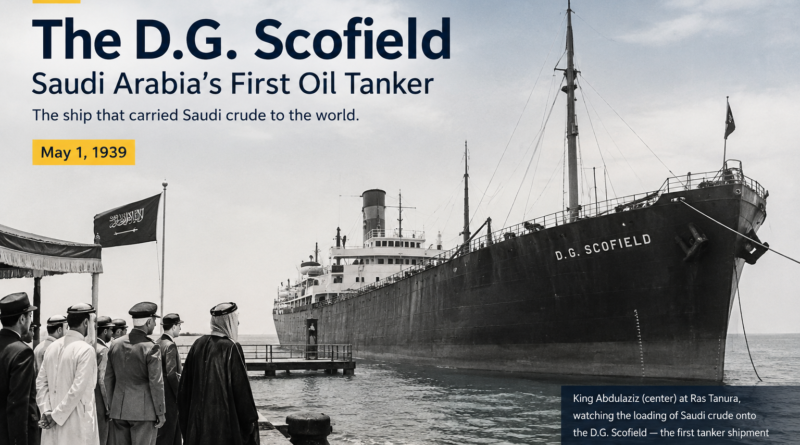
Saudi Arabia’s First oil Tanker: The Story of the D.G. Scofield
When people talk about Saudi Arabia’s oil story, they usually remember one thing: the discovery of crude oil.
But finding oil was only the beginning.
Saudi Arabia also had to answer a much bigger question:
How do you take oil from a desert oil field and send it to the rest of the world?
That question led to pipelines, ports and, eventually, oil tankers.
One ship became part of that early story.
Its name was D.G. Scofield.
The Story Started Before the Tanker
Saudi Arabia discovered commercial quantities of crude oil at Dammam Well No. 7 in 1938.
Oil began flowing from the well in March 1938 at a depth of about 1,440 meters.
The discovery changed the country’s future.
But there was a practical problem.
The oil was underground in the Eastern Province.
International customers were overseas.
Saudi Arabia needed a transportation system connecting the oil field with the sea.
That system began taking shape quickly.
The First Saudi Oil Shipment Was Not the D.G. Scofield
This is an important part of the history.
The first Saudi oil shipment actually left Al-Khobar Port in September 1938.
The oil was transported to Bahrain, where it was supplied to the BAPCO refinery.
So the first Saudi oil shipment and the first Saudi oil shipment loaded onto a tanker at Ras Tanura were two different events.
The next stage was much bigger.
Saudi Arabia needed a dedicated export route from the oil fields to a major Gulf port.
The Pipeline to Ras Tanura
A pipeline was built from the Dammam oil field to Ras Tanura.
The line was about 69 kilometers long.
It connected the oil-producing area with the port.
That simple connection was extremely important.
It meant crude oil could move from the field to the coast without having to be transported by trucks or other small-scale methods.
The chain was becoming:
Dammam oil field → pipeline → Ras Tanura → tanker → overseas market
And in 1939, the final part of that chain arrived.
Enter the D.G. Scofield
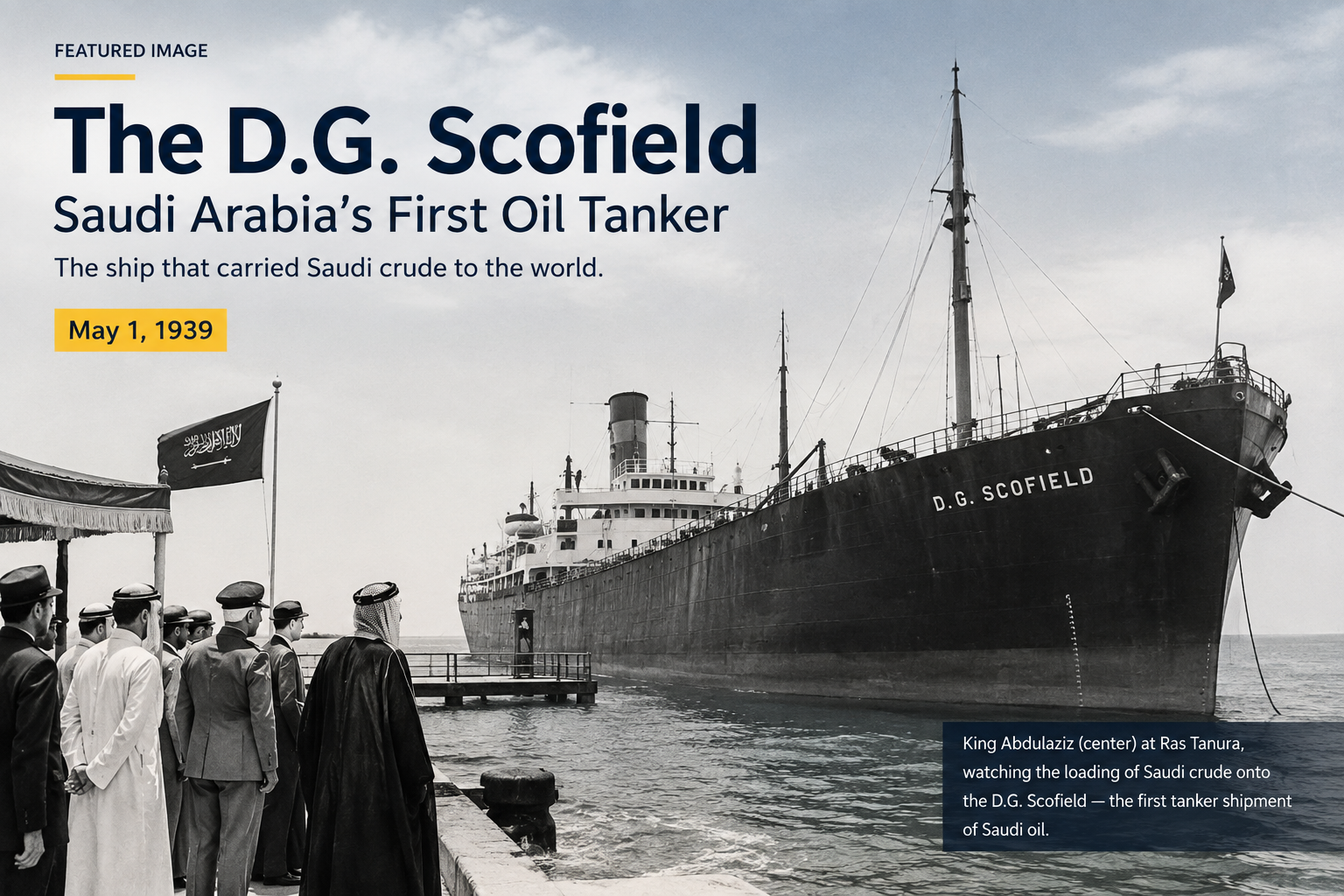
On May 1, 1939, the oil tanker D.G. Scofield arrived at Ras Tanura.
King Abdulaziz was present for the historic event.
He personally turned the valve that started the loading of Saudi crude into the tanker.
Saudi government historical records describe this as the first shipment of Saudi crude oil exported aboard a tanker.
It was a symbolic moment.
Oil had been found.
A pipeline had been built.
A port was ready.
And now a tanker was waiting to carry Saudi crude overseas.
Who Owned the Tanker?
The D.G. Scofield was not a Saudi national tanker in the modern sense.
Historical U.S. Maritime Administration records show the vessel associated with Standard Oil Company of California, commonly known as SoCal. The same records show a later transfer from Standard Oil Co. of California to the U.S. Maritime Commission in 1942.
This reflects the structure of the Saudi oil industry at the time.
Saudi Arabia had granted an oil concession to Standard Oil of California in 1933.
The company established the California Arabian Standard Oil Company, or CASOC, to conduct exploration and oil operations in Saudi Arabia.
The modern Saudi Aramco structure came much later.
So when the D.G. Scofield loaded Saudi crude in 1939, the oil operation was still part of an American-led concession system.
How Much Oil Could the Ship Carry?
The D.G. Scofield was an older American tanker.
U.S. Maritime Administration historical records list the ship at approximately 8,640 gross tons.
Historical vessel records also identify it as a tanker built in 1916.
A historical record gives its cargo capacity at about 81,224 barrels.
That is tiny compared with the giant crude tankers that would come to Ras Tanura decades later.
For perspective, a later supertanker could carry hundreds of thousands of barrels in a single voyage.
The difference shows how dramatically oil shipping changed.
What Was the Sea Route?
This is where the historical record needs to be handled carefully.
We know the documented starting point:
Ras Tanura, Saudi Arabia
The tanker loaded Saudi crude there.
But the available authoritative historical records do not clearly establish the complete nautical route of the D.G. Scofield’s first Saudi cargo.
So it would be wrong to invent a route and present it as fact.
What we can say with confidence is that the tanker was part of the new connection between Saudi oil production and the international oil market.
The port was on the Arabian Gulf.
From there, tankers could connect Saudi crude with international shipping routes.
That shipping network would become enormously important in the decades that followed.
How Many Pilots and Crew Members Were on Board?
This is another place where historical storytelling can easily go wrong.
There are records describing the people attending the 1939 ceremony, including Standard Oil of California officials.
But those people were not necessarily the ship’s crew.
The historical record available for the D.G. Scofield does not provide a reliable exact crew count for the May 1, 1939 Saudi loading.
So we should not simply say that the ship had a certain number of pilots or crew members without evidence.
What we do know is that the tanker required a professional maritime crew to operate the vessel, navigate the Gulf and handle the cargo.
The exact crew list for that historic voyage is a separate historical research question.
The Ceremony Was Bigger Than One Ship
The arrival of the D.G. Scofield was treated as a major event.
Historical Aramco material records a royal visit to Ras Tanura and describes company officials being entertained aboard the tanker.
King Abdulaziz personally turned the valve.
That image became a powerful symbol.
The valve connected the physical oil fields of Saudi Arabia with the international economy.
Before that moment, crude oil was mainly a resource beneath the ground.
After that moment, it was becoming an export business.
Then World War II Changed the Story
The timing was significant.
The D.G. Scofield loaded Saudi crude in May 1939.
A few months later, in September 1939, World War II began in Europe.
The war changed global shipping, energy markets and industrial supply chains.
Saudi Arabia’s young oil industry was also affected.
Exploration and development faced shortages of equipment, manpower and other resources.
Saudi historical records note that drilling activity was affected by the war.
The young Saudi oil industry therefore had to develop during a period of enormous global uncertainty.
Ras Tanura Became the Center of the Story
The D.G. Scofield was only the beginning.
Ras Tanura gradually became a major Saudi oil export center.
The infrastructure around the port expanded.
Pipelines brought crude from oil fields.
Storage facilities held crude before loading.
Tankers became larger.
Export operations became more sophisticated.
The port eventually became one of the most important oil-shipping locations in the world.
The Difference Between 1939 and Today
The scale of the change is difficult to imagine.
In 1939, one historic tanker arrived at Ras Tanura for the first tanker export of Saudi crude.
Decades later, much larger tankers would carry hundreds of thousands of barrels from the same general export system.
One historical Aramco account, for example, records the tanker Manhattan leaving Ras Tanura in 1962 with more than 718,000 barrels of crude oil, plus fuel oil.
That comparison tells the story better than almost any statistic.
D.G. Scofield represented the beginning.
The giant tankers represented the scale that came later.
What Did the D.G. Scofield Really Change?
The importance of the D.G. Scofield was not simply the amount of oil inside its tanks.
The bigger change was the system around it.
Saudi Arabia had created a complete export chain:
Oil field
↓
Pipeline
↓
Ras Tanura
↓
Tanker
↓
International market
That was the beginning of a new economic relationship between Saudi Arabia and the rest of the world.
From One Tanker to a Global Oil Business
The Saudi oil industry expanded rapidly after the early discoveries.
More fields were discovered.
Production increased.
More pipelines were built.
Ports expanded.
Refineries were developed.
And the tanker fleet serving Saudi crude became increasingly important.
Saudi Arabia was no longer simply a country with oil underground.
It was becoming a major participant in the global petroleum trade.
Why Tankers Matter to Oil Prices
There is another reason this history matters today.
Crude oil has to move.
A disruption to a major shipping route can affect how quickly oil reaches refineries.
That can affect freight costs, supply expectations and sometimes crude prices.
This is why modern oil markets pay attention to important maritime routes and chokepoints.
The connection is simple:
Oil underground is valuable.
But it becomes part of the global market only after it can be produced, transported and delivered to a buyer.
The D.G. Scofield Was the Beginning of a Much Bigger Story
The D.G. Scofield did not create Saudi Arabia’s oil industry by itself.
The discovery at Dammam No. 7 came first.
The pipeline came next.
The port was essential.
The tanker provided the connection to overseas markets.
And international buyers created the commercial market.
All of these pieces had to work together.
That is what made the 1939 event so important.
The Simple Story
If we explain the entire event in everyday language, it looks like this:
Saudi Arabia found commercial oil in 1938.
↓
The country needed a way to move that oil.
↓
A 69-kilometer pipeline connected the Dammam field with Ras Tanura.
↓
The D.G. Scofield arrived on May 1, 1939.
↓
King Abdulaziz opened the valve.
↓
Saudi crude was loaded onto the tanker.
↓
The oil entered the international tanker trade.
That was the beginning of Saudi Arabia’s modern crude-oil export story.
What Came Next?
The D.G. Scofield was only the first chapter.
Saudi Arabia would later build a much larger oil-export system.
Tankers became bigger.
Ports became more sophisticated.
Pipelines became longer.
Production increased.
And Ras Tanura became one of the world’s major oil-export hubs.
The story that began with one tanker eventually became a global energy network.
And that is why the D.G. Scofield matters.
It was not the biggest tanker.
It was not the most advanced tanker.
It did not carry the largest cargo.
But on May 1, 1939, it carried something historically important:
the first Saudi crude oil cargo exported by tanker from Ras Tanura.
That was the moment when Saudi oil began its journey from an underground resource toward the global market.
Sources and Historical Notes
This article uses Saudi government historical material, Saudi Aramco historical records and U.S. Maritime Administration vessel records. Where an exact crew number or complete first-voyage sea route could not be established from those records, no number or route has been presented as fact.
Next episode: From D.G. Scofield to supertankers — how Saudi Arabia built one of the world’s largest crude-oil shipping systems.
