
Wall Street Rebound: S&P 500, Dow, Nasdaq and Top Five U.S. Stocks on September 17, 2026
By NYFT Markets Desk
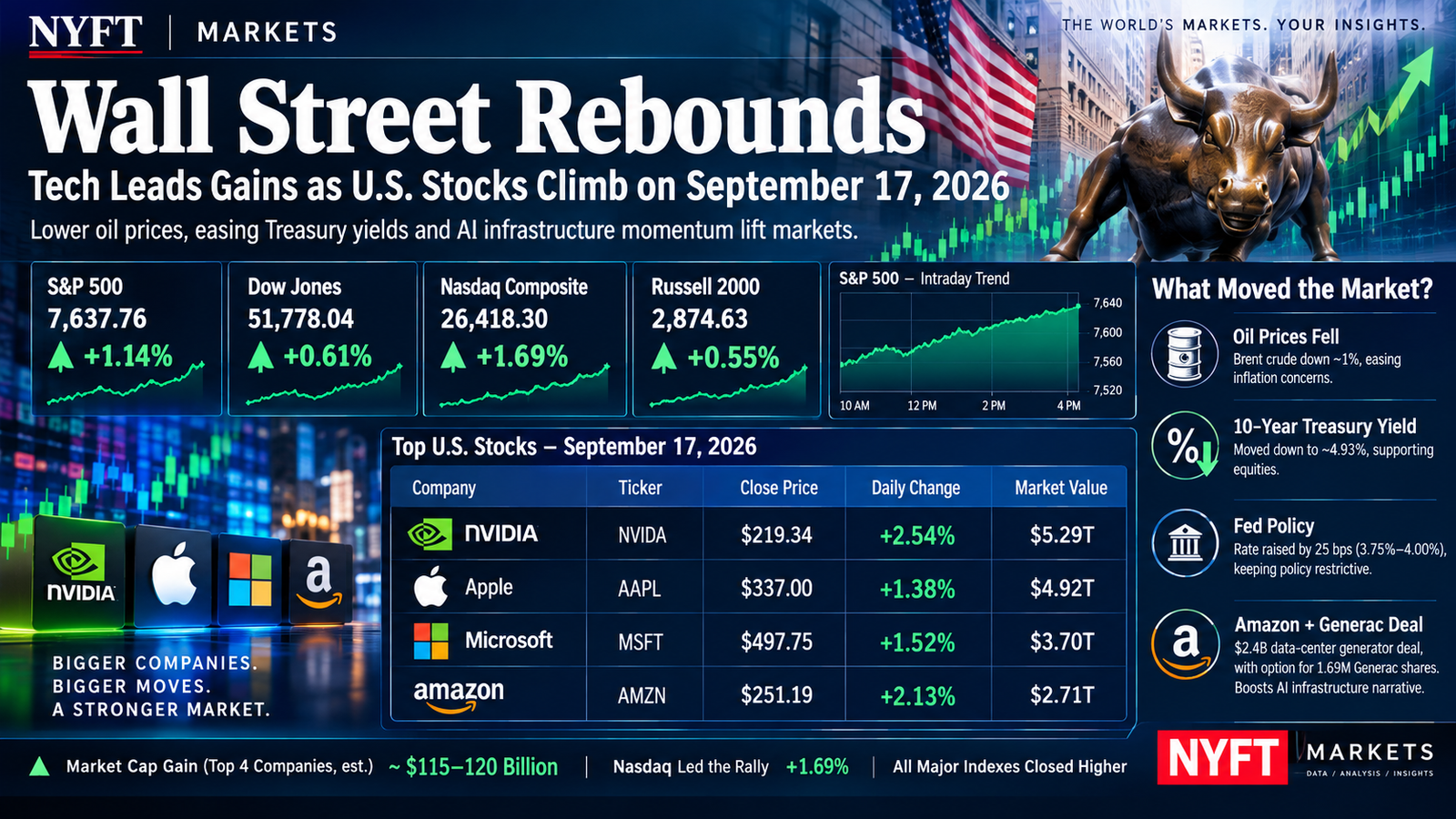
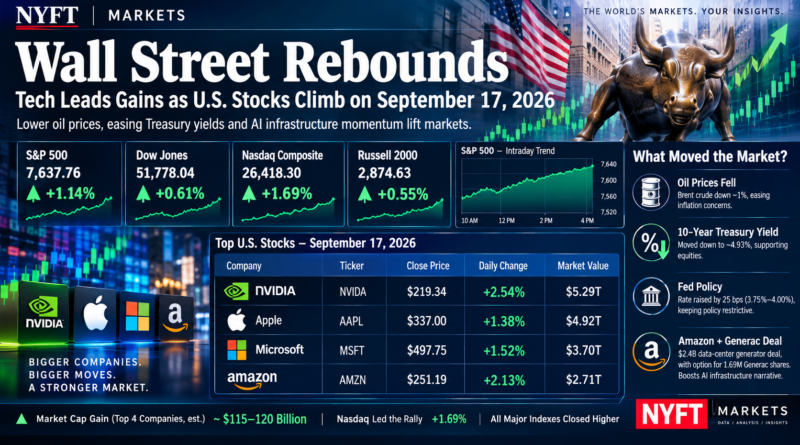
Wall Street staged a broad rebound on Thursday, September 17, 2026, as investors returned to technology and other large-cap stocks after the previous session’s selloff. The S&P 500 gained 1.14% to 7,637.76, the Dow Jones Industrial Average advanced 0.61% to 51,778.04, and the Nasdaq Composite jumped 1.69% to 26,418.30. The Russell 2000 also recovered, rising about 0.55%. The rally came as crude oil prices eased and the 10-year U.S. Treasury yield moved down toward 4.93%, reducing some of the immediate pressure on equity valuations.
U.S. Market Snapshot — September 17, 2026
| Market | Close | Daily Move | Direction |
|---|---|---|---|
| S&P 500 | 7,637.76 | +1.14% | ▲ Up |
| Dow Jones | 51,778.04 | +0.61% | ▲ Up |
| Nasdaq Composite | 26,418.30 | +1.69% | ▲ Up |
| Russell 2000 | 2,874.63 | +0.55% | ▲ Up |
The session was notable because all four major U.S. equity benchmarks finished higher. Technology-heavy Nasdaq stocks led the percentage gains, while the Dow posted a more moderate advance.
Trading-Style Market View
The chart shows the trading session clearly: Nasdaq led the rebound, followed by the S&P 500, while the Dow and Russell 2000 posted smaller gains.
The Five Mega-Cap Stocks in Focus
The market rebound was particularly important for the largest technology companies because their enormous market values mean relatively small percentage moves can translate into tens of billions of dollars of changing equity value.
1. NVIDIA — NVDA
NVIDIA closed at $219.34, up 2.54% on September 17. Historical market data put NVIDIA’s market capitalization at approximately $5.29 trillion at the close.
| NVIDIA | September 17 |
|---|---|
| Close | $219.34 |
| Daily change | +2.54% |
| Day high | $219.90 |
| Day low | $217.15 |
| Volume | ~94 million |
| Market value | ~$5.29T |
NVIDIA remained closely tied to the market’s continuing AI-investment story. Its 2.54% rise was larger than the S&P 500’s 1.14% gain, showing that semiconductor and AI-related shares participated strongly in the rebound.
2. Apple — AAPL
Apple closed at $337.00, gaining 1.38%. Its market capitalization was approximately $4.92 trillion at the September 17 close.
| Apple | September 17 |
|---|---|
| Close | $337.00 |
| Daily change | +1.38% |
| Day high | $338.34 |
| Day low | $330.18 |
| Volume | ~36.2 million |
| Market value | ~$4.92T |
Apple’s move was smaller than NVIDIA’s and the Nasdaq’s overall gain, but the company remained one of the largest sources of market capitalization in the U.S. equity market.
3. Microsoft — MSFT
Microsoft finished at $497.75, up 1.52%. Its market capitalization was approximately $3.70 trillion.
| Microsoft | September 17 |
|---|---|
| Close | $497.75 |
| Daily change | +1.52% |
| Day high | $501.47 |
| Day low | $493.17 |
| Volume | ~17.8 million |
| Market value | ~$3.70T |
Microsoft’s gain exceeded the S&P 500’s percentage advance, adding to the technology sector’s contribution to the day’s rebound.
4. Amazon — AMZN
Amazon was one of the day’s important company-specific stories. The stock closed at $251.19, gaining 2.13%. Its market capitalization was approximately $2.71 trillion.
| Amazon | September 17 |
|---|---|
| Close | $251.19 |
| Daily change | +2.13% |
| Day high | $252.73 |
| Day low | $249.24 |
| Volume | ~29.6 million |
| Market value | ~$2.71T |
Amazon’s move came as the company announced a major agreement with Generac to supply backup generators for Amazon’s data centers. The contracted value reported was $2.4 billion, while additional potential orders discussed by analysts could take the relationship substantially higher. The deal also included warrants giving Amazon rights to purchase Generac shares.
That news gave investors another angle on the AI infrastructure buildout: AI investment is not only about chips and software. Data centers also require electricity, backup power, cooling and physical infrastructure.
Five-Stock Trading Table
| Company | Ticker | Sept. 17 Close | Daily Move | Approx. Market Value |
|---|---|---|---|---|
| NVIDIA | NVDA | $219.34 | +2.54% | $5.29T |
| Apple | AAPL | $337.00 | +1.38% | $4.92T |
| Microsoft | MSFT | $497.75 | +1.52% | $3.70T |
| Amazon | AMZN | $251.19 | +2.13% | $2.71T |
Important: These four companies are the four names covered in the September 17 data reviewed for this article. If a strict “top five by market capitalization” ranking is required, Alphabet belongs in the comparison rather than treating the list above as a complete top-five ranking. Current market-cap rankings identify NVIDIA, Apple and Alphabet among the largest publicly traded companies, with Microsoft and Amazon also in the mega-cap group.
What Moved the Market Higher?
Oil Prices Came Down
Oil prices remained a major Wall Street variable. Brent crude declined by roughly 1% during the session, helping ease some immediate concerns about another energy-driven inflation shock. Reports also pointed to additional Saudi crude shipments and improving supply expectations.
For stock traders, the relationship is important:
Oil ↓ → Inflation pressure ↓ → Treasury-yield pressure ↓ → Growth-stock valuation pressure can ease
That is not a guaranteed one-for-one relationship, but it was an important part of the September 17 market narrative.
Treasury Yields Eased
The 10-year Treasury yield moved down to approximately 4.93%. Lower long-term yields can be supportive for equities because investors use Treasury yields as an important reference point when valuing stocks, particularly companies whose expected cash flows are further in the future.
The Federal Reserve Remained in Focus
The rebound occurred one day after the Federal Reserve raised its policy rate by 25 basis points, taking the target range to 3.75%–4.00%. Investors were therefore balancing two competing signals: monetary policy remained restrictive, but the decline in oil prices and Treasury yields offered some relief to equity markets.
Amazon Added an AI-Infrastructure Story
Amazon’s Generac agreement showed how the AI investment cycle is spreading beyond traditional semiconductor companies. Generac shares surged sharply after announcing the data-center generator agreement, while Amazon itself gained more than 2%.
The practical message for investors is straightforward: building AI data centers requires much more than GPUs. It requires power generation, grid connections, backup systems, cooling equipment, networking and real estate.
Up-and-Down Trading Picture
Market direction on September 17:
▲ NVIDIA +2.54%
▲ Amazon +2.13%
▲ Microsoft +1.52%
▲ Apple +1.38%
▲ S&P 500 +1.14%
▲ Dow Jones +0.61%
▲ Russell 2000 +0.55%
The Nasdaq Composite was the strongest major index, rising 1.69%. The session therefore had a distinctly technology-heavy character.
Market Value: What Does the Gain Actually Mean?
When NVIDIA’s market capitalization rises by billions of dollars or Amazon’s market capitalization rises by tens of billions, that does not mean the company earned that amount as accounting profit in one day.
Market capitalization is essentially:
Share price × shares outstanding = market capitalization
Therefore, when a stock rises, the quoted market value of the company’s outstanding equity also rises. This is a change in market valuation, not the same thing as cash profit generated by the company.
For example, Amazon moved from approximately $245.96 to $251.19, a gain of $5.23 per share, or 2.13%. Its market capitalization increased from roughly $2.65 trillion to about $2.71 trillion in the historical market data.
What Traders Were Watching Next
After the September 17 rebound, the key questions for U.S. equities included:
- Can oil prices remain below their recent highs?
- Will the 10-year Treasury yield stay below the 5% area?
- How will investors interpret the Federal Reserve’s new rate path?
- Can technology stocks maintain their rebound?
- Will AI infrastructure spending continue to support semiconductor and cloud companies?
- Will Amazon’s data-center investment translate into stronger AWS and AI-related growth?
- Can smaller companies and the Russell 2000 participate more strongly if financial conditions ease?
The answers to those questions could determine whether the September 17 move develops into a broader recovery or remains a one-session rebound.
Final Market Read
September 17 was a broad risk-on rebound session for U.S. equities. The S&P 500 gained 1.14%, the Dow added 0.61%, the Nasdaq jumped 1.69%, and the Russell 2000 rose about 0.55%. At the individual-stock level, NVIDIA gained 2.54%, Amazon 2.13%, Microsoft 1.52%, and Apple 1.38%.
The session brought together three major market themes: lower oil prices, easing Treasury yields and continued investment in AI infrastructure. Amazon’s Generac agreement added a company-specific example of how the AI buildout is expanding into the power and data-center infrastructure chain.
For everyday U.S. investors, the main lesson from the session was that market movements were being driven by several forces at once. A lower oil price can affect inflation expectations, Treasury yields can affect stock valuations, Federal Reserve policy can change the cost of money, and AI spending can influence the earnings expectations of the technology companies that dominate the major indexes.
September 17 therefore ended as a strong rebound day—but the next trading sessions remained important for determining whether the move could hold.
