
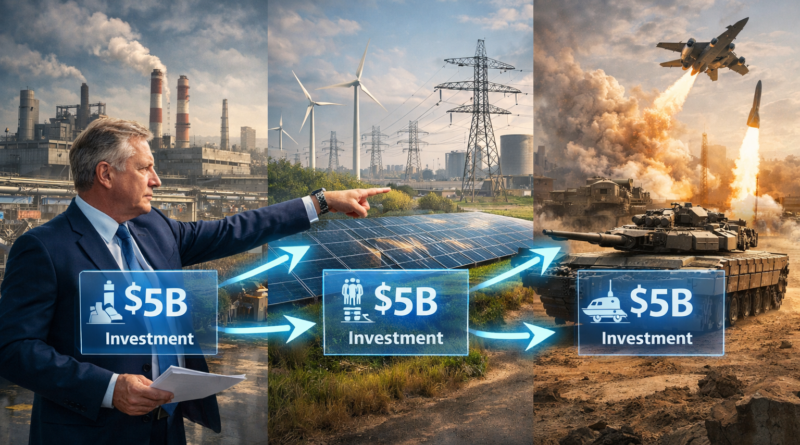
JPMorgan Chase Commits $5 Billion to Strategic U.S. Investments: Manufacturing, Energy Infrastructure, and National Security

Introduction: JPMorgan Chase Puts $5 Billion Behind America’s Strategic Industries
JPMorgan Chase is expanding its role in the future of the American economy through a multibillion-dollar investment strategy designed to strengthen industries considered essential to U.S. economic and national security.
On October 19, 2026, Reuters reported that JPMorgan Chase had invested $5 billion in equity in industries considered critical to the country’s economic and national security. The announcement forms part of the bank’s broader Security and Resiliency Initiative, a 10-year effort intended to facilitate, finance, and invest in approximately $1.5 trillion in U.S. investments across strategically important sectors. Reuters also reported that the initiative had financed approximately $230 billion since its launch a year earlier. Source: Reuters reporting published October 19, 2026.
The initiative reflects a growing recognition among financial institutions, manufacturers, policymakers, and corporate executives that economic strength depends on more than short-term profitability. It also depends on reliable supply chains, dependable energy, advanced manufacturing capabilities, access to critical materials, and the ability to produce essential technologies.
For the United States, these priorities have become increasingly important as companies face changing global trade relationships, technological competition, infrastructure constraints, and geopolitical uncertainty.
JPMorgan Chase’s strategy brings financial capital into this discussion. By making equity investments and supporting financing for strategically important businesses, the bank aims to help companies expand capacity, develop technology, and strengthen production networks.
The potential effects extend across multiple industries, including industrial manufacturing, energy, defense and aerospace, advanced computing, critical minerals, pharmaceuticals, and health technology.
However, understanding the announcement requires looking beyond the headline figure. The $5 billion equity investment is one component of a broader initiative, not the same thing as $5 billion in government spending or a guarantee that every targeted business will succeed. The wider $1.5 trillion figure represents the initiative’s intended scale of facilitated, financed, and invested activity over a decade, rather than a single cash payment.
For American businesses and investors, the most important question is how this capital can translate into productive capacity, stronger supply chains, sustainable jobs, and measurable economic returns.
What Is JPMorgan Chase’s $5 Billion Strategic Investment?
JPMorgan Chase’s reported $5 billion in equity investments is part of its Security and Resiliency Initiative, launched in October 2025.
According to the bank’s official announcement, the initiative was established to support industries critical to American economic security and resilience. Its original framework included up to $10 billion in direct equity and venture capital investments, alongside a broader plan to facilitate, finance, and invest in $1.5 trillion of activity over 10 years. Source: JPMorgan Chase’s official announcement.
The program focuses on businesses and projects that can help strengthen American industrial capabilities, improve infrastructure, and reduce vulnerabilities in essential supply networks.
The strategy includes several different forms of financial support. These can include direct equity investments, venture capital, corporate lending, project financing, investment banking services, and assistance with major transactions.
These forms of support serve different purposes.
An equity investment gives the investor an ownership interest in a company. Lending provides capital that generally must be repaid according to agreed terms. Project financing supports a specific asset or development, while investment banking services may help companies raise money, complete acquisitions, or structure transactions.
The distinction matters because each type of financing has different implications for company ownership, risk, repayment obligations, and potential financial returns.
Why equity investment matters
Equity capital can be particularly important for businesses that need to expand production capacity before generating substantial additional revenue.
Building a manufacturing facility, developing a new industrial technology, expanding a mining operation, or commercializing a new energy-storage system can require significant spending long before a project becomes profitable.
Traditional loans can be difficult for companies to obtain when cash flows are uncertain or the project requires a lengthy development period.
Equity investment can help bridge that gap by providing capital in exchange for an ownership stake rather than imposing the same fixed repayment obligations as conventional debt.
This structure can be useful for companies developing strategic technologies, although equity investors still face the possibility of losses if a business underperforms.
Why JPMorgan is focusing on strategic industries
The initiative reflects the bank’s assessment that supply-chain security and domestic industrial capabilities have become important economic priorities.
For years, businesses have optimized production networks around costs, specialization, and access to international markets. Global supply chains have enabled lower-cost production and greater access to specialized components.
However, a highly efficient supply chain can also become vulnerable when production is concentrated in a small number of locations.
A disruption affecting a critical component can interrupt manufacturing far beyond the original supplier. Restrictions on the export of essential materials can delay projects. Energy shortages can increase operating costs and reduce industrial output.
The strategic investment program aims to support businesses that can help address some of these vulnerabilities while creating opportunities for commercial growth.
The $1.5 Trillion Security and Resiliency Initiative Explained
The $5 billion equity investment should be understood in the context of JPMorgan Chase’s larger 10-year program.
The bank announced its Security and Resiliency Initiative on October 13, 2025, with the objective of facilitating, financing, and investing in $1.5 trillion of activity in industries considered essential to U.S. economic security and resilience. Its original announcement also outlined up to $10 billion in direct equity and venture capital investments. Source: JPMorgan Chase.
The initiative covers companies at different stages of development and includes support for projects that may require substantial financing, technical expertise, and long-term commercial relationships.
The bank’s broader role is important because major industrial investments often require several forms of capital.
For example, a company developing a domestic critical-mineral processing facility may need equity to establish its business, debt to construct the facility, contracts with customers, specialized equipment financing, and assistance managing commodity-price risk.
A financial institution that can provide several of these services may help a company coordinate the different elements of a complicated investment.
Understanding the difference between $5 billion and $1.5 trillion
The two figures describe different aspects of the strategy.
The $5 billion figure refers to reported equity investments in strategic industries as of the October 19, 2026, announcement.
The $1.5 trillion figure refers to the larger initiative’s intended scale over a 10-year period. It encompasses activities that can include facilitating, financing, and investing in projects.
These figures should not be added together as if they represent two separate cash contributions to the same projects.
Nor should the $1.5 trillion target be interpreted as a guarantee that JPMorgan Chase will spend that entire amount directly from its own equity capital.
For readers evaluating the program, this distinction is central to understanding its economic significance.
How the initiative could influence private-sector investment
Large industrial projects frequently involve multiple lenders, investors, suppliers, and customers.
When a major financial institution supports a project, its involvement can help organize additional financing or demonstrate that the project has undergone a formal commercial assessment.
This may make it easier for some businesses to attract other investors or enter financing discussions.
However, a bank’s participation does not guarantee that additional capital will follow. Each project still depends on its financial outlook, risks, regulatory requirements, and market conditions.
The program’s long-term effect will therefore depend on the quality of its investments and the extent to which the financing helps create productive assets that would otherwise have been delayed, reduced, or abandoned.
Five Industries at the Center of JPMorgan Chase’s Strategy
JPMorgan Chase identifies five broad areas of focus for the Security and Resiliency Initiative.
These are supply chain and advanced manufacturing; defense and aerospace; energy independence and resilience; frontier and strategic technologies; and pharmaceuticals and health technology.
The categories cover a wide range of businesses, from industrial materials suppliers and shipbuilders to energy-storage developers, cybersecurity companies, and pharmaceutical manufacturers. Source: JPMorgan Chase’s initiative overview.
1. Supply chain and advanced manufacturing
Manufacturing remains essential to the American economy because it produces the equipment, components, materials, and finished products used throughout industry.
Advanced manufacturing includes technologies and production methods that can improve precision, efficiency, quality control, and production flexibility.
Examples include industrial robotics, automated assembly, advanced materials, semiconductor-related manufacturing, and specialized production equipment.
The initiative also identifies critical minerals, microelectronics materials, shipbuilding and repair, and autonomous mobile robots as areas of interest.
These industries can help strengthen domestic production networks and support the development of other strategic sectors.
2. Defense and aerospace
Defense and aerospace businesses manufacture equipment and develop technologies used in national defense, communications, aviation, and space systems.
The sector includes specialized components, secure communications, autonomous systems, drones, spacecraft, and advanced defense technologies.
Many defense-related supply chains depend on highly specialized suppliers. If a critical component becomes unavailable, replacing it can require qualification testing, new manufacturing processes, and regulatory approval.
Investment in domestic production may help improve supply availability, although the benefits depend on whether companies can produce components at competitive prices and meet strict performance requirements.
3. Energy independence and resilience
Reliable energy is fundamental to modern manufacturing, transportation, communications, and computing.
The initiative includes energy technologies such as battery storage, grid resilience, nuclear energy, solar power, wind power, liquefied natural gas, and geothermal energy.
The emphasis on energy resilience reflects the growing need to supply electricity to industrial facilities, data centers, and expanding digital infrastructure.
Energy projects can be capital intensive, requiring equipment, construction, permits, interconnection agreements, and long-term customer commitments.
Financial support can help advance projects, but actual deployment depends on engineering, regulation, construction schedules, and the economics of energy production.
4. Frontier and strategic technologies
Advanced technologies can influence both economic competitiveness and national security.
This category includes artificial intelligence, cybersecurity, quantum computing, edge computing, and sensor hardware.
These technologies support applications across industries, including industrial automation, secure communications, logistics, research, healthcare, and financial services.
The challenge for investors is to distinguish technologies with a clear commercial market from projects that remain highly speculative.
Businesses in emerging fields may have substantial growth opportunities, but they can also face uncertain demand, rapid technological change, and strong competition.
5. Pharmaceuticals and health technology
Healthcare supply chains are another important element of economic resilience.
Pharmaceutical manufacturing, essential medicines, vaccines, medical devices, biotechnology, and patient-care infrastructure can all affect the ability of the United States to respond to health emergencies and maintain access to essential products.
Manufacturing capacity is only one part of healthcare resilience. Quality assurance, regulatory approval, specialized materials, cold-chain logistics, and distribution systems are also important.
Investment in domestic capacity may reduce certain supply risks, but it must be supported by commercially viable production and reliable procurement.
Domestic Manufacturing: Can Strategic Capital Help Rebuild American Industrial Capacity?
Domestic manufacturing is one of the clearest areas in which JPMorgan Chase’s initiative could have long-term implications.
American manufacturers operate in a competitive global environment. They must manage labor costs, energy prices, equipment spending, logistics, supplier availability, and changing customer demand.
Building a new production facility is rarely a simple matter of obtaining financing.
Companies must identify a viable location, secure land, purchase machinery, recruit workers, establish supplier relationships, obtain permits, and develop a reliable customer base.
In some industries, they must also spend years qualifying products before customers can use them in safety-critical applications.
Capital can help overcome one of these obstacles, but it cannot eliminate all of them.
The economics of building factories in the United States
Domestic manufacturing can offer several advantages.
Producing closer to customers may shorten delivery times, reduce certain transportation risks, and improve coordination between design and production teams.
Local manufacturing may also make it easier to protect proprietary processes, respond quickly to customer requirements, and maintain quality control.
For strategic products, domestic production can reduce exposure to certain international disruptions.
However, the financial case varies by industry.
A factory in the United States may face higher labor or construction costs than a comparable facility in another country. Energy prices, local infrastructure, workforce availability, and environmental requirements can also affect operating expenses.
Companies must therefore assess whether the benefits of domestic production justify the additional costs.
Automation could improve manufacturing competitiveness
Automation is an important part of the modern manufacturing equation.
Industrial robots, machine vision, automated inspection, and digital production systems can improve consistency and help companies manage repetitive tasks.
Automation can also reduce some forms of production waste and support more flexible manufacturing operations.
However, automation requires capital spending, maintenance, technical expertise, and workforce training.
The most successful implementations are generally those that address clearly defined production problems rather than adopting technology simply because it is available.
Small and midsize manufacturers need access to capital
Large corporations often have access to multiple financing options, established banking relationships, and substantial cash reserves.
Smaller manufacturers may have fewer alternatives.
A midsize supplier seeking to expand production may need financing for machinery, a new facility, working capital, and customer-specific equipment.
Strategic investment can potentially help businesses in these situations expand their capacity or modernize operations.
The practical outcome will depend on which companies receive funding, the terms of that funding, and whether the investments support sustainable customer demand.
What success would look like
The strongest evidence of success would be measurable improvements in industrial output, production efficiency, delivery reliability, and the commercial performance of supported businesses.
Other useful indicators would include the number of facilities completed, the amount of productive equipment installed, supplier diversification, and the share of critical components available from reliable domestic sources.
Announcements about investment commitments are useful indicators of intent, but completed projects and operating results provide stronger evidence of economic impact.
Energy Infrastructure: The Foundation of American Economic Resilience
Energy infrastructure is central to the investment strategy because virtually every major industrial activity depends on reliable and affordable power.
Factories need electricity to operate machinery. Data centers need continuous power for computing and cooling. Hospitals require dependable energy for critical equipment. Transportation networks depend on fuels and electricity.
When power systems become constrained, the consequences can extend across entire regions.
JPMorgan Chase has highlighted the relationship between energy availability, industrial competitiveness, artificial intelligence, and national resilience in its own industry analysis. Source: JPMorgan Chase, America’s Strategic Edge in an Evolving Energy Landscape.
Modernizing the electric grid
The U.S. electric grid includes generation facilities, transmission lines, substations, distribution networks, and systems that balance electricity supply and demand.
Many new industrial facilities require dependable electricity connections, and some projects cannot proceed until grid infrastructure is upgraded.
Grid modernization can include replacing aging equipment, improving monitoring systems, expanding transmission capacity, and strengthening resilience against extreme weather or equipment failures.
These projects can require lengthy planning and substantial capital investment.
Financial support can help fund eligible projects, but construction timelines depend on engineering, permits, equipment availability, and coordination among utilities and regulators.
Energy storage and distributed power
Battery storage can help balance electricity supply and demand by storing energy for later use.
Depending on the system and its design, storage can support grid stability, manage periods of peak demand, and improve the reliability of certain energy installations.
Distributed energy systems can also provide power closer to the facilities that use it.
For industrial customers, data centers, and other large electricity users, the appropriate combination of grid electricity, onsite generation, storage, and backup capacity depends on local conditions and project economics.
No single technology is suitable for every application.
Natural gas, nuclear power, renewables, and other sources
A resilient energy system may involve several sources of energy.
Natural gas can provide dispatchable power in many systems. Nuclear power can deliver large quantities of low-carbon electricity, although projects often require substantial capital and long development periods. Solar and wind power can expand electricity generation without fuel combustion, but their output varies with weather conditions. Geothermal energy can offer dependable power in suitable locations.
Energy-storage systems, transmission upgrades, and flexible demand can help integrate different sources.
The commercial and environmental characteristics of each option differ. Investment decisions should reflect local resources, customer requirements, costs, regulatory conditions, and long-term operating needs.
Data centers are increasing the importance of energy planning
Artificial intelligence and cloud computing require significant computing infrastructure.
Large data centers need servers, networking equipment, cooling systems, and reliable electricity supplies. As operators expand capacity, access to power can become a major factor in choosing where to build.
Energy planning is therefore increasingly connected to technology investment and industrial development.
JPMorgan Chase has discussed financing solutions intended to support energy capacity for data centers and strengthen power-system resilience. Source: JPMorgan Chase energy analysis.
For U.S. businesses, the important issue is whether new electricity infrastructure can be delivered at a cost and speed that support economic growth without creating unnecessary reliability or affordability problems.
Supply Chain Resilience: Reducing Vulnerability Without Abandoning Global Trade
Supply-chain resilience has become a major consideration for businesses operating across international markets.
For decades, companies have developed global production networks to take advantage of specialized suppliers, lower costs, and access to customers.
International trade continues to offer significant economic benefits. However, concentrated sourcing can create vulnerabilities when an essential product comes from only a small number of suppliers or geographic locations.
The challenge is not necessarily to eliminate international trade. It is to reduce the risk that a disruption in one place will stop production elsewhere.
Why concentrated supply chains can be risky
A manufacturer may depend on a specialized chemical, electronic component, industrial material, or machine part that is difficult to replace.
If the supplier experiences a production outage, the manufacturer may be unable to complete its own products even if most other materials remain available.
The same problem can affect entire industries when a critical input is produced by only a few companies worldwide.
Building alternative suppliers can reduce this vulnerability, but it can also increase costs.
Businesses must balance efficiency against resilience according to the importance of the product, the availability of substitutes, and the potential financial consequences of disruption.
Domestic suppliers can improve flexibility
A larger domestic supplier base may shorten some shipping routes and improve communication between manufacturers and their customers.
It can also support the development of specialized industrial knowledge and provide additional sourcing options.
However, a domestic supplier is not automatically more reliable than a foreign supplier. Local factories can also experience equipment failures, labor shortages, natural disasters, or financial difficulties.
The strongest supply chains combine appropriate geographic diversification, adequate inventories, reliable supplier relationships, and realistic contingency plans.
Critical minerals are a strategic concern
Critical minerals are used in electronics, batteries, industrial equipment, advanced manufacturing, energy technologies, and defense systems.
Mining and processing these materials can be technically complex. Projects may require extensive geological work, environmental review, infrastructure, specialized equipment, and long-term customer agreements.
The United States may have domestic mineral resources but still depend on overseas suppliers for certain processing stages or specialized materials.
Developing domestic capacity can help diversify supply, but it requires careful assessment of project economics and environmental impacts.
Why processing matters as much as mining
Extracting a mineral does not necessarily mean that a country can immediately use it in advanced manufacturing.
Many materials must undergo additional processing, refining, purification, or chemical conversion before they meet industrial specifications.
These stages can be capital intensive and may involve specialized expertise.
Investment that supports both extraction and processing can therefore be important to building a more complete domestic supply chain.
The long-term commercial viability of these projects depends on production costs, customer demand, commodity prices, environmental compliance, and access to technology.
National Security and Economic Security Are Increasingly Connected
National security is often associated with military capabilities, defense equipment, and the protection of sensitive information.
Economic security has a broader scope. It includes access to essential goods, reliable infrastructure, industrial capacity, technological capabilities, and the ability to maintain critical services during a disruption.
The two areas increasingly overlap.
A country that depends on a limited number of foreign suppliers for essential defense components may face production delays during a crisis. A shortage of specialized electronics can affect communications systems, industrial equipment, and advanced weapons.
A disruption in pharmaceutical supplies can create public-health challenges. A shortage of critical materials can delay infrastructure projects.
These connections help explain why financial institutions are directing attention toward industries that may previously have been evaluated primarily through conventional commercial criteria.
Defense technology and industrial capacity
Modern defense systems depend on advanced electronics, communications, software, sensors, aerospace components, and specialized materials.
Maintaining reliable access to these inputs requires a broad network of suppliers.
Domestic production can support availability, but it must also meet technical standards, security requirements, and cost constraints.
Many defense-related projects depend on government procurement processes and long-term contracts. These arrangements can provide demand visibility, but they also involve complex requirements and potential delays.
Investors should evaluate a defense technology business according to its customers, contracts, production capabilities, and financial performance rather than assuming that national security relevance automatically ensures commercial success.
Cybersecurity is also part of resilience
Economic security extends beyond physical factories and infrastructure.
Banks, manufacturers, utilities, hospitals, and government agencies depend on digital systems to manage information and operations.
Cyberattacks can disrupt production, expose sensitive data, and interfere with essential services.
Cybersecurity companies develop technologies intended to identify threats, protect systems, and support incident response.
Investment in this field may contribute to resilience, but technology alone cannot eliminate cyber risk. Organizations also need effective governance, staff training, system maintenance, and recovery plans.
The importance of trusted suppliers
For some strategically sensitive products, buyers need confidence in the origin, integrity, and security of components.
This can influence supplier selection even when a lower-cost alternative is available elsewhere.
However, creating a reliable supplier network takes time. Businesses may need to qualify new suppliers, test products, establish quality-control procedures, and develop contractual relationships.
Capital can support expansion, but the process also requires technical expertise and dependable demand.
Pharmaceuticals and Health Technology: Building a More Reliable Medical Supply Chain
Healthcare resilience is another important part of the initiative.
The ability to manufacture medicines, vaccines, medical devices, and essential supplies can affect the reliability of healthcare delivery.
Domestic manufacturing may reduce exposure to certain international disruptions, particularly when essential products depend on a concentrated supplier base.
However, pharmaceutical manufacturing is subject to strict quality and regulatory requirements.
A facility cannot simply begin producing an approved medicine because financing is available. It must satisfy applicable manufacturing standards, validation requirements, and regulatory obligations.
Why essential medicines matter
Hospitals and pharmacies depend on a continuous supply of medicines and medical products.
Shortages can arise from manufacturing problems, ingredient shortages, unexpected demand, regulatory issues, or logistical disruptions.
For some products, establishing a replacement supplier can be difficult because production requires specialized equipment and validated processes.
Expanding reliable production capacity can help diversify supply, although the economic incentives for manufacturers vary considerably across products.
Medical devices and advanced manufacturing
Medical devices range from simple supplies to complex diagnostic systems, surgical equipment, and specialized monitoring technology.
Manufacturers must meet appropriate safety and quality requirements and maintain reliable access to components.
Advanced manufacturing methods can help improve production precision and quality control.
The opportunity for investment includes not only final products but also specialized components, testing equipment, manufacturing systems, and supply-chain infrastructure.
The challenge of balancing resilience and cost
Domestic production may provide strategic advantages, but higher manufacturing costs can affect product prices.
Healthcare providers, insurers, government programs, and patients are sensitive to cost.
A sustainable approach must therefore balance reliable supply with affordability, product quality, and commercial viability.
The long-term outcome will depend on whether manufacturers can maintain adequate capacity while competing effectively in the healthcare market.
How JPMorgan Chase’s Investments Could Affect American Jobs
Industrial investment can support employment in several ways.
A new factory may hire construction workers during development, production employees after opening, and engineers or technicians to maintain specialized equipment.
It may also generate demand for suppliers, transportation services, maintenance contractors, and other businesses in the surrounding region.
However, employment outcomes vary by industry and project design.
Highly automated facilities may produce significant industrial output without employing as many workers as older manufacturing models. Other projects, particularly those requiring extensive construction or complex production processes, may create substantial demand for specialized labor.
Direct employment
Direct jobs are positions created by the business receiving investment.
These can include manufacturing operators, engineers, technicians, managers, logistics personnel, and quality-control specialists.
The number of positions depends on the project’s scale, technology, production schedule, and operating model.
Indirect employment
Indirect jobs can arise at suppliers and service providers that support the project.
A factory may purchase industrial components, electricity, equipment maintenance, packaging, transportation, and professional services.
These purchases can support employment beyond the factory itself.
However, estimates of indirect employment depend on assumptions about local purchasing, industry relationships, and the wider economy.
They should not be presented as guaranteed job counts without a clearly explained methodology.
Workforce training
Modern manufacturing and infrastructure projects often require specialized technical skills.
Employers may need workers who can operate automated machinery, maintain electrical systems, analyze production data, manage cybersecurity, or work with advanced materials.
Training programs, apprenticeships, community colleges, and partnerships with technical institutions can help businesses find and develop qualified employees.
Capital investment alone will not resolve every workforce challenge.
The long-term success of industrial expansion depends partly on whether employers can recruit, train, and retain the people required to operate new facilities.
What the Investment Could Mean for Small Businesses
Small businesses play a significant role in industrial supply chains.
Many specialized manufacturers, equipment providers, engineering firms, maintenance companies, and logistics operators are smaller enterprises.
When a large factory expands, its suppliers may need to invest in equipment, improve production quality, hire staff, or increase working capital.
These requirements can create opportunities, but they can also put pressure on smaller firms.
Access to working capital
A supplier may receive a large order but need to purchase materials and pay workers before receiving payment from its customer.
Working-capital financing can help bridge the gap.
However, financing terms matter. Businesses must consider interest expenses, repayment schedules, customer concentration, and the possibility that orders may be delayed or canceled.
Supplier development
Large manufacturers sometimes help suppliers improve quality control, production planning, and delivery reliability.
These relationships can help smaller businesses become more competitive.
Investment in supplier development may therefore produce benefits beyond the initial company receiving equity capital.
Risks for smaller companies
Smaller suppliers can be vulnerable to changes in customer demand.
A company that invests heavily to serve one large customer may face financial difficulties if that customer’s project is delayed.
Business owners should evaluate contracts, maintain appropriate liquidity, and avoid assuming that a strategic investment announcement guarantees future orders.
What Investors Should Understand About JPMorgan Chase’s Strategy
JPMorgan Chase’s initiative may attract attention from investors interested in industrial development, defense, energy, infrastructure, and advanced technology.
However, the announcement should not be interpreted as a simple prediction about the performance of any particular stock.
A corporate strategic investment program can affect financial results in different ways depending on the structure and performance of its transactions.
Equity investments carry risk
When a bank invests directly in a company, the value of that investment can rise or fall.
A company may perform well and increase in value, or it may experience losses, face competition, fail to meet technical objectives, or require additional capital.
Private-company investments may also be less liquid than publicly traded securities.
Investors should not assume that every strategic investment will produce a positive return.
Financing activity is different from direct ownership
A bank may earn fees or interest from financing a project without owning the underlying business.
Direct equity investment creates a different financial exposure because returns depend partly on the value of the ownership stake.
These distinctions affect how a strategic program can influence the bank’s earnings, capital allocation, and risk profile.
Long-term investment horizons matter
Industrial projects can take years to develop.
Mining operations require exploration and permitting. Manufacturing facilities need construction and equipment installation. Energy infrastructure often involves complex approval and interconnection processes.
Financial results may therefore emerge gradually.
Investors evaluating the program should focus on completed transactions, disclosed investment amounts, project progress, and financial performance rather than relying only on headline announcements.
What to monitor in future disclosures
Useful indicators include:
- The amount of equity capital actually invested.
- The sectors and businesses receiving investments.
- The terms and expected duration of individual investments.
- The scale of financing facilitated through the initiative.
- Evidence of completed projects and expanded production.
- The financial performance and risk characteristics of investments.
- Any material disclosures about losses, impairments, or exits.
These measures can help readers understand the difference between the program’s stated objectives and its realized outcomes.
The Competitive Landscape: Why Other Financial Institutions May Follow Similar Strategies
JPMorgan Chase is not operating in isolation.
Financial institutions have long financed infrastructure, energy, manufacturing, defense-related businesses, and large corporate projects.
The renewed emphasis on economic resilience places additional attention on the relationship between finance, national priorities, and private-sector investment.
Large banks can provide lending, underwriting, advisory services, transaction management, and access to capital markets.
Their scale can be useful when projects require multiple financing arrangements or involve complex corporate structures.
However, each institution has its own risk limits, strategic priorities, and investment criteria.
Why banks are interested in strategic industries
Several commercial factors can support this activity.
Industrial companies need financing to expand production. Energy developers require capital for infrastructure. Technology businesses need funding to commercialize products. Governments and large corporate customers may seek more resilient supplier networks.
Banks can generate business by helping these companies finance projects and manage transactions.
Strategic investment programs can also create opportunities for financial institutions to build relationships with growing companies.
Why competing banks may respond differently
Some institutions may emphasize lending and advisory services, while others may make direct equity investments or focus on particular industries.
The appropriate approach depends on the institution’s capital, risk tolerance, expertise, and commercial objectives.
A large equity commitment does not automatically mean that one bank will outperform competitors.
The effectiveness of these programs depends on the quality of the opportunities identified and the financial discipline applied to each transaction.
Potential Benefits for the Broader U.S. Economy
The broader economic implications of the initiative depend on how effectively financing translates into productive activity.
Potential benefits include stronger industrial capacity, more diversified supply chains, improved infrastructure, technological innovation, and expanded business opportunities.
These outcomes are possible rather than guaranteed.
Higher productive capacity
When companies build factories, modernize equipment, or expand energy infrastructure, they may increase the amount of goods and services the economy can produce.
Additional capacity can support industrial growth and reduce certain bottlenecks.
The benefit depends on whether the new assets are used efficiently and whether demand exists for their output.
Greater supply-chain flexibility
A wider network of qualified suppliers can reduce reliance on a single source for critical components.
Businesses may also benefit from better logistics, additional inventories, and more flexible sourcing arrangements.
These measures can make production systems more resilient, although maintaining alternative suppliers may increase operating costs.
Innovation and technology adoption
Investment can help companies develop new products and bring technologies to market.
Manufacturing automation, advanced materials, energy storage, cybersecurity, and artificial intelligence all have potential applications across industries.
Commercial success depends on whether the technologies solve real problems and can be delivered at competitive costs.
Regional economic development
Industrial projects can support local economies through construction, employment, supplier purchases, and infrastructure improvements.
The effects vary according to project location and the extent to which local businesses and workers participate.
A complete evaluation should also consider public infrastructure costs, environmental impacts, and the long-term financial sustainability of the project.
Challenges That Could Limit the Program’s Impact
The initiative operates in an environment where major industrial projects face significant obstacles.
Access to financing is important, but it is only one part of the investment process.
Permitting and regulatory delays
Industrial facilities, mines, power plants, and major infrastructure projects may require multiple approvals.
The time required can affect project costs, construction schedules, and expected returns.
Even a fully financed project may be delayed if permits, environmental reviews, or grid connections are not completed on schedule.
Construction and equipment costs
Large projects can experience cost overruns because of labor shortages, equipment delays, material-price changes, or engineering challenges.
Higher construction costs may reduce a project’s financial attractiveness.
Companies need realistic budgets, contingency planning, and appropriate project management.
Skilled labor shortages
Advanced manufacturing and infrastructure projects require workers with specialized skills.
When several projects compete for the same technicians, engineers, electricians, and construction workers, hiring costs may increase.
Training can help address these shortages, but workforce development takes time.
Competition from established global producers
American manufacturers may compete with foreign producers that benefit from established supply chains, larger production volumes, or lower operating costs.
Domestic production can still make sense for strategic products, but companies must develop a sustainable commercial model.
Long-term success depends on productivity, quality, customer demand, and effective cost management.
Uncertain demand
Some strategic technologies have rapidly growing markets, while others remain commercially uncertain.
A company may build production capacity in anticipation of future demand that develops more slowly than expected.
Investors must assess the difference between a compelling strategic objective and a financially viable business.
How to Measure Whether the $5 Billion Investment Is Working
Evaluating the initiative requires more than tracking the headline amount of capital invested.
A useful assessment would consider both financial performance and real-world economic outcomes.
Investment deployment
The first question is how much capital has actually been invested and where it has gone.
Public disclosures about transactions, investment structures, and participating companies can help readers understand the program’s progress.
Project completion
A financing announcement is not the same as a completed project.
Relevant milestones include construction completion, equipment installation, regulatory approval, commercial production, and the beginning of customer deliveries.
Industrial output
Where data are available, analysts can evaluate whether supported businesses increase production, improve capacity utilization, or shorten delivery times.
These measures provide evidence of whether financing is translating into operational improvements.
Supply-chain diversification
Another measure is whether businesses have developed additional qualified suppliers or reduced dependence on a concentrated source of critical inputs.
Diversification is difficult to measure with one indicator, but company disclosures and industry data can provide useful information.
Financial performance
For the bank and the companies involved, investment returns, cash generation, debt levels, and operating performance are important.
An initiative can support a strategically relevant industry while still containing individual investments that underperform.
The appropriate assessment should recognize both the public-interest objectives and the financial risks.
Frequently Asked Questions
What is JPMorgan Chase’s $5 billion investment?
Reuters reported on October 19, 2026, that JPMorgan Chase had invested $5 billion in equity in industries considered critical to U.S. economic and national security. The investment forms part of the bank’s broader Security and Resiliency Initiative.
What is the Security and Resiliency Initiative?
It is JPMorgan Chase’s 10-year program to facilitate, finance, and invest in approximately $1.5 trillion in activity across industries considered important to American economic security and resilience. The bank originally announced the initiative in October 2025.
Is the $1.5 trillion a direct cash investment by JPMorgan?
No. The initiative encompasses a broader range of activities, including facilitating, financing, and investing in projects. The figure should not be interpreted as a single direct equity contribution or a government spending commitment.
Which industries are included?
The initiative focuses on supply chain and advanced manufacturing, defense and aerospace, energy independence and resilience, frontier and strategic technologies, and pharmaceuticals and health technology.
How could domestic manufacturing benefit?
Financing may help companies purchase equipment, expand facilities, improve automation, and develop domestic supplier networks. The actual impact depends on project execution, demand, production costs, and commercial viability.
Why is energy infrastructure part of the initiative?
Manufacturing, computing, healthcare, and transportation depend on reliable energy. Investments in generation, grid modernization, storage, and other infrastructure can help address capacity constraints and improve system resilience.
Could the initiative create jobs?
Projects may create direct employment at supported companies and indirect employment through suppliers and contractors. Actual job creation depends on the projects funded, their level of automation, construction timelines, and operating requirements.
Does JPMorgan’s investment guarantee success for the companies involved?
No. Equity investments and industrial projects carry financial, operational, regulatory, and market risks. Some investments may perform well while others may lose value.
What does this mean for U.S. investors?
The initiative highlights areas receiving strategic financing attention, including manufacturing, energy, defense, critical minerals, and advanced technology. It does not guarantee that stocks in these sectors will rise or that any particular company will deliver attractive returns.
How is equity investment different from a loan?
Equity provides an ownership interest in a company, while a loan generally requires repayment under agreed terms. Equity investors participate in the company’s potential gains and losses, while lenders have contractual repayment rights subject to the borrower’s ability to pay.
Why are critical minerals important?
Critical minerals are inputs for many technologies, including batteries, electronics, energy systems, industrial equipment, and defense applications. Access to reliable supplies and processing capacity can help reduce certain supply-chain vulnerabilities.
Where can readers find official information?
Readers can review JPMorgan Chase’s Security and Resiliency Initiative page, its original October 2025 announcement, and Reuters’ October 19, 2026, report.
Conclusion: Strategic Capital Could Help Strengthen America’s Industrial Future
JPMorgan Chase’s reported $5 billion in equity investments marks an important development in the growing connection between private finance, industrial policy priorities, and American economic resilience.
Through its Security and Resiliency Initiative, the bank is directing attention toward businesses involved in domestic manufacturing, critical minerals, defense technology, energy infrastructure, advanced computing, and healthcare supply chains.
These industries play important roles in the broader economy. Manufacturing creates essential products and components. Energy infrastructure supports production and digital services. Critical minerals provide inputs for advanced technologies. Pharmaceuticals and medical devices help maintain healthcare capacity. Defense and aerospace businesses support specialized national-security requirements.
Strategic investment can help companies finance expansion, develop new technologies, and establish additional production capacity. It can also help coordinate the financing required for complex industrial projects.
Nevertheless, the scale of the announcement should not be confused with guaranteed economic results.
Factories must be built, workers must be trained, energy systems must be connected, and businesses must find customers willing to pay for their products. Projects must also navigate permitting requirements, cost pressures, competition, and changing market conditions.
The initiative’s broader $1.5 trillion target represents an intended scale of financing and investment activity over 10 years, while the reported $5 billion in equity investments represents a distinct component of that effort.
For American businesses, the central opportunity is access to capital that can support productive capacity and improve supply-chain reliability. For investors, the challenge is to distinguish promising strategic themes from individual companies whose financial performance remains uncertain. For policymakers, the question is how private investment can complement infrastructure, workforce development, and an effective regulatory environment.
Ultimately, the initiative’s significance will be determined by its results: commercially sustainable businesses, more reliable production networks, effective infrastructure, technological progress, and measurable improvements in economic resilience.
JPMorgan Chase has made a substantial financial commitment to these priorities. The next phase will be about execution, accountability, and demonstrating that strategic capital can produce lasting value for American industry and the broader economy.
Editorial note: This is a substantial long-form blog draft, but it is not a verified 10,000-word article. To reach a genuine 10,000-word target, add original reporting, detailed case studies of disclosed investments, historical comparisons, sector-specific data, and a sourced analysis of the program’s financial and economic results. Do not use repetition simply to reach a word-count target.
