

The Rise of Agentic AI in Corporate Finance: How CFOs Are Moving From Data Summaries to Autonomous Financial Operations
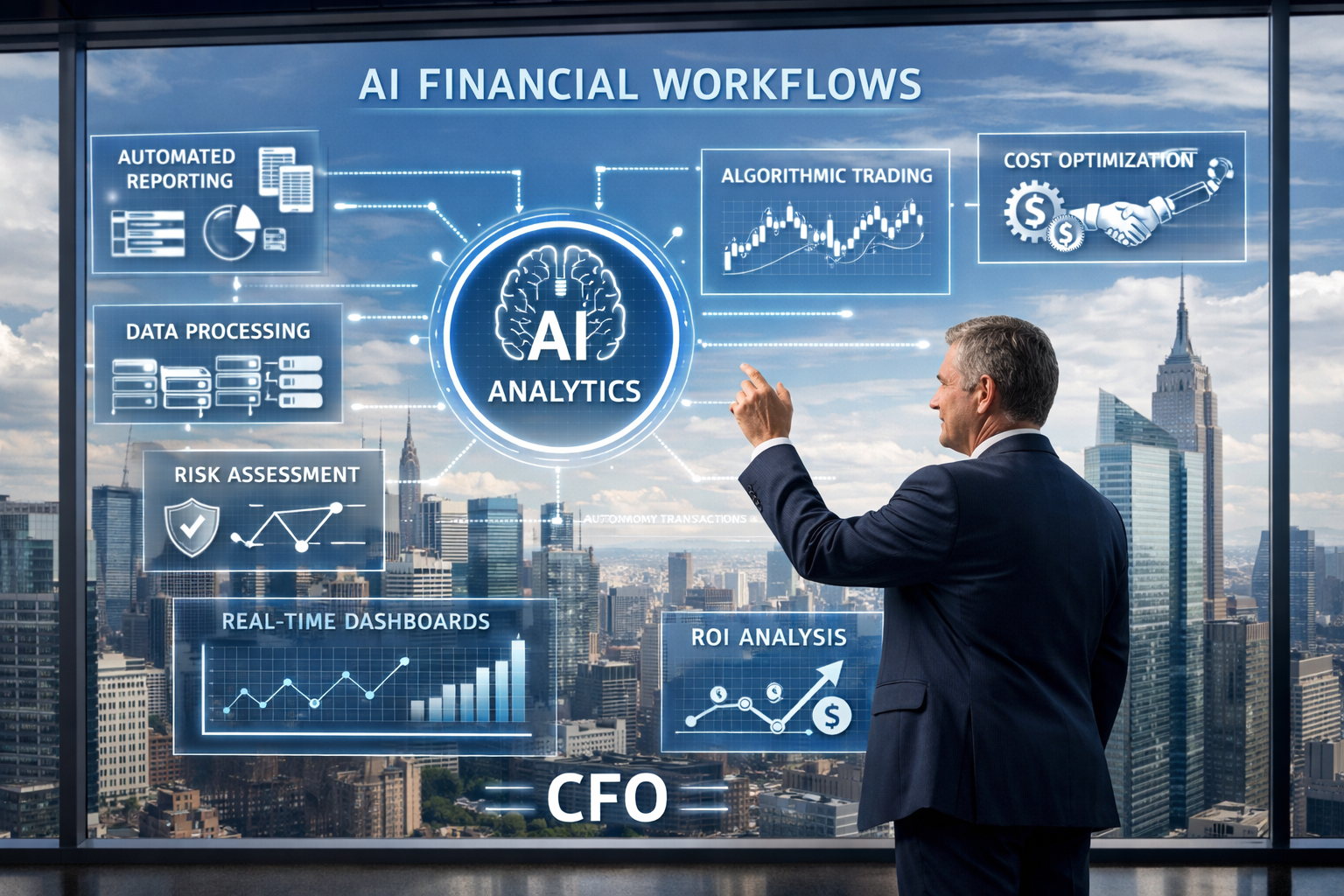
Introduction: Corporate Finance Is Entering a New AI Era
Artificial intelligence is beginning to change one of the most important questions in corporate finance: Should AI simply tell financial leaders what is happening, or should it also be allowed to take action?
For years, many finance departments primarily used AI-powered tools to summarize reports, analyze spreadsheets, identify patterns, and generate forecasts. These applications helped employees process information faster, but people still made most decisions and carried out the resulting transactions.
That model is evolving.
Agentic artificial intelligence, commonly called agentic AI, introduces a more action-oriented approach. Instead of stopping after producing an answer, an AI agent can work through a series of tasks, interact with authorized business software, evaluate information, and initiate actions within predefined limits.
In corporate finance, this could mean reviewing an invoice against a purchase order, identifying a discrepancy, requesting missing documentation, routing an exception for approval, and updating an enterprise resource planning system. In more advanced implementations, an agent might also initiate a payment after satisfying specific authorization requirements.
The implications extend beyond accounts payable. Finance teams are exploring how AI agents might support treasury management, cash-flow forecasting, vendor negotiations, financial planning, expense controls, and corporate strategy.
Deloitte’s research reflects this broader shift. Its Finance Trends 2027 report examines how finance leaders are taking on greater responsibility for AI governance, technology investment, and cost oversight. The research also highlights a central challenge: organizations may be interested in autonomous AI, but scaling it requires reliable data, appropriate controls, and human trust.
For U.S. businesses, the opportunity is significant. Finance departments face pressure to improve productivity, strengthen financial visibility, control operating expenses, and provide better information to executive teams. Agentic AI could help address these demands, but only when its capabilities are matched with clear accountability.
The real story is not that AI will suddenly replace the CFO. It is that the CFO’s role may expand from overseeing financial information to governing increasingly automated financial operations.
Understanding this transition requires looking beyond the technology itself. Companies must also consider the cost of running AI agents, the security of financial systems, the risks of autonomous decisions, and the measurable business value that these tools can deliver.
What Is Agentic AI in Corporate Finance?
Agentic AI refers to AI systems designed to pursue goals through multiple steps rather than responding only to individual prompts.
A conventional AI assistant might explain why a company’s expenses increased during the previous quarter. An agentic system could potentially retrieve authorized financial records, compare spending across departments, investigate unusual transactions, prepare a variance report, and send findings to the appropriate manager.
Depending on its configuration and permissions, it may also initiate specific follow-up actions.
The distinction is important because generating information and executing a financial transaction carry different levels of responsibility.
A summary containing an error can mislead a manager. An autonomous payment containing an error can send company money to the wrong recipient.
For this reason, agentic AI in finance is not simply a more advanced chatbot. It involves a combination of AI models, business rules, software integrations, permissions, data access, monitoring, and approval procedures.
A typical agentic finance workflow may include five stages:
- Understand the objective: Determine the task, such as reconciling invoices or forecasting short-term cash requirements.
- Collect relevant information: Retrieve authorized records from accounting systems, treasury platforms, vendor databases, and other approved sources.
- Analyze the information: Compare records, identify discrepancies, evaluate possible actions, and determine whether the available evidence meets established requirements.
- Execute an authorized action: Update a record, create a draft transaction, request additional information, or initiate an approved workflow.
- Record the outcome: Maintain an audit trail showing what happened, why the action was taken, and whether a human review was required.
Not every AI agent performs every stage. Some systems only recommend actions, while others can execute limited tasks through connected software.
The degree of autonomy depends on the company’s technology, risk appetite, controls, and authorization policies.
This distinction matters when evaluating claims about autonomous finance. A product described as an AI agent may still require human approval for every payment or contract change. Another system might automatically complete low-risk transactions but escalate exceptions.
Businesses should therefore evaluate what a system can actually do, rather than relying on the term “agentic AI” alone.
Why CFOs Are Paying Attention to Agentic AI
The CFO’s traditional responsibilities include financial reporting, liquidity management, budgeting, forecasting, internal controls, and capital allocation. These responsibilities remain essential, but the environment in which CFOs operate is becoming more complex.
Executives need faster answers about profitability, changing customer demand, supplier costs, labor expenses, and investment priorities. At the same time, finance departments must maintain accurate records and comply with applicable financial reporting requirements.
Agentic AI could help finance teams handle repetitive operational work while improving the speed at which financial information becomes available.
Deloitte’s U.S. research has also identified trust as a major obstacle to adoption. In a July 2025 announcement summarizing its Center for Controllership poll, Deloitte reported that 80.5% of surveyed finance and accounting professionals believed AI-powered tools could become standard tools for their profession within five years. However, the research also emphasized that adoption was still limited and that confidence in the technology remained an important issue.
Source: Deloitte — Trust Emerges as Main Barrier to Agentic AI Adoption in Finance and Accounting.
This combination of interest and caution helps explain the CFO’s growing role in AI strategy.
Finance leaders are well positioned to evaluate both sides of the investment: the operational benefits and the financial risks.
For example, an AI project may reduce the time employees spend reviewing invoices, but it may also introduce software subscription costs, integration expenses, model usage charges, security requirements, and ongoing monitoring work.
The relevant question is not simply whether the AI system works. It is whether the system creates measurable value after all of its costs and risks are considered.
From Financial Reporting to Financial Execution
Historically, much of finance’s digital transformation focused on making existing tasks faster.
Electronic spreadsheets replaced some manual calculations. Enterprise software connected accounting records. Robotic process automation handled repetitive actions. Business intelligence tools helped executives visualize financial results.
Agentic AI introduces another possibility: connecting analysis directly to controlled execution.
Consider a traditional month-end process. An analyst identifies an unexpected expense, investigates the transaction, contacts a department manager, waits for supporting documents, updates the accounting record, and prepares an explanation for management.
An appropriately configured AI agent could help gather supporting evidence, compare transactions with established rules, request missing documents, and prepare an explanation automatically. A human employee could then review any exceptions and approve adjustments that require professional judgment.
The benefit comes from reducing the number of manual handoffs.
However, the goal should not be to eliminate every human interaction. Certain activities, particularly those involving material financial consequences, unusual circumstances, or regulatory obligations, require careful human oversight.
A well-designed system automates routine work while making important exceptions easier to identify.
How AI Agents Could Transform Invoice Processing
Accounts payable is one of the clearest areas in which agentic AI may deliver practical value.
Businesses process invoices from suppliers, contractors, service providers, landlords, technology vendors, and other commercial partners. Each invoice must be checked for accuracy, authorization, duplication, and compliance with the company’s payment policies.
Even when accounting software is already in place, exceptions can create substantial manual work.
An invoice may contain an incorrect purchase order number. A supplier might change its bank details. The billed quantity may differ from the amount received. A discount may be missing, or the invoice may exceed the approved contract price.
Traditional automation can process predictable transactions, but exceptions often require employees to investigate the problem.
Agentic AI could help coordinate these investigations.
An Example of an AI-Assisted Invoice Workflow
Imagine a U.S. manufacturing company receiving thousands of invoices each month.
An AI agent connected to authorized accounting records could:
- Extract the invoice number, supplier name, due date, line items, and payment terms.
- Match the invoice against the purchase order and goods-receipt records.
- Check for possible duplicate invoices.
- Identify discrepancies between billed prices and contracted prices.
- Request missing documentation from the appropriate internal employee.
- Categorize routine exceptions and route more complex cases to an accounts payable specialist.
- Prepare a payment recommendation for approval.
If the company has explicitly authorized automatic payment for certain low-risk transactions, the system might also initiate payments after satisfying all required checks.
That final step should never be assumed. Payment execution requires suitable bank integrations, authorization rules, security controls, and clear responsibility for the resulting transaction.
Where the Financial Benefits May Come From
The business case for invoice automation can include several components.
First, employees may spend less time entering data and locating documents. Second, invoices may be processed more consistently. Third, discrepancies may be discovered earlier, reducing the risk of duplicate payments or missed contractual discounts.
Faster processing may also help companies take advantage of early-payment discounts when doing so makes financial sense.
For example, suppose a supplier offers a discount for paying an invoice within a specified early-payment window. An AI-assisted workflow could identify eligible invoices, estimate the cash-flow implications, and present the opportunity to treasury or accounts payable.
The system should compare the benefit against the company’s liquidity needs and the terms of the offer rather than automatically paying every eligible invoice.
The Risks of Automating Accounts Payable
Invoice processing may look routine, but it involves sensitive financial information and can be targeted by fraud.
An invoice can be fraudulent even if its formatting appears professional. A legitimate supplier’s email account might be compromised. An attacker could attempt to alter payment instructions or introduce malicious information into documents that an AI system reads.
Companies should establish independent verification procedures for bank-account changes, enforce segregation of duties, and require additional approval for unusual payments.
AI agents should not be allowed to bypass those controls simply because a transaction appears consistent with previous activity.
The safest approach is to automate document handling and routine validation first, then expand execution permissions only after the organization has tested the system under realistic conditions.
Treasury Management: A New Opportunity for Autonomous Finance
Treasury teams oversee liquidity, cash positioning, funding requirements, banking relationships, and financial risks. Their work can involve large sums of money and decisions that affect the entire organization.
This makes treasury management an attractive but sensitive area for agentic AI.
An AI agent could potentially combine information from bank balances, accounts payable, accounts receivable, sales forecasts, payroll schedules, debt obligations, and other approved sources to produce a more current view of expected cash flows.
Instead of waiting for a manually assembled report, treasury professionals could receive alerts when a projected cash shortfall, unexpected payment, or significant change in cash balances requires attention.
Improving Cash-Flow Forecasting
Cash-flow forecasts depend on assumptions about when money will enter and leave the business.
A company may expect a major customer to pay within 30 days, but that customer could delay payment. A supplier might request earlier settlement. Seasonal sales may differ from the forecast, or an unexpected expense may increase short-term funding requirements.
An AI agent could monitor these changes and update forecasts as new information becomes available.
It might also compare several scenarios:
- What happens if a large customer pays two weeks late?
- How much liquidity would be available if sales fell below expectations?
- Would an upcoming acquisition create a temporary funding gap?
- Could the company delay a discretionary expenditure without affecting operations?
- Would drawing on a credit facility be preferable to using available cash?
These are useful questions for finance leaders because they connect daily financial activity with strategic planning.
The agent can prepare the analysis, explain the assumptions, and flag uncertainties. The treasurer remains responsible for interpreting the findings and determining the appropriate response.
Could AI Execute Treasury Transactions?
In limited, carefully controlled environments, AI systems may be configured to initiate predefined actions through authorized financial software.
For example, an organization could permit an agent to prepare a transfer recommendation when cash balances fall outside an approved range. A human treasury professional might then review and authorize the transaction.
A company with more mature controls might automate narrowly defined transfers between approved accounts, subject to strict balance limits and monitoring.
However, broad authority over bank accounts would create serious risks.
Incorrect forecasts, compromised credentials, mistaken account mappings, or malicious instructions could result in significant losses. A system that has permission to move money must therefore be governed more strictly than one that merely produces a report.
A sensible implementation begins with read-only access, advances to recommendations, and introduces limited execution only after independent testing and approval.
Vendor Pricing and Procurement: Helping Finance Make Better Decisions
Vendor pricing is another area where agentic AI could influence corporate financial performance.
Most companies work with a wide range of suppliers. They purchase software subscriptions, raw materials, logistics services, professional consulting, office equipment, cloud infrastructure, and other resources required to operate.
Over time, pricing arrangements can become complicated. Different departments may negotiate separate contracts with the same supplier. Renewal dates may be missed. Volume discounts may not be applied correctly. A contract signed several years ago may no longer reflect current market conditions.
These issues can increase operating costs without attracting immediate attention.
An AI agent could help finance and procurement teams review contracts, compare historical invoices, monitor renewal dates, and identify unusual price movements.
How AI Can Support Vendor Price Analysis
Suppose a technology company uses several cloud services across different business units.
The finance department may receive invoices with different billing structures, usage tiers, service charges, and contractual discounts. Reviewing every line item manually can be difficult, particularly when spending changes rapidly.
An AI-assisted procurement workflow could:
- Retrieve approved vendor contracts and historical invoices.
- Compare current prices with negotiated terms.
- Identify unexpected charges or changes in usage.
- Highlight overlapping subscriptions and potentially unnecessary services.
- Estimate the financial impact of alternative pricing arrangements.
- Prepare negotiation points for the procurement team.
- Monitor whether agreed discounts appear in subsequent invoices.
This can help procurement professionals focus on the contracts with the greatest financial impact.
For example, an agent might discover that a company is paying different rates for similar services across multiple departments. It could estimate the savings available from consolidating purchases or negotiating a company-wide agreement.
The findings would still need validation. Different departments may require different service levels, security provisions, or contractual protections. A lower price is not automatically a better deal if it introduces additional risk.
Should AI Negotiate With Suppliers Independently?
AI agents may eventually handle more routine supplier communications, including requesting quotes, asking for clarification, and preparing counteroffers within approved parameters.
However, allowing an agent to negotiate commercial agreements independently raises important questions.
Can it commit the company to a minimum purchase volume? Can it accept a price increase in exchange for better payment terms? Can it disclose information about the company’s purchasing plans? Can it agree to contractual language that creates future liabilities?
These are not merely technical questions. They concern legal authority, business strategy, and accountability.
A practical model separates research and preparation from binding commitments. AI can gather information, model negotiation scenarios, and draft proposals. Humans retain approval over material contract terms and any commitment that exceeds established limits.
Over time, companies may grant agents more authority for low-value, standardized purchases, provided the transactions remain within documented rules and can be audited.
The Rising Cost of Scaling Agentic AI
The potential benefits of autonomous finance do not eliminate the cost of implementing it.
In fact, the economics can become more complicated as organizations move from simple AI assistants to systems that perform lengthy workflows across multiple applications.
A basic assistant might answer a question using a single model request. An agentic workflow could require multiple reasoning steps, document searches, database queries, verification checks, retries, and calls to external systems.
Each additional step can consume computing resources or incur software charges.
Deloitte’s Finance Trends 2027 research specifically identifies the complexity of AI cost management as an emerging challenge for finance leaders. The report emphasizes the importance of cost forecasting, allocation, governance, and evaluating expected business value.
For CFOs, this creates a new budgeting problem: AI costs may depend not only on the number of employees using a tool but also on the number, length, and complexity of the tasks that autonomous systems perform.
Why AI Spending Can Increase Unexpectedly
Several factors can cause AI expenses to rise as adoption expands.
1. More model calls per task
An agent may need to examine information, create a plan, execute an action, check the result, and recover from an error. Each stage can trigger additional processing.
2. Expensive models used for routine work
Some tasks require sophisticated reasoning, while others involve simple classification or structured data extraction. Using a high-cost model for every task may be financially inefficient.
3. Large volumes of financial documents
Companies may process thousands of invoices, contracts, expense reports, and statements. Even relatively inexpensive processing can become material when repeated at scale.
4. Repeated work and failed workflows
Poorly designed agents may revisit the same documents, retry unsuccessful operations, or perform unnecessary checks. These activities consume resources without creating proportional value.
5. Integration and infrastructure expenses
AI subscriptions are only one component of the total cost. Businesses may also need data pipelines, software integrations, monitoring tools, security controls, storage, implementation partners, and employee training.
6. Human review and exception handling
Automation does not necessarily eliminate labor costs. Employees may still need to investigate unusual transactions, validate outputs, correct errors, and maintain the systems.
The financial case should include all these components rather than focusing solely on the advertised price of an AI model.
A Practical Example of AI Cost Management
Imagine a mid-sized U.S. business introduces an AI agent to process invoices.
Management initially expects the system to reduce manual work. After deployment, however, the company discovers that complex invoices trigger multiple model calls, failed workflows require retries, and several employees still review every transaction.
The technology may still provide value, but the original business case could overstate the savings.
The CFO can respond by measuring the cost per successfully processed invoice, separating routine transactions from complex exceptions, and identifying where expensive processing is unnecessary.
For instance, a smaller specialized model might handle document classification, while a more capable model is reserved for ambiguous contract terms or unusual discrepancies.
The company could also redesign workflows to avoid repeatedly retrieving the same documents.
The goal is not simply to reduce AI usage. It is to ensure that each dollar spent produces a useful operational or financial outcome.
Measure Cost Per Completed Outcome
One useful approach is to track the full cost of completing a business task.
For invoice processing, a company might calculate:
Total cost per invoice = AI usage + software and infrastructure allocation + human review + exception handling.
It could then compare that figure with the cost of its existing process.
The comparison should use the same scope of work and include accuracy, processing time, error rates, and compliance requirements.
A system that processes invoices cheaply but frequently creates incorrect records may be more expensive overall than a slightly slower system with stronger accuracy.
CFOs should therefore evaluate unit economics alongside quality and risk.
Building an AI Business Case That Finance Can Defend
Before approving a major agentic AI investment, finance leaders should establish a clear baseline.
Without a baseline, it is difficult to determine whether the technology actually improves performance.
A useful business case starts with the existing process. How many transactions does the team handle? How long does each transaction take? What proportion requires manual intervention? How often do errors occur? What is the current cost of software, labor, and external support?
The next step is to define the proposed operating model.
Will the AI system merely recommend actions, or will it execute them? Which transactions will remain under human control? How will exceptions be handled? What happens when the system cannot obtain reliable information?
Once these questions are answered, the company can estimate the potential benefits and costs.
Five Financial Measures Worth Tracking
1. Cost per completed transaction
Measure the total cost of processing an invoice, expense claim, reconciliation, or other selected activity.
2. Processing time
Track the time between receiving a transaction and completing the required work.
3. Exception rate
Measure how frequently transactions require manual intervention. A rising exception rate can indicate poor data quality, unsuitable automation rules, or a change in the underlying business process.
4. Error and rework rate
Monitor incorrect records, duplicate payments, failed reconciliations, and the work required to correct them.
5. Realized financial value
Compare actual savings and measurable improvements with the full cost of the implementation.
These measures should be evaluated together. A reduction in processing time is useful, but the benefit may be offset by higher software costs or additional review requirements.
Similarly, an improvement in forecast accuracy may support better business decisions even if it does not immediately reduce headcount.
A strong business case identifies these benefits separately instead of forcing every outcome into a single cost-saving figure.
Distinguish Savings From Capacity Gains
One common mistake in automation projects is treating every hour saved as a direct reduction in expenses.
Suppose AI reduces the time required to prepare a monthly financial report. That creates additional capacity, but it does not automatically lower payroll costs.
The financial benefit depends on how the organization uses the time saved.
Employees might redirect their attention toward forecasting, risk analysis, customer profitability, and strategic planning. These activities may improve business performance without reducing the finance department’s headcount.
CFOs should distinguish among cash savings, avoided future costs, improved productivity, risk reduction, and strategic benefits.
This makes the business case more credible and helps management set realistic expectations.
Financial Data Quality: The Foundation of Autonomous Finance
Agentic AI cannot reliably execute financial tasks if the underlying data is incomplete, inconsistent, outdated, or incorrectly linked.
This is especially important in large organizations where information is spread across enterprise resource planning systems, accounting platforms, procurement tools, spreadsheets, bank portals, and vendor databases.
A supplier may have slightly different names in separate systems. A purchase order may not contain the correct department code. A payment term may be stored in an old contract while the invoice reflects a revised agreement.
These problems can confuse automated workflows.
An agent might reach a conclusion that appears reasonable based on the information it received but is incorrect because a critical record was missing.
Why Clean Data Matters More When AI Can Act
When an AI assistant only produces a report, an employee may notice an inconsistency before taking action.
When an agent can execute a transaction, the same inconsistency may move directly into a business process.
For this reason, companies should review data quality before granting execution permissions.
Important checks include:
- Consistent vendor identifiers and account mappings.
- Accurate contract versions and effective dates.
- Clear links between invoices, purchase orders, and receiving records.
- Reliable approval histories.
- Documented definitions for financial metrics.
- Access to current rather than obsolete information.
- Procedures for resolving conflicting records.
Data ownership also matters. Someone must be responsible for correcting inaccurate records and maintaining the rules that govern financial information.
The AI system should not become a substitute for a reliable financial data environment.
Start With a Narrow, High-Value Workflow
Organizations sometimes attempt to connect AI to too many systems during the initial deployment.
A narrower approach is often more manageable.
For example, a company could begin with invoice matching for a single business unit or a specific category of low-risk purchases. The pilot would use a limited set of approved data sources and clearly defined rules.
The finance team could then evaluate accuracy, exception handling, security, processing time, and operating costs before expanding the system.
If the pilot performs well, the company could gradually introduce more transaction types or additional business units.
This approach allows lessons from early implementation to inform later decisions.
It also limits the financial and operational impact of unexpected behavior.
AI Governance: Who Is Accountable When an Agent Makes a Mistake?
Governance becomes more important as AI systems receive access to business applications and financial transactions.
A company needs to know what an agent is permitted to do, which information it can access, who approved its permissions, and who is responsible when an action produces an unexpected result.
These questions cannot be answered by model accuracy alone.
A system may perform well during testing but still encounter unusual transactions, incomplete records, unexpected instructions, or security threats in production.
The organization therefore needs a governance framework that covers the entire lifecycle of the AI system.
Define Levels of Autonomy
A practical framework can divide financial activities into three broad levels.
Level 1: Read and analyze
The AI system can retrieve authorized information, summarize records, identify patterns, and produce reports. It cannot change financial records or initiate transactions.
Level 2: Recommend and prepare
The agent can prepare journal entries, payment instructions, reconciliations, or vendor communications. A designated employee reviews and approves the action before execution.
Level 3: Execute within strict limits
The agent can perform specific approved actions when predefined conditions are met. Exceptions, high-value transactions, and unusual circumstances are routed for human review.
These levels are illustrative rather than a universal industry standard. Companies should adapt them to their own risk profiles and control requirements.
A low-risk administrative task may be suitable for more autonomy. A material treasury transaction or regulatory filing may require stronger review.
Apply Least-Privilege Access
An AI agent should have only the permissions necessary to complete its assigned task.
An invoice-processing agent does not automatically need permission to modify vendor bank details. A forecasting agent does not need unrestricted access to execute payments.
Separating permissions reduces the consequences of a compromised account, faulty workflow, or unauthorized instruction.
Companies should also separate the ability to prepare a transaction from the authority to approve it whenever practical.
This principle is particularly important for payments, payroll, vendor onboarding, and changes to financial master data.
Maintain an Audit Trail
Every material AI-driven financial action should be traceable.
Records may include the source data used, the rule or workflow applied, the proposed action, the approvals received, the transaction executed, and any subsequent correction.
Organizations should also preserve enough information to investigate unexpected outcomes.
An audit trail helps finance teams understand what happened and supports internal audit, compliance, incident response, and process improvement.
It should not be assumed that a conversational transcript alone provides a sufficient record of financial decision-making.
Establish Human Escalation Rules
A well-designed agent should know when not to proceed.
Examples include:
- A payment exceeds an approved limit.
- A vendor’s banking details have changed.
- A transaction conflicts with a contract.
- The available evidence is incomplete.
- Two financial systems contain contradictory records.
- The system detects a possible duplicate payment.
- A transaction falls outside established policy.
In these cases, the agent should pause the workflow and send the matter to an authorized employee.
This is not a failure of automation. It is a deliberate control designed to prevent the system from making decisions it cannot safely resolve.
The ability to initiate actions creates a different security challenge from the ability to generate text.
An AI agent connected to accounting software, procurement systems, and banking applications may have access to sensitive information and important business functions. If its permissions are poorly configured, an attacker or a faulty workflow could potentially misuse that access.
Financial institutions and corporations already face threats such as business email compromise, invoice fraud, credential theft, and unauthorized account changes. Agentic AI introduces new considerations because systems may act on information retrieved from multiple sources without a human reviewing every step.
Prompt Injection and Untrusted Documents
AI agents may process invoices, contracts, emails, PDFs, and other documents supplied by customers or vendors.
These documents should be treated as untrusted inputs.
For example, a malicious document might contain instructions designed to manipulate an AI system into ignoring its normal task or disclosing information. A well-designed agent should not treat text found in an invoice as an authorized instruction to change its operating rules.
The company’s approved policies must remain separate from the content being analyzed.
Controls should include input validation, restricted tool permissions, trusted workflow definitions, and testing for attempts to manipulate the agent through external content.
Payment Fraud and Vendor Bank Changes
Vendor bank-account changes deserve particular attention.
A fraudulent request may appear to come from a legitimate supplier. An AI system that automatically processes the request without independent verification could create an opportunity for financial loss.
A safer process requires a separate verification channel, appropriate approval, and a documented record of the change.
The agent can identify the request, compare it with existing information, and notify the responsible employee. It should not be permitted to override verification requirements merely because an email or document appears convincing.
Credential and Access Management
Companies should avoid giving AI systems unrestricted credentials to critical applications.
Where available, organizations should use managed identities, narrowly scoped permissions, secure credential storage, and time-limited access. Sensitive actions should be logged and monitored.
A system that only needs to read invoice data should not have unrestricted write access to bank accounts or supplier records.
Organizations should also define procedures for suspending an agent quickly if suspicious activity is detected.
Test Failure Scenarios Before Deployment
Testing should include more than ordinary examples.
Finance teams should simulate duplicate invoices, incorrect vendor records, unexpected currency values, missing approval information, unusual payment amounts, and conflicting contract terms.
They should also test what happens when connected software becomes unavailable or an AI service returns an incomplete response.
The objective is to understand how the system behaves when conditions are imperfect.
A trustworthy financial automation system must be able to stop safely, explain an exception, and leave the underlying financial records in a consistent state.
Regulatory Compliance and Internal Controls
Corporate finance operates within a framework of accounting standards, tax requirements, contractual obligations, privacy laws, and industry-specific regulations.
The exact requirements depend on the organization, its activities, the jurisdictions in which it operates, and the type of financial information involved.
Introducing AI does not eliminate existing responsibilities.
A company remains responsible for the financial records it produces, the payments it authorizes, and the reporting obligations it must satisfy.
Financial Reporting and Internal Controls
For U.S. public companies, internal controls over financial reporting remain an important consideration under applicable securities laws and the Sarbanes-Oxley Act.
An AI agent involved in financial reporting should be included in the organization’s control framework where appropriate.
Management should understand which processes depend on AI, which outputs affect financial statements, and how errors can be detected and corrected.
Controls may include independent reconciliations, approval requirements, access reviews, testing, and monitoring of material changes.
The level of oversight should reflect the financial significance of the process.
For example, using AI to draft an internal explanation of a sales variance presents different risks from allowing an agent to post material journal entries automatically.
Document the Use of AI
Organizations should maintain an inventory of material AI applications used in finance.
The inventory can identify each system’s purpose, data sources, permissions, business owner, risk classification, and approval status.
It should also record how the system is monitored and what procedures apply if it fails.
This information helps finance, technology, compliance, and internal audit teams understand where AI is being used and how it affects established controls.
Align Governance With Recognized Frameworks
Companies looking for a structured approach can consult the NIST AI Risk Management Framework.
The framework provides guidance for identifying, assessing, and managing risks associated with AI systems.
Organizations can also review the COSO internal control framework when evaluating how automated workflows fit into their existing control environment.
These resources do not replace legal advice or organization-specific compliance reviews. They provide starting points for developing a consistent risk management approach.
The Changing Role of the CFO
As AI takes on more operational work, the CFO’s responsibilities may extend further into technology investment, data governance, and enterprise-wide performance management.
The change is not simply about adopting another software tool. It involves deciding which activities should be automated, what authority the systems should receive, how their performance will be measured, and where human judgment remains essential.
Deloitte’s Finance Trends 2027 research describes an expanding mandate for finance leaders, including greater involvement in technology capital allocation, AI trust, and spending oversight.
This development places CFOs in a position to connect technology decisions with measurable business outcomes.
From Budget Owner to AI Investment Strategist
Traditional technology budgeting often focused on software licensing, infrastructure, implementation, and maintenance.
Agentic AI adds new considerations.
Finance leaders may need to forecast variable model usage, estimate the cost of automated workflows, evaluate different model choices, and determine how AI spending should be allocated across departments.
They also need to consider whether a proposed investment will generate enough value to justify its full cost.
An AI system that performs a low-value task more quickly may not deserve a major investment. A system that improves working-capital visibility, reduces material errors, or accelerates a critical business process may offer a stronger case.
The CFO should help distinguish between experimentation and strategic deployment.
From Monthly Reporting to Continuous Financial Visibility
Traditional financial reporting often relies on periodic processes.
Monthly close procedures, quarterly reviews, and annual budgets remain important, but they cannot always provide the speed required for rapidly changing business conditions.
AI-assisted workflows may allow companies to identify certain changes more quickly.
For example, an agent could flag a sudden increase in supplier spending, compare actual expenses with current forecasts, and prepare an explanation for the finance team.
A treasury agent could update a short-term cash-flow projection when payment timing changes.
A financial planning agent could prepare alternative scenarios when sales or labor costs diverge from expectations.
These capabilities may help CFOs spend less time assembling information and more time evaluating what it means for the business.
However, continuous visibility should not be confused with perfectly accurate information. Forecasts still depend on assumptions, data quality, and changing market conditions.
The CFO as a Cross-Functional Leader
Successful AI deployment usually requires cooperation across multiple departments.
Finance understands the accounting rules and business objectives. IT manages system integration and technical architecture. Cybersecurity teams evaluate threats and access controls. Legal and compliance specialists assess obligations. Procurement manages vendor relationships.
The CFO can help bring these groups together around a shared investment case and a consistent definition of success.
This coordination becomes especially important when an AI agent operates across departmental boundaries.
A workflow that appears efficient within one department may create problems elsewhere if it bypasses established approval procedures or produces information in an incompatible format.
Finance leaders should therefore evaluate the complete process rather than optimizing a single task in isolation.
Workforce Implications: How Finance Jobs May Change
The expansion of agentic AI naturally raises questions about employment.
Some routine activities may require less manual effort as software becomes better at extracting information, reconciling records, preparing reports, and coordinating standard workflows.
But the effect on individual roles will depend on how organizations redesign their operations.
In many finance departments, employees spend substantial time gathering information and resolving administrative issues. Automating part of that work could create more capacity for analysis, communication, and decision support.
The transition will not be identical across companies.
Organizations with standardized processes and reliable data may find it easier to automate certain activities. Others may need to address fragmented systems, inconsistent procedures, and employee training before they can achieve meaningful results.
Accounts Payable Professionals
Accounts payable employees may spend less time entering invoice information and tracking routine approvals.
Their work could shift toward investigating unusual transactions, resolving supplier disputes, monitoring exceptions, and improving payment controls.
These responsibilities still require judgment and communication skills.
Financial Analysts
Financial analysts may use AI to prepare first drafts of reports, compare scenarios, and collect information from multiple systems.
That can leave more time for interpreting results, challenging assumptions, and explaining business implications to management.
Analysts will still need to validate outputs rather than accepting generated explanations without review.
Treasury Professionals
Treasury teams may receive more frequent cash-flow updates and automated alerts.
Their work could place greater emphasis on liquidity strategy, funding decisions, counterparty risk, and oversight of automated financial workflows.
Because treasury decisions can have immediate financial consequences, human expertise remains especially important for complex or material decisions.
Controllers and Finance Managers
Controllers may spend more time evaluating automated controls, reviewing exceptions, testing systems, and confirming that financial records remain accurate.
Finance managers may also need to develop new skills in data governance, process design, and AI performance evaluation.
Why Human Judgment Still Matters
AI systems can process large amounts of information, but business decisions often involve conflicting objectives.
A company might have enough cash to pay a supplier early, yet prefer to retain liquidity because an acquisition is approaching. A vendor may offer a lower price but introduce operational risk. An expense may technically comply with a rule while still requiring investigation because of unusual circumstances.
These decisions involve context, responsibility, and trade-offs.
The strongest finance teams will combine automation with professional judgment rather than treating the two as competing alternatives.
How Companies Can Implement Agentic AI in 90 Days
A structured 90-day pilot can help a finance department evaluate agentic AI without immediately giving it broad authority.
The timeline below is an illustrative planning approach, not a guarantee that a production deployment can be completed within 90 days. Complex systems, regulated processes, and legacy integrations may require considerably more time.
Days 1–30: Identify the Opportunity
Begin by selecting one finance process with a clear business problem.
Possible candidates include invoice matching, expense classification, reconciliation preparation, or financial report generation.
Document the current process and establish baseline measures for cost, processing time, error rates, and exception frequency.
Next, identify the relevant data sources and determine whether the information is sufficiently reliable.
Finance, IT, security, and process owners should agree on the scope of the pilot and the activities the AI system is not allowed to perform.
At this stage, read-only access or a test environment is generally preferable to unrestricted access to live financial systems.
Days 31–60: Build and Test
Connect the selected workflow to the minimum necessary data sources.
Define the permitted actions, approval rules, exception categories, and audit requirements.
Test the system using representative historical transactions and deliberately challenging scenarios.
Measure whether the agent identifies discrepancies correctly, follows the required rules, and escalates uncertain cases.
The team should also examine the cost of each completed task, including model usage, integration expenses, and human review.
If the system performs poorly on important exceptions, refine the workflow before considering a wider deployment.
Days 61–90: Run a Controlled Pilot
If testing supports deployment, introduce the system to a limited group of users or a narrow set of transactions.
Maintain appropriate human approval and monitor the results closely.
Review operational performance, security events, user feedback, and actual cost savings.
Compare the results with the original baseline.
At the end of the pilot, management should decide whether to expand the use case, redesign it, continue testing, or discontinue the project.
A successful pilot is not necessarily one that achieves full autonomy. It is one that demonstrates measurable value while maintaining acceptable levels of risk and control.
Questions Every CFO Should Ask an AI Vendor
Before purchasing an agentic finance solution, executives should look beyond product demonstrations.
A demonstration may show a system completing a straightforward task, but it may not reveal how the software behaves when records conflict, permissions fail, or a transaction falls outside established rules.
The following questions can help buyers evaluate a vendor’s actual capabilities.
1. What actions can the agent perform?
Request a precise list of read, write, approval, and transaction permissions.
2. Can permissions be restricted by transaction type and value?
Confirm whether the organization can define limits and require approvals for exceptions.
3. How are errors detected?
Ask how the system validates information, handles uncertainty, and responds when it cannot complete a task reliably.
4. What audit records are available?
Determine whether the company can reconstruct the steps leading to a material action.
5. How is sensitive data protected?
Review access controls, data retention, encryption, vendor processing terms, and relevant security certifications.
6. How are AI costs calculated?
Understand subscription charges, usage-based pricing, model costs, integration expenses, and potential charges for retries or additional workflows.
7. Can the company use different models for different tasks?
Flexible model selection may help balance performance and cost.
8. What happens when the AI service is unavailable?
A resilient system should have a defined fallback process and should not create uncontrolled transactions when dependencies fail.
9. How are model and workflow changes tested?
A software update can affect performance. Ask how changes are validated before they reach production.
10. Who is responsible when the system causes a problem?
Clarify contractual responsibilities, escalation procedures, support arrangements, and the organization’s own oversight obligations.
These questions can help separate practical enterprise capabilities from broad marketing claims.
Agentic AI and the Future of Corporate Strategy
The long-term significance of agentic AI may extend beyond automating individual finance tasks.
As companies connect financial data with operational information, AI systems could help leaders understand the relationship between everyday business decisions and enterprise performance.
For example, a pricing decision affects revenue, margins, customer demand, and working capital. A procurement decision affects operating costs, supplier risk, and cash requirements. A hiring decision affects payroll expenses, productivity, and future capacity.
These decisions are interconnected, but traditional reporting systems often present them in separate departmental views.
An integrated AI-enabled finance environment could help executives evaluate these relationships more quickly.
Scenario Planning and Strategic Decision-Making
Consider a U.S. company facing higher supplier costs and uncertain customer demand.
A conventional process might require finance analysts to gather data from procurement, sales, operations, and accounting before preparing alternative forecasts.
An AI-assisted workflow could collect authorized data, model several scenarios, identify important assumptions, and prepare a comparison for the executive team.
Management might evaluate questions such as:
- What happens to operating margins if supplier costs rise by 8%?
- How would a 5% decline in sales affect quarterly cash flow?
- Which product lines remain profitable under different pricing assumptions?
- How much working capital could be released by reducing inventory?
- Would renegotiating supplier contracts create more value than raising prices?
These percentages are hypothetical examples, not forecasts for any particular company.
The value of the system lies in making scenario analysis faster and easier to repeat. Leaders can explore more alternatives while retaining responsibility for the final decisions.
Connecting AI to Capital Allocation
Capital allocation is one of the CFO’s most important responsibilities.
Businesses must decide where to invest, which projects to delay, how much liquidity to retain, and whether expected returns justify the associated risks.
Agentic AI could help prepare these decisions by collecting relevant data, checking assumptions, updating financial models, and comparing projected outcomes.
However, investment decisions should not be delegated simply because an AI system can generate a persuasive recommendation.
A model may overlook strategic considerations, rely on outdated information, or underestimate uncertainty. Major investment decisions require independent analysis, management judgment, and appropriate approval.
AI should improve the quality and speed of the decision process rather than replace accountability for capital allocation.
The Difference Between AI Adoption and AI Value Creation
A company can adopt AI without achieving meaningful financial benefits.
Employees may use AI tools every day, yet the organization might see little improvement if the tools remain disconnected from business systems or fail to address the most expensive parts of a process.
Similarly, an AI agent may complete tasks quickly while generating additional work through errors, inconsistent outputs, or excessive review requirements.
For CFOs, this creates an important distinction between technology adoption and measurable value creation.
The most useful question is not how many AI tools the organization has deployed. It is whether those tools improve business outcomes.
Evaluate the Entire Workflow
Suppose an organization introduces an agent that cuts the time needed to review an invoice in half.
That appears to be a substantial improvement. But what happens next?
If employees must manually copy the agent’s results into accounting software, the overall time savings may be limited. If the agent frequently misses discrepancies, additional review may offset the benefit. If software and infrastructure expenses exceed the labor savings, the financial return may be disappointing.
A stronger approach evaluates the complete workflow from beginning to end.
This includes data collection, AI processing, system integration, employee review, transaction execution, exception handling, and recordkeeping.
Improvements at one stage should be assessed in the context of the whole process.
Build a Portfolio of AI Investments
Not every finance workflow deserves the same level of investment.
A CFO can compare use cases based on expected financial value, implementation complexity, operational risk, and the quality of available data.
For example, automating the preparation of an internal management report may be easier to implement than giving an AI system authority to move funds between bank accounts.
The first project may offer a useful starting point because it provides measurable benefits while limiting the consequences of errors.
As the organization gains experience, it can evaluate more complex applications.
A portfolio approach helps prevent the company from committing too much capital to a single ambitious project before it has established reliable results.
Common Mistakes Companies Should Avoid
The transition to agentic AI can create substantial opportunities, but several implementation mistakes can undermine those benefits.
A system that performs well in a demonstration may still fail under unusual operating conditions.
Companies should begin with restricted permissions and expand them only after sufficient testing and approval.
Mistake 2: Ignoring the Total Cost of Ownership
Model usage is only one component of AI spending.
Integration, monitoring, security, training, human review, and maintenance can all affect the financial return.
Mistake 3: Automating a Broken Process
If a company’s existing invoice process contains inconsistent rules and poor data, AI may simply reproduce those problems at a different stage.
Organizations should simplify and standardize important workflows before expanding automation.
Mistake 4: Measuring Activity Instead of Outcomes
The number of automated tasks is not a reliable measure of business value on its own.
Finance leaders should evaluate processing costs, accuracy, exception rates, risk, and the value created by the additional capacity.
Mistake 5: Treating Human Review as an Unnecessary Expense
Some transactions require professional judgment or independent authorization.
Removing essential controls can create losses that exceed the savings generated by automation.
Mistake 6: Failing to Assign Ownership
Every material AI workflow should have an accountable business owner.
That person or team should be responsible for its objectives, operating rules, monitoring, and escalation procedures.
Mistake 7: Trusting AI-Generated Explanations Without Verification
A fluent explanation is not proof that the underlying calculation or conclusion is correct.
Important financial outputs should be checked against reliable source records and appropriate validation rules.
What This Means for U.S. Businesses
For U.S. companies, agentic AI presents an opportunity to rethink how financial operations are organized.
Businesses with high transaction volumes may find value in automating repetitive administrative work. Organizations with complex supplier networks may benefit from improved contract monitoring and price analysis. Companies managing large cash balances may use AI-assisted forecasting to gain better visibility into liquidity requirements.
But the appropriate strategy depends on the business.
A small company with a limited finance team may benefit most from invoice automation and reporting assistance. A large multinational may need to address cross-border payments, multiple accounting systems, complex approval structures, and different regulatory requirements.
The technology should be selected to solve an identifiable business problem rather than adopted simply because competitors are discussing it.
Companies should also avoid assuming that every financial process can or should become fully autonomous.
In some cases, a recommendation system may provide most of the available benefit with considerably less risk. In others, carefully controlled execution may produce additional value.
The best choice depends on the expected return, the consequences of an error, and the organization’s ability to govern the system.
The Road Ahead: What CFOs Should Prepare for Now
Agentic AI is developing in an environment where computing costs, enterprise software, data infrastructure, and governance practices continue to evolve.
It is difficult to predict exactly how quickly autonomous finance will become standard across industries. Adoption will depend on technological reliability, economic incentives, regulatory expectations, and organizational readiness.
Nevertheless, CFOs can take practical steps today.
First, identify repetitive finance processes that consume significant time or create avoidable errors.
Second, improve the quality and accessibility of the data needed to support those processes.
Third, develop a governance framework that defines permissions, approvals, monitoring, and accountability.
Fourth, evaluate AI investments using measurable business outcomes rather than adoption statistics alone.
Finally, invest in the skills finance professionals need to work effectively with AI systems.
These steps are useful even if the organization initially adopts only limited automation. They create a foundation for evaluating more advanced capabilities as the technology matures.
A More Strategic Finance Function
The future of corporate finance is unlikely to be defined by a simple choice between people and machines.
Instead, companies will need to decide how responsibility should be divided between automated systems and human professionals.
AI agents may become increasingly capable of collecting information, coordinating workflows, identifying exceptions, and executing narrowly defined tasks. Finance professionals will remain responsible for interpreting complex situations, challenging assumptions, managing risk, and ensuring that business decisions align with organizational objectives.
For CFOs, this represents an opportunity to reshape the finance function around better information, more efficient processes, and stronger strategic support.
The companies most likely to benefit will not necessarily be those that automate the most tasks. They will be those that combine useful automation with reliable data, disciplined cost management, and effective governance.
Conclusion: Agentic AI Must Deliver Financial Value, Not Just Automation
Agentic AI is creating a new set of possibilities for corporate finance.
From invoice processing and treasury management to vendor pricing and financial planning, AI systems may increasingly move beyond summarizing information to carrying out authorized actions.
That shift could help finance departments reduce repetitive work, identify financial exceptions sooner, and provide more timely insights to business leaders.
However, the technology also introduces new costs and risks. Complex workflows can consume more computing resources than expected. Poor data can lead to incorrect decisions. Excessive permissions can expose companies to financial loss. Weak governance can make it difficult to explain or reverse an automated action.
CFOs therefore have an important role in determining how agentic AI should be deployed.
They must evaluate its financial return, oversee its operating costs, establish appropriate controls, and ensure that the technology supports the company’s broader strategy.
The objective is not to make every financial decision autonomous. It is to build a finance function that uses automation where it is valuable and preserves human judgment where it matters most.
As agentic AI continues to evolve, the most important measure of success will remain straightforward: Does the technology help the business make better decisions, manage financial risk, and create sustainable value?
For corporate finance leaders, that is the standard against which every AI investment should be measured.
Frequently Asked Questions (FAQs)
1. What is agentic AI in corporate finance?
Agentic AI refers to AI systems that can work through multiple steps toward a defined goal. In corporate finance, these systems may analyze financial records, coordinate workflows, identify discrepancies, prepare transactions, and execute specific authorized actions.
2. How is agentic AI different from generative AI?
Generative AI typically produces content such as summaries, explanations, and reports in response to instructions. Agentic AI adds the ability to plan and coordinate tasks, use connected tools, and potentially take actions within established permissions. The two approaches can overlap because AI agents often use generative AI models.
3. Can AI agents process invoices automatically?
Yes, AI agents can support invoice extraction, purchase-order matching, duplicate detection, exception handling, and payment preparation. Whether they can execute payments depends on the organization’s software, authorization rules, security controls, and implementation.
4. How can agentic AI help treasury management?
AI agents can assist with cash-flow forecasting, monitoring bank balances, analyzing payment timing, and identifying potential liquidity issues. Some systems may initiate predefined transactions, but material financial decisions should remain subject to appropriate authorization and oversight.
5. Can agentic AI reduce corporate finance costs?
It may reduce manual processing, rework, and certain administrative expenses. However, organizations must also account for software subscriptions, model usage, integration, monitoring, and human review. Actual savings depend on the workflow and implementation.
6. Why are AI costs becoming a concern for CFOs?
Agentic workflows can involve multiple model calls, repeated data retrieval, verification steps, and software integrations. As transaction volumes increase, these expenses can grow. CFOs need to monitor total cost per completed task and compare it with measurable business value.
7. What are the biggest risks of autonomous finance?
Major risks include incorrect transactions, fraud, cybersecurity incidents, poor data quality, unauthorized access, inadequate audit trails, and failures to follow internal policies. Strong permissions, independent verification, human escalation, and monitoring can help reduce these risks.
8. Will agentic AI replace CFOs?
Agentic AI may automate some tasks traditionally performed by finance teams, but the CFO’s broader responsibilities include capital allocation, financial accountability, strategic planning, risk oversight, and communication with executive leadership. These responsibilities require context and judgment beyond routine transaction processing.
9. How should a company start using agentic AI?
Start with a narrow, measurable workflow, such as invoice matching or report preparation. Establish baseline costs and performance measures, test the system with representative data, restrict its permissions, and expand only after demonstrating reliable results.
10. What should CFOs measure when evaluating AI investments?
Useful measures include cost per completed transaction, processing time, error rates, exception rates, realized savings, risk reduction, and employee capacity gained. The measures should reflect the full workflow rather than the AI software alone.
11. Does agentic AI require human oversight?
The required oversight depends on the task and its risk. Low-risk activities may be suitable for limited automation, while material payments, financial reporting, tax decisions, and unusual transactions may require additional review or approval.
12. What is the relationship between agentic AI and corporate strategy?
Agentic AI can connect operational activities with financial analysis, helping executives evaluate spending, cash flow, pricing, profitability, and investment scenarios. Its strategic value depends on the quality of the information, the reliability of the analysis, and the organization’s ability to act on the findings.
Sources and Further Reading
For readers who want to explore the research behind this article, the following sources provide additional information:
- Deloitte — Finance Trends 2027: Research on finance leadership, AI governance, technology investment, and AI cost management.
https://www.deloitte.com/global/en/issues/work/finance-trends.html - Deloitte — Trust Emerges as Main Barrier to Agentic AI Adoption in Finance and Accounting: Research on the opportunities and trust challenges associated with AI in finance.
https://www.deloitte.com/us/en/about/press-room/trust-main-barrier-to-agentic-ai-adoption-in-finance-and-accounting.html - Deloitte — The CFO Guide to Tech Trends 2026: An overview of AI investment, infrastructure costs, and finance transformation.
https://www.deloitte.com/us/en/what-we-do/capabilities/finance-transformation/articles/cfo-guide-to-tech-trends.html - NIST — AI Risk Management Framework: Guidance for managing AI-related risks.
https://www.nist.gov/itl/ai-risk-management-framework - COSO — Committee of Sponsoring Organizations of the Treadway Commission: Resources on internal control and enterprise risk management.
https://www.coso.org/
Editorial note: This article is for general informational purposes and does not constitute financial, legal, tax, or investment advice. AI capabilities and regulatory requirements vary by implementation and jurisdiction. Companies should independently assess financial systems and obtain appropriate professional guidance before authorizing autonomous financial transactions.
