

California Billionaire Wealth Tax: The History, Politics and Economic Debate Behind Proposition 40
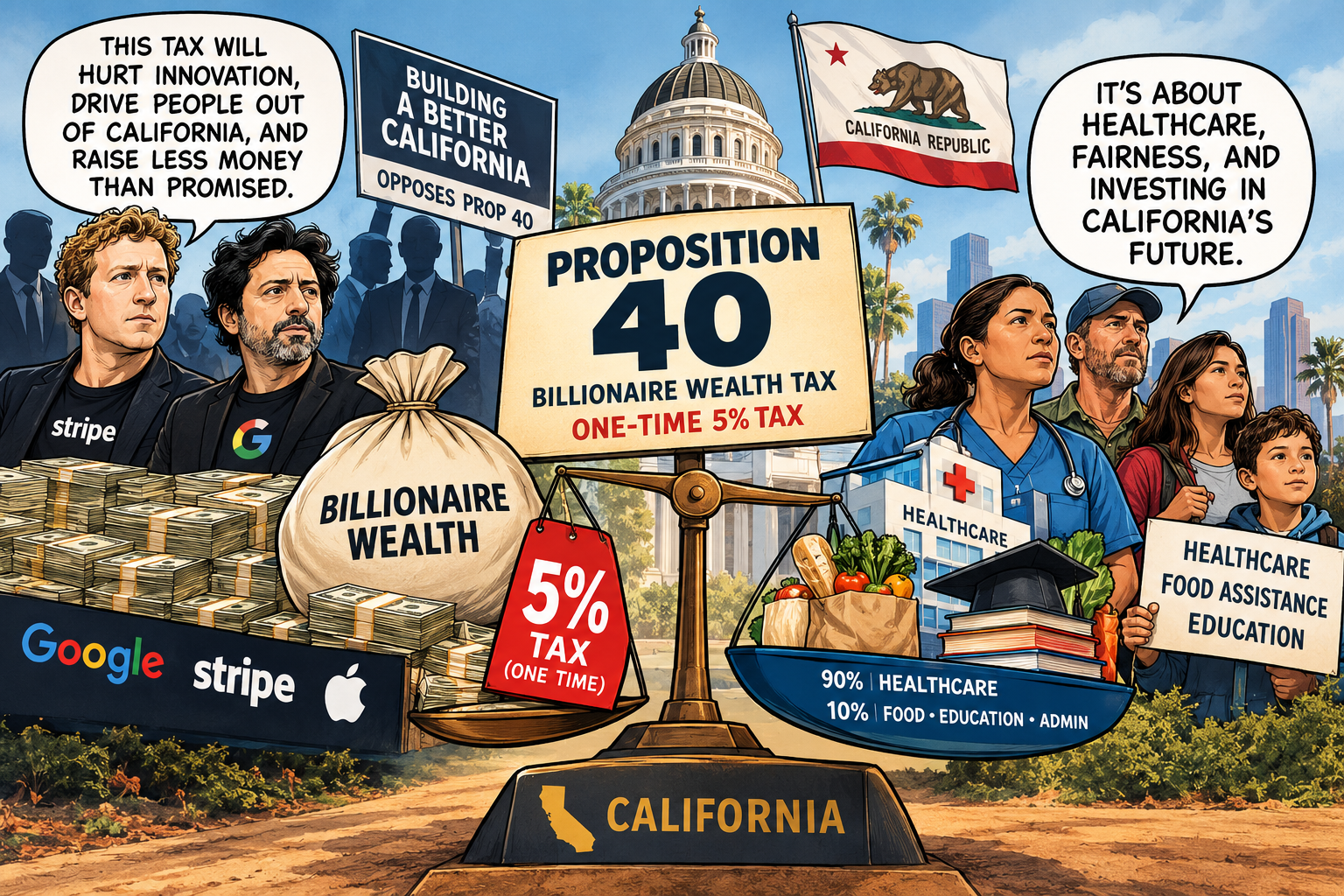
An editorial examination of California’s proposed one-time billionaire wealth tax, the fight over healthcare funding, Silicon Valley’s response and what the debate could mean for the future of American tax policy.
By New York Finance Think | October 30, 2026
Introduction: A Tax Proposal That Has Become Much Bigger Than Money
California is approaching one of its most closely watched political and economic debates of 2026. Proposition 40, a proposed one-time wealth tax on certain billionaires, has turned into a major confrontation involving labor unions, healthcare advocates, technology entrepreneurs, business organizations, political leaders and some of the wealthiest people in the United States.
At first glance, the proposal appears straightforward. California would impose a one-time tax of up to 5% on the covered wealth of certain people whose assets exceed $1 billion and who were California residents on January 1, 2026. Most of the money would be directed toward healthcare, while a smaller share would support food assistance and education-related programs.
But the debate is about much more than a percentage written into a tax proposal.
Supporters see the measure as a way to raise substantial money for public services at a time when healthcare programs face serious funding pressures. They argue that people who have accumulated enormous fortunes should contribute more toward the public systems that support the state’s economy and communities.
Opponents see a different picture. They worry that a new tax on accumulated wealth could encourage wealthy residents to move, create difficult valuation disputes, discourage investment and introduce uncertainty into California’s business environment. Some also question whether a one-time revenue collection can solve a continuing healthcare funding problem.
Both sides are raising questions that deserve serious attention.
The real issue is not simply whether billionaires should pay more. It is whether a state can design a tax on wealth that raises meaningful revenue without creating economic, administrative or legal problems that are larger than the benefits it is intended to deliver.
That question matters beyond California. Other states, policymakers and investors are watching because the outcome could influence the national discussion about how governments tax wealth in an economy increasingly shaped by technology companies, financial assets and privately held businesses.
1. Understanding the Difference Between Income and Wealth
To understand Proposition 40, it is important to understand a basic distinction in the American tax system: income and wealth are not the same thing.
Income is money received during a particular period. It may come from a salary, business profits, interest, dividends, rental payments or other sources.
Wealth is the value of what someone owns after subtracting debts. It can include company shares, investment portfolios, business ownership, property, art and other valuable assets.
Consider a technology founder who owns shares in a company worth billions of dollars. The value of those shares may increase significantly over several years. That increase can make the founder much wealthier on paper, even if the founder does not sell the shares and receive cash.
This creates an important difference between financial wealth and spendable income.
A person can have a very high net worth but relatively little cash available compared with the value of their assets. That does not mean the person has no financial resources. Shares can sometimes be sold, borrowed against or used in other financial arrangements. However, the timing and consequences of selling assets can be complicated.
The traditional income-tax system generally focuses on income when it is earned or realized under applicable tax rules. A wealth tax, by contrast, focuses on the value of assets held by a person at a particular time.
This is the central policy change behind Proposition 40.
Instead of asking only how much money a billionaire earned during a year, the proposal asks how much covered wealth the person held under the measure’s rules.
That distinction explains why the proposal has generated such strong reactions in California’s technology and investment communities.
2. California’s Earlier Attempts to Tax Wealth
Proposition 40 did not emerge from nowhere. California has debated wealth taxation for years.
The state has a large concentration of wealthy entrepreneurs, technology executives, investors and company founders. Many accumulated substantial fortunes through ownership in businesses whose values increased dramatically over time.
This has repeatedly raised a policy question: should a state rely mainly on income taxes, or should it also consider taxing certain forms of accumulated wealth?
Earlier proposals attempted to answer that question, but they did not become law.
The 2020 proposal: Assembly Bill 2088
One important earlier attempt came in 2020, when California lawmakers considered Assembly Bill 2088.
The proposal sought to establish an annual tax on the wealth of certain high-net-worth residents. It was broader in its potential reach than the billionaire-only approach later associated with Proposition 40.
The proposal attracted attention because it challenged the traditional boundary between income taxation and wealth taxation.
However, AB 2088 did not become law.
The debate exposed several practical questions. How should privately held companies be valued? What happens when the value of an asset changes? How should the state treat people who move? How would the tax interact with federal tax rules and other state obligations?
Those questions did not disappear when the bill failed.
The 2021 proposal: Assembly Bill 310
Another attempt followed in 2021 through Assembly Bill 310.
This proposal also sought to tax substantial personal wealth, using different thresholds and rates for people with very high net worth.
It did not become law either.
The repeated legislative attempts demonstrated that wealth taxation had become a continuing issue in California politics. Supporters continued to argue that the tax system should address the growing concentration of wealth. Critics continued to warn about valuation difficulties, migration and the potential consequences for investment.
The 2024 proposal: Assembly Bill 259
The debate returned again with Assembly Bill 259 in 2024.
Like earlier proposals, it reflected interest in creating a tax on accumulated wealth rather than relying exclusively on annual income.
It also failed to become law.
These earlier attempts matter because they show that Proposition 40 is part of a longer policy discussion. The 2026 measure is not simply another version of an annual wealth tax. It uses a one-time tax structure and focuses on a narrower group of taxpayers.
The distinction is important. A one-time tax may produce a large temporary revenue increase, but it does not automatically create a permanent source of funding for services that require money every year.
3. Why Proposition 40 Became a Major Issue in 2026
The immediate political environment helped move the billionaire tax debate into the center of California’s 2026 election.
Healthcare funding became a major concern as changes in federal policy raised questions about the resources available to California programs.
The state spends substantial amounts on healthcare, including Medi-Cal, public health services, mental health care and other programs. These services are important to lower-income residents, older people, families and people who depend on public coverage.
Supporters of Proposition 40 argue that federal healthcare funding reductions could put additional pressure on California’s budget and healthcare providers.
Their argument is that the state needs a new source of money to protect essential services. They believe a one-time tax on the covered wealth of billionaires could help address that gap.
The proposal also became part of a wider argument about economic inequality.
California is home to some of the world’s wealthiest technology entrepreneurs. The value of their businesses and investments can rise dramatically, while many ordinary residents face high housing costs, expensive healthcare, food bills and other everyday financial pressures.
Supporters say the tax would ask a small group of extremely wealthy residents to contribute toward services that benefit the wider population.
Opponents respond that the state’s financial problems should not be addressed through a tax that could create new economic risks or uncertainty.
The result is a debate that combines healthcare policy, taxation, inequality and the future of California’s technology economy.
4. What Proposition 40 Actually Proposes
The official proposal is more specific than the general phrase “billionaire tax” suggests.
Under Proposition 40, certain individuals who were California residents on January 1, 2026, and whose covered assets exceed the $1 billion threshold would face a one-time tax.
The tax is scheduled to be due in 2027 under the proposal. Taxpayers would have an option to spread payments over five years, with an additional amount required for that payment arrangement.
The proposal includes different rules for assets that are included and excluded from the tax calculation.
Covered assets include categories such as:
- Business interests.
- Securities and investment holdings.
- Art and collectibles.
- Intellectual property.
- Other assets covered by the measure’s valuation rules.
Real estate, pensions and certain retirement accounts generally would be excluded.
The measure also specifies how the money would be allocated.
90% of the revenue would be directed toward healthcare services.
10% would be allocated to food assistance, education-related programs and administration of the tax.
The official fiscal analysis estimates that the state could collect tens of billions of dollars over several years. It also warns that the final amount is difficult to predict because asset values change and taxpayers may take steps that affect their tax liability.
This is an important point: the tens-of-billions estimate is not a guaranteed amount of money available on a fixed date.
The amount collected would depend on asset valuations, legal challenges, payment arrangements, taxpayer responses and the administration of the measure.
5. Why Supporters Believe a Billionaire Tax Is Necessary
Supporters of Proposition 40 begin with a straightforward concern: public services require funding, and healthcare is one of the most expensive responsibilities facing the state.
They argue that the federal government’s healthcare policy changes could leave California with difficult decisions. The state may have to find additional revenue, reduce services, change eligibility rules or shift financial responsibilities.
From their perspective, a one-time tax on billionaire wealth offers an opportunity to raise a large amount of money without placing a new tax directly on ordinary wage earners.
Supporters also point to the difference between the financial position of billionaires and the experiences of many households.
A family earning a regular salary may pay income taxes every year. A business founder whose wealth is primarily held in company shares may see the value of those shares rise substantially without selling them.
Supporters argue that this difference raises questions about fairness.
They believe that a person who has accumulated an extraordinary fortune in a state should contribute toward the public systems that help make economic activity possible.
There is also a broader public-investment argument.
Businesses depend on infrastructure, educated workers, transportation systems, public safety, research institutions and functioning communities. Healthcare can also affect the workforce: people who cannot access treatment may struggle to work, study or care for family members.
Supporters therefore describe the proposal as a way to protect the economic and social foundations of California.
However, the argument should not be simplified into the claim that every billionaire pays no tax or that all wealth is immediately available as cash. Those claims would be misleading. The actual tax treatment of individuals depends on their income, assets, deductions, transactions and applicable laws.
The more precise question is whether California should impose an additional one-time tax on a defined category of wealth and whether the expected public benefits justify the associated risks.
6. Why Billionaires and Business Groups Oppose the Measure
Opposition to Proposition 40 includes wealthy technology figures, business organizations and other groups concerned about its economic and administrative consequences.
One of the central concerns is tax migration.
If someone knows that a major tax liability may be imposed based on residency at a particular date, that person may consider changing residence or reorganizing financial arrangements. The extent to which people would do this is uncertain, but the possibility is central to the opposition’s argument.
Critics say California already depends significantly on high-income taxpayers for state revenue. If wealthy residents leave, the state could lose future income-tax payments.
The Legislative Analyst’s Office identifies this as a possible consequence. Its official analysis estimates that taxpayer responses could lead to an ongoing reduction of less than $1 billion per year in state income-tax revenue from billionaires.
That estimate is not a guarantee. It is a projection based on uncertain future behavior.
Opponents also raise concerns about asset valuation.
A publicly traded stock has a visible market price. A private company does not have the same continuously available public valuation. The value of a privately held business may depend on revenue, future growth, debt, intellectual property, market conditions and other assumptions.
Art, collectibles and intellectual property can be even more difficult to value consistently.
Critics argue that disagreements over valuation could lead to expensive disputes and litigation.
Another concern involves the timing of tax payments.
A founder may own a large stake in a private company but may not have enough cash to pay a major tax bill without selling shares, borrowing money or making other financial arrangements.
That does not mean the tax is impossible to pay. It does mean the financial impact may differ depending on the structure of a person’s wealth.
Opponents also question whether a one-time tax can provide a reliable answer to a recurring healthcare funding problem.
Their argument is that hospitals, clinics and public healthcare programs need dependable funding every year. A temporary revenue increase may help in the short term, but it cannot automatically guarantee long-term financial stability.
These concerns deserve examination rather than dismissal.
7. The Silicon Valley Connection
California’s technology industry is central to this debate.
Silicon Valley and the wider Bay Area have produced some of the world’s most valuable companies. Their founders, executives and early investors have accumulated enormous fortunes through ownership in technology businesses.
For many founders, wealth is not simply a bank balance. It is tied to shares, company ownership, intellectual property and investments.
That structure helps explain why a tax based on covered assets can attract strong opposition from technology entrepreneurs.
The campaign against Proposition 40 has received substantial financial support from wealthy business figures. Google co-founder Sergey Brin has been a prominent contributor to the opposition effort. Stripe CEO Patrick Collison has also been reported among donors associated with the opposition campaign.
A political organization called Building a Better California has played a prominent role in the campaign against the measure.
The involvement of wealthy technology figures has made the debate especially visible. It has also created a larger question about the role of private money in public policy campaigns.
Campaign contributions are legal forms of political participation when made under applicable rules. At the same time, large donations can give wealthy individuals and organizations substantial influence over the advertising and public messaging surrounding a ballot measure.
That does not automatically prove that a campaign’s position is correct or incorrect.
It does mean voters should pay attention to who is funding the arguments, what evidence those arguments use and which interests may benefit from the proposed policy.
The same scrutiny should apply to supporters. Labor unions and other organizations also have policy interests and campaign priorities.
The public deserves a clear explanation of the proposal, not simply competing advertisements.
8. The Campaign Spending Battle
Proposition 40 has attracted unusually large campaign spending.
By late October 2026, news organizations reported that hundreds of millions of dollars had been raised or spent in the broader fight surrounding the billionaire tax and related ballot measures.
The opposition has raised substantially more money than the supporters, according to recent reporting and campaign finance records.
This financial imbalance matters because political campaigns use money to communicate with voters. Advertising can shape which arguments receive the most attention, how frequently voters hear them and which concerns become central to the public debate.
However, campaign spending should not be confused with evidence.
A campaign that spends more money does not automatically have the stronger economic argument. A campaign that spends less money does not automatically have the better public policy.
The most useful way to examine campaign spending is to ask:
- Who contributed the money?
- Which committees received it?
- What messages are those committees promoting?
- Are the claims supported by official analysis?
- Are important limitations or opposing arguments being left out?
California’s Secretary of State publishes campaign contribution information. Readers should use those records rather than relying only on campaign advertisements or social media posts.
9. The Complicated Role of Propositions 41 and 42
The Proposition 40 debate is not happening in isolation.
Propositions 41 and 42 are also part of the 2026 ballot discussion. They create an unusual situation because their legal relationship with Proposition 40 could affect whether the wealth-tax measure takes effect.
The official voter guide explains that if Proposition 41 or Proposition 42 receives more yes votes than Proposition 40, Proposition 40 could be stopped from becoming law, even if it receives support from a majority of voters.
This is a complicated ballot interaction, and it deserves careful attention.
A voter who looks only at the headline of Proposition 40 may not understand the full legal picture. The interaction with the other measures means the result could depend on more than a simple yes-or-no majority for the billionaire tax.
The details should be checked in the official voter guide before drawing conclusions about the legal outcome.
10. What Could the Tax Mean for Ordinary Californians?
For most residents, Proposition 40 would not create a direct personal wealth-tax bill.
The measure targets a limited group of very wealthy taxpayers who meet its residency and asset requirements.
But ordinary Californians could still be affected through the state budget.
If the tax collects substantial revenue, the money could support healthcare programs and other designated services. That could help hospitals, clinics, patients and public programs facing financial pressure.
For families who depend on Medi-Cal or other public healthcare services, the availability of funding can be significant.
A hospital that receives public funding may use those resources to support staffing, treatment and operations. A community clinic may depend on public programs to serve patients who cannot afford private healthcare.
But the public should not assume that a large headline revenue estimate automatically translates into a particular benefit for every patient.
The timing of collections, spending rules, administrative costs and the needs of individual programs will all matter.
There is also the possibility of indirect economic effects.
If the tax changes where some wealthy residents live or invest, California could experience changes in future income-tax revenue, business activity or investment decisions.
The size of those effects is uncertain. It would be misleading to claim that a mass departure of billionaires is inevitable. It would also be misleading to claim that there is no possibility of economic consequences.
The central challenge is measuring the likely public benefit against the potential long-term costs.
11. Can a One-Time Tax Solve a Long-Term Healthcare Problem?
This may be the most important question in the entire debate.
Healthcare is not a one-year expense.
Hospitals need staff and equipment. Patients need continuing treatment. Public health programs require ongoing administration. Mental healthcare and community services cannot operate effectively on temporary funding alone.
A one-time tax could provide a substantial financial boost. But a temporary source of revenue cannot automatically solve a structural funding problem.
Imagine a state that receives a large one-time payment. It can use the money to address urgent needs, support services or help bridge a budget gap.
But what happens when the money is spent?
If the underlying cost of healthcare continues to rise, the state will still need a long-term funding strategy.
That strategy could involve a combination of federal funding, state revenue, program reforms, cost controls, preventive care, improved administration and other policy decisions.
The question is not whether temporary revenue can help. It can.
The question is whether policymakers have a credible plan for the years after that revenue is collected.
Supporters need to explain how the money would be used and how the state would avoid becoming dependent on a temporary revenue source.
Opponents need to explain what alternative funding approach they believe would protect healthcare services if Proposition 40 does not take effect.
A serious public debate requires answers from both sides.
12. The Difficult Problem of Valuing Billionaire Wealth
Taxing a salary is relatively straightforward compared with valuing a complex portfolio of assets.
A person who receives a salary has records showing how much money was paid. Publicly traded stocks have market prices. But a private business may not have an obvious market value on any particular date.
Consider a founder who owns 20% of a private company.
The company may have recently raised money at a valuation of $20 billion. On paper, the founder’s stake might appear to be worth $4 billion.
But that figure may not represent the amount the founder could receive by selling the shares immediately.
There may be restrictions on selling. The company may have debt. Future growth assumptions may change. Investors may have different rights. A later financing round may value the business differently.
A tax authority would need rules to determine what value should be used.
The same challenge applies to art, collectibles and intellectual property.
A rare painting might sell for one price at auction and a different price in a private transaction. A patent may have significant future value but uncertain commercial prospects.
The state would need qualified professionals, clear valuation rules, audit procedures and a process for resolving disputes.
The cost and complexity of that work should be part of any honest assessment of the proposal.
13. Could Billionaires Leave California?
Tax migration is one of the most frequently discussed issues in the campaign.
California has high-income residents who contribute substantial amounts to state tax revenue. Some wealthy individuals may consider relocating if they believe a new tax makes the state less attractive.
But moving is not always a simple financial decision.
People have homes, families, businesses, employees, professional networks and personal connections. Companies may have offices and operations that cannot easily be moved. Some founders may be able to change their residence more easily than others.
The rules for determining residency can also be complicated.
It is therefore not possible to know in advance exactly how many people would move because of Proposition 40.
The official fiscal analysis recognizes that some billionaires may leave or change their financial behavior. It estimates that such responses could reduce ongoing income-tax revenue by less than $1 billion annually.
That is an important estimate, but it should be understood as a projection rather than a certain outcome.
The broader question is how California balances its need for revenue with its ability to remain attractive to entrepreneurs, investors and businesses.
14. What the Debate Says About Wealth Inequality in America
Proposition 40 also reflects a wider American debate about the concentration of wealth.
Over recent decades, the growth of technology companies, financial markets and private investment has created extraordinary fortunes.
Some founders have become billionaires because they built businesses that transformed communication, commerce, software, advertising, transportation and other industries.
Those businesses have created jobs, products and economic activity. They have also produced large differences in wealth between owners and many ordinary workers.
The argument over wealth inequality is not simply about whether someone deserves to become rich.
It is about how the tax system should operate when wealth grows through assets that may not produce taxable income every year.
Supporters of wealth taxes argue that a system focused mainly on income may not adequately address the economic power represented by large accumulated fortunes.
Opponents argue that taxing wealth can create problems because assets may be difficult to value, may not generate immediate cash and may be tied to businesses that create jobs and investment.
Both arguments involve important economic questions.
A useful discussion should avoid treating every billionaire as the same. Some fortunes are based on publicly traded shares, others on private businesses, inherited assets, investment portfolios or different combinations.
The tax consequences can vary considerably.
15. What Investors Should Watch
Although Proposition 40 is a state ballot measure, investors may want to follow the debate because it touches several broader economic issues.
Technology company founders
The proposal could influence how some founders think about the location of their personal residence and the structure of their assets.
However, a change in an individual’s tax position does not necessarily mean a company will move its headquarters or operations.
Those are separate decisions.
Venture capital and private investment
Investors may watch whether the debate changes perceptions of California’s tax environment.
A predictable tax system is important to businesses and investors. Uncertainty about valuation, residency and future tax policy can influence financial planning.
But it would be premature to assume that Proposition 40 alone will determine investment decisions across Silicon Valley.
California state finances
Investors and businesses also care about the state’s ability to fund healthcare, education, infrastructure and public services.
A stable public system can support a functioning workforce and business environment.
If Proposition 40 raises substantial revenue, the use of that money could become an important part of California’s budget outlook.
If the measure fails, policymakers may face renewed pressure to identify other funding sources or spending changes.
Legal and administrative developments
The proposal could lead to legal disputes over valuation, residency and the interpretation of its rules.
Investors should distinguish between political announcements, enacted law, administrative guidance and court decisions.
Those are different stages of a policy process.
16. What Happens After the November 3 Election?
The November 3, 2026, general election is the immediate milestone.
But the debate will not necessarily end when the votes are counted.
If Proposition 40 takes effect, California would face the difficult task of implementing the tax.
That would involve creating valuation procedures, identifying taxpayers, determining covered assets, reviewing filings and collecting payments.
Legal challenges could also affect the timing or application of the measure.
If the proposal does not take effect, the underlying policy debate may continue. Healthcare funding pressures, wealth inequality and the question of how to tax accumulated fortunes will remain part of California politics.
The election could determine the future of this particular proposal. It will not settle every question about wealth taxation in the United States.
17. The Editorial Question: Fairness, Economic Growth and Public Responsibility
There is a temptation to frame Proposition 40 as a simple contest between billionaires and ordinary people.
That framing may attract attention, but it does not explain the real policy challenge.
A tax system must raise revenue. It must also be understandable, administratively workable and consistent with the legal framework. It should not create unnecessary uncertainty, but it should not avoid difficult questions simply because powerful interests may object.
The supporters of Proposition 40 have a legitimate policy question to raise: should people with extraordinary accumulated wealth make an additional contribution toward healthcare and other public needs?
The opponents also raise legitimate questions: can the state value complex assets fairly, collect the tax efficiently and avoid damaging future revenue or investment?
The most useful debate is one that examines the evidence behind both positions.
A large tax bill does not automatically guarantee a successful public program. A warning about tax migration does not automatically prove that the economy will suffer. A campaign advertisement is not a substitute for a detailed fiscal analysis.
California’s decision should be examined through the actual rules of the proposal, the state’s long-term budget needs and the possible economic consequences.
18. The Broader Lesson for Other U.S. States
Other states are watching California because the proposal touches a policy issue that could become more important as wealth increasingly takes the form of financial assets and private company ownership.
State governments face a difficult balance.
They need revenue to fund public services. They also compete for residents, businesses, investment and skilled workers.
A policy that raises significant revenue but creates administrative uncertainty may be difficult to sustain. A policy that protects investment but leaves public services without adequate funding may also create long-term problems.
The challenge is to design tax systems that are fair, predictable and capable of supporting public responsibilities.
Proposition 40 may become a reference point in future debates, regardless of its final outcome.
Other states could study its valuation rules, residency provisions, revenue estimates and legal challenges before considering similar proposals.
The national discussion will likely continue to focus on whether wealth should be taxed differently from income and how governments can address the growing importance of unrealized gains.
19. Questions Californians Should Ask Before Forming an Opinion
A ballot measure this complicated deserves more than a headline or a campaign slogan.
Readers should ask several practical questions:
- Who exactly would be subject to the tax?
- Which assets would be included in the calculation?
- Which assets would be excluded?
- How would private companies and difficult-to-value assets be assessed?
- How much revenue does the official analysis estimate?
- How much would be spent on healthcare?
- What happens if the tax generates less revenue than expected?
- What administrative costs would the state face?
- Could taxpayer migration reduce future income-tax revenue?
- How do Propositions 41 and 42 interact with Proposition 40?
- What long-term funding plan would exist after the one-time revenue is spent?
These questions help move the conversation away from slogans and toward the actual design and consequences of the policy.
20. Final Analysis: California Is Testing a Difficult Economic Question
Proposition 40 represents a major test of how California approaches wealth, taxation and public services.
Its supporters want the state to use a portion of billionaire wealth to protect healthcare and other public programs. Its opponents warn that a one-time tax could create valuation disputes, encourage some wealthy residents to leave and introduce uncertainty into the state’s business environment.
The official analysis points to a potentially large but temporary revenue increase, alongside a possible ongoing reduction in income-tax revenue from billionaires.
Neither the promised benefits nor the feared economic consequences should be treated as automatic.
The proposal raises a deeper question about the relationship between private wealth and public responsibility.
California’s technology economy has generated extraordinary fortunes. It has also created jobs, investment, innovation and products used around the world. The state must consider how to preserve those economic strengths while maintaining the public services that residents depend on.
A tax policy should be judged not only by how much money it might collect, but also by how clearly it is written, how fairly it is administered, how reliably it funds public needs and what incentives it creates for future economic activity.
That is why Proposition 40 deserves careful attention.
The debate is not only about billionaires. It is about the future of healthcare funding, the structure of state taxation, the influence of campaign money and the kind of economic environment California wants to maintain.
Whatever happens on November 3, the questions raised by this proposal are unlikely to disappear.
Frequently Asked Questions
What is California Proposition 40?
Proposition 40 is a 2026 California ballot measure proposing a one-time tax of up to 5% on the covered wealth of certain billionaires who were California residents on January 1, 2026.
When would the billionaire tax be due?
Under the proposal, the tax would be due in 2027. An option to spread payments over five years would be available, with an additional amount required.
Would the tax apply to every wealthy person in California?
No. The measure focuses on taxpayers who meet its billionaire-level covered-asset threshold and residency requirements. It is not a general tax on every millionaire or homeowner.
What assets would be included?
Covered assets include certain business interests, securities, art, collectibles and intellectual property. The precise treatment depends on the measure’s rules.
Would homes and retirement accounts be taxed?
Real estate, pensions and certain retirement accounts generally would be excluded under the proposal.
Where would the money go?
The proposal directs 90% of the revenue toward healthcare services. The remaining 10% would go toward food assistance, education-related programs and administration.
How much money could California collect?
The Legislative Analyst’s Office estimates that the tax could raise tens of billions of dollars over several years. The exact amount is uncertain.
Why are technology billionaires opposing Proposition 40?
Opponents raise concerns about residency changes, asset valuation, legal disputes, investment decisions and possible reductions in future state income-tax revenue.
Could billionaires leave California?
Some may consider relocating or changing financial arrangements, but the number of people who might do so and the economic consequences are uncertain.
When will California voters decide?
The measure is on the November 3, 2026, general-election ballot. Its interaction with Propositions 41 and 42 is also important.
Sources and Further Reading
For readers who want to check the proposal and the economic claims directly, these sources provide useful background:
- California Secretary of State – Official Proposition 40 Voter Guide: https://voterguide.sos.ca.gov/propositions/40/
- California Legislative Analyst’s Office – Proposition 40 analysis: https://www.lao.ca.gov/BallotAnalysis/Proposition?number=40&year=2026
- California Secretary of State – Proposition 40 campaign contribution records: https://www.sos.ca.gov/campaign-lobbying/helpful-resources/measure-contributions/2026-ballot-measure-contribution-totals/
- CalMatters – Billionaire tax explained: https://calmatters.org/politics/2026/10/california-billionaire-tax-explainer/
- KQED – California Proposition 40 voter guide: https://www.kqed.org/voterguide/california/proposition-40/
- Los Angeles Times – Campaign spending and the billionaire tax debate: https://www.latimes.com/california/story/2026-10-24/more-than-351-million-spent-on-wealth-tax-on-november-ballot
Editorial note: This article separates the proposal’s official provisions and fiscal analysis from the arguments made by supporters and opponents. Campaign claims and projected economic effects should not be treated as guaranteed outcomes.
