
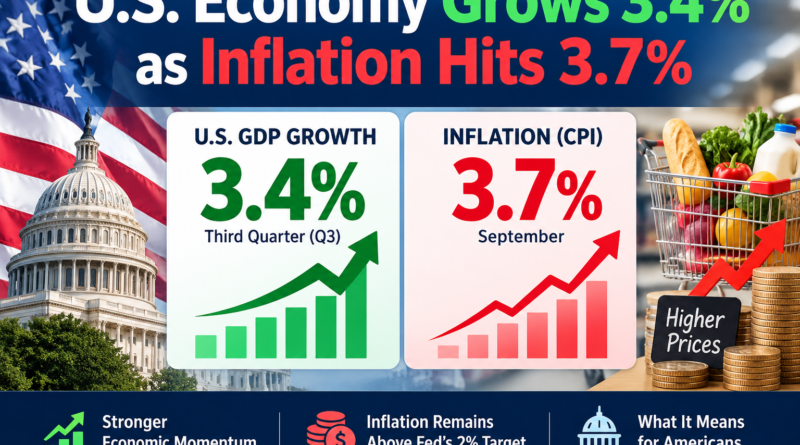
U.S. Economy Grows 3.4% as Inflation Hits 3.7%
The U.S. economy delivered a stronger-than-expected performance in the third quarter of 2026, but rising inflation is creating a difficult question for policymakers and households: how healthy is an economy when production and spending are growing while everyday expenses remain under pressure?
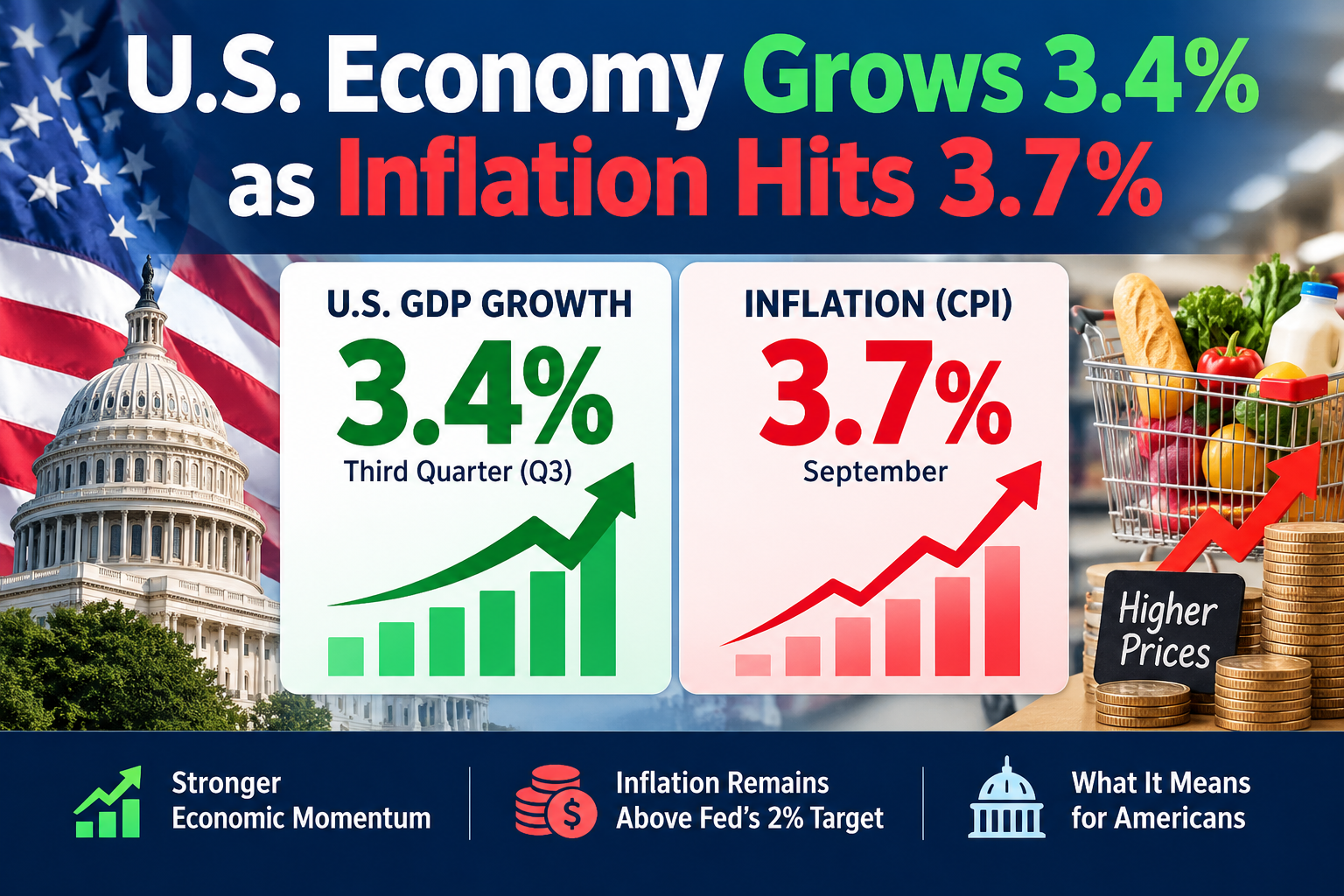
The latest economic figures tell two different stories about the United States. On one side, the economy expanded at an annualized rate of 3.4% during the third quarter, accelerating from the 2.2% growth recorded in the second quarter. On the other side, consumer prices were 3.7% higher in September than they were a year earlier. The combination is significant because it suggests that economic activity remains resilient even as the cost of living continues to challenge American households.
At first glance, the GDP report appears to be encouraging news. A growing economy generally means that businesses are producing more goods and services, consumers are purchasing products, companies are investing in equipment and technology, and government spending is contributing to economic activity. Strong growth can support employment, business confidence and corporate earnings. It can also help reduce fears that the economy is approaching a recession.
However, the inflation figures make the picture more complicated. Economic growth is not the same thing as financial comfort. A household can live in a country where GDP is increasing and still struggle to pay rent, purchase groceries, cover transportation costs, manage credit-card balances and save for emergencies. National economic statistics measure the broad performance of the economy. They do not automatically describe the financial experience of every family.
That distinction is at the center of the latest U.S. economic debate. The country is growing, but the price of maintaining an ordinary standard of living remains a major concern. The Federal Reserve must evaluate whether economic demand is expanding too quickly, whether inflation is becoming more persistent and whether interest rates need to remain restrictive for longer. Investors must decide whether strong GDP growth supports higher corporate earnings or whether inflation and borrowing costs could eventually place pressure on company valuations.
The most important question is not simply whether the United States is growing. It is whether that growth can continue without creating another wave of inflation.
The headline numbers: stronger growth, higher consumer prices
The Bureau of Economic Analysis reported that real gross domestic product increased at a 3.4% annualized rate in the third quarter of 2026. The advance estimate covers July, August and September. Growth accelerated from the 2.2% annualized pace recorded in the second quarter, indicating that economic activity gained momentum during the summer months.
The report identified increases in investment, consumer spending and government spending as contributors to growth. A decline in exports partly offset those gains, while imports increased. Because imports are subtracted in the calculation of GDP, an increase in imports can reduce the measured contribution to domestic production, even when it reflects strong demand for goods purchased by American businesses and consumers.
The BEA also reported that real final sales to private domestic purchasers increased at a 4.9% annualized rate in the third quarter, compared with 4.6% in the second quarter. This measure combines consumer spending and private fixed investment. It is useful because it gives economists another way to examine the strength of private-sector domestic demand.
The inflation picture is less comfortable. According to the Bureau of Labor Statistics, the Consumer Price Index for All Urban Consumers increased 0.6% on a seasonally adjusted basis in September. Over the 12 months ending in September, the CPI increased 3.7%. The annual rate was higher than the 3.4% recorded in August.
The monthly increase was particularly important because it showed that inflation pressure had not disappeared. Gasoline prices rose 9.1% during September and accounted for more than half of the monthly increase in the all-items CPI. The energy index increased 5.2%, while the shelter index rose 0.4%.
These numbers should be read carefully. The 3.4% and 3.7% figures do not measure the same thing. GDP growth is an inflation-adjusted measure of economic output expressed at an annualized quarterly rate. CPI measures changes in the prices consumers pay for a basket of goods and services. GDP describes production and economic activity; CPI describes consumer-price movements.
Together, however, they provide a useful snapshot of the economy: demand remains active, production is expanding and inflation is still above the level policymakers would prefer.
What a 3.4% GDP growth rate actually means
Gross domestic product is one of the most widely followed measurements of economic performance. It represents the market value of final goods and services produced within a country’s borders during a particular period. When economists discuss real GDP, they are referring to output adjusted for changes in prices.
The word “real” matters. If businesses sell more products only because prices have increased, that does not necessarily mean the economy has produced more goods and services. Real GDP attempts to separate changes in production from changes in prices.
The third-quarter figure of 3.4% is also an annualized rate. It does not mean that the economy literally expanded by 3.4% during the three-month period. Annualization shows what the quarterly growth rate would look like if the same pace continued for four consecutive quarters. It is a common way of presenting U.S. quarterly GDP data.
For ordinary readers, the simplest interpretation is that the economy expanded at a faster pace during the third quarter than it did during the second quarter. That is a positive signal, but it is not a guarantee that the same pace will continue.
GDP is built from several major components. Consumer spending is one of the most important because household purchases represent a substantial part of U.S. economic activity. Business investment is another major component. Companies purchase equipment, build facilities, develop software and invest in technology because they expect those investments to improve productivity or generate future revenue.
Government spending also contributes to GDP. Public purchases of goods and services can support economic activity, although the long-term effect depends on how spending is financed and whether it produces lasting economic benefits. International trade matters as well. Exports represent goods and services produced domestically and sold abroad, while imports represent purchases from other countries.
A strong GDP number is therefore not a single explanation of economic health. It is the combined result of activity across many parts of the economy. To understand whether growth is sustainable, investors and policymakers need to look beyond the headline percentage and examine what is driving it.
Consumer spending remains central to the U.S. economy
American households play a central role in the country’s economic performance. When consumers purchase groceries, pay for medical services, replace vehicles, book travel, buy electronics or spend money at restaurants, that activity supports businesses and employment.
The third-quarter GDP report showed that consumer spending contributed to economic growth. Reporting on the release also highlighted a 3.8% increase in consumer spending during the quarter. That strength helps explain why the economy expanded faster than it did in the previous quarter.
But consumer spending requires more careful interpretation than simply looking at the total amount spent. Spending can rise because households are earning more, because they are using savings, because they are borrowing, or because they are paying higher prices for the same products and services.
These situations have different implications for the future.
If spending increases because wages and household incomes are growing at a healthy pace, the expansion may have a stronger foundation. Families can continue purchasing goods and services without necessarily weakening their financial position. Businesses may benefit from stronger demand, while employment and investment can remain supportive.
If spending rises because households are using credit cards or reducing savings, the situation may be less sustainable. Consumers can continue supporting the economy for a period, but debt payments eventually become a burden. Higher interest rates can make that burden more expensive, particularly for people carrying revolving credit-card balances.
A household does not experience the economy through GDP tables. It experiences the economy through the amount left in its bank account after paying rent, utilities, insurance, groceries, transportation, medical bills and debt obligations. That is why strong consumer spending should be considered alongside disposable income, savings and household debt.
The latest September personal-income and spending report adds another layer. BEA data showed personal income rising 0.2% in September and personal consumption expenditures increasing 0.5% in current-dollar terms. These figures are monthly changes and should not be confused with the quarterly real-spending growth rate. They also need to be interpreted alongside inflation, because an increase in nominal spending does not necessarily mean households purchased a proportionately larger amount of goods and services.
The bigger issue for the coming months will be whether consumer demand is being supported by income growth or increasingly dependent on borrowing and savings. If household finances remain healthy, spending can provide a stable foundation for growth. If financial pressure increases, consumers may become more selective, delay major purchases and reduce discretionary spending.
That shift could affect retailers, restaurants, travel companies, entertainment businesses and other industries that depend on consumer demand.
Why 3.7% inflation matters to American families
Inflation is often discussed as a percentage, but families experience it as a series of decisions. A grocery bill that once fit comfortably within a weekly budget may now require cutting back on other purchases. A higher gasoline bill can reduce the money available for savings. Rising rent or insurance premiums can make it difficult to manage even when income has increased.
The September CPI reading of 3.7% means that the overall consumer-price index was 3.7% higher than it was 12 months earlier. It does not mean every product became 3.7% more expensive. Some prices rose much faster, some increased more slowly, and others may have declined.
The impact varies depending on what a household buys. A family that drives long distances may be particularly sensitive to gasoline prices. A renter may be more concerned about housing costs. A household with significant medical expenses may experience a different inflation pattern from a household that spends more on travel and entertainment.
This is one reason inflation can feel different from the national average. CPI is designed to measure price changes across a broad basket of consumer goods and services. It cannot perfectly represent the spending habits of every individual household.
Nevertheless, the overall figure matters because it influences expectations, wage negotiations, business pricing decisions and Federal Reserve policy. When inflation remains elevated, households may expect prices to continue rising. Businesses may adjust prices in response to higher costs. Workers may seek higher wages to protect purchasing power. These reactions can make inflation more persistent.
There is also a difference between the level of prices and the rate at which prices are increasing. Even if inflation falls from 3.7% to a lower level, that does not mean prices return to where they were several years ago. It means prices are increasing more slowly. The accumulated increase in the cost of living remains.
This distinction is important for public understanding. A lower inflation rate is generally welcome, but it does not automatically reverse previous price increases. Families may still feel pressure even after inflation has cooled because the higher price level remains part of their everyday budget.
Gasoline prices are an important part of the September inflation story
Energy prices can have a direct effect on household budgets and an indirect effect on business costs. The September CPI report showed that gasoline prices increased 9.1% during the month, accounting for more than half of the monthly increase in the overall index. The energy index rose 5.2%.
That is a meaningful contribution to the inflation report. Gasoline is one of the most visible prices in the economy because consumers encounter it frequently. A driver can see a price change at the pump immediately, unlike some service costs that may adjust only once a year.
Higher fuel costs can also affect businesses. Delivery companies, trucking operators, airlines, construction firms, manufacturers and agricultural businesses all face energy-related expenses. When fuel becomes more expensive, companies may absorb some of the increase, reduce other costs or pass part of it on to customers.
The effect can spread through supply chains. A company that transports goods over long distances may face higher operating expenses. A retailer may face increased distribution costs. A food producer may pay more to move ingredients and finished products. The eventual effect on consumer prices depends on competition, demand, contracts and the company’s ability to absorb costs.
However, one month’s gasoline increase should not automatically be treated as proof of a permanent inflation trend. Energy prices can be volatile. They respond to global supply conditions, geopolitical events, refinery operations, seasonal demand and other factors.
The more important question is whether energy increases begin influencing a broader range of prices. If higher transportation costs are passed through to goods and services, inflation pressure could become more widespread. If energy prices stabilize and other categories remain contained, the effect may be more temporary.
For the Federal Reserve, the challenge is to determine whether inflation is being driven mainly by temporary movements or by persistent demand and pricing pressures across the economy.
Housing and shelter costs remain important
Housing is one of the largest expenses for many American households. Rent, owners’ equivalent rent, utilities, maintenance and other housing-related expenses can have a substantial influence on household finances.
The September CPI report showed the shelter index rising 0.4% during the month, following a 0.3% increase in August. Shelter inflation is important because housing costs affect a large share of consumer budgets and can be persistent.
Housing inflation does not always move in the same direction as home-sale prices. The CPI shelter measure is designed to capture the cost of housing services consumed by households, not simply the latest price of houses sold in the market. Rent measures and owners’ equivalent rent are important parts of that calculation.
This difference can confuse readers. A decline in home prices does not necessarily produce an immediate decline in measured shelter inflation. Existing leases may adjust gradually. New rental listings may move differently from the rents paid by households already living in their homes. The statistical measures also use methods designed to capture housing costs over time.
For families, the practical issue is affordability. A household may face higher rent at renewal even if the broader housing market has become less competitive. Homebuyers may face a combination of high property prices, mortgage rates, taxes, insurance and maintenance expenses.
Higher interest rates can create a difficult situation. They may help cool demand and reduce inflation pressure, but they also increase the cost of financing a home. People who need to move, refinance or purchase their first property can feel the effect directly.
This is why inflation and interest-rate discussions should not be treated as abstract financial-market issues. They influence decisions about where families live, how much they can save and whether homeownership is within reach.
The Federal Reserve faces a difficult balancing act
The Federal Reserve is responsible for conducting monetary policy in pursuit of its congressionally assigned goals, including maximum employment and price stability. In practical terms, it must consider whether the economy is growing at a sustainable pace and whether inflation is moving toward its longer-run objective.
The latest data make that task more complicated. GDP growth accelerated to 3.4%, while September CPI inflation reached 3.7%. The separate September Personal Consumption Expenditures price index, the inflation measure the Federal Reserve emphasizes, increased 3.6% over 12 months, according to the latest report. Core PCE inflation, which excludes food and energy, was 3.1% annually.
An important clarification is necessary: the Federal Reserve’s 2% longer-run inflation objective is expressed in terms of the annual change in the PCE price index, not CPI. CPI is still an important indicator of consumer-price pressures, but it is not the Fed’s formal target measure.
The difference matters because CPI and PCE use different methods and weights. They can show different inflation rates in the same month. A responsible analysis should not say that CPI at 3.7% means the Fed’s official target has been exceeded by exactly 1.7 percentage points. The appropriate comparison is between the PCE inflation rate and the Fed’s 2% objective.
Even with that distinction, the overall picture is challenging. Inflation remains above the central bank’s objective, and economic growth is not showing an obvious collapse in demand. If the economy continues to expand rapidly while prices rise, policymakers may worry that inflation will remain elevated.
The Fed can use higher interest rates to make borrowing more expensive. That can reduce demand for credit, slow some business investment and encourage households to save rather than spend. Over time, tighter financial conditions can help reduce inflation pressure.
But monetary policy works with delays. Interest-rate changes do not immediately affect every mortgage, business loan or household purchase. The effects move through financial markets and the economy over time. Policymakers therefore need to consider not only the latest figures but also the likely direction of the economy over the coming quarters.
There is a risk in both directions. If the Fed eases policy too quickly while inflation remains persistent, price pressures could become harder to control. If it keeps policy too restrictive for too long, it could weaken hiring, investment and household demand more than necessary.
The central bank cannot guarantee a perfect outcome. It must make decisions with incomplete information, revised data and uncertainty about future conditions.
Why CPI and PCE inflation should not be confused
The Consumer Price Index and the Personal Consumption Expenditures price index are both important measures of inflation, but they are not identical.
CPI is produced by the Bureau of Labor Statistics. It measures price changes for a basket of goods and services purchased by urban consumers. It is widely used in news reporting, wage discussions, benefit adjustments and financial analysis.
PCE inflation is produced by the Bureau of Economic Analysis. It covers a broader range of household consumption expenditures, including some spending made on behalf of households by employers or government programs. Its weights can also change as consumers adjust their purchasing patterns.
The Federal Reserve prefers PCE inflation when evaluating progress toward its 2% longer-run objective. This does not make CPI irrelevant. CPI can reveal important price pressures, especially in areas that households notice directly. But the two measures should not be treated as interchangeable.
There is also a difference between headline and core inflation. Headline measures include food and energy. Core measures exclude those categories to help analysts examine underlying price movements that may be less affected by short-term volatility.
Core inflation is not a perfect measure of permanent inflation, and food and energy costs are certainly important to households. A family cannot simply ignore gasoline or groceries because economists are examining a core index. The purpose of core measures is analytical: they help policymakers assess whether price pressure is spreading beyond volatile categories.
In September, gasoline contributed substantially to the monthly CPI increase. That makes it especially important to examine other categories and the PCE data before concluding that every part of the economy is experiencing the same acceleration.
A strong article about inflation should therefore explain what each number measures, which agency publishes it and why the Federal Reserve pays particular attention to PCE.
AI investment is becoming an important part of the economic story
Technology investment is another major issue behind the latest economic figures. Businesses are spending heavily on computing equipment, software, data centers, networking infrastructure and artificial-intelligence systems. These investments can increase measured GDP because purchases of equipment and construction contribute to investment.
The economic opportunity is significant. AI tools could help businesses automate repetitive tasks, improve forecasting, analyze large datasets, support customer service, accelerate software development and increase productivity. If companies can use these systems effectively, they may eventually produce more output with the same amount of labor and capital.
But investment is not the same as productivity. Spending money on new technology does not automatically create a profitable business model. Companies must still demonstrate that the equipment and software produce measurable benefits.
A business may purchase advanced computing systems because it expects demand for AI services to grow. It may build data centers because customers are expected to need more computing capacity. It may spend heavily on research and development because it wants to compete in a rapidly changing industry.
Those decisions can support current economic activity, but the financial return may arrive years later. If expected revenue does not materialize, companies could face excess capacity, lower returns on capital and pressure to reduce future investment.
That creates a complicated relationship between technology spending and economic growth. In the short term, investment can support GDP. In the longer term, the investment must generate enough productivity, revenue or cost savings to justify the money spent.
Investors should therefore separate two questions. First, is AI-related spending supporting current business activity? Second, are the companies making those investments likely to earn attractive returns?
The first question concerns economic output. The second concerns profitability and valuation. A positive answer to the first does not guarantee a positive answer to the second.
For the wider economy, the most important outcome would be sustained productivity growth. If AI allows companies across many industries to produce more efficiently, the benefits could extend beyond technology firms. If the gains remain concentrated in a small group of companies while costs rise faster than revenue, the broader economic benefit may be less impressive.
Strong GDP does not guarantee a strong stock market
Investors often welcome strong GDP figures because economic expansion can support corporate revenue and earnings. When households spend more and businesses invest, companies may sell more products and services. A healthy economy can also reduce the risk of widespread defaults and business failures.
But stock prices do not simply follow GDP. Markets respond to expectations about future earnings, interest rates, inflation, company guidance, valuations and investor confidence.
A strong economic report can sometimes create pressure on stocks if investors believe it will make the Federal Reserve less willing to cut interest rates. Higher interest rates can reduce the present value investors place on future corporate profits. They can also make bonds and cash-like investments more attractive relative to equities.
This is particularly relevant for high-growth technology companies. Many of these businesses are valued partly on profits expected years into the future. When interest rates rise, investors may demand a larger discount before paying high prices for those future earnings.
A company can report strong sales and still see its stock fall if investors expected even better results. It can announce a major investment program and receive a negative market reaction if shareholders worry that the spending will reduce free cash flow without generating enough returns.
The same principle applies to the broader market. GDP growth of 3.4% is positive economic information, but it does not automatically make every stock attractive. Investors still need to examine valuations, balance sheets, profit margins, debt costs and competitive conditions.
The market may also react differently across sectors. Banks can benefit from some interest-rate environments but face pressure if credit quality weakens. Consumer companies may perform well when households remain confident, while discretionary retailers may struggle if budgets become tighter. Energy companies can benefit from higher commodity prices, while transportation businesses may face increased fuel costs.
The central question for equity investors is whether stronger demand will translate into higher earnings without creating an inflation and interest-rate environment that damages valuations.
What higher interest rates could mean for mortgages and housing
Mortgage rates are influenced by several factors, including Treasury yields, inflation expectations, economic growth, investor demand for mortgage-backed securities and expectations about Federal Reserve policy.
The Federal Reserve does not directly set the rate on a standard 30-year fixed mortgage. Its policy decisions influence short-term interest rates and broader financial conditions, but mortgage rates can move independently based on market expectations.
If inflation remains elevated and investors expect the Fed to keep rates higher for longer, longer-term borrowing costs may remain under pressure. That can make monthly mortgage payments more expensive for prospective homebuyers.
For example, a buyer considering a home purchase must evaluate more than the advertised property price. The total cost includes the down payment, mortgage interest, property taxes, homeowners insurance, maintenance and sometimes homeowners association fees.
Even a modest increase in mortgage rates can change the amount a household can comfortably borrow. Some buyers may delay purchasing, choose a less expensive property or remain renters for longer.
Existing homeowners with fixed-rate mortgages may be less directly affected by changes in current mortgage rates. However, they can still face higher property taxes, insurance premiums, maintenance costs and other expenses.
Housing affordability is therefore connected to both inflation and interest rates. A policy designed to reduce inflation can also make financing more expensive in the short term. The challenge for policymakers is to cool demand without causing unnecessary damage to employment and economic activity.
Credit-card debt and household financial pressure
One of the most important ways higher interest rates affect ordinary consumers is through borrowing costs. Credit-card balances with variable interest rates can become more expensive when market rates and card APRs remain elevated.
A household that carries a balance from month to month may find that a larger portion of each payment goes toward interest rather than reducing the principal. This can make debt repayment slower and more expensive.
When grocery prices, fuel costs and housing expenses rise at the same time, some families may rely more heavily on credit cards to cover routine expenses. That can create a difficult cycle: higher living costs lead to more borrowing, and higher interest charges make the next month’s budget even tighter.
Consumers should not assume that strong GDP growth means their personal finances are improving. A better approach is to review income, essential expenses, debt balances, interest rates and emergency savings.
For people carrying expensive revolving debt, prioritizing high-interest balances can reduce the amount paid in interest over time. However, any repayment strategy should account for minimum payments, emergency needs and the risk of taking on additional debt.
The wider economic impact is also important. If many households become more cautious because of debt payments and living costs, spending on nonessential products and services may slow. Businesses that depend on discretionary purchases could then experience weaker sales.
Household finances are not just a personal issue. They are an important part of the economic outlook because consumer spending is a major driver of U.S. GDP.
What the latest figures mean for businesses
Businesses operate in an environment where demand, wages, financing costs and input prices all matter. Strong GDP growth can create opportunities because customers may continue purchasing goods and services. But persistent inflation can make it harder to plan expenses and protect profit margins.
A retailer may experience higher sales but also face increased wages, rent, transportation costs and wholesale prices. A manufacturer may receive more orders but need to pay more for energy, components and financing. A service company may have strong demand but struggle to recruit and retain workers at the wages it can afford.
Companies with strong pricing power may be able to pass some cost increases to customers. Businesses operating in highly competitive markets may have less flexibility. If customers are already under financial pressure, raising prices can lead to lower sales volumes.
The quality of revenue growth matters. A company that increases sales because it sells more products may be in a stronger position than one whose revenue rises mainly because it charges higher prices. Both can report nominal revenue growth, but their underlying business conditions are different.
Businesses also need to evaluate investment decisions carefully. Higher borrowing costs can make new factories, equipment purchases and technology projects more expensive. Companies may postpone projects if expected returns are not sufficient.
The strongest businesses are likely to be those that combine stable demand with disciplined cost management, manageable debt and investments that improve productivity.
Is the U.S. economy heading toward a soft landing?
A soft landing is an economic outcome in which inflation moves lower without a severe recession or a major increase in unemployment. It is a difficult objective because the tools used to reduce inflation can also slow demand.
The latest GDP report provides evidence that the economy remains resilient. Growth accelerated from the second quarter, and private domestic demand remained strong. But the inflation figures show that price stability has not yet been fully restored.
A successful soft landing would require several things to happen together. Inflation would need to moderate over time. Employment would need to remain reasonably stable. Consumer spending would need to grow at a sustainable pace. Business investment would need to generate productive returns rather than simply expand costs. Financial conditions would need to cool excessive demand without creating a sharp contraction.
There are risks on both sides.
If consumer demand remains strong and companies continue raising prices, inflation may stay elevated. That could require the Federal Reserve to maintain restrictive policy or tighten further. If borrowing costs rise too much, households and businesses may reduce spending, increasing the risk of slower growth.
On the other hand, if energy prices stabilize, supply conditions improve and productivity increases, inflation could gradually ease without a major decline in economic activity.
The latest data do not prove that a soft landing has been achieved. They show that the economy is still expanding while inflation remains a challenge. The coming months will provide more evidence about whether demand is cooling at the right pace.
Why the GDP advance estimate could change
The third-quarter GDP figure is an advance estimate. It is the first official estimate for the quarter and is based on information available at the time of publication. Some source data are incomplete or subject to revision.
The BEA updates GDP as additional information becomes available. The second estimate is scheduled for November 25, 2026, and a third estimate is scheduled for December 23, 2026.
This matters because early estimates are useful but not final. A revision could change the reported growth rate or the contribution of individual components. Investors should avoid treating the first estimate as an unchangeable measure of economic performance.
Revisions are a normal part of national economic statistics. They do not automatically mean the original report was misleading. They reflect the process of incorporating more complete information.
For a market analysis article, the accurate wording is that the U.S. economy grew at an annualized 3.4% rate according to the advance estimate. It would be inaccurate to describe the figure as the final confirmed growth rate for the quarter.
What investors should watch next
The GDP and inflation reports provide a starting point, but investors need to follow several additional indicators to understand where the economy may be heading.
First, watch the next inflation reports. A single monthly reading can be affected by energy prices and other temporary factors. The direction of inflation over several months is more useful than one isolated number. Investors should examine headline CPI, core CPI, headline PCE and core PCE.
Second, watch employment. Job creation, unemployment, wage growth and hours worked can show whether household income is keeping pace with the cost of living. A labor market that remains stable can support consumer demand, while a weakening labor market can quickly change the economic outlook.
Third, monitor consumer spending and income. Spending that is supported by rising real income is generally more sustainable than spending supported by declining savings or increasing credit-card debt. Personal income, disposable income and the personal saving rate can help provide context.
Fourth, examine business investment. Companies may continue investing in equipment, software, buildings and AI infrastructure. The key question is whether those investments lead to higher productivity and stronger future cash flow.
Fifth, follow Treasury yields and Federal Reserve communication. Bond markets constantly adjust expectations about inflation, growth and future monetary policy. Changes in yields can affect mortgages, corporate borrowing and equity valuations.
Sixth, look at corporate earnings quality. Revenue growth is important, but investors should also examine profit margins, free cash flow, debt and management guidance. A strong economy does not prevent individual companies from making poor investment decisions.
Finally, watch energy prices. September’s CPI report showed that gasoline was a major contributor to the monthly increase. If energy prices remain volatile, they could complicate the inflation outlook and affect household budgets.
Three possible paths for the U.S. economy
The latest figures leave room for several different outcomes. These are scenarios rather than predictions, and actual results will depend on future data and policy decisions.
Scenario one: Growth continues and inflation gradually cools
This would be the most favorable outcome. Consumer spending would remain stable, businesses would continue investing, and inflation would gradually move lower. The Federal Reserve would gain more confidence that price pressures were easing without a major deterioration in employment.
In this environment, companies could benefit from stronger demand while investors might become more comfortable with the outlook for interest rates. Households would still face the higher price level created by previous inflation, but slower price increases could make budgeting more manageable.
Scenario two: Growth remains strong but inflation stays elevated
This is a more difficult environment for policymakers. If demand remains strong and prices continue rising, the Federal Reserve may need to keep interest rates restrictive for longer or consider additional tightening.
Businesses could face higher financing costs, while households may continue paying elevated rates on credit cards, auto loans and new mortgages. Stocks could experience greater volatility as investors adjust their expectations for future earnings and interest rates.
Strong GDP would remain a positive signal, but it could also make policymakers less comfortable with easing financial conditions.
Scenario three: Inflation pressure weakens demand
A third possibility is that high prices and borrowing costs eventually reduce consumer spending and business investment. Households may cut discretionary purchases, companies may delay projects and employment growth may slow.
If demand weakens substantially, inflation could decline, but the process might come with a cost to economic growth. The Federal Reserve would then face a different challenge: preventing an excessive slowdown while keeping inflation expectations under control.
The purpose of considering these scenarios is not to claim that one outcome is certain. It is to understand how different combinations of growth, inflation and interest rates can affect households, companies and financial markets.
What American households should take from the report
For households, the most useful lesson is that national economic growth and personal financial security are related but not identical.
A 3.4% GDP growth rate does not mean every worker receives a 3.4% pay increase. It does not mean rent will become cheaper, gasoline prices will decline or credit-card interest will fall. It also does not mean every industry is expanding at the same pace.
Families should focus on the parts of the economy that directly affect their budgets. These include wage growth, housing costs, insurance, fuel, groceries, debt payments and emergency savings.
If household income is increasing faster than essential expenses, financial conditions may be improving. If expenses are rising faster than income, families may feel pressure even when the national economy is expanding.
It is also important to avoid making major financial decisions based on a single economic headline. A GDP report cannot determine whether a person should buy a home, sell investments, change jobs or take on additional debt. Those decisions depend on individual circumstances, risk tolerance, financial goals and the full cost of available options.
For investors, diversification and an understanding of risk remain important. Economic reports can influence markets, but they cannot reliably predict the short-term movement of every stock or index.
The difference between a growing economy and an affordable economy
One of the most important issues in the current debate is affordability. A country can produce more goods and services while many households still struggle with the cost of essential expenses.
GDP measures economic output. It does not directly measure how affordable housing is, whether a family can pay medical bills or how much money remains after debt payments. Those questions require additional information about income distribution, prices, household balance sheets and access to essential services.
The difference becomes especially visible when inflation affects necessities. Families can postpone buying a new television or taking a vacation, but they cannot easily avoid paying for housing, food, transportation and medical care.
A household with a higher income may be better positioned to absorb rising prices. A household with limited savings and high debt may have very little flexibility. The same national inflation rate can therefore produce very different personal experiences.
This is why economic analysis should not stop at the GDP headline. A complete picture requires looking at wages, employment, household debt, savings and the cost of essential goods and services.
The broader policy challenge is to support sustainable economic growth while improving the conditions that allow households to benefit from it.
Why productivity could change the inflation debate
Productivity is one of the most important long-term factors in economic growth. It measures how efficiently labor and other inputs are used to produce goods and services.
When productivity improves, businesses may be able to produce more without increasing costs at the same rate. Over time, that can support higher real wages and economic growth while limiting inflation pressure.
Technology can contribute to productivity, but the benefits are not automatic. Companies must integrate new systems into their operations, train workers, redesign processes and make sure the technology actually improves output.
AI is receiving particular attention because it may affect a wide range of industries. It could assist with research, customer service, logistics, coding, document processing, manufacturing and data analysis. But the economic benefit will depend on real-world adoption and measurable results.
There can also be adjustment costs. Some jobs may change, certain tasks may be automated and workers may need new skills. Businesses may spend heavily before seeing meaningful productivity gains.
For policymakers, productivity growth can make the inflation challenge easier if it expands the economy’s productive capacity. But it would be premature to assume that current technology investment will immediately solve inflation or guarantee faster long-term growth.
The international impact of U.S. economic strength
The U.S. economy has an important influence on global markets. American consumer demand supports exporters around the world, while U.S. financial markets influence international investment decisions.
Strong U.S. growth can support global businesses that sell products and services to American customers. It can also influence commodity demand, trade flows and currency markets.
However, higher U.S. interest rates can create pressure outside the country. Global investors may shift funds toward dollar-denominated assets when U.S. yields become more attractive. That can affect exchange rates and financing conditions in other economies.
Countries and companies with significant dollar-denominated debt may face additional pressure if the dollar strengthens or borrowing costs rise. Emerging markets can be particularly sensitive to changes in global financial conditions.
The relationship is not one-directional. International energy prices, supply chains and geopolitical developments can also influence U.S. inflation and economic activity.
For global investors, the latest GDP and inflation figures are therefore relevant beyond Wall Street. They can shape expectations for the dollar, international bond markets, commodities and the cost of financing around the world.
The political and public debate around economic performance
Economic statistics are frequently used in political discussions, but public confidence depends on more than a headline growth rate.
People tend to judge economic conditions through their own experiences. They notice whether wages are keeping pace with expenses, whether rent is affordable, whether they can find stable employment and whether they have enough money to save.
That can create a gap between national statistics and public sentiment. Economists may describe growth as strong because production and spending are expanding. Households may remain dissatisfied because essential expenses are still high.
Neither perspective should automatically be dismissed. GDP is a valuable measure of economic activity, while household experiences provide important information about affordability and financial security.
A responsible economic discussion should explain both. Strong growth is meaningful, but it does not erase the pressure created by accumulated price increases. Elevated inflation is serious, but it does not mean the economy has stopped expanding.
The real policy challenge is to convert economic growth into broadly shared improvements in living standards.
My view: the strongest GDP number is not the whole story
In my view, the latest U.S. economic data should be interpreted with cautious optimism rather than celebration or alarm. The 3.4% GDP growth rate is encouraging because it shows that economic activity accelerated during the third quarter. Consumer spending and investment helped support the expansion, and the economy has not shown the kind of broad contraction that would normally dominate a recession discussion.
But the 3.7% September CPI reading is a reminder that the inflation problem remains unresolved. Gasoline was a major contributor to the monthly increase, and shelter costs continued to rise. The separate PCE data also showed inflation above the Federal Reserve’s 2% objective.
That combination creates a difficult environment for the central bank. Strong demand can support employment and company earnings, but it can also make it harder to bring inflation down. Higher interest rates can help reduce price pressure, but they can also increase borrowing costs for households and businesses.
I would pay particular attention to the quality of growth. Is consumer spending being supported by stronger incomes? Are businesses investing in projects that will improve productivity? Are wage increases keeping pace with living costs? Is inflation broadening across services, or is the latest increase concentrated in a smaller number of volatile categories?
These questions are more useful than looking at GDP or CPI in isolation.
The AI investment story deserves special attention. Technology spending may become a meaningful source of future productivity, but markets should not confuse capital expenditure with guaranteed profits. A company can spend billions on infrastructure and still struggle to generate attractive returns. The long-term economic value will depend on whether businesses can turn investment into real productivity improvements and sustainable revenue.
For American households, the message is straightforward: a strong economy does not automatically make everyday life affordable. Families should continue paying attention to their own income, essential costs, debt and savings rather than assuming that a positive GDP headline means financial pressure has disappeared.
For investors, the message is to remain selective. Strong economic growth can support earnings, but inflation and interest rates still matter. Company valuations, debt levels, profit margins and cash flow deserve close attention.
The United States is not facing a simple economic story. It is experiencing solid growth alongside persistent inflation pressure. That is a more complicated position than either a recession or a clean recovery.
The next stage will depend on whether inflation begins to cool without a significant decline in demand. If that happens, the economy could move toward a more balanced expansion. If price pressures remain persistent, the Federal Reserve may have to keep financial conditions tighter, creating challenges for borrowers, businesses and financial markets.
For now, the 3.4% GDP figure is good news, but it is not the end of the economic debate. The real test is whether growth can continue while the cost of living becomes more manageable for American families.
Conclusion: America is growing, but the inflation challenge remains
The third-quarter GDP report confirms that the U.S. economy expanded at a faster pace than in the previous quarter. The advance estimate showed annualized real growth of 3.4%, supported by consumer spending, investment and government spending. That is a meaningful sign of resilience.
At the same time, September CPI inflation reached 3.7% over 12 months, with gasoline playing a major role in the monthly increase. The Federal Reserve’s preferred PCE inflation measure also remained above its 2% objective.
The combination creates a difficult policy environment. Strong growth is welcome, but persistent inflation can prevent borrowing costs from falling and keep pressure on household budgets. The Federal Reserve must balance the need to control inflation against the risk of weakening employment and economic activity.
Investors should monitor future inflation readings, employment data, consumer income, business investment, Treasury yields and corporate earnings. Households should focus on the practical impact of prices, wages, debt and savings.
The most important takeaway is that economic strength should be measured not only by how much the country produces, but also by whether households and businesses can sustain that growth. The U.S. economy is expanding, but the next challenge is making that expansion more affordable and durable.
This article is for general information and educational purposes only. It is not individualized investment, tax or financial advice. Economic data can be revised, and financial markets involve risk.
Sources and official data
- U.S. Bureau of Economic Analysis — GDP Advance Estimate, Third Quarter 2026
https://www.bea.gov/news/2026/gdp-advance-estimate-3rd-quarter-2026 - U.S. Bureau of Labor Statistics — Consumer Price Index, September 2026
https://www.bls.gov/news.release/archives/cpi_10142026.htm - U.S. Bureau of Economic Analysis — Personal Income and Outlays, September 2026
https://www.bea.gov/ - Reuters — U.S. inflation heats up in September; consumer spending rises
https://www.reuters.com/business/us-inflation-heats-up-september-consumer-spending-rises-2026-10-29/ - Federal Reserve — Monetary Policy and the Federal Reserve’s Inflation Objective
https://www.federalreserve.gov/monetarypolicy.htm
Data note: The Q3 2026 GDP figure is the BEA’s advance estimate and is subject to revision. CPI and PCE inflation are different measures. The Federal Reserve’s 2% longer-run inflation objective is based on PCE inflation, not CPI.
