
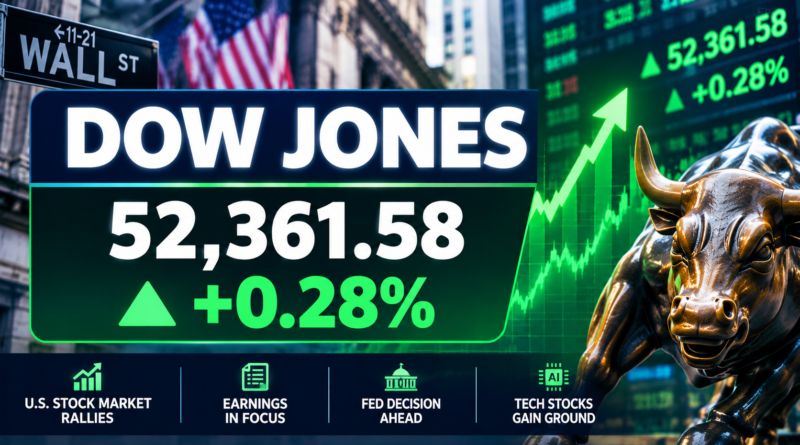
Dow Jones Today: Dow Rises 0.28% to 52,361.58 as Investors Look Ahead to Earnings and Fed Decision

The Dow Jones Industrial Average finished higher on Monday, October 26, as investors returned to U.S. stocks ahead of an unusually busy week for corporate earnings and monetary policy.
The Dow closed at 52,361.58, gaining 146.42 points, or 0.28%. The index traded between 52,263.25 and 52,620.19 during the session.
The move was modest compared with the stronger gains in some technology-related shares, but it was still an important recovery after Friday’s selloff.
The broader market also finished higher. The S&P 500 gained 0.70% to 7,676.77, while the Nasdaq Composite climbed 0.82% to 26,169.38. The Russell 2000 added 0.38%.
For American investors, however, Monday’s gain was only part of the story. The bigger question is what happens next as major companies prepare to report earnings and the Federal Reserve prepares for its policy decision.
Why Did the Dow Jones Rise Today?
Several factors helped improve sentiment on Wall Street.
One of the most notable developments came from the artificial intelligence sector. Anthropic’s filing for an initial public offering helped revive investor interest in AI-related companies after concerns about expensive AI infrastructure investments had recently weighed on technology stocks.
The news was particularly supportive for semiconductor and technology shares. Reuters reported that U.S. stocks ended higher as the Anthropic filing helped boost sentiment toward AI-related stocks.
The Dow itself is less heavily concentrated in technology than the Nasdaq, so its gain was more limited. Still, stronger sentiment across the broader market helped push the index higher.
Monday’s advance also came after the Dow lost 652.82 points, or 1.23%, on Friday. The latest rise therefore recovered only part of that decline.
Dow Jones Market Snapshot
Here is how the major U.S. indexes finished Monday:
| Index | October 26 Close | Daily Change |
|---|---|---|
| Dow Jones | 52,361.58 | +0.28% |
| S&P 500 | 7,676.77 | +0.70% |
| Nasdaq Composite | 26,169.38 | +0.82% |
| Russell 2000 | 2,786.42 | +0.38% |
The figures show that technology stocks were among the stronger areas of the market on Monday, while the Dow’s advance was comparatively restrained.
The Dow Is Still Below Its Recent High
Monday’s rebound did not put the Dow back at its October peak.
The index closed at 52,867.98 on October 22, its highest close of the month so far. It then dropped sharply on October 23 before recovering on Monday.
That recent pattern is worth watching.
The Dow has moved through several large daily swings this month. It gained more than 1% on October 20, added another 0.69% on October 21, barely moved on October 22, dropped 1.23% on October 23 and then recovered 0.28% on October 26.
For investors, that tells a simple story: the market remains sensitive to new information.
Earnings Season Takes Center Stage
One of the biggest reasons investors are watching the market closely this week is the earnings calendar.
A large group of major U.S. companies is scheduled to report financial results. Microsoft, Alphabet and Amazon are among the companies investors are watching as technology earnings take center stage.
Earnings matter because investors need to see whether high stock valuations are supported by actual business performance.
A company can have strong sales growth and still disappoint investors if its costs are rising too quickly. Likewise, a company can report modest revenue growth but receive a positive market reaction if profits and future guidance are better than expected.
This makes management guidance particularly important during the current earnings season.
Investors will want to hear how companies view consumer demand, labor costs, interest expenses, capital spending and artificial intelligence investment.
AI Spending Remains a Major Market Question
Artificial intelligence has become one of the central themes in the U.S. stock market.
The enthusiasm is understandable. AI is creating demand for chips, data centers, networking equipment, cloud services and software.
But investors have also started asking whether companies are spending too much too quickly.
That question has become particularly important because some technology companies are considering enormous investments in AI infrastructure.
The market therefore appears to be entering a more demanding phase of the AI story.
Earlier, investors were willing to pay for the expectation of future growth. Now they increasingly want evidence that the spending will translate into sustainable revenue and profits.
Anthropic’s IPO filing provided a fresh boost to the AI narrative on Monday, but it does not eliminate those longer-term questions.
What the Federal Reserve Means for Stocks
The Federal Reserve is another major focus for investors this week.
The Fed is expected to announce its latest interest-rate decision on Wednesday.
Interest rates matter because they affect almost every part of the economy.
Higher rates can make borrowing more expensive for businesses and households. They can also change how investors value stocks because future corporate earnings become less attractive when alternative investments offer higher yields.
Lower rates can have the opposite effect, particularly for companies whose valuations depend heavily on future growth.
For the Dow, the effect can be somewhat different from the Nasdaq because the Dow includes a broad mix of established companies across industries.
Still, a major change in interest-rate expectations could affect the entire U.S. stock market.
Treasury Yields Are Also Important
Investors are not watching the Federal Reserve in isolation.
Treasury yields remain an important part of the market’s daily direction because they influence borrowing costs and the relative attractiveness of stocks and bonds.
When yields rise quickly, investors sometimes become more cautious about higher-valued stocks.
When yields fall, equity valuations can receive some support.
That is why investors should pay attention not only to the Fed’s rate decision but also to how bond markets react afterward.
The initial announcement may be less important than what investors believe it means for future monetary policy.
What Happened to the Dow Last Week?
The Dow entered Monday’s session after a difficult end to the previous week.
On October 22, the index closed at 52,867.98, gaining only 0.02%.
The following day, the Dow dropped 652.82 points, or 1.23%, closing at 52,215.16.
Monday’s 146.42-point recovery brought the index back above 52,000 but left it well below the previous week’s high.
This is why describing Monday’s move as a complete recovery would be premature.
It was better viewed as a modest rebound following a sharp decline.
A Broader Market Recovery
The encouraging part of Monday’s session was that the gains were not limited to the Dow.
The S&P 500 advanced 0.70%, while the Nasdaq gained 0.82%. Small-cap stocks also moved higher, with the Russell 2000 gaining 0.38%.
That broad participation can be a positive sign because it suggests investors were willing to add exposure across several parts of the market.
At the same time, technology stocks were particularly strong.
That distinction matters because the market’s next move may depend on whether gains spread beyond the AI and technology trade.
Stocks Investors May Be Watching
The market’s attention is likely to remain focused on large companies with significant exposure to technology, AI and consumer spending.
Microsoft and Alphabet are among the major technology names scheduled to report earnings this week, while Amazon is also expected to provide investors with an important update on its business performance.
Tesla has also attracted attention after receiving a positive analyst upgrade, with its shares reaching their highest level in more than three months during Monday’s trading.
Meanwhile, not every company benefited from the AI optimism.
Meta shares declined after the company announced plans involving as much as $95 billion in financing for AI infrastructure, highlighting the growing debate over how much companies are willing to spend on the technology.
That contrast captures the current market environment well: investors like AI growth, but they are increasingly asking how much that growth will cost.
What Could Move the Dow This Week?
Several events could influence the Dow over the next few sessions.
Corporate earnings
Quarterly results could quickly change investor sentiment. Strong earnings and optimistic guidance could support stocks, while disappointing results could increase volatility.
Federal Reserve decision
The Fed’s interest-rate announcement and subsequent comments will be closely watched for clues about future policy.
Treasury yields
Changes in bond yields could affect stock valuations and investor positioning.
AI investment
Investors will continue to evaluate whether massive AI spending can generate adequate returns.
Economic data
Inflation, employment and consumer activity remain important indicators of the health of the U.S. economy.
What Does the Dow Jones Gain Mean for American Investors?
A 0.28% daily increase may not seem dramatic, but it is useful to put the move into context.
The Dow represents 30 large U.S. companies and is often viewed as a barometer of established American businesses.
That means the index can behave differently from the Nasdaq, which has greater exposure to technology and growth companies.
Monday provided a good example.
The Nasdaq gained 0.82%, nearly three times the Dow’s 0.28% advance.
This difference suggests that technology-related optimism was an important part of Monday’s market move.
For investors with diversified portfolios, the broader picture is more useful than following the Dow alone.
Is the U.S. Stock Market Still Strong?
The answer depends on the time frame.
The market has experienced significant volatility during October, but the major indexes remain substantially higher for the year.
As of the October 26 close, the Dow was up about 8.9% year to date, while The Dow represents 30 large U.S. companies was up about 12.1% and the Nasdaq was up about 12.6%.
Those numbers show that the recent pullbacks have not erased the broader gains of 2026.
However, past performance does not guarantee future results.
The market could continue higher if earnings remain strong and economic conditions hold up. It could also become more volatile if inflation, interest rates, corporate spending or geopolitical risks create new concerns.
Dow Jones Outlook
The short-term outlook is likely to remain sensitive to headlines.
Monday’s gain was encouraging, but investors still have several major events ahead.
The Dow needs more than one positive session to establish a clear new trend. The next few trading sessions could provide more information, particularly once major companies begin reporting their results and the Federal Reserve releases its latest policy decision.
For now, the market appears to be balancing two competing ideas.
On one side, corporate earnings and AI-related growth continue to provide reasons for optimism.
On the other, high valuations, large technology investments and uncertainty over interest rates are keeping investors cautious.
That combination could produce more sharp moves before the market settles on a clearer direction.
Final Takeaway
The Dow Jones Industrial Average closed at 52,361.58 on October 26, 2026, gaining 146.42 points, or 0.28%. The advance came as U.S. stocks recovered from Friday’s losses and investors looked ahead to major corporate earnings and the Federal Reserve’s upcoming policy decision.
AI optimism provided additional support after Anthropic filed for an IPO, helping technology and semiconductor stocks recover. At the same time, investors remain focused on whether enormous AI infrastructure spending can eventually translate into strong financial returns.
For American investors, the next few days could be more important than Monday’s gain itself. Earnings reports, Treasury yields and the Federal Reserve’s message could determine whether the recent rebound develops into a stronger recovery or another short-lived move.
The Dow’s 52,361.58 close is therefore best viewed as one piece of a much larger market story.
Market data note: This article uses the October 26, 2026 U.S. market close. Stock prices can change during subsequent trading sessions.
