
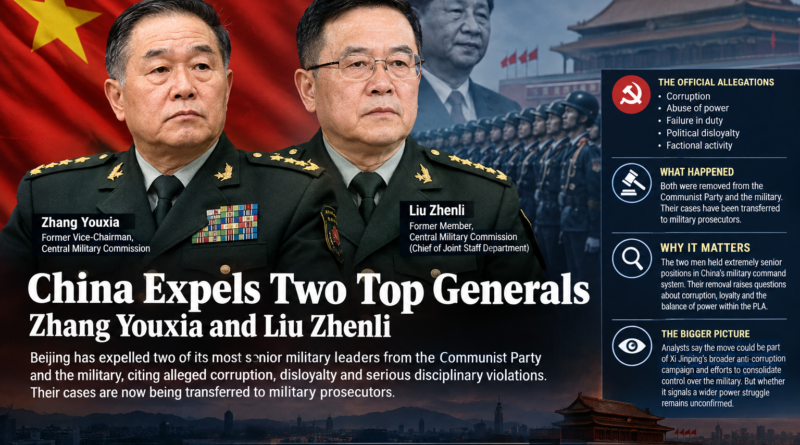
China Expels Two Top Generals: The Story Behind Zhang Youxia and Liu Zhenli
By NYFT World Affairs Desk
September 21, 2026
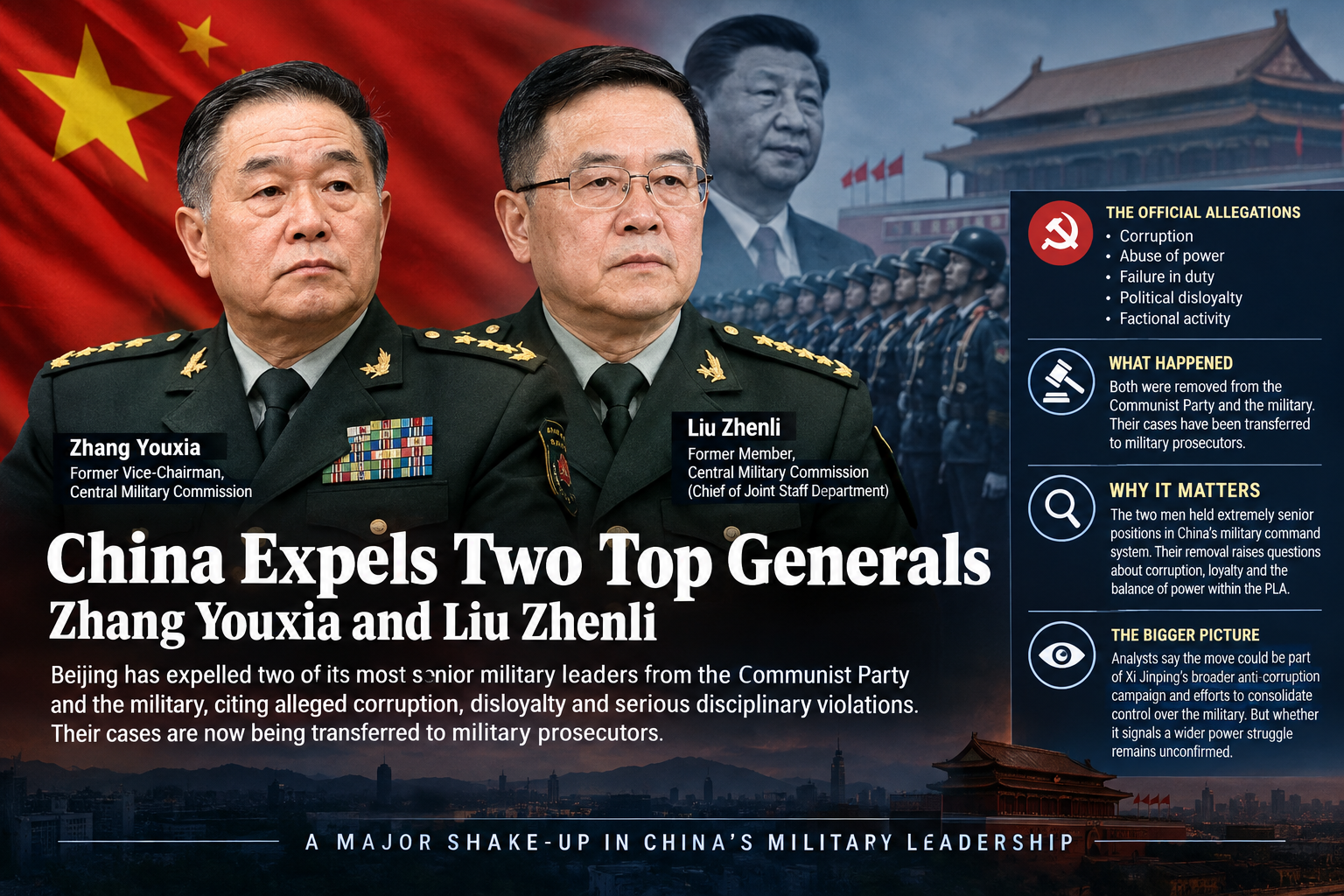
China has taken a dramatic step in the restructuring of its military leadership by expelling two of the country’s most senior generals, Zhang Youxia and Liu Zhenli, from the Communist Party and the People’s Liberation Army. The announcement on September 21, 2026, followed months of investigation and has immediately drawn international attention because both men occupied extremely senior positions inside China’s military command system. Zhang Youxia had served as a vice-chairman of the Central Military Commission, the body through which the Communist Party exercises command over China’s armed forces, while Liu Zhenli had served as a member of the same commission and as chief of its Joint Staff Department. Chinese authorities say their investigations uncovered serious violations involving corruption, abuse of official power, failures in duty, political discipline and the formation of cliques and factions. Their cases have now been transferred to military prosecutors, moving the matter from an internal disciplinary investigation toward a formal legal process.
The significance of this story goes well beyond the removal of two generals. In China’s political system, the military is not simply a separate national institution operating independently of the Communist Party. The People’s Liberation Army is fundamentally under Party control, and the Central Military Commission is at the center of the country’s military command structure. Xi Jinping serves as chairman of the commission, making control over the senior military leadership closely connected to the broader question of political authority in Beijing. When two officers who occupied such senior positions are investigated, removed from the Central Military Commission, expelled from the Party and military, and then referred to military prosecutors, governments and analysts outside China naturally pay close attention. The immediate question is what exactly happened inside the military leadership, while the larger question is what these removals tell the world about corruption, political loyalty, command structures and the concentration of power inside China’s armed forces.
The Story Did Not Begin on September 21
The announcement made on September 21 was the culmination of a process that had been developing for months. The investigation into Zhang Youxia and Liu Zhenli became public in January 2026, when Chinese authorities announced that the two senior military officials were under investigation for serious violations of discipline and law. At that stage, Beijing did not publicly provide every detail of the allegations, leaving outside observers to watch for further developments. Over the following months, the two men disappeared from important military and political activities, and their positions became increasingly uncertain. By August, both had been removed from the Central Military Commission. The September announcement then completed another major step by declaring that they were being expelled from the Communist Party and the military and that their cases would be transferred to military prosecutors. This timeline matters because it shows that the September decision was not an overnight political event; it was the public conclusion of a months-long investigation that gradually moved from suspicion to removal and then toward prosecution.
Zhang Youxia’s position makes the development particularly notable. He was not an ordinary PLA officer and was not simply another general caught in a routine disciplinary investigation. He was one of the highest-ranking figures in China’s military leadership and had served as a vice-chairman of the Central Military Commission. For years, outside observers regarded Zhang as a particularly important figure because of his long experience inside the Chinese military and his relationship with Xi Jinping. Reuters has described him as a close military ally of Xi. That background creates one of the most striking aspects of the story: a senior officer who had been regarded as close to China’s top leader is now being accused by the Chinese authorities of serious political and disciplinary violations. That does not by itself prove that Zhang became politically opposed to Xi or that he attempted to challenge Xi’s leadership, but it explains why the case has generated far more attention than an ordinary corruption investigation involving a lower-ranking official.
Liu Zhenli’s position was also significant. He served on the Central Military Commission and was chief of its Joint Staff Department, placing him within the senior operational leadership of the People’s Liberation Army. His responsibilities were connected to military planning, operations and coordination, so his removal alongside Zhang affects two highly important parts of China’s senior military establishment. For international observers, this raises questions about how Beijing will reorganize senior command responsibilities and whether the new leadership will represent continuity or a broader change in the way the PLA is managed. At this stage, however, it would be premature to assume that the personnel changes automatically represent a change in China’s military strategy. Leadership changes can be politically significant without immediately producing a different national-security policy.
What China Says Happened
The official Chinese explanation is centered on corruption, abuse of authority, political discipline and serious violations of law and Party rules. Chinese authorities say the investigation found that the two generals accepted large sums of money and used their positions improperly. The accusations also go beyond financial corruption. Beijing has alleged that they violated political discipline, failed in their official duties and formed cliques or factions. This last part is particularly important because the language used by China’s Communist Party is broader than the language normally associated with a simple bribery investigation. A corruption case can focus on money, contracts or personal enrichment. An allegation involving political disloyalty and faction-building raises a different set of questions about relationships, networks of influence and the authority of the Party over senior officials. Chinese authorities have presented the case as a serious breach of both law and political discipline rather than as an isolated financial scandal.
The accusation of faction-building deserves careful explanation because it can easily be misunderstood outside China. When Chinese authorities say that senior officials formed cliques or factions, they are not necessarily saying that those officials were preparing a military coup. Political factionalism can refer to networks of officials who protect one another, influence promotions, share interests or resist decisions made by the central leadership. In a highly centralized political system, the existence of independent networks of influence inside the military can be viewed as a serious political problem even if there is no evidence of an armed challenge to the country’s leadership. This is why the wording in Beijing’s announcement is important. The Chinese government has accused Zhang and Liu of political disloyalty and factional activity, but the public evidence does not establish that they planned to overthrow Xi Jinping or organize a coup. Those are much stronger claims, and responsible reporting should not turn a political-discipline allegation into an unproven story of an attempted takeover.
Why Analysts Are Talking About a Power Struggle
The phrase “power struggle” has appeared in outside discussions because of the extraordinary seniority of the two men and especially because of Zhang Youxia’s previous relationship with Xi Jinping. In simple terms, a power struggle means competition among influential people or networks over authority, access, policy influence or control of important institutions. In China’s case, control over the military is particularly sensitive because the PLA is one of the most important instruments of state and Party power. If senior military officials develop independent networks of influence, the central leadership has a strong reason to ensure that those networks do not become alternative centers of authority. This is why analysts are examining the case not only through the lens of corruption but also through the broader question of how Xi Jinping maintains control over the military leadership. Reuters has reported that the allegations of disloyalty and faction-building are an important part of the political significance of the case.
But the phrase “power struggle” should not be turned into a definitive explanation when the public evidence does not establish one. There is a major difference between saying that analysts are examining whether an internal struggle over influence exists and saying that a confirmed struggle against Xi Jinping has taken place. The first is an analytical question; the second is a factual claim that would require evidence. At present, the Chinese government has publicly framed the case around corruption, violations of Party discipline, abuse of office, dereliction of duty and political disloyalty. Outside analysts can reasonably ask whether those allegations also reveal deeper tensions within China’s military leadership, but the available information does not establish that Zhang or Liu launched a coup, planned to remove Xi, or controlled a military faction preparing to challenge the government.
The Zhang case is especially interesting because of what it says about political loyalty inside China’s military. If a senior officer who has previously been considered close to the country’s top leader can later become the subject of a major investigation, it demonstrates that personal relationships do not necessarily provide permanent protection from disciplinary action. It could indicate that Xi’s campaign against corruption and political disloyalty reaches even into the highest levels of the military. It could also indicate that China’s leadership is continuing to reorganize networks of influence within the PLA. Another possibility is that corruption, personal networks and political relationships became connected in ways that are difficult for outsiders to see from public information alone. The evidence currently available does not allow one explanation to be declared the complete answer.
The Larger Anti-Corruption Campaign
The removal of Zhang and Liu also fits into a much longer story inside China. Since Xi Jinping became China’s top leader, his administration has conducted a broad campaign against corruption and violations of Communist Party discipline. The campaign has reached government ministries, provincial administrations, state-owned companies and the military. Beijing presents the campaign as an effort to remove corruption, strengthen discipline and protect the effectiveness of the Party and the state. Outside China, researchers and analysts have also studied the campaign as part of a broader process of political centralization and leadership consolidation. These two interpretations can exist at the same time: an anti-corruption campaign can genuinely target corruption while also changing the balance of influence among senior officials. The challenge for international observers is to distinguish what has been documented from what remains an interpretation.
The military has particular importance within this campaign because corruption inside a military organization can affect more than government finances. Military procurement, weapons contracts, promotions, logistics, equipment quality and command appointments can all be influenced by corruption or favoritism. If senior officers use their positions for personal benefit, the consequences can reach operational readiness and institutional trust. That is one reason Beijing has repeatedly emphasized discipline within the PLA. The government’s argument is that removing corrupt officials ultimately strengthens the military. Critics and outside analysts, meanwhile, have raised questions about whether repeated investigations and leadership removals can create uncertainty inside the command structure. Whether the latest removals produce such an effect will become clearer only as new appointments and military decisions emerge.
Does This Mean China’s Military Is Weakening?
There is not enough evidence to make such a broad conclusion. The removal of two senior generals clearly represents a major personnel change, but personnel changes do not automatically mean that an entire military organization is becoming weaker. China’s PLA is a very large institution with extensive command structures, professional personnel and substantial resources. Beijing’s own explanation is that disciplinary action is designed to strengthen the military by removing corruption and enforcing political and organizational discipline. The outside question is whether repeated investigations among senior officers could affect confidence, continuity or decision-making at the top. Both questions are legitimate, but neither should be turned into a prediction about the future strength of the PLA without additional evidence.
For international audiences, the more useful question is what happens next. Who replaces Zhang and Liu? Which officers receive greater authority? Do additional generals come under investigation? Does China’s military activity around Taiwan change? Does Beijing alter its public language toward the United States or other countries? Does the restructuring affect defense procurement or senior promotions? These developments will tell observers much more about the consequences of the current purge than speculation about what may have happened behind closed doors.
Why Washington Is Watching Closely
The United States has a direct interest in China’s military leadership because the U.S.-China relationship is not only an economic relationship. It also involves military competition, Taiwan, the South China Sea, advanced technology, nuclear strategy, regional alliances and the broader balance of power in the Indo-Pacific. Any major change at the top of China’s military leadership therefore receives attention in Washington. However, the removal of Zhang Youxia and Liu Zhenli should not automatically be interpreted as a signal that China’s foreign or military policy has changed. There has been no public announcement establishing that their removal represents a fundamental change in China’s approach to Taiwan, the United States or regional security.
Taiwan is particularly important because China’s military leadership is responsible for planning and preparing for a wide range of contingencies involving the island. Yet it would be premature to say that the latest purge means Beijing will become either more aggressive or less aggressive toward Taiwan. There is currently no established evidence that the removal of these two officers represents a decision to accelerate or abandon any particular Taiwan strategy. The more important indicators will be China’s future military exercises, official statements, deployments, command appointments and defense planning. Those are observable developments that can be measured over time.
The same caution applies to U.S.-China relations. A major military leadership investigation does not automatically mean that diplomatic relations will deteriorate or improve. China’s leadership can conduct a domestic military purge while continuing negotiations and diplomatic engagement with Washington. The timing may attract attention, but timing alone does not prove that one event caused another. International reporting should therefore avoid creating a direct connection between the military expulsions and unrelated diplomatic developments unless governments or reliable evidence establish such a link.
What Happens to Zhang and Liu Now?
The September 21 announcement marks the beginning of another stage rather than the end of the entire process. China has said that the cases will be transferred to military prosecutors. This means that the allegations can move into the military legal system for further review and possible prosecution. It is important to distinguish expulsion from criminal conviction. Being removed from the Communist Party and military is a political and disciplinary action. A criminal conviction would require a separate legal process. Therefore, it would be inaccurate to say that Zhang and Liu have already received prison sentences simply because they have been expelled from the Party and military.
The eventual legal proceedings could provide additional information about the allegations, including the financial conduct involved, the alleged abuse of authority and the nature of the political violations described by Chinese authorities. If Beijing releases more details, international observers will be able to compare those findings with the earlier public statements. Until then, some of the most important questions surrounding the case remain unanswered.
What the World Should Watch Next
The next phase of this story will probably be more revealing than the announcement itself. The first thing to watch is China’s appointment of replacements and the professional backgrounds of the officers who receive new responsibilities. If Beijing promotes officials with particular operational, technological or political backgrounds, that could provide clues about the priorities of the next phase of military leadership. The second issue is whether additional senior officers are investigated. If more cases appear, the September announcement could prove to be part of a much broader restructuring. If no major additional cases emerge, the current action may remain relatively concentrated around the individuals already named.
The third area to watch is Taiwan and China’s wider military activity. Changes in the frequency, location or character of military exercises could become important indicators, although individual exercises should not automatically be interpreted as evidence of a new strategy. The fourth area is China’s relationship with Washington and other major powers. Statements from the Pentagon, the White House, China’s Ministry of Defense and China’s Foreign Ministry will help establish whether the leadership changes are affecting external policy. Finally, the legal process involving Zhang and Liu could reveal whether the case is primarily being treated as a corruption investigation, a political-discipline case, or a combination of both.
The Bigger Story
At its core, the removal of Zhang Youxia and Liu Zhenli is a story about how power, discipline and military command operate inside modern China. The official Chinese account is that two senior generals committed serious violations involving corruption, abuse of office, dereliction of duty, political disloyalty and factional activity. The government has taken the extraordinary step of removing them from both the Party and the military and transferring their cases to military prosecutors. Those are the documented developments.
The broader political interpretation is more complicated. Because Zhang Youxia was one of China’s most senior military figures and had been regarded as close to Xi Jinping, his removal raises questions about how China’s leadership defines political loyalty and how Xi manages relationships within the PLA. Outside analysts are examining whether the case reflects a wider struggle over influence and control, but that remains an analytical interpretation rather than a proven account of a coup or organized attempt to remove Xi from power.
For the international community, the most important lesson may be that China’s military leadership is continuing to experience significant internal change. The consequences will not necessarily become visible immediately. They may emerge through new appointments, military exercises, defense procurement decisions, diplomatic statements and future investigations. For the United States and its allies, understanding those changes will be important because China’s military decisions have consequences far beyond China’s borders, particularly in the Indo-Pacific.
For now, the clearest conclusion is also the most defensible one: China has removed two of its most senior military leaders after a months-long investigation, accusing them of serious corruption, political and disciplinary violations, and factional activity. Their cases have entered the military prosecution process. The extraordinary seniority of the two officers, and Zhang Youxia’s previously reported closeness to Xi Jinping, make the case significant for understanding the continuing evolution of China’s military leadership. But claims of a confirmed coup, attempted overthrow or definitive internal power struggle go beyond what the publicly available evidence currently establishes.
That distinction matters because the story is important enough on its own. China does not need an unproven coup narrative for the removal of two top generals to be a major international development. The real story is the changing structure of China’s military leadership, the continuing reach of Xi Jinping’s discipline and anti-corruption campaign, and the unanswered question of what the next generation of PLA leadership will mean for China’s domestic politics and its relationship with the rest of the world.
Here is the ready-to-copy Sources section for your WordPress article:
Sources
This article is based on reporting and background research concerning the September 21, 2026 removal of Zhang Youxia and Liu Zhenli from China’s Communist Party and military leadership.
- Reuters — Reporting on China’s expulsion of Zhang Youxia and Liu Zhenli and the allegations of corruption, disloyalty and other violations.
- Al Jazeera — Coverage of the removal of the two senior Chinese military leaders and the broader implications for China’s military leadership.
- Institute for Security and Development Policy (ISDP) — Background analysis of the investigations involving senior Chinese military officials.
Clickable source links:
- Reuters — China expels two top generals
- Al Jazeera — China expels two top military leaders
- ISDP — Background analysis
Government Sources
This article uses official Chinese government and military sources for the documented announcements concerning Zhang Youxia and Liu Zhenli.
- China Ministry of National Defense — September 21, 2026
Official announcement concerning the expulsion of Zhang Youxia and Liu Zhenli from the Communist Party and military and the transfer of their alleged criminal cases to military procuratorial authorities.
Ministry of National Defense of China — Official Announcement - China Ministry of National Defense — January 2026
Official announcement concerning the investigation into Zhang Youxia and Liu Zhenli.
Ministry of National Defense of China — Investigation Announcement - China Ministry of National Defense — August 2026
Official announcement concerning the removal of Zhang Youxia and Liu Zhenli from their Central Military Commission positions.
Ministry of National Defense of China — Central Military Commission Announcement - China Military Online / Xinhua
Official English-language report concerning the September 21, 2026 disciplinary action.
China Military Online — Official Report
Editorial Note
Official Chinese government sources are used to document what Chinese authorities announced and alleged. Any discussion of an internal power struggle, factional competition or political implications should be understood as analysis rather than established fact unless independently supported by evidence.
