
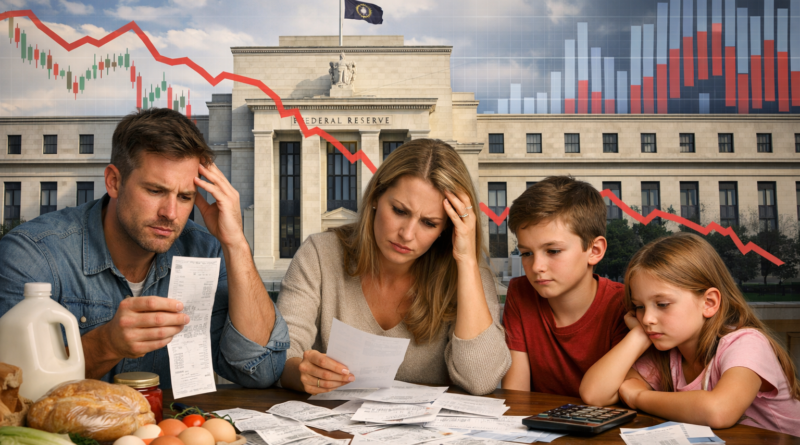
Inflation and Interest Rates 2026: How Rising Prices Shape Federal Reserve Policy, Markets and American Households
Part 4 of 6 — Fed & Interest Rates Series
Updated: October 8, 2026
By: NYFT News Desk
Introduction
Inflation is one of the most important words in the U.S. economy.
Americans hear it when grocery bills increase.
They see it when rent becomes more expensive.
They feel it when insurance premiums rise.
They notice it when restaurant meals cost more.
Businesses experience it through higher wages, materials, transportation and financing costs.
Investors watch it because inflation can influence interest rates, Treasury yields, stock valuations, corporate profits and the U.S. dollar.
And the Federal Reserve watches it because inflation is central to monetary policy.
The relationship can be summarized simply:
Inflation rises → the Fed may keep rates higher or raise them.
Inflation falls sustainably → the Fed may have more room to lower rates.
But real-world inflation is much more complicated.
The Federal Reserve does not respond to one grocery bill, one gasoline-price increase or one monthly inflation report.
Officials examine broad measures of prices, underlying trends, inflation expectations, employment, economic growth and financial conditions.
As of October 8, 2026, the latest available Personal Consumption Expenditures price data showed headline PCE inflation at 3.4% in August 2026, compared with the Fed’s longer-run 2% objective. Core PCE inflation, which excludes food and energy, was 3.0%.
That gap between actual inflation and the Fed’s target helps explain why inflation remains such an important issue for monetary policy.
Key Takeaways
- Inflation means a broad increase in the prices of goods and services over time.
- The Federal Reserve’s longer-run inflation goal is 2%, measured by the annual change in the PCE price index.
- The Fed watches both headline and core inflation.
- Core inflation excludes food and energy to provide a view of underlying price pressures.
- Higher inflation can encourage the Fed to maintain restrictive monetary policy.
- Lower and more stable inflation can give the Fed more flexibility to reduce rates.
- Inflation does not have one single cause.
- Demand, wages, housing, energy, supply chains, tariffs, services and expectations can all matter.
- Interest rates can influence demand but cannot directly produce more oil, homes or computer chips.
- Inflation can fall without prices falling.
- A slowdown in inflation means prices are rising more slowly; it does not necessarily mean prices are becoming cheaper.
- As of August 2026, PCE inflation remained above the Fed’s 2% target.
- The Fed’s September 2026 projections placed median 2026 PCE inflation at 3.7% and core PCE inflation at 3.4%.
1. What Is Inflation?
Inflation is a broad increase in the prices of goods and services over time.
Suppose a basket of everyday goods and services costs $100 one year.
A year later, the same basket costs $104.
The price level has increased.
The inflation rate is approximately 4%.
The important word is broad.
If only the price of one product rises, that does not necessarily mean the economy is experiencing broad inflation.
For example, if a hurricane damages orange crops and orange prices jump, that is a price shock.
If prices across housing, transportation, healthcare, restaurants, services and many other categories rise broadly, that is more consistent with economy-wide inflation.
The Federal Reserve explains inflation as a general increase in the overall price level rather than simply an increase in the cost of one product.
2. Inflation Does Not Mean Every Price Rises
This is another important beginner concept.
Inflation can be 3% even if:
- gasoline prices fall,
- some electronics become cheaper,
- airline tickets decline,
- clothing prices remain flat.
Why?
Because inflation measures the overall movement in prices across a broad basket.
Some prices rise.
Some prices fall.
Some remain unchanged.
The resulting index provides an estimate of the general change in prices.
3. Inflation Versus the Cost of Living
People often use “inflation” and “cost of living” interchangeably.
They are related but not identical.
Inflation measures changes in prices.
The cost of living describes the amount of money a household needs to maintain a particular standard of living.
A family can experience a rising cost of living even when inflation is slowing.
For example:
Year 1: prices rise 6%.
Year 2: prices rise 3%.
Inflation has slowed dramatically.
But prices are still generally higher than they were before.
That distinction is critical.
4. Disinflation Is Not Deflation
These three terms are often confused.
Inflation
Prices are generally rising.
Disinflation
Prices are still rising, but at a slower rate.
Deflation
The overall price level is falling.
For example:
Scenario A
Inflation falls from 6% to 3%.
That is disinflation.
Prices are still rising.
Scenario B
Inflation falls from 3% to -1%.
That would indicate deflation.
The Federal Reserve generally seeks low and stable inflation, not persistent deflation.
5. Why the Fed Wants 2% Inflation
The Federal Reserve has a longer-run inflation objective of 2%, measured by the annual change in the PCE price index.
The Fed says 2% inflation is most consistent over the longer run with its mandate for maximum employment and price stability.
Why 2%?
A low, positive inflation rate can provide room for the economy to adjust to shocks without creating the risks associated with prolonged deflation.
Stable inflation also makes it easier for households and businesses to plan.
They can make decisions about:
- saving,
- borrowing,
- investment,
- hiring,
- pricing,
- wages,
- long-term contracts.
6. Why the Fed Uses PCE Inflation
The Federal Reserve pays particular attention to the Personal Consumption Expenditures price index, or PCE.
PCE measures changes in prices paid for goods and services purchased by consumers in the United States.
The Fed prefers PCE because the index captures a broad range of consumer spending and can adjust more quickly to changes in consumer behavior.
For example, if consumers switch from an expensive product to a cheaper alternative, PCE can better reflect those changing spending patterns.
7. PCE Versus CPI
Americans also hear about the Consumer Price Index, or CPI.
CPI and PCE both measure inflation, but they are constructed differently.
CPI
Produced by the Bureau of Labor Statistics.
PCE
Produced by the Bureau of Economic Analysis.
The Federal Reserve places particular emphasis on PCE.
This does not mean CPI is unimportant.
Financial markets closely monitor both.
Investors also study other measures of inflation to understand the broader trend.
8. What Is Core Inflation?
Core inflation generally excludes:
- food,
- energy.
The reason is not that food and energy do not matter.
They matter enormously to households.
The reason is that those prices can be highly volatile.
Oil prices can move sharply because of geopolitical developments.
Food prices can change because of weather, agricultural conditions and supply disruptions.
By excluding those categories, analysts can get a clearer picture of some underlying price pressures.
The latest August 2026 data showed core PCE inflation at 3.0% year over year.
9. Why Food and Energy Still Matter
Imagine a family spends a large part of its budget on:
- gasoline,
- electricity,
- groceries.
If energy prices suddenly rise, the family has less money available for other purchases.
That can affect:
- restaurants,
- entertainment,
- clothing,
- travel,
- retail spending.
Energy can therefore influence the broader economy even when it is excluded from core inflation.
This is why the Fed does not simply ignore food and energy.
10. Headline Inflation Versus Core Inflation
Headline inflation
Includes the full basket, including food and energy.
Core inflation
Excludes food and energy.
Both provide information.
Suppose headline inflation jumps because oil prices rise sharply.
If core inflation remains stable, policymakers may interpret the situation differently than if both headline and core inflation accelerate.
That is why investors should examine the details.
11. What Causes Inflation?
There is no single cause.
Inflation can result from:
- strong consumer demand,
- supply shortages,
- labor-market tightness,
- rising wages,
- energy shocks,
- housing shortages,
- tariffs,
- transportation costs,
- commodity prices,
- currency movements,
- changing inflation expectations.
Often, several causes happen at the same time.
12. Demand-Pull Inflation
Demand-pull inflation occurs when demand for goods and services grows faster than supply can keep up.
Imagine an economy where consumers suddenly have much more purchasing power.
They spend heavily.
Businesses become busy.
Factories operate near capacity.
Restaurants become crowded.
Workers become harder to find.
Companies raise prices.
That is a simplified example of demand-driven inflation.
Higher interest rates can reduce this type of pressure by making borrowing more expensive and slowing demand.
13. Cost-Push Inflation
Cost-push inflation occurs when the cost of producing goods and services increases.
Examples include:
- higher oil prices,
- higher wages,
- more expensive raw materials,
- shipping disruptions,
- tariffs,
- electricity costs,
- supply shortages.
Businesses may pass some of these higher costs to customers.
The result can be higher prices.
Interest rates cannot directly lower the global price of crude oil.
This is one limitation of monetary policy.
14. Housing and Inflation
Housing is a major part of household budgets.
Housing-related costs can influence inflation significantly.
If rents rise rapidly, households have less disposable income.
Home prices can also affect consumer behavior.
People who own valuable homes may feel wealthier.
People trying to buy homes may feel financially squeezed.
High mortgage rates can reduce housing affordability even if they eventually help slow demand.
15. Services Inflation
Goods prices receive a lot of attention.
But services are also important.
Services include:
- healthcare,
- restaurants,
- transportation,
- insurance,
- education,
- personal care,
- financial services,
- entertainment.
Service prices can be influenced by wages because many services require human labor.
That is why labor-market conditions are closely connected to inflation analysis.
16. Wage Growth and Inflation
Wage growth is not automatically inflationary.
Higher wages can reflect:
- higher productivity,
- stronger worker demand,
- improved skills,
- demographic changes.
If workers become more productive, companies may be able to pay higher wages without significantly increasing prices.
The concern arises when wage growth remains significantly above productivity growth while businesses pass higher labor costs through to consumers.
That can create persistent service-price pressure.
17. The Wage-Price Spiral
A wage-price spiral is a situation in which:
prices rise → workers demand higher wages → businesses raise prices → workers demand still higher wages → prices rise again.
Economists debate how frequently true wage-price spirals occur and how powerful they are.
The important point is that inflation expectations can become embedded in wage and pricing decisions.
That makes inflation harder to bring down.
18. Inflation Expectations
Inflation is partly about what people expect.
Suppose businesses believe prices will rise 5% next year.
They may raise prices today.
Workers may demand larger wage increases.
Consumers may accelerate purchases before prices rise further.
Those behaviors can reinforce inflation.
This is why central banks care about keeping long-term inflation expectations anchored.
The Federal Reserve has said that well-anchored expectations around 2% support price stability and the ability to respond to economic disturbances.
19. Why Expectations Matter So Much
Imagine two economies.
Economy A
People expect 2% inflation.
Economy B
People expect 7% inflation.
Even before prices actually rise, behavior can differ.
In Economy B:
- workers may seek larger raises,
- businesses may increase prices,
- consumers may buy earlier,
- lenders may demand higher rates.
That can make inflation more persistent.
20. How Interest Rates Fight Inflation
The basic mechanism is:
Higher rates → higher borrowing costs → lower interest-sensitive demand → slower economic activity → less pricing pressure.
This is not immediate.
Monetary policy works through financial conditions and economic behavior.
It can take time before higher rates meaningfully affect:
- home purchases,
- business investment,
- hiring,
- consumer borrowing,
- spending.
21. Why Higher Rates Cannot Fix Every Inflation Problem
Suppose oil prices jump because of a major geopolitical disruption.
The Federal Reserve cannot create additional oil.
Suppose semiconductor production falls because of a factory shutdown.
The Fed cannot manufacture chips.
Suppose housing supply is limited.
The Fed cannot immediately build millions of homes.
Higher interest rates can reduce demand.
They cannot directly solve every supply problem.
That is one reason monetary policy requires careful judgment.
22. The Risk of Over-Tightening
If the Fed raises rates too aggressively, demand can weaken excessively.
That can lead to:
- slower GDP growth,
- lower business investment,
- weaker housing activity,
- rising unemployment,
- lower consumer spending.
This is why policymakers face a difficult balancing act.
They want inflation to fall.
But they do not want to create unnecessary economic damage.
23. The Risk of Under-Tightening
The opposite problem is also serious.
If inflation remains high and the Fed keeps policy too easy:
- inflation expectations can rise,
- wages can accelerate,
- businesses can keep raising prices,
- inflation can become persistent.
The Fed may then need to tighten even more aggressively later.
That could produce a more painful economic adjustment.
24. Inflation and the Federal Funds Rate
The relationship can be visualized simply:
Inflation rises
↓
Fed becomes more concerned
↓
Fed keeps rates higher
↓
Borrowing becomes more expensive
↓
Demand slows
↓
Economic pressure eases
↓
Inflation gradually falls
But the real economy is not a machine.
The chain can be interrupted by:
- oil shocks,
- tariffs,
- fiscal policy,
- global events,
- productivity changes,
- supply disruptions.
25. What Happens When Inflation Falls?
Falling inflation can create room for the Fed to lower interest rates.
But policymakers generally want confidence that inflation is moving sustainably toward target.
One good monthly inflation report is not enough.
Officials look for a trend.
For example:
One month of lower inflation
is different from:
Six or twelve months of sustained disinflation.
The second provides much stronger evidence of a lasting trend.
26. Inflation Can Fall While Prices Remain High
This is one of the most misunderstood concepts.
Suppose:
Year 1 prices rise 8%.
Year 2 prices rise 4%.
Year 3 prices rise 2%.
Inflation has fallen sharply.
But prices remain much higher than they were before.
This explains why Americans can say:
“Inflation is falling, but everything is still expensive.”
Both statements can be true.
27. Why Americans May Still Feel Inflation
Official inflation measures represent the economy as a whole.
Individual households have different spending patterns.
One family may spend heavily on:
- rent,
- childcare,
- healthcare.
Another may spend more on:
- gasoline,
- travel,
- restaurants.
Their personal experience with inflation can therefore differ from the national average.
28. Inflation and Real Wages
Suppose wages rise 4%.
But inflation rises 5%.
The worker’s nominal paycheck increased.
But purchasing power may have declined.
Now suppose wages rise 5% while inflation is 2%.
Real purchasing power may improve.
This is why economists monitor both:
nominal wage growth
and
inflation.
29. Inflation and Savings
Inflation reduces the purchasing power of money over time.
If you keep $10,000 in cash and inflation averages 3%, that money will buy less in the future.
This is why savers care about the relationship between:
interest earned
and
inflation.
A savings account paying 4% while inflation is 3% produces a positive nominal return and, roughly speaking, a positive return before taxes after accounting for inflation.
But taxes and actual inflation experienced by the household also matter.
30. Inflation and Bonds
Inflation is particularly important for bond investors.
Suppose you own a bond paying a fixed coupon.
If inflation rises unexpectedly, the purchasing power of those interest payments falls.
That is why investors often demand higher yields when they expect higher inflation.
Higher expected inflation can therefore push longer-term bond yields higher.
31. Inflation and Stocks
The relationship between inflation and stocks is complicated.
Moderate inflation can coexist with healthy economic growth.
But high and persistent inflation can create problems.
Companies may face:
- higher labor costs,
- higher materials costs,
- higher transportation costs,
- higher financing costs.
If companies cannot pass those costs to customers, profit margins can decline.
32. Pricing Power
A company’s ability to raise prices without losing customers is called pricing power.
Companies with strong brands or unique products may have more pricing power.
For example, if a company sells a product customers consider essential or difficult to replace, it may be able to increase prices.
Companies operating in highly competitive markets may have less flexibility.
During inflationary periods, investors often pay close attention to pricing power.
33. Inflation and Technology Companies
Technology companies can have different inflation exposures.
Some have:
- high margins,
- strong recurring revenue,
- significant cash reserves,
- relatively low physical input costs.
Others may depend heavily on:
- chips,
- electricity,
- data centers,
- labor,
- infrastructure.
AI investment has also become an important economic theme.
The Fed’s September 2026 meeting materials discussed strong capital investment and productivity growth, while also noting demand associated with AI investment as one factor in the economic outlook.
34. Inflation and Small Businesses
Small businesses can be particularly sensitive to inflation.
A restaurant may face:
- higher food costs,
- higher wages,
- higher rent,
- higher insurance,
- higher electricity costs.
If the owner raises prices too much, customers may leave.
If prices are not raised enough, profit margins shrink.
This creates a difficult operating environment.
35. Inflation and the U.S. Consumer
Consumers experience inflation through everyday purchases.
Important categories include:
- housing,
- food,
- energy,
- transportation,
- healthcare,
- insurance,
- education,
- entertainment.
The impact depends on household income and spending patterns.
Lower-income households can be especially sensitive to increases in essential expenses because necessities represent a larger share of their budgets.
36. Why Gasoline Prices Get So Much Attention
Gasoline is highly visible.
Consumers see the price every time they visit a gas station.
Oil prices can move quickly because of:
- geopolitical events,
- production decisions,
- global demand,
- supply disruptions,
- inventories,
- transportation issues.
Gasoline can also influence transportation and delivery costs throughout the economy.
But one gasoline-price spike does not automatically mean persistent broad inflation.
37. Energy Shocks and the Fed
Suppose oil rises sharply.
The Fed has a difficult choice.
If policymakers raise rates aggressively to offset the economic effects of higher energy prices, they may reduce demand too much.
If they ignore the shock entirely, broader inflation expectations could become unanchored.
The correct response depends on whether the shock appears temporary or persistent and whether it spreads into broader inflation.
38. Tariffs and Inflation
Tariffs can affect prices because they can increase the cost of imported goods or inputs.
The ultimate effect depends on:
- who bears the cost,
- exchange rates,
- supply chains,
- business margins,
- consumer demand,
- substitution toward domestic products.
The September 2026 FOMC minutes discussed tariff-related inflation risks as part of the policy assessment.
For investors, this means trade policy can become relevant to monetary-policy expectations.
39. Supply Chains and Inflation
Supply disruptions became a major economic lesson during the early 2020s.
If factories shut down or transportation becomes constrained, supply can fall.
If demand remains strong while supply falls, prices can rise.
Central banks can reduce demand through higher rates.
But that does not immediately restore the missing supply.
This is why supply-driven inflation can be difficult for monetary policy.
40. Global Inflation
The U.S. economy does not operate alone.
Inflation can be influenced by:
- global commodity prices,
- foreign exchange rates,
- international trade,
- overseas demand,
- shipping costs,
- geopolitical developments.
A major international shock can therefore affect U.S. prices even when domestic demand is stable.
41. Why the Fed Watches Global Developments
The Federal Reserve’s mandate is focused on the U.S. economy.
But global events can affect U.S. financial conditions.
For example:
A geopolitical crisis can increase oil prices.
Higher oil prices can increase inflation.
Higher inflation can influence Fed policy expectations.
Those expectations can affect Treasury yields.
Treasury yields can affect financial conditions.
Financial conditions can affect stocks.
One global event can therefore travel through multiple channels.
42. Inflation and the Labor Market
The labor market matters because wages are an important business cost.
When employers have difficulty finding workers, they may raise wages.
Higher wages can support consumer demand.
Higher demand can support business revenue.
But if wage growth remains high while productivity does not keep pace, companies may raise prices.
This is one reason the Fed watches employment and inflation together.
43. Productivity Can Change the Inflation Equation
Productivity measures how efficiently the economy produces goods and services.
Suppose workers become significantly more productive.
A company may be able to pay higher wages without raising prices as much.
That can create a healthier environment:
Higher wages + higher productivity + stable prices.
This is one reason strong productivity growth can be positive for both workers and businesses.
44. Inflation and Economic Growth
Inflation and growth can move together.
A strong economy can produce:
- strong consumer demand,
- high employment,
- strong wages.
That can support prices.
But growth itself is not necessarily inflationary.
If supply and productivity expand rapidly enough, the economy can grow without excessive inflation.
The Fed therefore watches both sides of the equation.
45. The September 2026 Inflation Picture
The September 2026 Fed projections showed median PCE inflation of:
3.7% in 2026
2.3% in 2027
2.1% in 2028
2.0% in 2029
The corresponding median core PCE projections were:
3.4% in 2026
2.5% in 2027
2.2% in 2028
2.0% in 2029.
This tells investors something important.
Policymakers expected inflation to improve over time, but not immediately return to 2%.
46. Why 3% Inflation Is Still Important
Some people might look at 3% inflation and think:
“That is close enough to 2%.”
For the Federal Reserve, the difference matters.
Persistent inflation above target can influence:
- wage negotiations,
- business pricing,
- bond yields,
- household expectations,
- interest-rate decisions.
A central bank wants inflation expectations to remain anchored.
47. The August 2026 PCE Report
The latest available PCE report as of October 8 came from the August 2026 data release.
The BEA reported:
- headline PCE: 3.4% year over year
- core PCE: 3.0% year over year
- monthly PCE price index: +0.3%
- monthly core PCE: +0.2%.
Consumer spending was also strong in August.
Current-dollar PCE increased 0.9% during the month, while real PCE increased 0.6%.
That combination matters.
Inflation remained elevated while consumer spending remained relatively strong.
48. Why the October 29 PCE Report Matters
The BEA has scheduled the September 2026 Personal Income and Outlays report for October 29, 2026.
That release is important because it will provide another look at:
- PCE inflation,
- core PCE,
- consumer spending,
- personal income,
- savings.
It will also arrive after the October 27–28 FOMC meeting.
That means the timing matters.
The September inflation data may not be available before that October FOMC meeting.
49. Inflation Before an FOMC Meeting
Investors often examine the most recent available data before a Fed decision.
They ask:
Is inflation accelerating?
Is inflation slowing?
Is core inflation sticky?
Are services prices still rising?
Are wages accelerating?
Are inflation expectations rising?
These questions help determine whether policy is likely to remain restrictive.
50. What Is Sticky Inflation?
Sticky inflation means price increases remain persistent rather than quickly disappearing.
Some categories can remain elevated for long periods.
Services are often considered more persistent than certain volatile goods prices.
If inflation is sticky, the Fed may become cautious about cutting rates too quickly.
51. Why the Fed Fears Persistent Inflation
Imagine inflation falls from 5% to 3%.
That is significant progress.
But if inflation remains stuck around 3% for years, the Fed may worry that 3% has become embedded.
Households and businesses may begin planning around higher inflation.
That can make returning to 2% more difficult.
52. Why Cutting Rates Too Early Can Be Risky
Suppose inflation is falling but remains above target.
The Fed cuts rates aggressively.
Financial conditions become easier.
Consumers spend more.
Businesses invest more.
Asset prices rise.
Demand strengthens.
Inflation could stop falling.
The Fed might then need to reverse course.
This is sometimes called the risk of easing too early.
53. Why Keeping Rates Too High Can Also Be Risky
Now consider the opposite.
Inflation is falling rapidly.
The labor market begins weakening.
The Fed keeps rates very high for too long.
Businesses reduce hiring.
Consumers cut spending.
Unemployment rises.
The economy slows sharply.
This is the risk of keeping policy too restrictive for too long.
54. The Fed’s Balancing Act
The Fed essentially faces three broad possibilities.
Scenario 1: Inflation too high
Keep policy restrictive or tighten further.
Scenario 2: Inflation near target and economy balanced
Hold and observe.
Scenario 3: Inflation falling while economic weakness increases
Consider easing policy.
The challenge is identifying which scenario is actually developing.
55. Inflation and Treasury Yields
Inflation expectations are a major factor in bond markets.
If investors expect inflation to remain high, they may demand higher yields.
If inflation expectations decline, Treasury yields can fall.
But Treasury yields also depend on:
- economic growth,
- government borrowing,
- Fed policy expectations,
- global demand,
- risk sentiment.
This relationship will receive deeper treatment in Part 5 of this series.
56. Inflation and the U.S. Dollar
Higher U.S. inflation can influence expectations for Fed policy.
If investors believe inflation will force the Fed to maintain higher rates, U.S. yields may become more attractive.
That can support the dollar.
But the dollar also depends on monetary policy abroad and global risk sentiment.
Therefore:
Higher inflation does not automatically mean a stronger dollar.
The entire policy outlook matters.
57. Inflation and Gold
Gold is often discussed as an inflation hedge.
But gold does not rise every time inflation increases.
Gold also responds to:
- real interest rates,
- dollar movements,
- geopolitical risk,
- investor demand,
- central-bank activity.
When real yields rise, gold can face pressure because gold does not pay interest.
Again, one economic variable rarely explains an entire market.
58. Inflation and Real Interest Rates
The real interest rate is approximately:
Nominal interest rate − inflation
For example:
A 5% nominal rate with 3% inflation gives a rough real rate of 2%.
Real rates matter because they provide a better sense of the purchasing-power-adjusted cost of borrowing or return on an asset.
59. Why Real Rates Matter to the Fed
If inflation is high, a nominal policy rate may not be particularly restrictive in real terms.
Suppose:
Fed funds rate = 4%
Inflation = 4%
The simple real rate is approximately 0%.
Now imagine:
Fed funds rate = 4%
Inflation = 2%.
The simple real rate is approximately 2%.
The second environment is substantially more restrictive in real terms.
This is one reason inflation trends matter so much to monetary policy.
60. Inflation and Credit Conditions
Higher inflation and higher rates can make credit more expensive.
Banks may become more cautious.
Businesses may reduce borrowing.
Consumers may postpone large purchases.
Credit conditions can therefore reinforce monetary policy.
But financial institutions also respond to their own assessment of credit risk.
61. Inflation and Consumer Confidence
High inflation can damage consumer confidence.
People may feel that their income is not keeping up with prices.
They may cut discretionary spending.
That can affect businesses.
On the other hand, strong wage growth can partially offset the impact.
Therefore, analysts watch:
- wages,
- inflation,
- real income,
- consumer spending.
62. Inflation and Real Consumer Spending
The August 2026 BEA data showed real PCE increased 0.6% from the previous month.
That means consumer spending, after adjusting for price changes, remained relatively strong.
This matters because inflation can slow spending, but strong real spending can indicate continued consumer resilience.
63. Inflation and Business Investment
Inflation can create uncertainty.
Businesses may struggle to estimate future costs.
A company planning a factory may not know what construction materials, wages and financing will cost next year.
High uncertainty can cause businesses to delay investment.
However, strong demand and high expected returns can still encourage investment.
64. Inflation and Corporate Profits
Inflation can affect both revenue and costs.
Suppose a company raises prices by 5%.
Revenue may increase.
But if wages, materials and transportation costs rise by 6%, profit margins can shrink.
Therefore, investors should not look at revenue alone.
They should examine:
- gross margins,
- operating margins,
- labor costs,
- input costs,
- pricing power.
65. Why Inflation Is Different for Every Sector
Consider several industries.
Energy
Highly sensitive to commodity prices.
Airlines
Sensitive to fuel, labor and demand.
Banks
Sensitive to interest rates and credit conditions.
Technology
Sensitive to valuation, capital costs and investment trends.
Consumer staples
Often have stronger pricing power but face input costs.
Homebuilders
Highly sensitive to mortgage rates and construction costs.
Utilities
Sensitive to financing costs and regulated pricing.
Inflation therefore affects sectors differently.
66. Inflation and the Stock Market: The Big Picture
Stocks generally prefer:
low, stable inflation
rather than:
very high or highly unpredictable inflation.
Low and stable inflation allows companies and investors to plan.
Very high inflation can create uncertainty.
But moderate inflation can coexist with strong economic growth.
The market reaction therefore depends on the level, direction and expectations.
67. What Happens if Inflation Falls Faster Than Expected?
Markets may begin pricing in lower interest rates.
Potential consequences can include:
- lower Treasury yields,
- higher bond prices,
- increased expectations for Fed cuts,
- stronger interest in rate-sensitive stocks.
But if inflation falls because the economy is collapsing, stocks may not benefit.
Again, the cause matters.
68. What Happens if Inflation Rises Faster Than Expected?
Markets may begin pricing in:
- fewer Fed cuts,
- more restrictive policy,
- higher Treasury yields,
- tighter financial conditions.
Stocks can become volatile.
Growth stocks may be particularly sensitive if valuations are high.
69. Inflation Surprise Versus Inflation Level
Suppose inflation is 3%.
If investors expected 3%, there may be little surprise.
If investors expected 2.5%, 3% could be a negative surprise.
If investors expected 3.5%, 3% could be positive.
Therefore, markets care about:
actual data versus expectations.
This principle applies to almost every major economic report.
70. Why One Inflation Report Should Not Dictate an Investment Strategy
Monthly economic data can be noisy.
Revisions can occur.
Seasonal patterns can affect results.
Temporary price changes can distort the picture.
Investors should look for trends.
A single number can be important.
But a sequence of numbers is usually more informative.
71. The Three Questions Investors Should Ask
Whenever a new inflation report is released, ask:
Question 1
Is inflation higher or lower than last month?
Question 2
Is it higher or lower than economists expected?
Question 3
What does it mean for future Fed policy?
These three questions provide a useful framework.
72. How Inflation Changes the Fed’s Rate Path
Imagine inflation is moving:
4.0% → 3.7% → 3.4% → 3.1% → 2.8%
That is a clear disinflationary trend.
The Fed may eventually have more room to cut.
Now imagine:
2.5% → 2.8% → 3.0% → 3.3%
The Fed may become more concerned.
Rate cuts could be delayed.
Additional tightening could become possible.
The trend matters.
73. What “Higher for Longer” Means
When investors say the Fed will keep rates higher for longer, they mean policymakers are expected to maintain relatively restrictive interest rates for an extended period.
This can happen when inflation remains persistent.
Higher-for-longer policy can affect:
- mortgages,
- business financing,
- bonds,
- stocks,
- the dollar,
- savings yields.
74. What “Lower for Longer” Means
Lower-for-longer policy means interest rates remain relatively low for an extended period.
This can support:
- borrowing,
- housing,
- investment,
- asset prices.
But it can also encourage excessive risk-taking if financial conditions become too loose.
75. Inflation and Financial Stability
Inflation can influence financial stability indirectly.
If the Fed responds to inflation with aggressive rate hikes, asset prices can decline.
Bond portfolios can lose value.
Highly leveraged companies may struggle.
Commercial real estate can face financing pressure.
Banks can face credit risks.
This is why monetary policy can have consequences far beyond consumer prices.
76. Inflation and Commercial Real Estate
Commercial real estate is particularly sensitive to financing costs.
Higher interest rates can increase the cost of refinancing properties.
Property valuations can also be affected by higher required returns.
Office buildings, retail centers, industrial properties and apartment complexes can experience different effects depending on demand and location.
Inflation therefore interacts with both property income and financing costs.
77. Inflation and Housing Supply
Interest rates can reduce housing demand.
But they cannot instantly create additional homes.
If the U.S. faces structural housing shortages, monetary policy alone cannot solve affordability.
Higher rates may reduce demand enough to cool prices.
But the supply side remains critical.
78. Inflation and Insurance
Insurance costs can rise because of:
- claims,
- repair costs,
- labor,
- construction materials,
- weather-related losses,
- reinsurance costs.
These price increases may not respond immediately to higher interest rates.
That is another example of why inflation is more complicated than simply “too much money.”
79. Inflation and Healthcare
Healthcare prices are affected by:
- labor,
- pharmaceuticals,
- medical equipment,
- insurance,
- provider costs,
- government policy.
Interest rates can influence the broader economy, but healthcare inflation also has sector-specific drivers.
80. Inflation and Food Prices
Food inflation can result from:
- weather,
- crop conditions,
- transportation,
- fertilizer,
- energy,
- labor,
- global commodity markets.
A central bank cannot control weather.
But it can influence overall demand.
This distinction is important when evaluating Fed policy.
81. Why Inflation Can Be Uneven Across States
The U.S. is not one identical economy.
Housing costs in New York can differ dramatically from housing costs in rural states.
Energy prices can vary.
Wages differ.
Taxes differ.
Insurance costs differ.
Population growth differs.
Therefore, the inflation experience of a household in California may differ significantly from that of a household in Texas, Florida or Indiana.
82. Why National Inflation Still Matters
Despite regional differences, the Fed operates monetary policy for the entire United States.
It therefore relies on national economic indicators.
The national PCE index provides a broad picture.
Regional conditions can still influence the overall economy through migration, employment, housing and consumer spending.
83. Inflation and the Federal Reserve’s Dual Mandate
The Fed does not pursue inflation in isolation.
Its mandate includes maximum employment and price stability.
That creates trade-offs.
If inflation is high and unemployment is low, policymakers may focus more heavily on price stability.
If inflation is falling and unemployment is rising, employment risks can become more important.
The policy response therefore changes with economic conditions.
84. Why 2% Is a Goal, Not a Daily Requirement
The Fed does not expect inflation to be exactly 2.000% every month.
Economic data naturally move around.
Energy prices fluctuate.
Weather changes food prices.
Supply chains change.
Consumer behavior changes.
The objective is to achieve 2% inflation over the longer run.
The Fed describes its objective as longer-run and symmetric around 2%.
85. What Investors Should Watch in Inflation Data
A practical inflation checklist:
Headline PCE
What is the overall inflation rate?
Core PCE
What is happening beneath volatile food and energy prices?
Monthly change
Is inflation accelerating or slowing recently?
Three-month trend
Is the short-term direction changing?
Six-month trend
Is the improvement persistent?
Year-over-year trend
What is the broader picture?
Services
Are service prices remaining sticky?
Goods
Are goods prices accelerating?
Wages
Are labor costs increasing?
Expectations
Do households and businesses expect higher inflation?
86. What American Households Should Watch
For everyday Americans, inflation analysis does not need to be complicated.
Watch your own:
- rent or mortgage,
- grocery costs,
- energy bills,
- insurance,
- transportation,
- healthcare,
- wages,
- savings rate.
Then compare those changes with the broader inflation data.
National averages are useful, but personal finances are personal.
87. What Investors Should Watch Next in 2026
The upcoming calendar is particularly important.
The BEA is scheduled to release:
September 2026 PCE data — October 29, 2026
and
Q3 2026 advance GDP — October 29, 2026.
Those releases will provide important information about both inflation and economic growth.
That makes late October an important period for investors following the Fed.
88. The October 2026 Fed Meeting
The next scheduled FOMC meeting is:
October 27–28, 2026.
The September 2026 meeting minutes showed that inflation remained a significant concern for policymakers.
That means inflation data released before the meeting will be closely watched by markets.
But investors should avoid assuming the outcome in advance.
The Fed’s decision depends on incoming information.
89. A Simple Example of the Fed’s Inflation Problem
Imagine the following economy:
Inflation = 4%
Unemployment = 3.5%
GDP growth = strong
Consumer spending = strong
In this environment, the Fed may be concerned about overheating.
Now change the situation:
Inflation = 2.5%
Unemployment = 5.5%
GDP growth = weak
Consumer spending = falling
The policy conversation would be very different.
The inflation number alone does not determine policy.
90. Another Example: Falling Inflation During a Recession
Suppose inflation falls from 5% to 2%.
That sounds excellent.
But suppose unemployment has also risen from 4% to 8%.
The Fed may need to consider whether monetary policy is too restrictive.
This illustrates why inflation and employment must be analyzed together.
91. Another Example: Inflation Falling Slowly
Suppose:
Inflation = 4%
Then:
3.8%
Then:
3.7%
Then:
3.6%
Progress is occurring.
But the pace may not be fast enough for policymakers to feel comfortable cutting rates aggressively.
This can produce a higher-for-longer environment.
92. Why “Sticky” Inflation Matters for Mortgage Buyers
Suppose inflation remains persistent.
The Fed keeps rates high.
Mortgage rates remain elevated.
A household that hoped for rapid mortgage-rate declines may have to wait.
This is why prospective homebuyers should not base decisions solely on predictions about the next Fed meeting.
93. Why Inflation Matters for Retirees
Retirees can be particularly sensitive to inflation because many expenses are recurring.
If prices rise faster than income or portfolio withdrawals, purchasing power can decline.
Important categories include:
- healthcare,
- housing,
- food,
- insurance.
Retirement planning therefore needs to consider inflation over many years.
94. Inflation and Long-Term Investing
Long-term investors should think about real returns.
A portfolio can gain 7% nominally.
If inflation averages 3%, the purchasing-power gain is lower.
Taxes can reduce it further.
Therefore, the relevant question is not simply:
“How much did my investment rise?”
It is:
“How much did my purchasing power increase?”
95. Inflation and Diversification
Different assets can respond differently to inflation.
Stocks, bonds, real estate, commodities and cash have different characteristics.
Diversification can help reduce dependence on one economic outcome.
But diversification does not eliminate risk.
It also does not guarantee positive returns.
96. Why Investors Should Avoid Inflation Panic
Inflation headlines can generate fear.
But markets often price expected inflation before official data are released.
If inflation comes in exactly as expected, the market reaction may be modest.
Large moves often occur when data surprise investors.
Therefore, investors should avoid making major decisions based solely on emotionally worded headlines.
97. The Difference Between Price Levels and Inflation Rates
This distinction deserves repeating.
Suppose gasoline costs:
$3.00 → $4.00
That is a large price increase.
If gasoline then remains around $4.00 for a year, the price is still high.
But the year-over-year inflation rate for gasoline can fall dramatically if the comparison base catches up.
This is why inflation can fall while consumers still feel that prices are high.
98. Why Base Effects Matter
Inflation is often measured against the same month a year earlier.
If prices jumped sharply last year, the comparison can make today’s inflation rate appear lower.
These are called base effects.
Investors should therefore examine several measures rather than reacting to one percentage.
99. What “Transitory” Inflation Means
Inflation is sometimes described as transitory when policymakers believe a price increase is temporary.
Examples might include:
- temporary supply disruptions,
- one-time reopening effects,
- short-lived commodity shocks.
The difficult part is determining whether inflation is actually temporary.
If temporary shocks begin affecting wages, expectations and services prices, inflation can become more persistent.
100. The Most Important Lesson
Inflation is not simply:
“Prices are high.”
It is about the rate at which the overall price level changes.
That distinction explains many confusing economic headlines.
A household can still face high prices even after inflation falls.
The Federal Reserve’s objective is not to return every price to its previous level.
Its goal is to maintain low and stable inflation over the longer run.
101. Frequently Asked Questions
What is inflation?
Inflation is a broad increase in the prices of goods and services over time.
What inflation rate does the Fed want?
The Federal Reserve’s longer-run goal is 2% inflation as measured by the annual change in the PCE price index.
What was U.S. PCE inflation in August 2026?
The PCE price index increased 3.4% from August 2025 to August 2026.
What was core PCE inflation in August 2026?
Core PCE increased 3.0% year over year in August 2026.
Why does the Fed prefer PCE?
PCE captures a broad range of consumer spending and adapts more readily to changes in consumer behavior.
What is core inflation?
Core inflation generally excludes food and energy to provide a clearer view of underlying price trends.
Does falling inflation mean prices are falling?
No. Falling inflation usually means prices are rising more slowly.
Can higher interest rates reduce inflation?
Yes. Higher rates can reduce demand and financial activity, potentially easing inflationary pressure over time.
Can interest rates fix supply shortages?
Not directly. Higher rates can reduce demand, but they cannot directly create oil, homes, food or semiconductor capacity.
Why does the Fed care about inflation expectations?
Because expectations can influence wage-setting, pricing and spending decisions. Well-anchored expectations can help maintain price stability.
Is 3% inflation dangerous?
The answer depends on how persistent it is and what is causing it. For the Fed, sustained inflation above its 2% objective is an important policy concern.
Why can inflation fall while groceries remain expensive?
Because lower inflation means prices are rising more slowly; it does not mean prices have returned to previous levels.
When is the next U.S. PCE report?
The September 2026 Personal Income and Outlays report, which includes PCE inflation, is scheduled for October 29, 2026.
Conclusion
Inflation is at the center of the Federal Reserve’s interest-rate decisions.
When inflation is too high and persistent, the Fed may keep interest rates restrictive or raise them further.
When inflation is moving sustainably toward the 2% objective and economic conditions weaken, the Fed may have more room to reduce rates.
But the relationship is never automatic.
Inflation can come from demand.
It can come from supply.
It can come from energy.
It can come from housing.
It can come from wages.
It can come from tariffs.
It can come from global events.
And sometimes several forces operate at the same time.
That is why successful Fed analysis requires looking at the entire economic picture.
As of October 8, 2026, the latest available August PCE data showed headline inflation at 3.4% and core inflation at 3.0%, both above the Federal Reserve’s 2% longer-run objective.
The September 2026 Fed projections also showed policymakers expected inflation to decline gradually, with median PCE inflation projected at 3.7% in 2026, 2.3% in 2027, 2.1% in 2028 and 2.0% in 2029.
For American households, the most important lesson is simple:
Lower inflation does not necessarily mean lower prices.
For investors:
The direction of inflation can be just as important as its current level.
For the Federal Reserve:
The challenge is getting inflation back toward 2% without unnecessarily damaging employment and economic growth.
That balancing act will remain one of the most important forces driving U.S. markets and the economy.
Editorial Data Policy
NYFT uses Federal Reserve, U.S. Bureau of Economic Analysis and other official economic sources when reporting inflation and monetary-policy developments.
Inflation figures can be revised as government agencies incorporate new information. Readers should consult the latest official releases when making decisions based on economic data.
The inflation figures in this article reflect information available as of October 8, 2026. The latest available PCE data at that time were for August 2026.
Financial Disclaimer
This article is for educational and informational purposes only.
It is not investment, financial, tax or legal advice.
Inflation, interest rates, stock prices, bond yields, mortgage rates and other economic conditions can change quickly.
Readers should conduct their own research and consider consulting a qualified financial professional before making investment, borrowing or financial-planning decisions.
Past performance does not guarantee future results.
Official Sources
- Federal Reserve — Inflation (PCE)
- Federal Reserve — Why the Fed Targets 2% Inflation
- Federal Reserve — September 2026 Economic Projections
- BEA — Personal Consumption Expenditures Price Index
- BEA — August 2026 Personal Income and Outlays
- BEA — Core PCE Price Index
Part 4 ends here.
Part 5 will focus on Treasury Yields: what Treasury yields are, why they move, how the Fed influences them, why the 2-year and 10-year Treasury matter, yield-curve signals, and what Treasury yields mean for U.S. investors, mortgages, banks, stocks and the economy.
