
U.S. Stock Market Slump: Nasdaq Falls as Amazon and Intel Earnings Raise Fresh Concerns About AI Spending
The U.S. stock market is facing renewed pressure as technology shares lead another wave of selling on Wall Street. Investors who had spent much of the year rewarding companies for their artificial intelligence ambitions are now asking a more difficult question: how much money will these investments actually make? Disappointing earnings and cautious business outlooks from major technology companies, including Amazon and Intel, have added to concerns about the cost of building the next generation of AI infrastructure. The result has been a sharp decline in technology stocks, renewed volatility across major U.S. indexes, and growing debate about whether expectations for the AI boom have moved too far ahead of financial reality.
The latest sell-off is particularly important because it highlights a change in investor behaviour. For much of the recent technology rally, announcements about AI data centers, advanced chips, cloud computing capacity and large infrastructure projects were often enough to support strong share prices. Investors were willing to look beyond immediate costs because they expected artificial intelligence to become a major source of future revenue. That confidence has not disappeared, but the market is becoming more selective. Companies are now being judged not only on how much they spend on AI, but also on whether that spending can produce stronger earnings, sustainable cash flow and attractive returns for shareholders.
Why the Nasdaq Is Under Pressure
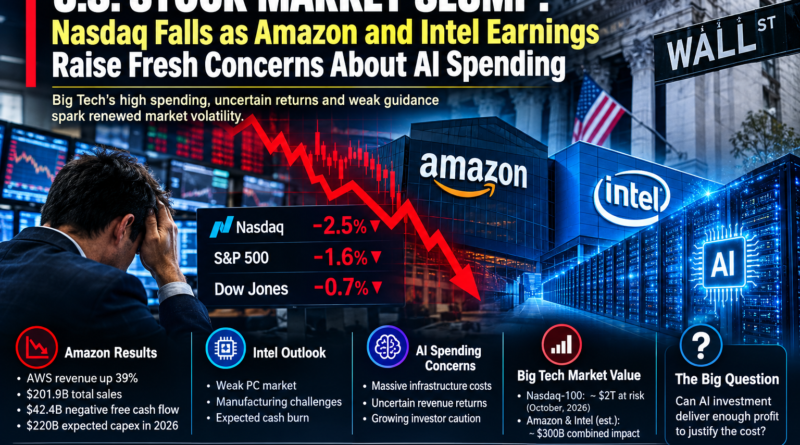
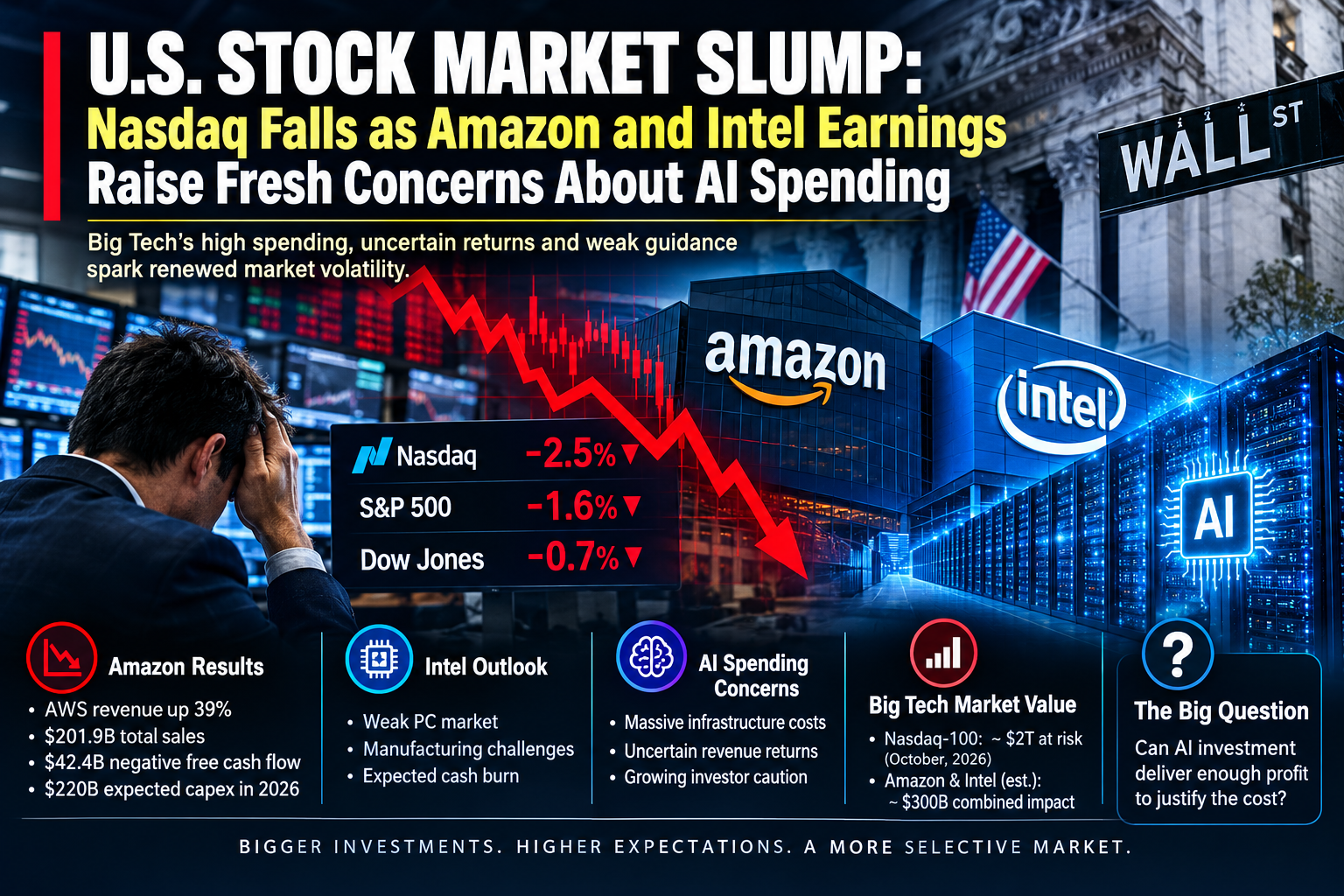
The Nasdaq Composite is especially sensitive to movements in technology and growth stocks. When major technology companies fall, the index can come under significant pressure because many of its largest constituents are technology businesses or companies closely connected to the digital economy. On October 30, 2026, technology shares extended their losses as investors reacted to disappointing results and business outlooks. The Associated Press reported that the Nasdaq fell approximately 2.5% during the session, while the S&P 500 declined around 1.6% and the Dow Jones Industrial Average lost roughly 0.7%.
The difference in performance between these indexes reflects the concentration of selling in technology-related shares. The Dow has exposure to major industrial, financial, healthcare and consumer businesses, while the Nasdaq has a much larger sensitivity to technology valuations. When investors reduce exposure to expensive growth stocks, the Nasdaq can experience a deeper decline than the broader market.
This does not automatically mean that the U.S. economy is entering a recession or that every technology company is facing serious financial trouble. Stock indexes move in response to expectations, earnings forecasts, interest rates, valuations and investor positioning. A company can report strong revenue growth and still see its shares fall if investors expected even better results or believe future spending will reduce profitability.
Amazon’s Results Put AI Investment Under the Spotlight
Amazon has become one of the central companies in the latest debate about AI spending. Its cloud computing division, Amazon Web Services, remains an important part of the company’s long-term growth strategy. AWS reported third-quarter 2026 net sales of $46 billion, an increase of 39.3% from the same period a year earlier. Amazon also reported total quarterly net sales of $201.9 billion and operating income of $28.1 billion.
Those figures show that Amazon continues to operate a large and growing business. However, investors are also looking closely at the amount of money the company is spending to expand its infrastructure.
Amazon reported negative free cash flow of $42.4 billion for the twelve months ending September 30, 2026, compared with positive free cash flow of $14.8 billion in the previous comparable twelve-month period. The company attributed the change primarily to a substantial increase in purchases of property and equipment, much of it connected to artificial intelligence investment. Amazon also said it expected cash capital expenditure of approximately $220 billion for 2026.
This is where the market’s concern becomes understandable. Building data centers, purchasing advanced processors, expanding electricity capacity and developing cloud infrastructure require enormous amounts of capital. These investments may support future growth, but the cash is spent today while the full financial benefits may take years to emerge.
Amazon’s challenge is not simply to build more AI capacity. It must also demonstrate that customers are willing to pay enough for the services running on that infrastructure. Strong AWS growth is encouraging, but investors want to understand how much additional profit and cash flow will eventually come from the investment.
The company’s outlook also matters. When management signals that capital spending could remain elevated or increase further, investors may begin adjusting their expectations for future free cash flow. A business can be growing quickly while still facing pressure on the cash available for debt reduction, shareholder returns and other investments.
In my view, Amazon’s latest results illustrate the difference between business growth and investor satisfaction. The company can report impressive cloud growth and still face a share-price decline if the market believes the cost of achieving that growth is becoming too high.
Intel Adds Another Layer of Pressure to Technology Stocks
Intel’s latest outlook has added to the negative mood across the technology sector. The semiconductor company is navigating several challenges, including weakness in the personal computer market, manufacturing difficulties and the cost of expanding its production capabilities.
Investors were particularly concerned by Intel’s warning that it expected to burn cash during the year. A cash-burn warning is important because semiconductor manufacturing requires significant investment in factories, equipment, research and development. These costs can remain high even when demand is not strong enough to support the expected level of revenue.
Intel’s situation also demonstrates that the AI opportunity is not equally beneficial for every technology company. Demand for artificial intelligence infrastructure has increased the importance of advanced processors, accelerators, memory and networking equipment. However, companies must still compete on manufacturing efficiency, product performance, pricing and customer demand.
A company cannot benefit from the AI boom simply because it operates in the semiconductor industry. It must produce products that customers need, deliver them at competitive costs and convert demand into profitable sales.
The market reaction to Intel’s outlook therefore reflects more than a single earnings report. It highlights concerns about the cost of competing in an industry where technological progress requires continuous investment and where manufacturing problems can quickly affect financial performance.
The Bigger Concern: AI Spending Is Growing Faster Than Investor Patience
The most important issue behind the current market weakness is the scale of investment taking place across the AI industry. Major technology companies are competing to build data centers, secure computing capacity, develop AI models and expand cloud services. These projects are designed to support future demand, but they require substantial spending before the full revenue opportunity becomes clear.
For investors, the calculation is becoming more complicated. A company may announce a multibillion-dollar investment and describe it as essential for future competitiveness. But shareholders still need to know how the project will affect earnings, cash flow and returns on invested capital.
The market is effectively asking three questions.
First, how much revenue will AI services generate? Second, how much will it cost to operate the infrastructure behind those services? Third, will the resulting profits justify the money being invested today?
These questions are especially important because AI infrastructure is not a one-time expense. Data centers require electricity, cooling systems, networking equipment, maintenance and regular hardware upgrades. Advanced processors can become outdated as new generations arrive. Companies may also need to spend more to secure energy supplies and expand physical infrastructure.
This means the long-term cost of AI competition could be much larger than the initial construction budget. Businesses must plan for operating expenses as well as capital expenditure.
The concern is not that artificial intelligence has no commercial value. AI is already being used in software development, customer service, business automation, data analysis, cybersecurity and cloud computing. The uncertainty is whether the revenue generated by these services will be large enough to support the industry’s enormous infrastructure commitments.
Nearly $900 Billion? Understanding the Market-Value Headlines
Large market-value figures can be confusing because different reports may refer to different indexes, companies and time periods. Investors should distinguish between the potential combined market-value decline of individual companies and the wider decline across a stock index.
Reuters reported on October 30 that Amazon and Intel together could lose approximately $300 billion in market value if their share-price declines held. The same report said the Nasdaq-100 was on track to erase roughly $950 billion that day, adding to an estimated $1.4 trillion decline in market value earlier in October.
Separately, Reuters reported that the Nasdaq-100 had fallen more than 5.8% during October, putting more than $2 trillion in market value at risk as investors reassessed the financial returns from AI investment.
These figures should not be mixed together or presented as if they describe the same companies and period. Market capitalization changes when share prices move; it is not the same as cash physically leaving a company’s bank account. A fall in market value reflects a change in what investors are willing to pay for the company’s shares.
The distinction matters because a dramatic headline can make a market decline sound like a direct loss of operating cash. In reality, market capitalization is a valuation measure, while free cash flow is a measure of cash generated by a business after capital expenditure.
Both are important, but they tell investors different things.
One of the most misunderstood parts of the stock market is the relationship between company performance and share-price performance.
Investors do not buy a stock based only on what a company earned in the previous quarter. They buy it based on what they believe the company will earn in the future compared with the price they are paying today.
Suppose a company reports revenue growth of 20%. That may look impressive. But if investors expected growth of 25%, the report could disappoint. The same principle applies to profit margins, cash flow, customer growth and future guidance.
Valuation also matters. A company with strong growth prospects can still be vulnerable if its share price already assumes years of exceptional performance. When expectations become extremely high, even a relatively small disappointment can trigger a large decline.
This is particularly relevant to AI-related stocks. Some investors have paid premium valuations because they expect these companies to become major winners in the next phase of technology development. If spending rises faster than revenue or profitability, those valuations may come under pressure.
That does not necessarily mean the underlying businesses are weak. It means the market may be reconsidering the price it is willing to pay for future growth.
What This Means for the Broader U.S. Economy
A technology-led stock market decline does not automatically translate into an economic downturn. The U.S. economy includes many industries beyond technology, and consumer spending, employment, housing, manufacturing, services and business investment all influence economic activity.
However, a prolonged decline in major technology stocks can have wider effects.
Retirement accounts and investment portfolios may be affected because many Americans have exposure to large technology companies through index funds, mutual funds and exchange-traded funds. A decline in technology valuations can therefore influence household wealth, even among investors who do not directly own individual technology stocks.
Businesses may also become more cautious if financial markets remain volatile. Companies that rely on capital markets to fund expansion could face higher financing costs or greater scrutiny from lenders and investors. Startups and smaller technology firms may find it harder to raise money if investors become less willing to finance projects with uncertain returns.
There can also be an effect on business confidence. When the largest companies in the market begin questioning the economics of major investment plans, smaller businesses may reconsider their own spending decisions.
Still, it would be premature to conclude that the latest technology sell-off signals a broad collapse in the U.S. economy. The market reaction is currently focused heavily on earnings expectations, AI investment costs and company-specific guidance.
Interest Rates and the Cost of Building AI Infrastructure
Interest rates are another important part of the story. Large technology companies can finance investment through operating cash flow, debt issuance or a combination of both. When borrowing costs are high, expensive infrastructure projects become more difficult to justify.
A data center project may generate revenue over many years, but the company must pay construction and financing costs much earlier. If interest rates remain elevated, the cost of funding that project can reduce its expected return.
Investors therefore pay attention to both the amount of capital expenditure and the financial environment in which that spending takes place.
Higher borrowing costs can also affect valuations. Growth companies are often valued partly on expected future earnings. When interest rates rise, investors may place a lower present value on profits expected many years from now. This can put pressure on high-growth stocks even when their current businesses remain profitable.
For AI infrastructure companies, the challenge is to generate enough revenue and operating profit to justify the combined cost of hardware, energy, buildings, networking and financing.
Is the AI Boom Ending, or Is the Market Becoming More Selective?
The latest decline should not be interpreted as proof that artificial intelligence is becoming irrelevant. The technology may continue to change how companies operate, how software is developed and how customers interact with businesses.
What appears to be changing is the market’s approach to valuing AI-related investment.
During the early stages of a major technology shift, investors often focus on opportunity. They look at the size of the potential market and the possibility that a small group of companies could dominate a new industry. As the technology matures, attention moves toward execution, competition, pricing and profitability.
That transition can be uncomfortable for investors because the companies receiving the most attention may not necessarily become the most profitable businesses.
Some firms may spend heavily but struggle to earn attractive returns. Others may benefit by selling chips, cloud capacity, software tools or specialist services without taking on the same level of infrastructure risk.
The long-term winners will likely be determined by their ability to turn technological advantages into repeatable revenue and sustainable profits.
In other words, AI adoption and AI investment returns are not the same thing. The first can grow rapidly while the second takes longer to materialize.
What Investors Should Watch Next
Investors following the U.S. market should look beyond daily index movements and pay attention to several financial indicators.
Free cash flow: This helps show how much cash remains after a company pays for capital expenditure. A growing business with sharply declining free cash flow deserves closer examination.
Capital expenditure guidance: Investors should compare planned spending with expected revenue growth. Rising investment is not automatically negative, but the expected return should be clear.
Cloud revenue growth: Cloud services can provide recurring revenue for companies investing in AI infrastructure. The rate of growth and the profitability of these services are both important.
Operating margins: Higher revenue does not always translate into higher profit. Margins can reveal whether a company is controlling costs as it expands.
Debt and financing costs: Companies relying increasingly on borrowing to fund infrastructure may face greater pressure if interest rates remain high.
Customer demand: Announcements about new AI products are useful, but actual customer adoption, contracts and recurring payments provide stronger evidence of commercial success.
Management guidance: Investors should compare management’s future expectations with previous forecasts and actual performance. Guidance can influence share prices as much as the latest reported earnings.
These indicators can help investors separate temporary market sentiment from changes in a company’s underlying financial position.
My Editorial View: Wall Street Is Asking a Necessary Question
The current technology sell-off may look dramatic, but the question behind it is reasonable. Artificial intelligence has the potential to become one of the most important technologies of this generation. That does not mean every investment made in its name will automatically generate a strong return.
Amazon’s latest results show that cloud demand can remain strong while investment spending places pressure on free cash flow. Intel’s outlook demonstrates that semiconductor companies still face manufacturing, demand and capital-allocation challenges. Together, these developments remind investors that technology growth requires more than ambitious announcements.
In my view, the market is moving from an excitement-driven phase toward a financial-results phase. Investors want proof that AI investment can create durable revenue, protect margins and generate cash. Companies that demonstrate those results may continue to attract capital, while businesses that spend heavily without showing a convincing path to profitability could face further valuation pressure.
This shift does not mean the AI opportunity is over. It means the standard for investment decisions is becoming more demanding.
The most important lesson for investors is to avoid treating every market decline as a buying opportunity or every technology announcement as a reason to purchase a stock. A falling share price does not automatically make a company undervalued. Equally, a strong company can remain expensive if its market valuation already assumes exceptional future growth.
Investors should examine business fundamentals, cash flow, debt, competitive position and valuation before making decisions. They should also consider their investment time horizon and risk tolerance rather than reacting to every headline.
What Could Happen to the U.S. Stock Market Next?
The next direction of the market will depend on how investors interpret upcoming earnings reports, company guidance, economic data and interest-rate expectations. If technology companies demonstrate that AI investment is producing strong customer demand and improving financial returns, confidence could recover.
On the other hand, if spending continues to rise while free cash flow and profit expectations weaken, technology shares could remain under pressure. The market may also become more selective, rewarding companies with strong balance sheets and measurable earnings growth rather than businesses relying mainly on future promises.
A recovery is possible, but it may not happen evenly across the technology sector. Companies with established revenue streams, strong customer relationships and disciplined capital allocation could perform differently from businesses still trying to prove their commercial models.
For now, investors should pay close attention to earnings quality rather than focusing only on headline revenue growth or AI-related announcements.
Final Thoughts
The latest U.S. stock market slump is a reminder that even the most powerful technology companies are not immune to investor scrutiny. Amazon and Intel have become important examples of the questions facing the technology sector: how much should companies spend to remain competitive, how quickly can that spending produce returns, and how much risk should shareholders accept while waiting for those returns?
Artificial intelligence may continue to reshape business and the global economy, but the financial success of individual companies will depend on execution. Building infrastructure is only one part of the opportunity. Turning that infrastructure into profitable products and services is the harder test.
Wall Street is not necessarily rejecting AI. It is demanding stronger evidence that the investment can pay for itself. That distinction may define the next stage of the technology market.
This article is for informational and educational purposes only. It is not investment advice or a recommendation to buy or sell any security. Market prices and company guidance can change. Readers should review current financial disclosures and consider their own circumstances before making investment decisions.
Sources and Further Reading
- Amazon – Third Quarter 2026 Financial Results
- Reuters – Nasdaq Faces $2 Trillion Wipeout in October as AI Spending Fears Deepen
- Reuters – Nasdaq Futures Tumble as Amazon and Intel Results Deepen AI Spending Woes
- Associated Press – The Sell-Off for Tech Stocks Worsens and Overwhelms Wall Street
- Charles Schwab – Running Scared: Amazon, Intel Put Tech on Defense
