
President Trump Holds 19-Minute Press Gaggle Before Manila Arrival: China, NVIDIA, Ukraine and US Foreign Policy Dominate Discussion
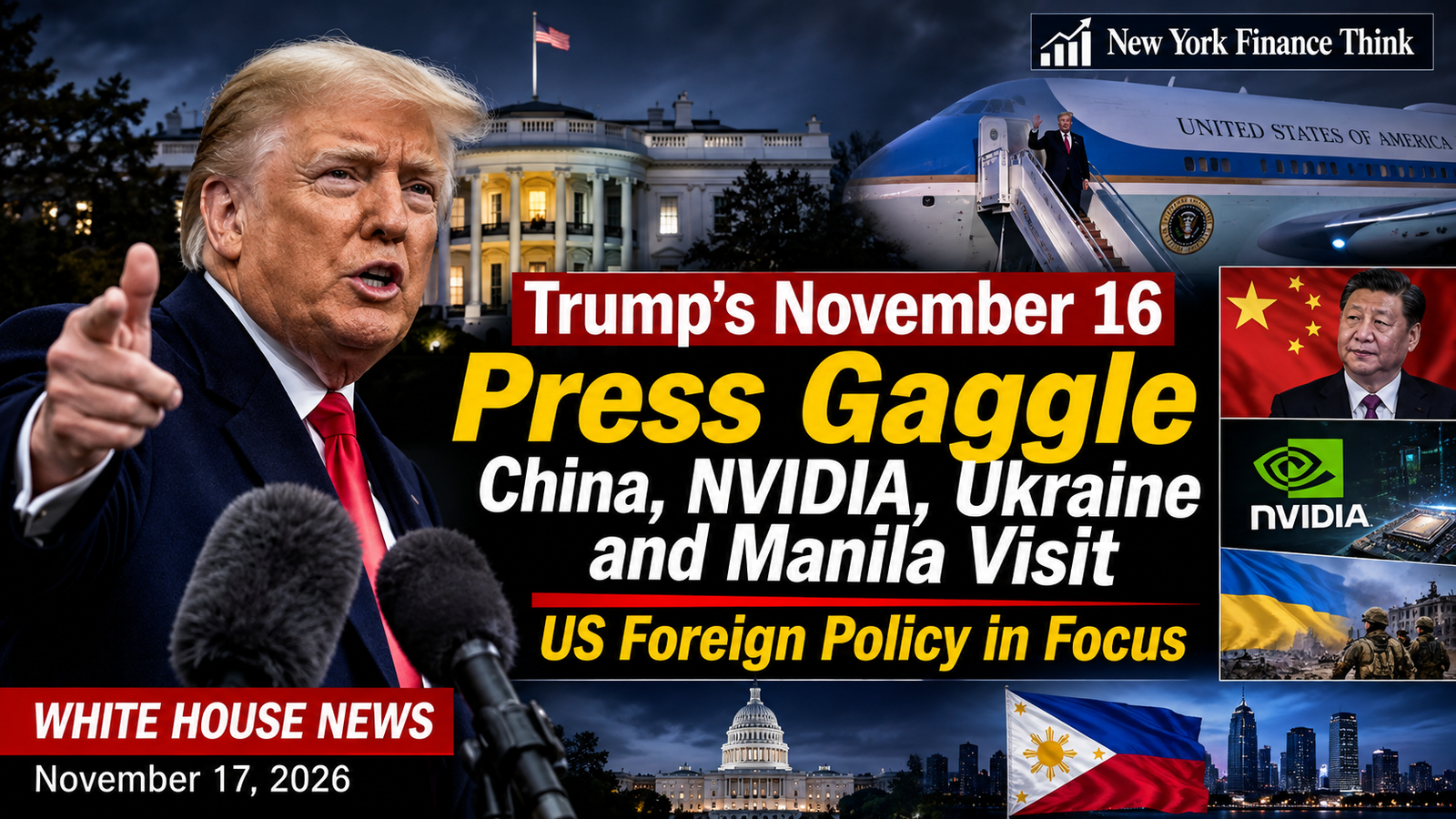
WASHINGTON, D.C. | November 17, 2026 | White House News | New York Finance Think
President Donald Trump spoke with reporters during a 19-minute press gaggle outside the White House on Monday, November 16, 2026, shortly before departing Washington for Manila, Philippines. The president was expected to arrive in the Philippine capital on Tuesday, November 17, as part of his international diplomatic engagements.
The exchange covered a broad range of domestic and international issues, including America’s relationship with China, advanced semiconductor technology, NVIDIA, the Russia-Ukraine war, Iran, immigration, aviation infrastructure and the administration’s international diplomatic priorities.
According to reporting and coverage referenced from Anadolu Agency and PBS NewsHour, the departure-day exchange provided an opportunity for journalists to question Trump about his administration’s policies and upcoming international discussions.
Rather than focusing exclusively on the Philippines visit, the conversation moved across several important subjects that could influence America’s economic, political and diplomatic direction.
Contents
- 1. US-Philippines Relations and International Diplomacy
- 2. China Relations and NVIDIA Semiconductor Technology
- 3. Discussions Involving Xi Jinping and Vladimir Putin
- 4. America’s Aviation Infrastructure and Air Traffic Control Modernization
- 5. Russia-Ukraine War and International Security
- 6. Iran and Middle East Security
- 7. Immigration Policy and US Domestic Politics
- 8. Mexico, Immigration and Trade Pressure
- 9. White House Renovation and Presidential Priorities
- 10. What These Developments Could Mean for the American Economy
- 11. Three Major Issues to Watch
- 12. Final Analysis
US-Philippines Relations and International Diplomacy
The Philippines remains an important partner for the United States in the Indo-Pacific region. Its strategic geographic position, economic relationships and security partnerships make it an important participant in regional diplomatic discussions.
Trump’s departure for Manila comes at a time when Washington is managing complicated relationships with several major international powers, particularly China and Russia.
Economic cooperation, international trade, regional security and diplomatic coordination are among the issues attracting attention.
The president also referred to possible discussions involving China, Russia and North Korea. These subjects demonstrate the wider international context surrounding the administration’s diplomatic agenda.
For the United States, maintaining strong relationships across Asia is important not only for security but also for trade, technology, investment and long-term economic cooperation.
China Relations and NVIDIA Semiconductor Technology
Relations between Washington and Beijing remain one of the most important issues in international economic policy.
During the press exchange, Trump discussed different approaches within his administration toward China, including questions surrounding trade, advanced technology and semiconductor exports.
NVIDIA and its advanced Blackwell chips also featured in the discussion. The president referred to NVIDIA CEO Jensen Huang and the sensitive issue of advanced semiconductor technology exports.
The semiconductor industry has become a major area of competition between the world’s largest economies.
Advanced chips are essential for artificial intelligence, data centers, cloud computing, autonomous systems and other emerging technologies.
For American technology companies, government export restrictions can influence international sales opportunities, research investment and long-term business strategies.
Investors will continue watching how Washington approaches semiconductor exports and whether future decisions create additional opportunities or restrictions for American technology businesses.
Discussions Involving Xi Jinping and Vladimir Putin
Trump also addressed possible discussions with Chinese President Xi Jinping and Russian President Vladimir Putin.
The subjects mentioned included international security, nuclear disarmament, Iran, the Russia-Ukraine war and broader diplomatic relationships.
The possibility of discussions involving North Korean leader Kim Jong Un was also raised.
These subjects represent some of the most complicated diplomatic challenges facing the international community.
Nuclear security remains an important concern for governments around the world. Meanwhile, tensions involving Russia, Ukraine and other regional powers continue to influence international security and economic expectations.
Although Trump discussed potential diplomatic conversations, such statements should not be interpreted as confirmation that agreements have already been reached.
America’s Aviation Infrastructure and Air Traffic Control Modernization
Another significant issue involved America’s aviation infrastructure.
Trump was questioned about aviation disruptions and concerns surrounding outdated air traffic control technology.
The president criticized the age of parts of the existing system and emphasized the importance of modernization.
The United States operates one of the world’s largest aviation networks. Its airports, airlines, air traffic control systems and supporting infrastructure are essential to the national economy.
Outdated technology can create operational challenges, making modernization an important long-term investment priority.
Replacing aging equipment requires funding, technical planning, coordination and cooperation between federal agencies and Congress.
The discussion highlighted the importance of maintaining reliable aviation infrastructure while ensuring that the transportation network can support future demand.
Russia-Ukraine War and International Security
The Russia-Ukraine war also featured in the press exchange.
Trump discussed the conflict and its continuing human and economic costs. He suggested that the possibility of ending the war could feature in conversations with international leaders.
The conflict has consequences extending beyond the countries directly involved.
Energy markets, international trade, military spending, food security and financial markets have all been affected by developments surrounding the war.
For American policymakers, the challenge involves balancing diplomatic opportunities, national security priorities and the economic implications of continued instability.
However, discussions about ending the conflict do not automatically indicate that a peace agreement is close. Any lasting settlement would depend on negotiations and the positions of the parties involved.
Iran and Middle East Security
Iran was another subject raised by reporters.
Trump indicated that Iran could feature in future diplomatic conversations. Questions also touched on security concerns involving Iranian drones and wider regional developments.
The Middle East remains strategically important for American foreign policy because of its energy resources, shipping routes, regional alliances and security challenges.
Any significant escalation in the region could affect international oil prices, shipping costs and global financial markets.
Energy investors and businesses therefore continue to monitor developments involving Iran and other regional powers.
Immigration Policy and US Domestic Politics
The press exchange also covered domestic political issues, including immigration enforcement and Republican election performance.
Trump discussed the possibility of immigration legislation while emphasizing strong border enforcement requirements.
He indicated that any legislative proposal would need to address enforcement and would not involve amnesty.
The president also responded to questions about Republican political setbacks and the administration’s wider domestic agenda.
Immigration remains a major issue in American political discussions, affecting border communities, employers, workers and federal policymakers.
Future legislative developments could influence labor markets, business operations and government spending.
Mexico, Immigration and Trade Pressure
Relations with Mexico were also discussed in connection with migration and border enforcement.
Trump referred to the possibility of additional tariffs if Mexico failed to take sufficient action to prevent migrant caravans from reaching the United States.
The comments illustrate how immigration and trade policy can become interconnected in negotiations between neighboring countries.
Mexico is one of America’s most important trading partners. Any significant trade restrictions could affect manufacturers, agricultural businesses, transportation companies and consumers on both sides of the border.
Businesses will be watching for official policy announcements and the possibility of new trade negotiations.
White House Renovation and Presidential Priorities
Journalists also questioned Trump about White House construction and renovation projects.
The discussion included improvements to the presidential residence, its exterior, the helipad and plans for a ballroom.
Trump defended the projects and rejected criticism concerning their priorities and costs.
The exchange demonstrated how questions about presidential spending and government priorities can become part of wider political debates.
What These Developments Could Mean for the American Economy
Although the press gaggle was primarily political and diplomatic, several subjects have direct economic implications.
Technology and artificial intelligence: Semiconductor export policies could affect NVIDIA and other American technology companies operating in international markets.
Energy markets: Developments involving Iran, Russia and the Middle East could influence oil prices, transportation costs and inflation expectations.
Infrastructure investment: Modernizing America’s aviation network could create opportunities for technology suppliers, engineering businesses and infrastructure contractors.
International trade: Relations with China, Mexico and the Philippines could influence American exporters, manufacturers and international investors.
Geopolitical uncertainty: Diplomatic developments involving major world powers could influence investor confidence and financial market volatility.
These are potential economic implications rather than confirmed market outcomes.
Three Major Issues to Watch
- US-China technology relations: Future semiconductor export decisions and artificial intelligence competition will remain important for American technology businesses.
- International diplomatic developments: Discussions involving the Philippines, China, Russia and North Korea could influence America’s foreign policy priorities.
- Domestic infrastructure and immigration policy: Federal funding, aviation modernization and immigration legislation will remain important issues for the American economy.
Final Analysis
President Donald Trump’s November 16 press gaggle offered a wide-ranging look at the issues confronting his administration before its international engagement in the Philippines.
Although the upcoming Manila visit provided the immediate setting, the questions extended far beyond Southeast Asia.
China, NVIDIA, artificial intelligence, Russia, Ukraine, Iran, aviation infrastructure, immigration and international trade all featured in the discussion.
For American citizens, businesses and investors, these subjects matter because decisions made in Washington can influence economic opportunities, national security, international partnerships and financial market expectations.
The next important development will be whether the administration turns its diplomatic statements into specific agreements, policy announcements or measurable commitments.
New York Finance Think will continue monitoring White House announcements, international diplomacy, American economic policy and global financial developments.
Editorial disclosure: This article distinguishes presidential statements and reported discussions from independently verified policy decisions. Potential diplomatic meetings and outcomes should not be treated as confirmed agreements.
