
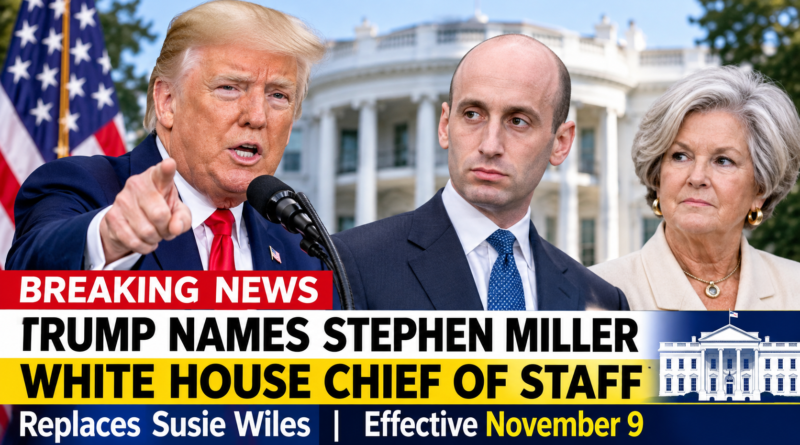
Trump Appoints Stephen Miller as White House Chief of Staff, Replacing Susie Wiles After Republican Midterm Defeats
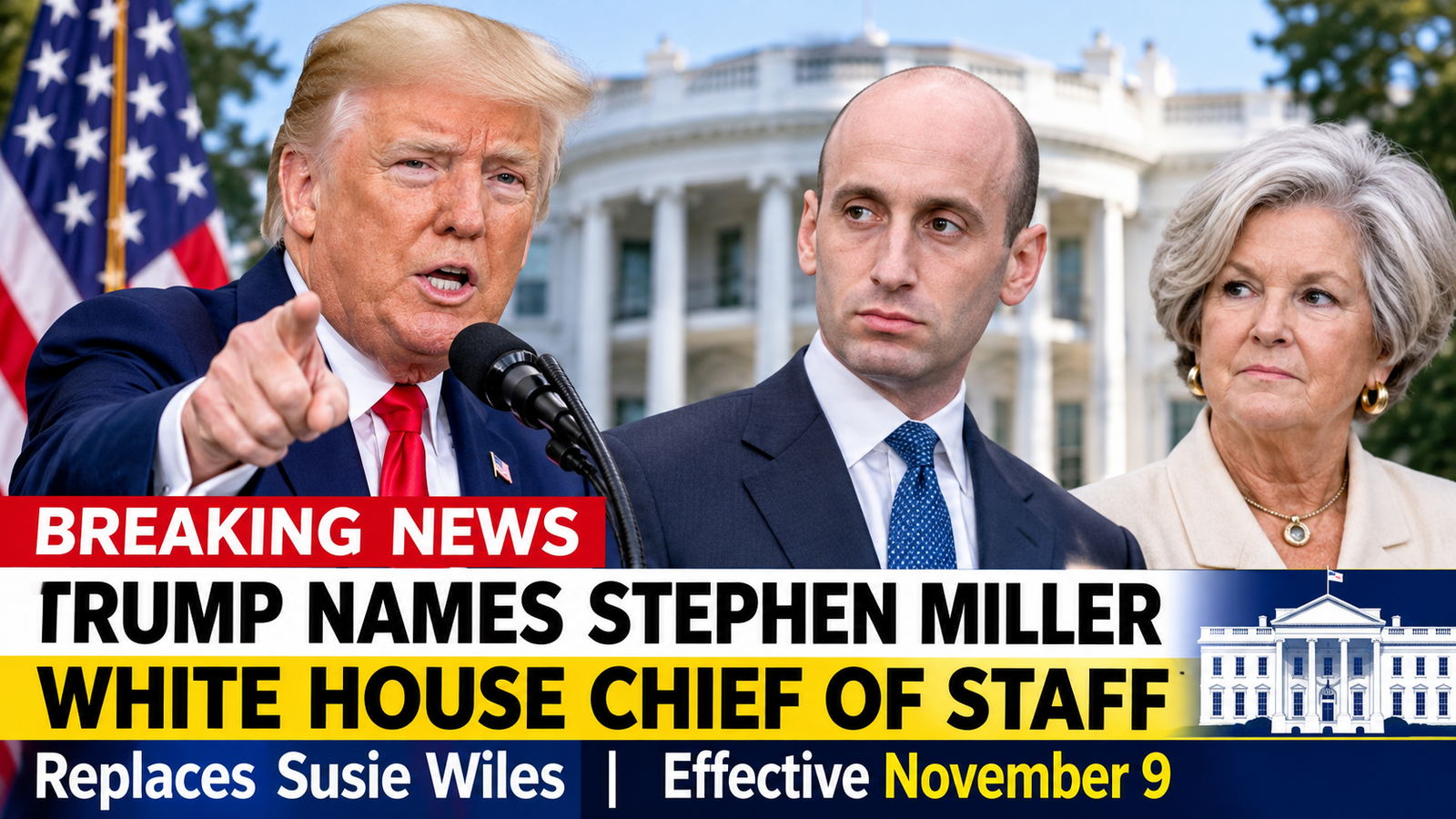
WASHINGTON, November 6, 2026 — President Donald Trump has announced a major leadership change inside the White House, appointing longtime adviser Stephen Miller as the next White House chief of staff, replacing Susie Wiles in a decision that comes just days after Republicans suffered significant losses in the 2026 midterm elections.
The transition is scheduled to take effect on Monday, November 9. Miller, who currently serves as a deputy White House chief of staff, will assume one of the most influential positions in the American executive branch. Wiles, who has been among Trump’s closest political advisers, is expected to move into the president’s political operation, according to Trump’s announcement.
The decision represents an important moment for an administration preparing to enter a politically more complicated phase of its second term. With Republicans facing a changed balance of power in Congress and Democrats preparing to exercise greater influence over the legislative agenda, the White House is confronting questions about its political strategy, policy priorities and relationship with lawmakers.
Although Trump described the appointment as a leadership transition, its timing has placed the decision under intense political scrutiny. The Republican losses in the midterm elections have increased pressure on the administration to reconsider how it communicates with voters, manages congressional relationships and advances its domestic agenda.
A Major Leadership Change Inside the White House
The White House chief of staff is one of the most powerful unelected positions in Washington. The individual holding the position works closely with the president, coordinates senior advisers, supervises the flow of information into the Oval Office and helps manage the administration’s daily operations.
The chief of staff also serves as a central connection between the White House, federal agencies, congressional leaders and outside political organizations.
For Trump, selecting Miller represents a decision to place a longtime and trusted adviser in a position with substantial influence over the administration’s internal operations and policy coordination.
Announcing the appointment on Friday, Trump praised Miller’s loyalty and experience within the administration. He also thanked Wiles for her service and said she would continue working with his political organization.
The transition is particularly significant because Wiles had played a central role in Trump’s political comeback and his return to the White House. Her departure from the chief of staff position therefore marks the end of an important chapter in the administration’s leadership structure.
The announcement also raises questions about how responsibilities will be redistributed among senior White House officials and whether additional personnel changes could follow.
Who Is Stephen Miller?
Stephen Miller has been one of Donald Trump’s most influential advisers since the president’s first campaign in 2016.
He became nationally recognized for his involvement in immigration policy, border enforcement, national security debates and the development of the administration’s broader political agenda.
During Trump’s first presidency, Miller played a prominent role in shaping immigration proposals and executive policy initiatives. His influence continued during Trump’s return to office, where he served in a senior White House position overseeing important areas of domestic policy.
Immigration enforcement has remained one of the administration’s defining political priorities. Miller has been closely associated with policies involving border security, deportation operations and restrictions on immigration.
His appointment as chief of staff could give him a more direct role in coordinating the president’s priorities across different departments and agencies.
However, the position also carries responsibilities that extend well beyond immigration. Miller will be expected to help manage the president’s schedule, coordinate competing policy demands, maintain communication among senior officials and work with members of Congress.
The challenge will be to translate the president’s political priorities into an operational strategy while navigating a Congress in which the administration faces a different balance of political power.
Republican Midterm Defeats Create a New Political Environment
The timing of the leadership change has become a central part of the Washington political discussion.
The 2026 midterm elections produced significant Republican setbacks, creating a more difficult environment for the Trump administration as it approaches the remaining years of its second term.
Midterm elections often serve as a public assessment of the governing party. Voters use them to express their views on economic conditions, government performance, national security, immigration, healthcare and the direction of federal policy.
For Republicans, the election results represent a serious political challenge. The administration will now have to consider how to advance its agenda when Democrats have greater congressional influence.
A changed congressional balance can affect nearly every major policy discussion in Washington. Legislative proposals may face stronger opposition, committee investigations may become more prominent, and negotiations over federal spending and government priorities could become more complicated.
The White House will also have to consider how its political messaging is received by voters who may have expressed dissatisfaction with particular policies.
Trump has not publicly presented Miller’s appointment as an admission that the administration’s policy direction must change. Instead, he has emphasized the transition as a personnel decision.
Nevertheless, the political circumstances surrounding the announcement make it difficult to separate the leadership change from the broader consequences of the midterm elections.
Susie Wiles Leaves a Significant Position
Susie Wiles has been an important figure in Trump’s political organization for years.
She helped manage Trump’s 2024 presidential campaign and became the first woman to serve as White House chief of staff when he returned to office in January 2025.
Her position placed her at the center of the administration’s internal decision-making process. She was responsible for managing the president’s working environment, coordinating senior advisers and helping maintain communication across the federal administration.
Wiles was widely associated with the organizational and political management of Trump’s White House.
Her departure from the chief of staff position is therefore more than an ordinary personnel adjustment. It changes the structure of the president’s immediate advisory circle at a time when the administration faces new political challenges.
According to reporting by CBS News, Wiles submitted her resignation on Thursday evening, November 5. Sources cited by the network connected her departure to the Republican midterm defeats.
Trump, however, publicly thanked her for her work and said she would move into his political operation.
Her next role could allow her to continue contributing to the president’s political activities outside the daily management of the White House.
Immigration Policy Could Remain Central Under Miller
One of the most closely watched questions surrounding Miller’s appointment concerns immigration policy.
Border security and immigration enforcement have been among the administration’s most prominent priorities. Miller has played a significant role in developing and coordinating the president’s approach.
His elevation may indicate that immigration will remain central to the administration’s agenda rather than becoming a secondary issue following the midterm elections.
However, the political environment surrounding immigration has become more complicated.
The subject affects border communities, employers, agricultural businesses, technology companies, local governments and millions of families across the country.
Supporters of stricter enforcement argue that stronger border controls are necessary to protect national security, enforce immigration laws and manage pressure on public services.
Critics have raised concerns about deportation procedures, family separation, humanitarian protections, legal immigration pathways and the economic consequences of large-scale enforcement operations.
The administration will have to navigate these competing concerns while dealing with a Congress that may be less receptive to its legislative proposals.
Miller’s new position could make him an even more important participant in these debates.
Washington Faces a More Difficult Relationship With Congress
The chief of staff’s responsibilities will become particularly important as the administration prepares to work with a changed Congress.
Under a divided political environment, the White House cannot assume that its legislative priorities will receive the same level of congressional support as before.
Federal spending, taxation, immigration legislation, healthcare, energy policy and government oversight could all become areas of increased political disagreement.
Congressional investigations may also become a more significant part of the political landscape.
Democratic lawmakers could seek additional information about administration decisions, federal agency operations and the implementation of executive policies.
For the White House, managing these developments will require careful coordination between the president’s advisers, congressional relations team and federal departments.
Miller will inherit a position that requires both political loyalty and administrative organization. His ability to coordinate different parts of the administration will be closely watched by lawmakers, government officials and political observers.
Economic Policy and American Businesses
Although Miller is primarily associated with immigration and domestic political policy, the chief of staff position can influence a much wider range of government decisions.
American businesses will be watching how the administration approaches taxation, trade, tariffs, labor availability, energy regulation and federal spending during the next phase of Trump’s presidency.
The political balance in Congress can influence the direction of economic legislation. Businesses often depend on predictable government rules, stable regulatory conditions and clarity about future tax and trade policies.
A more confrontational relationship between Congress and the White House could complicate negotiations over economic legislation and government funding.
Immigration policy also has direct economic implications.
Industries such as agriculture, construction, hospitality, food processing and certain service businesses employ substantial numbers of immigrant workers. Changes in immigration enforcement can affect recruitment, labor costs, production schedules and business planning.
At the same time, supporters of tighter enforcement argue that immigration rules should be applied consistently and that employers should prioritize lawful employment practices.
The economic impact of future policy decisions will depend on the specific measures adopted, how they are implemented and how businesses and workers respond.
For financial markets, the appointment itself does not automatically change corporate earnings, interest rates or economic growth. However, investors may pay attention to whether the leadership change signals greater policy continuity or a shift in the administration’s approach to trade, immigration and regulation.
What the Appointment Could Mean for Trump’s Remaining Term
The next two years will be an important period for the Trump administration.
The midterm results have changed the political environment, and the White House must now determine how to pursue its priorities under different congressional conditions.
Miller’s appointment may signal an emphasis on maintaining the president’s existing policy direction. It could also reflect Trump’s preference for an adviser who has worked closely with him for many years.
But the chief of staff role involves difficult institutional responsibilities.
The new chief of staff will need to manage the competing expectations of Cabinet officials, congressional Republicans, political advisers, conservative organizations and the president himself.
At the same time, the administration will face pressure from Democrats seeking greater oversight and from voters concerned about the economy, immigration and the federal government’s performance.
Whether the appointment produces a significant change in the administration’s daily operations remains to be seen.
A leadership change can alter internal coordination, but its practical consequences will depend on the policies the president chooses to prioritize and the decisions made by the wider administration.
The Political Message Behind the Decision
Political appointments are rarely viewed in isolation in Washington, especially when they occur immediately after an election.
Miller’s elevation sends a message about the president’s confidence in a longtime adviser and his willingness to reorganize his administration during a difficult political period.
For Republican supporters, the appointment may represent continuity with the president’s established agenda.
For Democratic lawmakers and immigration-policy critics, it raises questions about whether the administration intends to maintain or intensify its current approach.
The appointment will also be closely watched by moderate Republicans and lawmakers representing competitive districts. They may face pressure to explain how the administration’s policies connect with the concerns expressed by voters during the midterm elections.
The central political question is not simply who occupies the chief of staff office. It is how the White House will respond to a changed political landscape.
What Happens Next?
Stephen Miller is scheduled to take over as White House chief of staff on November 9, 2026.
The immediate focus will be the transition of responsibilities from Wiles, the organization of the senior White House team and the administration’s approach to the next congressional session.
Lawmakers and political observers will be watching several developments:
First, whether Miller changes the way the White House coordinates its domestic policy agenda.
Second, whether immigration enforcement remains the administration’s dominant domestic priority.
Third, whether the president adopts a more negotiated approach toward congressional Democrats or continues pursuing policies primarily through executive authority.
Fourth, whether additional changes occur among senior administration officials following the departure of Wiles.
Finally, whether the White House responds to the midterm results with adjustments in economic communication, legislative priorities and its relationship with voters.
These developments will provide a clearer picture of what the leadership change means in practical terms.
Conclusion: A New Chapter for the Trump White House
Donald Trump’s decision to appoint Stephen Miller as White House chief of staff marks a significant leadership transition at a politically sensitive moment.
The departure of Susie Wiles ends an important period in the administration’s internal management, while Miller’s promotion places a longtime immigration and domestic policy adviser in a position with broad responsibility for the president’s daily operations.
The timing, coming immediately after Republican midterm losses, gives the announcement additional political significance.
The administration now faces the challenge of governing in a changed congressional environment while maintaining its policy priorities and responding to voters’ concerns.
For Washington, November 9 will mark the beginning of a new White House leadership arrangement. Whether it produces a broader change in governing strategy will depend on the decisions that follow.
One thing is clear: the next phase of Trump’s presidency will be shaped not only by the people working inside the White House, but also by the new political balance in Congress and the administration’s ability to work within it.
Reporting note: This article distinguishes the confirmed appointment and transition date from analysis of the possible political and economic implications. The longer-term consequences remain uncertain as the transition develops.
Source basis: The White House announcement, Associated Press reporting and CBS News reporting dated November 6, 2026.
