
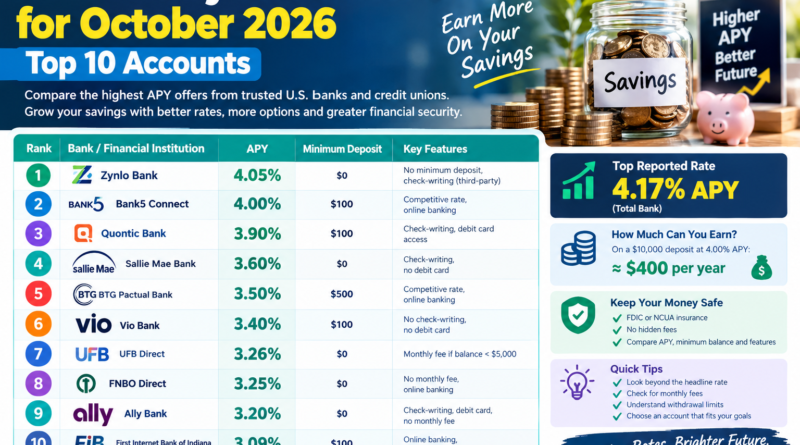
Best Money Market Rates for October 2026: Top 10 Accounts, Highest APY Offers and What American Savers Should Know
Publication date: October 30, 2026
Category: Personal Finance, Banking, Savings and Money Management
audience: United States and worldwide readers
Primary keyword: Best money market rates October 2026
Secondary keywords: Best money market accounts, highest money market APY, money market interest rates, high-yield savings, online banks, FDIC insured accounts.
Introduction: Where Can Americans Earn More Interest on Their Savings in October 2026?
Saving money is not just about putting cash into a bank account and leaving it there. For millions of American households, the bigger question is whether their savings are actually earning a reasonable return.
A person may have several thousand dollars sitting in a traditional savings account for months or even years without paying much attention to the interest rate. Meanwhile, another bank may offer a considerably higher annual percentage yield on a similar deposit.
That difference can become meaningful over time.
This is one reason money market accounts continue to attract attention from people who want to earn interest without giving up convenient access to their savings.
October 2026 brings a competitive environment for American savers. Several banks and credit unions are advertising money market account yields around 3% to 4% APY, while some financial institutions are offering higher promotional or limited-balance rates.
However, choosing an account should involve more than looking at the largest percentage displayed in an advertisement.
The opening deposit, minimum balance, monthly maintenance fee, withdrawal options, account access and deposit insurance can all influence the actual value of an offer.
For example, a bank advertising a higher APY may require a substantial balance to qualify. Another institution might offer a slightly lower rate but have no monthly fees, no opening deposit requirement and easier access to funds.
For households building an emergency fund, saving for a house, preparing for education expenses or keeping money available for an upcoming purchase, these differences matter.
This guide examines the best money market account rates reported for October 2026, explains how these accounts work and explores what consumers should consider before moving their money.
The goal is straightforward: help readers understand their options and make more informed savings decisions.
1. October 2026 Money Market Rate Overview
The American savings market includes traditional banks, online banks, credit unions and financial technology companies working with regulated banking institutions.
Their rates are not identical.
Some large banks offer relatively modest interest on ordinary savings products. Online institutions may compete more aggressively because they often operate with fewer physical branches and different operating costs.
According to Bankrate’s October 30, 2026 rate comparison, its featured money market accounts include several options paying between 3% and 4.05% APY.
The national average reported in that comparison was approximately 0.48% APY. That means consumers who compare accounts carefully may find considerably better rates than those offered by many ordinary savings accounts.
Here is a snapshot of the featured offers.
2. Top 10 Money Market Accounts to Compare in October 2026
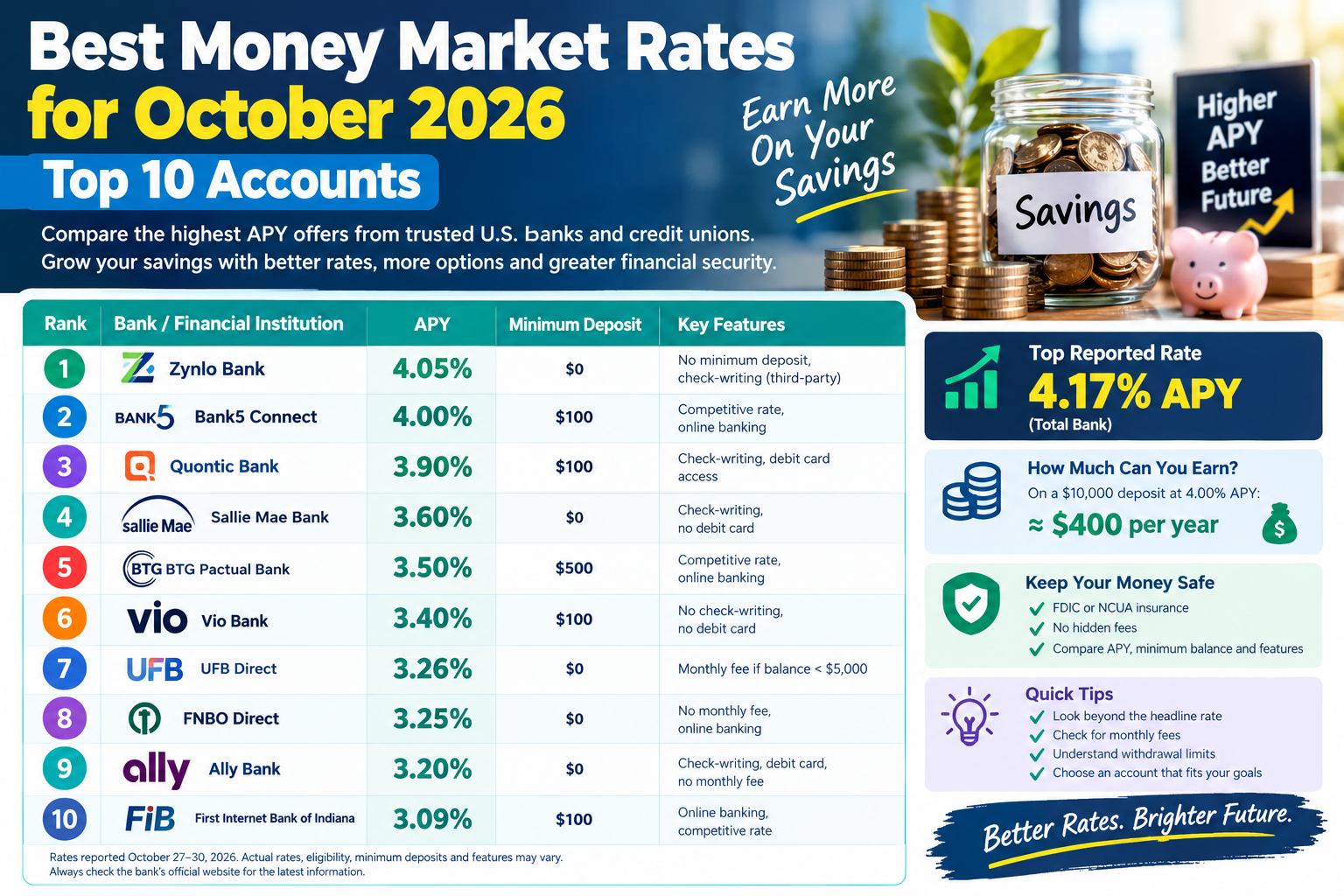
The following table uses Bankrate’s published money market account comparison. Rates are reported as of October 27–30, 2026, depending on the institution.
| Rank | Financial institution | Reported APY | Minimum opening deposit |
|---|---|---|---|
| 1 | Zynlo Bank | 4.05% | $0 |
| 2 | Bank5 Connect | 4.00% | $100 |
| 3 | Quontic Bank | 3.90% | $100 |
| 4 | Sallie Mae Bank | 3.60% | $0 |
| 5 | BTG Pactual Bank | 3.50% | $500 |
| 6 | Vio Bank | 3.40% | $100 |
| 7 | UFB Direct | 3.26% | $0 |
| 8 | FNBO Direct | 3.25% | $0 |
| 9 | Ally Bank | 3.20% | $0 |
| 10 | First Internet Bank of Indiana | 3.09% | $100 |
Important: This is a comparison of published offers, not a guarantee that every customer will qualify for the displayed rate. Rates, eligibility and terms can change. The minimum opening deposit is not necessarily the same as the minimum balance required to earn the advertised APY.
1. Zynlo Bank – 4.05% APY
Zynlo Bank is one of the notable names in the October money market comparison.
Its reported 4.05% APY makes it an option worth examining for savers who want a competitive rate without committing to a large initial deposit.
One important attraction is its reported zero-dollar minimum opening balance.
That can make the account easier to consider for people who are starting with a relatively small amount of savings.
The account also offers check-writing privileges through third-party checks, according to the published comparison.
Before opening an account, consumers should review the current terms, permitted transactions and account eligibility.
Official website: https://www.zynlobank.com/
2. Bank5 Connect – 4.00% APY
Bank5 Connect is another institution worth comparing.
Its reported money market APY is 4.00%, with a $100 minimum opening deposit.
A rate of 4% can make a noticeable difference when compared with an account earning only a small fraction of one percent.
For example, a $20,000 balance earning 4% APY would generate approximately $800 in interest over a full year if the rate and balance remained unchanged.
Consumers should examine the account’s transaction features and electronic banking services before deciding whether it fits their needs.
Official website: https://www.bank5connect.com/
3. Quontic Bank – 3.90% APY
Quontic Bank offers another competitive option for people looking for a money market account.
Its reported APY is 3.90%, with a minimum opening deposit of $100.
The account may appeal to consumers who want a combination of interest earnings and access to their money.
Money market account features can include check-writing or debit card access, but the exact availability should always be confirmed in the current account agreement.
A consumer should also compare the interest rate with the fees and restrictions attached to the product.
Official website: https://www.quontic.com/
4. Sallie Mae Bank – 3.60% APY
Sallie Mae Bank is another name in the comparison.
Its reported money market account APY is 3.60%, with no minimum opening deposit listed.
The account includes check-writing privileges, although the published comparison indicates that it does not provide a debit or ATM card.
That distinction matters.
Someone who mainly wants to keep savings separate from everyday spending may find check access sufficient. Someone who frequently needs cash from an ATM may prefer a different account.
A savings product should match the way the customer actually uses money.
Official website: https://www.salliemae.com/banking/
5. BTG Pactual Bank – 3.50% APY
BTG Pactual Bank is included among the competitive offers with a reported 3.50% APY.
The minimum opening deposit is $500.
This requirement is worth considering for people who are just beginning to build their emergency savings.
An account with a higher opening requirement may not be the most convenient choice for someone who wants to deposit small amounts regularly.
Consumers should also confirm whether the rate applies to the entire account balance and whether additional conditions apply.
Official website: https://www.btgpactual.com/
6. Vio Bank – 3.40% APY
Vio Bank’s Cornerstone Money Market Savings Account is another option for comparison.
Its reported APY was 3.40%, with a $100 minimum opening deposit.
One detail to consider is account accessibility. The published comparison indicates that the product does not provide check-writing privileges or a debit card.
That does not automatically make it a poor choice.
For someone who wants to keep emergency savings separate from daily spending, limited transaction access may actually encourage better saving habits.
However, consumers who need frequent access should compare alternatives before applying.
Official website: https://www.viobank.com/
7. UFB Direct – 3.26% APY
UFB Direct offers another money market option.
Its reported APY was 3.26%, and the comparison listed no minimum opening deposit.
However, fees deserve particular attention.
The published comparison indicates a $10 monthly service fee when the balance falls below $5,000, along with a paper statement fee.
A monthly fee can reduce the benefit of earning interest.
For instance, a $10 monthly fee adds up to $120 over one year. That is a meaningful expense for someone maintaining a relatively small balance.
Before opening the account, review the fee waiver conditions carefully.
Official website: https://www.ufbdirect.com/
8. FNBO Direct – 3.25% APY
FNBO Direct is another option for consumers comparing online banking products.
Its reported money market APY was 3.25%, with no minimum opening deposit and no monthly maintenance fee in the comparison.
A lower rate can still be attractive when the account has fewer fees and straightforward requirements.
The important question is not simply which bank has the highest advertised number.
It is which account offers the best combination of interest, convenience, security and overall cost.
Official website: https://www.fnbo.com/
9. Ally Bank – 3.20% APY
Ally Bank is a familiar name in the American online banking market.
Its reported money market APY was 3.20%.
The account offers check-writing and debit card access, giving customers multiple ways to use their money.
The published comparison also highlights the absence of a monthly maintenance fee and certain other charges.
However, consumers should review transaction restrictions and current account terms.
A bank’s digital services, customer support and transfer experience can be just as important as its advertised APY.
Official website: https://www.ally.com/
10. First Internet Bank of Indiana – 3.09% APY
First Internet Bank of Indiana completes this comparison with a reported APY of 3.09%.
Its listed minimum opening deposit was $100.
For consumers who prefer an established online banking option, it may be worth including in a broader comparison.
The bank’s current balance requirements, fees, account features and transfer policies should be checked before an application is submitted.
Official website: https://www.firstib.com/
3. Why Money Market Rates Matter to American Households
Interest rates influence everyday financial decisions.
When savings accounts pay very little, consumers may feel that keeping extra money in the bank produces almost no benefit.
But when competitive savings rates become available, the decision becomes more interesting.
Consider a household with $15,000 set aside for emergencies.
If that money earns 0.50% APY, the annual interest would be approximately $75.
If the same amount earns 4.00% APY, the approximate annual interest would be $600.
That is a difference of $525.
The household has not taken stock market risk or purchased a complicated investment. It has simply moved eligible cash into a higher-yielding deposit account.
Of course, the calculation assumes the rate stays unchanged for the entire year. Actual interest will depend on the bank’s rate, compounding method and account balance.
For families facing higher housing costs, insurance premiums, education expenses and everyday bills, earning additional interest can provide a little more financial breathing room.
The amount will not replace employment income, but it can help savings grow without requiring additional work.
4. What Is a Money Market Account?
A money market account is a bank or credit union deposit account that pays interest on deposited funds.
It combines features commonly associated with savings accounts and, in some cases, checking accounts.
Depending on the institution, customers may receive:
- Interest on deposited money.
- Check-writing privileges.
- Debit card access.
- Electronic transfers.
- Online account management.
- Mobile banking access.
The exact features vary from one institution to another.
Money market accounts are often used for emergency funds, short-term savings, large upcoming purchases and cash reserves.
They are not designed to replace every type of financial account.
For example, a household may still need a checking account for regular bill payments and a retirement investment account for long-term financial goals.
The money market account fills a different role: earning interest while keeping cash relatively accessible.
5. Money Market Account vs. Money Market Mutual Fund
This is one of the most important distinctions consumers should understand.
The terms sound similar, but the financial products are different.
Money market deposit account
A money market deposit account is a bank deposit product.
At an FDIC-insured bank, eligible deposits receive FDIC protection within applicable limits.
At an eligible federally insured credit union, deposit protection is generally provided through the National Credit Union Share Insurance Fund.
The account earns interest, and the institution sets its rate.
Money market mutual fund
A money market mutual fund is an investment product.
It invests in short-term financial instruments such as government securities, certificates of deposit and other eligible money market instruments.
The fund distributes income to investors, generally reflecting short-term market rates.
However, a money market mutual fund is not a bank deposit and is not protected by FDIC deposit insurance.
Its value and returns are subject to investment-related risks.
A fund may aim to maintain a stable $1 net asset value per share, but that value is not guaranteed in every circumstance.
For readers who want a bank savings product, it is important not to confuse a money market deposit account with a money market mutual fund.
The distinction affects safety, access, taxation and potential investment risk.
6. What Does APY Mean?
APY stands for Annual Percentage Yield.
It represents the annual return on a deposit, including the effect of compound interest.
It is one of the most useful figures to compare when evaluating savings products.
Suppose one bank advertises a 3.50% interest rate and another advertises a 3.60% APY.
Those numbers may not be directly comparable because APY includes the effect of compounding.
When comparing accounts, look for APY rather than relying only on a basic interest rate.
A higher APY generally means more interest over a year, assuming the same deposit amount and no changes to the rate or account balance.
However, APY is not the only consideration.
A high-yield account with a large monthly fee may deliver less value than a slightly lower-yield account without maintenance charges.
7. How Much Can You Earn From a Money Market Account?
The potential return depends on the amount deposited and the APY.
Here are some illustrative annual earnings calculations.
| Deposit | 3.00% APY | 3.50% APY | 4.00% APY |
|---|---|---|---|
| $1,000 | $30 | $35 | $40 |
| $5,000 | $150 | $175 | $200 |
| $10,000 | $300 | $350 | $400 |
| $20,000 | $600 | $700 | $800 |
| $50,000 | $1,500 | $1,750 | $2,000 |
| $100,000 | $3,000 | $3,500 | $4,000 |
These are simplified estimates assuming the balance remains constant and the APY does not change.
Actual interest may differ because banks can change variable rates, compound interest on different schedules and apply account-specific conditions.
Example: A $10,000 savings balance
Imagine someone deposits $10,000 into an account paying 4.00% APY.
If the rate remains unchanged for 12 months, the account would earn approximately $400.
That is an additional $400 without having to buy shares, trade stocks or lock the money into a long-term investment.
Example: A $50,000 savings balance
Now consider a family with $50,000 available for short-term financial needs.
At 4.00% APY, the estimated annual interest would be approximately $2,000.
That amount could help cover insurance premiums, household repairs, travel expenses or other planned costs.
However, interest earnings may be taxable, depending on the account holder’s circumstances and applicable tax laws.
8. How the Federal Reserve Influences Money Market Rates
The Federal Reserve plays an important role in the United States financial system.
Its monetary policy decisions influence short-term interest rates across the economy.
On October 28, 2026, the Federal Open Market Committee maintained its target federal funds rate range at 3.75% to 4.00%.
The decision matters because banks operate within a broader financial system in which short-term borrowing costs, market yields and deposit rates are interconnected.
When the Federal Reserve raises interest rates, banks may have greater incentives to compete for deposits.
When rates decline, banks may reduce the APY offered on savings and money market accounts.
However, there is no automatic one-to-one relationship between the federal funds rate and a bank’s money market APY.
Each financial institution makes its own pricing decisions.
Banks also consider:
- Their need for customer deposits.
- Competition from other financial institutions.
- Their lending activity.
- Operating expenses.
- Liquidity requirements.
- Overall market conditions.
This explains why two banks can offer noticeably different interest rates even during the same economic period.
9. Should You Choose an Online Bank or a Traditional Bank?
American consumers have more choices than ever.
A person can open an account at a traditional bank with physical branches or select an online institution that primarily operates through websites and mobile applications.
Both approaches have advantages.
Advantages of online banks
Online banks may offer competitive interest rates because their business models can involve lower branch-related operating costs.
Other potential advantages include:
- Convenient digital applications.
- Online transfers.
- Mobile check deposits where available.
- Account alerts.
- Digital statements.
- Competitive savings offers.
However, customers should examine how deposits and withdrawals work.
Some online banks may rely on external transfer networks, which means moving money into or out of the account can take time.
Advantages of traditional banks
Traditional banks may offer:
- Physical branches.
- In-person customer support.
- Access to tellers.
- Established banking relationships.
- A wider range of financial services.
The disadvantage is that some traditional institutions may pay lower interest on ordinary deposit accounts.
A customer should compare the actual APY rather than assuming that a well-known banking brand offers the best return.
Which option makes more sense?
The answer depends on personal circumstances.
Someone who rarely visits a branch and wants to earn competitive interest may prefer an online bank.
Someone who frequently deposits cash or needs in-person banking services may value a traditional institution.
There is no universal winner.
10. Is Your Money Safe in a Money Market Account?
Safety is an important issue when choosing where to keep savings.
A competitive interest rate is useful, but protecting the principal should remain a priority.
For eligible deposits at FDIC-insured banks, the standard insurance limit is $250,000 per depositor, per insured bank, for each ownership category.
This protection includes eligible money market deposit accounts.
For example, a person with a single-owner account at an FDIC-insured bank generally receives coverage up to $250,000 for the combined eligible deposits held in that ownership category at the same bank.
Opening several accounts at different branches of the same bank does not create separate insurance limits.
Accounts at separately chartered insured banks are generally insured separately, subject to applicable rules.
Federally insured credit unions have a separate deposit protection system administered by the National Credit Union Administration.
Consumers should confirm the institution’s insurance status before transferring money.
It is also important to understand that deposit insurance does not protect against every possible financial problem.
It does not insure investment losses, ordinary market fluctuations or every type of fraud.
The protection applies to eligible deposits under the applicable insurance rules.
11. Understanding Fees Before Opening an Account
A bank may advertise an attractive APY, but fees can reduce the return.
This is especially important for people who do not maintain large balances.
Common charges may include:
Monthly maintenance fees: Some accounts charge a recurring fee if the customer does not meet certain balance or activity requirements.
Excess transaction fees: Some institutions may charge for transactions beyond the account’s permitted limits or under specific account agreements.
Paper statement fees: Certain banks charge customers who request physical statements.
Wire transfer fees: Sending money through a wire transfer may involve a separate charge.
ATM fees: Customers may pay fees when using an out-of-network ATM.
Early account closure fees: Some institutions may charge a fee if an account is closed shortly after opening.
Before applying, read the fee schedule.
A bank that offers 3.50% APY without monthly fees may be more attractive than an account advertising a higher yield but requiring a costly balance threshold.
12. Money Market Accounts vs. High-Yield Savings Accounts
These products are often compared because both are designed to help consumers earn interest on cash.
However, their features may differ.
| Feature | Money market account | High-yield savings account |
|---|---|---|
| Interest earnings | Yes | Yes |
| Variable APY | Common | Common |
| Check-writing | Sometimes | Usually not |
| Debit card | Sometimes | Sometimes |
| ATM access | Depends on bank | Depends on bank |
| FDIC protection | Eligible deposits | Eligible deposits |
| Minimum balance | Varies | Varies |
| Monthly fees | Varies | Varies |
The difference is often less about the interest rate and more about how customers can access their funds.
A person who wants check-writing privileges may prefer a money market account.
Someone who mainly wants to transfer money into savings and leave it untouched may prefer a high-yield savings account.
It is worth comparing both categories before making a decision.
13. Money Market Accounts vs. Certificates of Deposit
Certificates of deposit, commonly known as CDs, are another option for people who want to earn interest on savings.
The main difference is the commitment period.
With a traditional CD, a customer agrees to leave money deposited for a specific term.
The term might be several months or several years.
In return, the bank may offer a fixed interest rate for that period.
With a money market account, the interest rate is generally variable and the money is usually more accessible, subject to the account agreement.
When a CD may make sense
A CD may be appropriate for someone who:
- Has money they will not need immediately.
- Wants a fixed rate for a defined period.
- Is comfortable with withdrawal penalties.
- Wants to plan around a known maturity date.
When a money market account may make sense
A money market account may be more appropriate for someone who:
- Wants accessible savings.
- Needs an emergency fund.
- Expects to use the money within a relatively short period.
- Wants to avoid committing to a fixed maturity date.
Neither product is automatically better.
The choice depends on the purpose of the savings.
14. Why Some Banks Pay More Than Others
Many consumers wonder why one institution offers 4.05% APY while another offers only 1% or less.
The answer involves competition, operating costs and deposit demand.
Banks need deposits to support their business activities.
Deposits provide funding that can help financial institutions make loans and manage liquidity.
An online institution seeking to attract more customers may offer a competitive APY.
Another bank with a large existing customer base may not feel the same pressure to increase its deposit rates.
The institution’s lending strategy can also influence pricing.
Banks evaluate how much they are willing to pay for deposits compared with alternative sources of funding.
These decisions change over time.
That is why consumers should review savings rates periodically instead of assuming that an account opened several years ago still offers a competitive return.
15. What Happens When Interest Rates Fall?
A money market account generally does not guarantee a fixed APY for the entire life of the account.
If market interest rates decline, banks may reduce the APY offered to customers.
For example, someone might open an account paying 4.00% APY and later find that the bank has reduced the rate to 3.50%.
This does not necessarily mean the account is performing incorrectly.
It may reflect a change in market conditions or the institution’s deposit pricing strategy.
Customers should pay attention to rate notifications and account statements.
They can then compare the revised rate with other available offers.
However, constantly moving money for a tiny difference may not be worth the inconvenience.
Transfer delays, eligibility requirements and account restrictions should also be considered.
16. How to Choose the Best Money Market Account
A useful comparison starts with the reason for saving.
Different people need different features.
Someone building an emergency fund may prioritize reliable access and deposit insurance.
Someone saving for a home down payment may focus on earning interest while keeping the money available for a future purchase.
Someone with a larger cash reserve may pay special attention to deposit insurance limits and balance requirements.
Here are the main factors to evaluate.
Compare APY
Start by comparing the current APY offered by several institutions.
Do not rely on advertisements from previous months.
Check the bank’s own website and confirm the rate before submitting an application.
Review the minimum deposit
Some banks allow customers to open an account with no initial deposit.
Others require $100, $500 or more.
Choose a product that matches the amount you are ready to deposit.
Examine the balance requirements
An account may require a minimum balance to earn the highest APY.
A bank might advertise a rate that applies only to deposits above a particular threshold.
Read the full rate disclosure.
Check the monthly fee
A monthly maintenance fee can significantly reduce the value of a savings account.
If possible, choose an account without recurring maintenance charges.
Check withdrawal access
Find out whether the account includes:
- Debit card access.
- ATM withdrawals.
- Check-writing.
- ACH transfers.
- Wire transfers.
Choose features that match your needs.
Confirm deposit insurance
Verify whether the bank is FDIC-insured or the credit union is federally insured through the NCUA.
Do not assume that every financial product sold through a banking website is automatically insured.
Read customer service information
Digital banking is convenient, but account problems can happen.
Check whether the institution provides phone support, secure messaging and other customer assistance.
Review transfer times
If you need emergency access, understand how long it takes to move money to your primary checking account.
A high APY is less useful if accessing funds becomes difficult when an unexpected bill arrives.
17. How to Open a Money Market Account in the United States
Opening an account is generally straightforward, although each financial institution has its own process.
Most banks allow customers to apply online.
The application commonly requests:
- Full legal name.
- Residential address.
- Date of birth.
- Social Security number or applicable taxpayer identification number.
- Government-issued identification.
- Contact details.
- Initial deposit information.
Banks may also ask questions to verify identity and comply with financial regulations.
Once approved, customers can transfer money from an existing bank account or use another permitted funding method.
Before completing the application, review the account agreement and fee disclosures.
Do not deposit money until you understand the account’s terms.
18. How Much Money Should You Keep in a Money Market Account?
There is no single correct amount.
The right balance depends on household income, monthly expenses, debt obligations and future financial plans.
One commonly used personal finance approach is to build an emergency fund that can cover several months of essential living expenses.
For example, if a household spends $3,000 per month on essential expenses, a reserve covering three months would be $9,000.
A larger reserve may be appropriate for people with variable income, dependents or uncertain employment.
A money market account may be one place to hold this reserve, provided the account offers suitable access and insurance protection.
However, not every dollar needs to remain in cash.
Money needed for retirement many years from now may have a different investment purpose.
The important thing is to separate short-term savings from long-term investment money.
19. Should You Move Money From a Traditional Savings Account?
It may be worth considering, especially when the existing account pays very little interest.
However, do not move money simply because another institution advertises a larger number.
First compare the complete product.
Imagine a customer has $25,000 in a savings account paying 0.50% APY.
Another institution advertises a money market account at 4.00% APY with no monthly fee.
The potential annual interest difference is substantial.
At 0.50%, $25,000 would generate approximately $125 in annual interest.
At 4.00%, the same balance would generate approximately $1,000.
That represents an estimated difference of $875 over one year, assuming the rates and balances remain constant.
Before transferring funds, confirm the new account’s insurance coverage, fees and transaction arrangements.
Also keep enough money in the original checking account to cover upcoming payments.
20. Common Mistakes Savers Should Avoid
Even a competitive account can become a disappointing choice if the customer overlooks important details.
Choosing an account based only on the headline rate
The highest advertised APY does not automatically mean the best overall account.
Minimum balance requirements and fees matter.
Ignoring promotional conditions
Some advertised rates are temporary.
They may apply only to new customers or specific deposit amounts.
Check when the promotional period ends and what the regular rate will be afterward.
Keeping too much money at one bank
FDIC insurance has limits.
Customers with large balances should understand how ownership categories and institution-specific coverage work.
Confusing deposit accounts with investments
A money market mutual fund is not the same as an insured bank money market deposit account.
Understand the product before transferring funds.
Forgetting about variable rates
A money market account’s APY can change.
A rate that looks attractive today may be lower several months later.
Overlooking transfer delays
A customer may need money immediately for a medical bill, home repair or urgent travel.
Understand the bank’s withdrawal and transfer arrangements.
Ignoring taxes
Interest earned on bank deposits is generally taxable income under U.S. federal tax rules, subject to applicable exceptions and reporting requirements.
Consumers should consider their own tax circumstances.
21. Money Market Accounts for Emergency Savings
An emergency fund is money set aside for unexpected expenses.
It is not intended for everyday shopping or speculative investing.
Typical reasons to use an emergency fund include:
- Unexpected medical expenses.
- Car repairs.
- Temporary unemployment.
- Urgent home repairs.
- Emergency travel.
- Essential household expenses.
A money market account may be suitable because it can combine interest earnings with access to cash.
However, customers should choose an account with practical withdrawal arrangements.
An emergency fund should not depend on selling volatile investments during a market downturn.
Keeping a reasonable amount of accessible cash can reduce financial pressure when unexpected expenses arise.
22. Money Market Accounts for Homebuyers
Buying a home can require years of preparation.
A future homeowner may need money for a down payment, closing costs, moving expenses, furniture and unexpected repairs.
Money needed within the next few years generally has a different purpose from money invested for retirement decades away.
A competitive money market account may help keep a home purchase fund earning interest while remaining relatively accessible.
For example, a household saving $1,000 every month may gradually build a substantial balance.
The interest earned can add to the savings without requiring the household to take unnecessary market risk.
However, buyers should review the timing of their planned purchase.
If the money will be needed soon, liquidity and principal protection may matter more than pursuing a slightly higher yield.
23. Money Market Accounts for Retirees
Retirement planning involves balancing income, stability and long-term purchasing power.
Retirees may hold cash for regular expenses, unexpected medical costs or planned withdrawals.
A money market deposit account can serve as one component of a broader cash management strategy.
It may provide interest while keeping funds available for short-term needs.
However, holding all retirement savings in cash can create other problems.
Inflation can reduce purchasing power over time, and cash returns may not keep pace with long-term financial needs.
Retirees should distinguish between money required for near-term expenses and assets intended to support many years of retirement.
A money market account can have a role, but it should not automatically replace a diversified retirement plan.
24. How Inflation Affects Money Market Returns
A savings account can earn interest and still lose purchasing power if inflation is higher than the account’s return.
Consider an illustrative situation.
A saver earns 4% APY, but prices rise by 3% over the same period.
The account balance increases in dollar terms, but the purchasing power of that money grows by less than 4%.
The real return is approximately the nominal return minus inflation, although the exact calculation is slightly different.
This is why consumers should consider both the account’s APY and the broader cost of living.
A money market account can be useful for preserving accessible savings, but it is not necessarily a complete long-term wealth-building strategy.
25. Are Money Market Accounts Good for International Savers?
The American banking market attracts attention from readers around the world.
People outside the United States may research U.S. savings rates because the dollar is an important global currency.
However, a high U.S. APY does not mean that every international reader can open an American bank account.
Most U.S. banks have identity verification, residency, documentation and eligibility requirements.
Some accounts may require a U.S. residential address, a Social Security number or another qualifying taxpayer identification number.
International customers should also consider:
- Currency conversion costs.
- Tax obligations in their country of residence.
- U.S. tax documentation.
- Restrictions on nonresident applicants.
- Cross-border transfer fees.
- Exchange-rate movements.
- Applicable local banking rules.
For example, someone saving in Indian rupees should not compare a U.S. dollar APY with a domestic rupee deposit rate without considering currency risk.
If the dollar weakens against the person’s home currency, the exchange-rate movement may reduce the value of the dollar interest earned.
Likewise, a stronger dollar may increase the value when converted back.
Currency movements can be unpredictable.
International readers should check eligibility and tax requirements before considering a foreign deposit account.
26. What Should Consumers Expect During November and December 2026?
Money market rates can change as banks respond to market conditions and monetary policy.
The Federal Reserve’s October 28 decision to maintain its target federal funds rate at 3.75% to 4.00% provides important context for the savings market.
However, it does not guarantee that money market APYs will remain unchanged.
Banks may adjust their offers in response to deposit competition, funding needs and expectations about future interest rates.
As the year approaches its end, consumers may also review their savings goals, emergency funds and cash requirements for the following year.
The best approach is to compare rates periodically.
Avoid assuming that an October offer will still be available in November or December.
A bank’s official rate page should always be checked before an account is opened.
27. Frequently Asked Questions
What are the best money market rates in October 2026?
Bankrate’s October 30 comparison lists Zynlo Bank at 4.05% APY, Bank5 Connect at 4.00% and Quontic Bank at 3.90%. Rates can change, so consumers should verify current offers.
Which bank offers 4% APY on a money market account?
Zynlo Bank and Bank5 Connect were among the featured institutions offering approximately 4% APY in the October 2026 comparison. Eligibility and account terms apply.
Are money market accounts FDIC-insured?
Eligible money market deposit accounts at FDIC-insured banks receive deposit insurance within applicable limits. The standard limit is $250,000 per depositor, per insured bank, for each ownership category.
Is a money market account better than a savings account?
It depends on the APY, fees and features. Money market accounts may provide check-writing or debit card access, while high-yield savings accounts may offer similar interest without those features.
Can I lose money in a money market account?
Eligible deposits at an insured bank are protected within applicable FDIC limits. This is different from a money market mutual fund, which is an investment and is not FDIC-insured.
How much interest will $10,000 earn at 4% APY?
At a constant 4% APY, a $10,000 deposit would earn approximately $400 over one year.
How much interest will $50,000 earn at 4% APY?
At a constant 4% APY, $50,000 would earn approximately $2,000 over one year.
Can a money market account lose its interest rate?
The APY on most money market deposit accounts is variable. Banks can change their rates according to their account agreements and business decisions.
Do money market accounts have monthly fees?
Some do and some do not. Check the account’s fee schedule before applying.
Can I withdraw money whenever I need it?
Money market accounts generally provide access to deposits, but transaction methods, processing times and restrictions depend on the institution and account agreement.
Are money market mutual funds safe?
They are generally designed to invest in short-term, relatively liquid securities, but they are not bank deposits and are not guaranteed by the FDIC. Investors can lose money.
Do money market accounts pay monthly interest?
Many accounts calculate interest daily and credit it monthly, but the exact method depends on the bank.
Are money market account earnings taxable?
Interest earned on U.S. bank deposit accounts is generally taxable under federal tax rules. Individual circumstances can affect reporting and tax treatment.
Can international customers open U.S. money market accounts?
Some institutions may accept certain non-U.S. applicants, but many have residency, identification and tax documentation requirements. Eligibility must be confirmed directly with the bank.
28. Final Thoughts: Compare the Full Account, Not Just the APY
The October 2026 money market market gives American savers several opportunities to earn more from cash that might otherwise sit in a low-interest account.
Zynlo Bank, Bank5 Connect, Quontic Bank, Sallie Mae Bank, BTG Pactual Bank, Vio Bank, UFB Direct, FNBO Direct, Ally Bank and First Internet Bank of Indiana are among the institutions worth comparing.
But the best choice will not be the same for every household.
Someone with a small emergency fund may prioritize no minimum deposit and no monthly fee.
A family holding a larger cash reserve may focus on insurance coverage and balance requirements.
A customer who needs regular access may prefer an account with check-writing or debit card features.
The most sensible decision is to look beyond the headline rate and compare the complete account.
Interest rates are important, but convenience, fees, access and deposit protection matter too.
For households that want to keep their savings accessible while earning a competitive return, a money market account may be a useful part of a broader financial plan.
The key is to make the decision based on current information, realistic savings goals and a clear understanding of the product.
A good savings decision is not simply about finding the biggest percentage. It is about choosing an account that helps your money work harder without creating unnecessary financial complications.
Sources and Further Reading
- Bankrate – Best Money Market Accounts and Rates:
https://www.bankrate.com/banking/money-market/rates/ - RateBrain – Money Market Rate Comparison:
https://ratebrain.com/money-market-rates - Federal Reserve – October 28, 2026 FOMC Statement:
https://www.federalreserve.gov/newsevents/pressreleases/monetary20261028a.htm - FDIC – Your Insured Deposits:
https://www.fdic.gov/resources/deposit-insurance/brochures/insured-deposits - FDIC – Deposit Insurance FAQs:
https://www.fdic.gov/resources/deposit-insurance/faq - Investor.gov – Understanding Money Market Funds:
https://www.investor.gov/introduction-investing/investing-basics/investment-products/mutual-funds-and-exchange-traded-5
Editorial disclosure: This article is for general educational purposes and does not constitute individualized financial, investment, legal or tax advice. APYs and account terms are subject to change. Always confirm current information with the financial institution before opening an account.
