
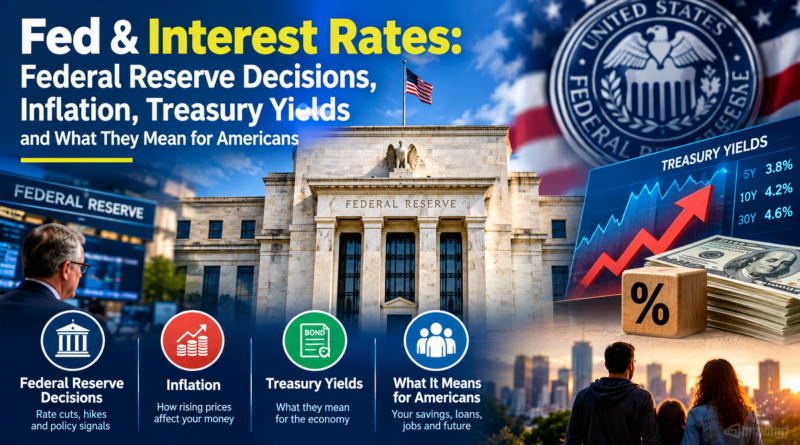
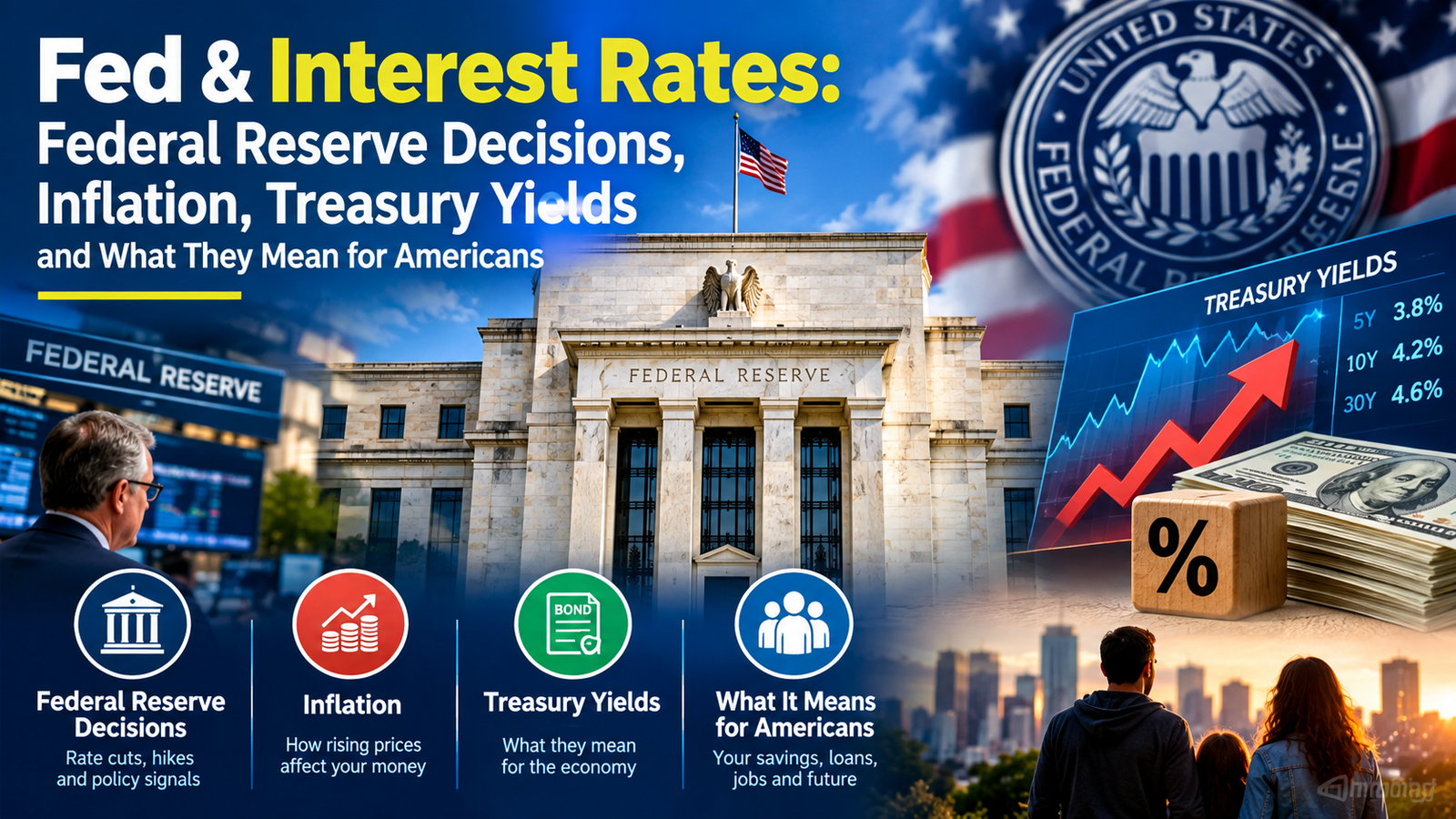
Fed & Interest Rates: Federal Reserve Decisions, Inflation, Treasury Yields and What They Mean for Americans
By New York Finance Think | Updated October 10, 2026
The Federal Reserve influences the financial conditions that affect American families, homebuyers, credit-card customers, savers, businesses, and investors. When the Fed changes its policy rate—or signals that a change may be coming—the effects can spread through borrowing costs, savings rates, bond yields, stock valuations, hiring decisions, and consumer spending.
But understanding the Fed requires more than watching headlines about rate cuts and rate hikes. Inflation, employment, consumer spending, economic growth, and financial-market conditions all help shape the policy debate.
This NYFT guide explains how the Federal Reserve works, how to read its meetings, why interest rates change, what Treasury yields tell investors, and how Americans can understand the possible effects on their everyday finances.
What this guide covers
- Federal Reserve rate decisions and FOMC meetings
- How to read Fed statements, minutes, and economic projections
- Interest-rate cuts versus rate hikes
- Inflation, employment, and the economy
- Treasury yields and the bond market
- Mortgage rates, credit cards, auto loans, savings, and retirement accounts
- What Americans should watch after each Fed announcement
Key Takeaways
- The Federal Reserve’s monetary-policy decisions aim to support maximum employment and stable prices.
- A rate cut does not automatically mean stocks will rise, and a rate hike does not automatically mean stocks will fall. Economic conditions and investor expectations matter.
- Inflation, employment, consumer spending, and wage growth help shape the Fed’s decisions.
- Treasury yields are important because they influence borrowing costs, bond prices, and how investors value stocks.
- Mortgage rates, credit-card APRs, auto loans, and savings rates do not all move in lockstep with the federal funds rate.
- Americans can use Fed news to understand economic conditions, but should avoid making major financial decisions based on a single announcement
visit :- Looking for creative food, shareable plates, and an exciting atmosphere in Manhattan? Discover Wildair, a popular Lower East Side restaurant known for inventive contemporary American dishes and an interesting natural wine selection
✨ Creative small plates
🍷 A distinctive wine program
🥩 Thoughtfully prepared dishes
🌆 A lively New York dining atmosphere
📍 Location: 142 Orchard Street, New York, NY 10002
📞 Phone: (646) 964-5624

🌐 Website: https://www.wildair.nyc/
📅 Reservations: https://www.wildair.nyc/reservations ( free promotion)
Restaurant details: Official Wildair website · Reservations
1. What Is the Federal Reserve?
The Federal Reserve, often called the Fed, is the central bank of the United States. It conducts monetary policy, supervises certain banking institutions, supports the stability of the financial system, and helps maintain the safety and efficiency of payment systems.
One of its most closely watched responsibilities is influencing financial conditions through monetary policy.
The Federal Open Market Committee, or FOMC, makes decisions about the target range for the federal funds rate. This is the overnight interest rate at which banks lend reserve balances to one another. It is not the same as the interest rate a consumer pays on a mortgage or credit card.
The Fed’s monetary-policy framework focuses on two goals:
- Maximum employment: Supporting labor-market conditions consistent with a strong economy.
- Stable prices: Keeping inflation under control over time.
The Fed has a longer-run inflation objective of 2%, measured using the annual change in the Personal Consumption Expenditures price index. Policymakers also evaluate employment, economic growth, financial conditions, and other information before making decisions.
Official source: https://www.federalreserve.gov/monetarypolicy/monetary-policy-what-are-its-goals-how-does-it-work.htm
2. Federal Reserve Rate Decisions: What Investors Should Know
Fed announcements attract attention because even a small change in interest rates can affect the financial calculations of households and businesses.
However, the decision itself is only part of the story. Investors also examine the statement, the press conference, economic projections when released, and the details of the committee’s reasoning.
What a rate decision tells you
When the Fed raises rates: Policymakers are generally making monetary policy more restrictive. Higher short-term borrowing costs can discourage some spending and investment, helping reduce demand when inflationary pressure is too strong.
When the Fed cuts rates: Policymakers are generally easing monetary policy. Lower short-term borrowing costs can support spending, investment, and hiring, depending on how banks and financial markets respond.
When the Fed holds rates steady: The committee may want more evidence about inflation, employment, and the economic outlook before changing policy. A pause does not necessarily mean that a rate cut or hike will follow.
The important question is not simply whether the Fed raised, cut, or held rates. It is whether the decision and the accompanying message were different from what financial markets had already anticipated.

BUILD YOUR BRAND ACROSS THE USA WITH NYFT! 🇺🇸
Reach a wider U.S. audience and grow your brand with NewYork FinanceThink (NYFT).
Promote your business, products, and services through website banner advertising, sponsored content, and digital brand promotions.
🚀 Grow Your Brand. Reach U.S. Audiences. Expand Your Business.
📩 Contact Us for Paid Advertising & Partnership Opportunities.
🌐 https://newyorkfinancethink.com/
🌐 newyorkfinancethink.com
How to read the latest Fed announcement
Before publishing a market update, check the official FOMC page:
https://www.federalreserve.gov/monetarypolicy/fomccalendars.htm
Read these items in order:
- The policy statement and the new target range.
- The explanation of inflation and employment conditions.
- Any changes to the committee’s assessment of economic risks.
- The press conference, if one takes place.
- The Summary of Economic Projections, when released.
- The meeting minutes, published later.
As of October 10, 2026, the Fed’s published calendar lists the September 15–16 meeting and minutes released October 7. The next scheduled meeting is October 27–28, 2026. The official calendar should be checked again before publishing a report about the next decision.
A useful newsroom rule: report the actual decision first, then explain what changed and what remains uncertain.
3. Fed Meeting Analysis: How to Read the Signals
A strong Fed meeting analysis should go beyond repeating the headline rate decision.
A. Look at the wording
Changes in the statement may indicate how policymakers view inflation, employment, and risks to economic activity. Compare the new statement with the previous one rather than reading it in isolation.
A change in wording is not a promise that the Fed will act in a particular way at its next meeting.
B. Compare inflation with the Fed’s objective
The Fed pays close attention to PCE inflation. The Consumer Price Index, or CPI, is also important because it provides another widely followed measure of consumer-price changes.
CPI and PCE are different indexes. They use different methods and spending weights, so their readings should not be treated as interchangeable.
C. Examine employment data
The unemployment rate is important, but it does not tell the whole story. Payroll growth, labor-force participation, wages, hours worked, and revisions to earlier job reports can provide additional context.
D. Read economic projections carefully
The Summary of Economic Projections includes individual policymakers’ projections for economic growth, unemployment, inflation, and the federal funds rate.
These projections are not a guaranteed policy path. They reflect policymakers’ assessments at that time and can change as new data arrives.
E. Watch the market response without assuming cause and effect
Stocks can rise after a rate hike if investors had expected a larger increase or if the accompanying outlook is more reassuring. Stocks can fall after a rate cut if investors believe policymakers are responding to deteriorating economic conditions.
A market move is evidence of how investors reacted—not proof that one factor caused the entire move.
4. Interest-Rate Cuts vs. Hikes
Rate cuts and hikes are often described as simple good-or-bad news. The reality is more complicated.
| Topic | Rate cuts | Rate hikes |
|---|---|---|
| Monetary-policy direction | Generally easier | Generally tighter |
| Short-term borrowing | May become less expensive | May become more expensive |
| Business investment | May receive support | May face higher financing costs |
| Consumer demand | May receive support | May cool |
| Inflation pressure | Could increase if demand strengthens too much | May ease over time as demand slows |
| Stock valuations | May benefit if discount rates fall | May face pressure if discount rates rise |
| Savings yields | May decline on some deposits | May rise on some deposits |
These are general tendencies, not guaranteed outcomes. The actual effect depends on the economic backdrop, market expectations, credit conditions, and how quickly financial institutions adjust their rates.
Example: A family planning a home purchase
Suppose a family is considering a mortgage. A Fed rate cut may influence short-term market rates, but a fixed-rate mortgage is also strongly affected by longer-term Treasury yields, mortgage-backed securities, lender costs, and credit conditions.
If long-term yields remain high, mortgage rates may not fall as much as the family expects.
That is why homebuyers should compare actual loan offers and annual percentage rates rather than assuming a Fed announcement will automatically make a mortgage cheaper.
5. Inflation and Interest Rates: Why the Connection Matters
Inflation means that the general price level is rising. When inflation increases, the same dollar buys less than it did previously.
For households, this can mean higher costs for groceries, rent, insurance, medical services, transportation, and other everyday expenses.
The Fed cannot directly control every price. Energy markets, supply disruptions, housing supply, global trade, productivity, and fiscal policy can all influence inflation. Monetary policy mainly works by influencing financial conditions and overall demand.
When demand is persistently stronger than the economy’s ability to supply goods and services, inflationary pressure can build. Tighter monetary policy can help cool demand, although the effects take time and are not perfectly predictable.
When inflation falls, that does not mean prices have returned to their earlier levels. It usually means prices are rising more slowly. Actual price declines are a different situation.
Current U.S. inflation data to use in this article
As of October 10, 2026, the latest releases available for the following measures report August data:
| Indicator | Latest reported result | Source |
|---|---|---|
| CPI inflation | 3.4% over 12 months through August 2026 | U.S. Bureau of Labor Statistics |
| Monthly CPI change | +0.4% in August 2026, seasonally adjusted | U.S. Bureau of Labor Statistics |
| PCE inflation | 3.4% over 12 months through August 2026 | U.S. Bureau of Economic Analysis |
| Core PCE inflation | 3.0% over 12 months through August 2026 | U.S. Bureau of Economic Analysis |
Sources:
- CPI: https://www.bls.gov/news.release/cpi.htm
- PCE: https://www.bea.gov/news/2026/personal-income-and-outlays-august-2026
The September CPI release is scheduled for October 14, 2026. Update this table when the new report is published. Do not label August figures as September data.
Why core inflation matters
Core CPI and core PCE exclude food and energy prices. Analysts often examine these measures to understand underlying inflation trends because food and energy prices can move sharply.
However, households still pay for food, electricity, gasoline, and heating. Core inflation is a useful analytical measure, not a statement that excluded expenses are unimportant.
6. Treasury Yields: A Major Signal for U.S. Markets
Treasury yields are the returns investors demand for holding U.S. government debt. They vary by maturity, including short-term Treasury bills and longer-term notes and bonds.
The 10-year Treasury yield is closely watched because it is a reference point for many longer-term borrowing costs and investment decisions.
Treasury yields are influenced by several factors:
- Expectations for future Fed policy.
- Inflation expectations.
- Economic growth expectations.
- Demand for Treasury securities.
- Government borrowing and the supply of bonds.
- Global demand for safe assets.
- The additional compensation investors may require for holding longer-term securities.
Why yields and bond prices move in opposite directions
When an existing bond’s price rises, its yield generally falls. When its price falls, its yield generally rises.
That relationship matters for investors holding bond funds, long-duration bonds, and other fixed-income investments.
What rising yields can mean for stocks
Higher long-term yields can place pressure on stock valuations because future corporate earnings are discounted at a higher rate. They can also make Treasury securities more competitive with stocks for some investors.
But a yield increase is not automatically bearish. If yields rise because the economy is growing more strongly and corporate earnings expectations improve, stocks may respond differently than they would to a rise driven by inflation fears.
Where to check official Treasury yields
Use the U.S. Treasury’s daily rate tables:
https://home.treasury.gov/resource-center/data-chart-center/interest-rates
When quoting a yield, include the date and maturity. Do not describe a 10-year yield as the Fed’s policy rate; they measure different things.
7. What Fed Policy Means for Americans
Monetary policy reaches households through several channels, but the timing and size of the effect differ.
Mortgage rates and housing
Fixed-rate mortgage pricing depends substantially on longer-term market rates and mortgage-backed securities, along with lender-specific costs and borrower credit profiles.
Adjustable-rate mortgages may change according to their contract terms and reference rates. A Fed rate move does not automatically change every mortgage payment immediately.
Homebuyers should compare the interest rate, APR, points, fees, closing costs, and expected time in the home.
Credit cards
Many credit cards have variable APRs linked to a benchmark rate. A change in short-term interest rates can therefore affect cardholders’ interest costs, although the timing depends on the card agreement and issuer’s terms.
People carrying balances should focus on the actual APR, minimum-payment requirements, fees, and a realistic payoff plan. A lower policy rate does not eliminate credit-card debt or guarantee a large reduction in the amount owed.
Auto loans
Auto-loan rates depend on market rates, the lender, credit history, loan term, vehicle, and promotional financing offers.
A Fed rate cut may improve the financing environment, but borrowers should compare the total cost of the loan, not just the monthly payment.
Savings accounts and certificates of deposit
Banks may lower savings yields as short-term rates fall or increase them when rates rise. Changes are not always immediate or equal across institutions.
Compare annual percentage yield, minimum-balance requirements, withdrawal rules, fees, and deposit insurance eligibility.
Small businesses
Higher borrowing costs can make it more expensive for small businesses to finance inventory, equipment, expansion, or working capital. Lower rates may help, but lenders still consider revenue, cash flow, collateral, and creditworthiness.
Business owners should evaluate financing needs and cash reserves rather than assuming a rate cut will make every loan affordable.
Retirement accounts
A Fed announcement should not be the sole reason to change a retirement portfolio. Stocks and bonds react to a range of factors, and short-term market moves are difficult to predict consistently.
People investing through 401(k)s and IRAs should consider their time horizon, diversification, risk tolerance, fees, and withdrawal needs.
8. What the Latest Employment Data Says
The September 2026 U.S. Employment Situation report, released October 2, reported that nonfarm payroll employment increased by 29,000 and the unemployment rate was 4.2%.
The report also showed that average hourly earnings for private nonfarm employees rose 3.0% over the prior 12 months. The Bureau of Labor Statistics revised earlier monthly job estimates as additional information became available.
Source: https://www.bls.gov/news.release/empsit.htm
These figures provide context for the Fed’s employment mandate, but one report cannot establish the entire direction of the labor market. Payrolls can be revised, and policymakers examine multiple indicators.
For NYFT market coverage, explain whether the new report differs from expectations only when a reliable, dated consensus source is available. Otherwise, report the actual figures without claiming that the data surprised markets.
9. How Investors Can Interpret Different Economic Scenarios
Scenario A: Inflation cools while employment remains steady
If inflation trends lower and the labor market remains resilient, policymakers may have more flexibility to consider easing policy. Market participants may reassess expected interest rates, bond yields, and stock valuations.
This is a possible scenario, not a forecast or guarantee.
Scenario B: Inflation remains elevated
If inflation stays above the Fed’s longer-run objective, policymakers may be cautious about easing too quickly. Longer-term yields could remain sensitive to inflation expectations, and borrowing costs may remain elevated.
The effect on stocks would depend on earnings, valuations, growth, and the extent to which the situation was already priced into the market.
Scenario C: Employment weakens sharply
A weakening labor market could increase the case for monetary-policy support, depending on inflation conditions. However, a sharp slowdown can also reduce company revenues and increase credit risk.
In that environment, lower interest rates would not automatically mean that stock prices must rise.
Scenario D: Inflation and unemployment both rise
This creates a difficult policy trade-off. The Fed must assess the sources and persistence of inflation alongside labor-market conditions. There may be no simple policy response that immediately resolves both problems.
For investors, this scenario highlights why economic analysis should consider multiple indicators rather than relying on a single headline.
10. A Practical Fed-Watching Checklist
Before or after each FOMC meeting, readers can use this checklist:
- Confirm the official target range in the latest Fed statement.
- Compare the new statement with the previous one.
- Review the latest CPI and PCE inflation releases.
- Check payroll growth, unemployment, wage growth, and revisions.
- Review Treasury yields by maturity and note the observation date.
- Check whether the market’s rate expectations changed, using a reliable dated source.
- Consider the effects on mortgage rates, credit cards, savings, and business loans.
- Avoid treating a single data release as a certain signal about the next Fed decision.
- Separate confirmed facts from forecasts and analyst opinions.
- Update the article when new official data becomes available.
Frequently Asked Questions
1. What does the Federal Reserve do?
The Fed conducts U.S. monetary policy, supervises certain banks, supports financial stability, and helps maintain the payment system. Its monetary-policy goals include maximum employment and stable prices.
2. What is the federal funds rate?
It is the overnight interest rate at which banks lend reserve balances to one another. The FOMC sets a target range for this rate to help guide short-term financial conditions.
3. Does a Fed rate cut make mortgage rates fall?
Not necessarily. Fixed mortgage rates are influenced heavily by longer-term market yields, mortgage-backed securities, lender costs, and borrower characteristics. A policy-rate cut does not guarantee an immediate mortgage-rate decline.
4. Why does the Fed raise interest rates?
The Fed may raise rates when it judges that tighter financial conditions are needed to help control inflationary pressure or bring demand into better balance with the economy’s capacity.
5. Why does the Fed cut interest rates?
The Fed may cut rates when it judges that easier financial conditions are appropriate to support economic activity, employment, or progress toward its goals. The reasons depend on the economic situation.
6. What is the difference between CPI and PCE inflation?
Both measure price changes, but they use different methods and spending weights. The Fed’s longer-run 2% inflation objective is based on PCE inflation.
7. Why do Treasury yields affect the stock market?
Treasury yields influence borrowing costs and provide a reference point for valuing future cash flows. Their effect on stocks depends on why yields are moving and how earnings and growth expectations are changing.
8. Where can I find official Fed meeting dates?
Use the Federal Reserve’s official FOMC calendar, which provides meeting dates, policy statements, minutes, and related documents: https://www.federalreserve.gov/monetarypolicy/fomccalendars.htm
9. Should investors buy stocks before a Fed meeting?
There is no universally suitable decision. Market outcomes depend on expectations, valuations, earnings, and economic conditions. Investors should make decisions based on their individual circumstances and investment plans rather than trying to predict one announcement.
10. Where can Americans check official inflation and employment data?
The U.S. Bureau of Labor Statistics publishes CPI and employment reports at https://www.bls.gov/. The Bureau of Economic Analysis publishes PCE inflation and personal-income data at https://www.bea.gov/.
Official Sources and Data Links
Use these primary sources for reporting and future updates:
- Federal Reserve monetary-policy overview: https://www.federalreserve.gov/monetarypolicy.htm
- FOMC calendar, statements, and minutes: https://www.federalreserve.gov/monetarypolicy/fomccalendars.htm
- Federal Reserve monetary-policy explanation: https://www.federalreserve.gov/monetarypolicy/monetary-policy-what-are-its-goals-how-does-it-work.htm
- U.S. Bureau of Labor Statistics CPI: https://www.bls.gov/news.release/cpi.htm
- U.S. Bureau of Labor Statistics employment report: https://www.bls.gov/news.release/empsit.htm
- U.S. Bureau of Economic Analysis PCE data: https://www.bea.gov/data/personal-consumption-expenditures-price-index
- BEA August 2026 personal income and outlays report: https://www.bea.gov/news/2026/personal-income-and-outlays-august-2026
- U.S. Treasury daily interest rates: https://home.treasury.gov/resource-center/data-chart-center/interest-rates
- Federal Reserve Bank of New York: https://www.newyorkfed.org/
- FINRA investor education: https://www.finra.org/investors
Financial Disclaimer
This article is for educational and informational purposes only. It is not individualized investment, tax, legal, mortgage, or financial advice. Economic conditions and market prices can change, and no Federal Reserve indicator or policy announcement can reliably predict market performance. Readers should evaluate their own circumstances and consult a qualified professional when appropriate.
New York Finance Think aims to explain financial news and economic data in clear, accessible language. Readers should refer to original government publications for the latest figures and policy decisions.
