
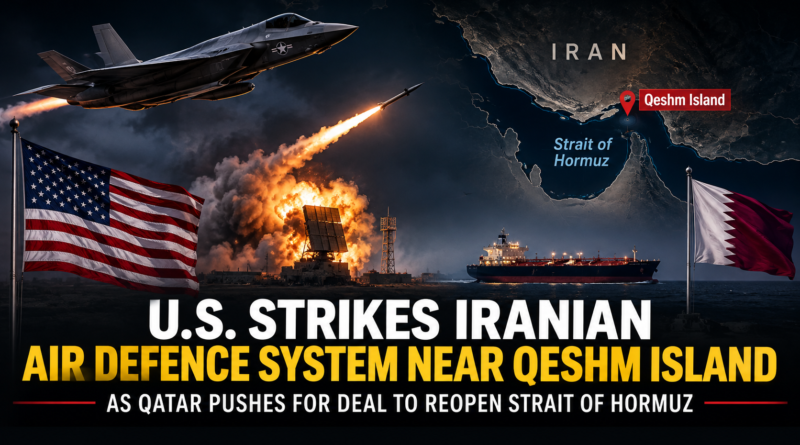
U.S. Strikes Iranian Air Defence System Near Qeshm Island as Qatar Pushes for Deal to Reopen Strait of Hormuz
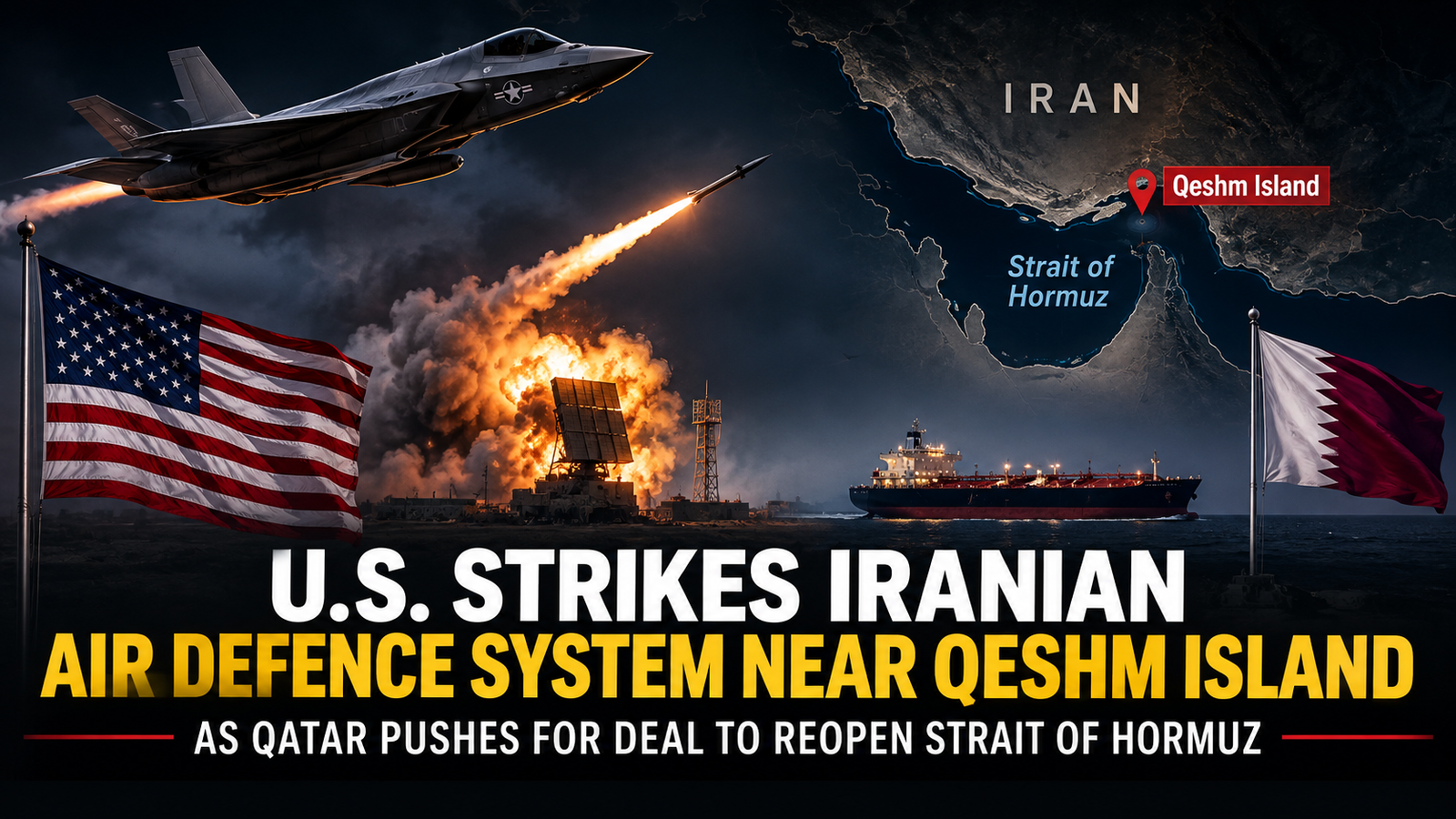
WASHINGTON, November 6, 2026 — Tensions between the United States and Iran have intensified after American forces carried out limited military strikes against an Iranian air-defence system near Qeshm Island, a strategically important location close to the Strait of Hormuz. The military action comes as diplomatic efforts led by Qatar seek to prevent another escalation and establish arrangements that could restore shipping through one of the world’s most important energy corridors.
President Donald Trump confirmed the latest military action on Friday, describing the strikes as limited. According to the Associated Press, Trump said American forces had destroyed an Iranian anti-aircraft system near Qeshm Island. Iranian state media reported hearing two explosions in the Suza area of the island.
The latest development illustrates the difficult position facing Washington and Tehran. Military confrontation continues even as diplomatic intermediaries attempt to bring both governments closer to an agreement involving Iran’s nuclear programme, regional security and access to international shipping routes.
For American households, businesses and investors, the consequences could extend well beyond the Middle East. Any prolonged disruption around the Strait of Hormuz could affect international oil transportation, energy prices, shipping costs, insurance premiums and the broader global economy.
U.S. Military Carries Out Limited Strikes Near Qeshm Island
The latest American military action comes after weeks of confrontation involving U.S. and Iranian forces in the Persian Gulf region.
According to the Associated Press, Trump said American forces targeted an Iranian air-defence system near Qeshm Island. He characterized the operation as a limited action rather than the beginning of a wider military campaign.
Qeshm is located near the entrance to the Strait of Hormuz, making the island strategically important to military operations and commercial shipping in the region. Its position gives it significance beyond its geographic size because developments around the island can influence security calculations throughout the surrounding waterway.
Iranian state media reported explosions in the Suza area following the strikes. The available reporting did not establish a complete independent assessment of the damage, the number of casualties or the full operational consequences of the attack.
The distinction between a limited military strike and a broader offensive is important. A targeted operation may be intended to eliminate a specific military capability, but it can also create new risks if the other side responds with additional military action.
Washington and Tehran therefore face a difficult challenge: maintaining their security positions without allowing individual incidents to develop into a much wider confrontation.
Why Qeshm Island Matters to the United States and the World
Qeshm Island is situated in the Persian Gulf near the Strait of Hormuz, a narrow maritime passage connecting the Persian Gulf with the Gulf of Oman and the wider Indian Ocean.
The strait is particularly important because major oil and gas exporters in the Gulf depend on it to transport energy supplies to international customers. Tankers carrying crude oil, petroleum products and liquefied natural gas use the surrounding shipping routes to reach markets across Asia, Europe and other regions.
This makes the waterway an important part of the international economic system.
For the United States, security around Hormuz has implications for military operations, regional partnerships, international energy markets and the protection of commercial shipping. Although America produces substantial quantities of its own energy, it remains connected to global markets where disruptions in one region can influence prices elsewhere.
For Asian economies, the importance is especially direct because many major energy importers depend on supplies transported through the Gulf.
The consequences of a prolonged disruption would not necessarily remain limited to countries located near Iran. Higher energy transportation costs can affect manufacturing, aviation, agriculture, logistics and household electricity expenses across multiple continents.
Qatar Attempts to Build a Diplomatic Bridge
While American military operations continue, Qatar is working to create a diplomatic path toward reducing tensions.
According to Associated Press reporting, Qatari mediators have presented proposals intended to address disagreements between Washington and Tehran over Iran’s nuclear programme and the future of shipping through the Strait of Hormuz.
Regional officials described a potential two-day arrangement designed to establish confidence-building measures before more comprehensive nuclear negotiations begin.
The reported proposal includes steps such as lifting the U.S. blockade on Iranian ports and releasing some frozen Iranian funds in exchange for Iran permitting International Atomic Energy Agency inspectors to visit nuclear facilities previously struck by the United States and Israel.
A subsequent stage would involve reopening the Strait of Hormuz under a temporary arrangement, with further negotiations expected to address a longer-term framework for the waterway.
These proposals remain diplomatic discussions rather than a confirmed final agreement. Important details still require negotiation, and the positions of the two governments remain far apart.
Qatar’s role is significant because it maintains diplomatic relationships across the region and has experience acting as an intermediary in difficult international negotiations. Its objective is to prevent military developments from closing the remaining opportunities for dialogue.
The success of these efforts will depend on whether both governments are willing to make concessions on issues they consider central to their national security.
Iran’s Nuclear Programme Remains at the Centre of the Dispute
The nuclear issue remains one of the most difficult parts of the confrontation.
Washington has repeatedly demanded that Iran address international concerns about its nuclear activities, including its stockpile of highly enriched uranium and access for international inspectors.
The International Atomic Energy Agency has reported that Iran accumulated approximately 440.9 kilograms of uranium enriched to 60% purity. Uranium at that enrichment level is not itself equivalent to weapons-grade material, but it is much closer to the approximately 90% enrichment level generally associated with weapons-grade uranium.
The distinction is important because enrichment levels, stockpile quantities and verification arrangements are central to assessing nuclear proliferation risks.
Iran has maintained that its nuclear programme is peaceful and has demanded significant changes in American policy before entering broader negotiations.
According to AP reporting, Tehran has called for measures including the lifting of sanctions, the release of frozen assets, compensation for war damage, an end to the U.S. blockade and an end to regional hostilities.
The United States has not accepted all of these demands.
This creates a complicated negotiating environment. Washington wants meaningful assurances about Iran’s nuclear activities, while Tehran wants economic and security concessions before making commitments.
A sustainable agreement would likely require both sides to establish a process for verification, compliance and resolving future disagreements.
Strait of Hormuz: The Economic Risk Behind the Military Conflict
For global markets, the Strait of Hormuz is one of the most important locations in the current confrontation.
The waterway carries a substantial share of internationally traded petroleum. When security conditions deteriorate, energy traders, shipping companies and insurance providers must assess the possibility of delays, higher operating costs or restrictions on commercial vessels.
Even the possibility of disruption can influence financial markets.
Oil prices are shaped by several factors, including global demand, available supply, inventories, production decisions and geopolitical risk. A military confrontation near Hormuz can add a risk premium because traders must consider the possibility that future supplies may become more difficult or expensive to transport.
If the waterway remains accessible under reliable security arrangements, markets may have greater confidence in the movement of energy supplies. If disruptions continue, the opposite could occur.
The economic impact would depend on the duration and severity of any interruption, the availability of alternative supply routes and the response of major oil-producing countries.
The important point is that military developments around Qeshm Island are not simply a regional security story. They are connected to a global energy network that affects businesses and consumers far beyond the Middle East.
What Higher Oil Prices Could Mean for American Families
American consumers could feel the effects of prolonged instability through several channels.
The first is gasoline. Crude oil is a major input in gasoline production, although retail fuel prices also depend on refining costs, distribution, taxes and regional market conditions.
When international oil prices rise, fuel costs can increase, creating additional pressure on commuters, delivery drivers, trucking companies and businesses that depend on transportation.
The second is food. Agricultural production, packaging, refrigeration and distribution all require energy. Higher fuel and transportation costs can eventually affect the prices of products moving through supply chains.
The third is household utilities. Energy markets influence electricity and heating costs differently across regions, depending on local generation systems, fuel sources and regulatory arrangements.
The fourth is business expenses. Airlines, manufacturers, logistics companies and retailers may face higher operating costs if energy prices remain elevated.
These expenses can eventually reach consumers through higher prices for goods and services.
However, it is important not to assume that every military escalation will automatically produce a sustained increase in American inflation. The actual effect depends on how long the disruption lasts, how energy markets respond and whether alternative supplies can compensate for lost or delayed shipments.
Financial Markets Watch the Conflict Closely
Investors are monitoring the confrontation because energy prices influence inflation expectations, corporate earnings and central bank decisions.
A sustained increase in oil prices could complicate the Federal Reserve’s efforts to maintain price stability. Higher energy costs can increase the expenses of households and businesses while making it more difficult for inflation to decline.
If inflation remains elevated, financial markets may reconsider expectations about future interest-rate reductions.
Treasury yields, currency markets and equity valuations can also respond to changes in geopolitical risk. Energy companies may experience different effects from airlines, transportation businesses, manufacturers and consumer-facing retailers.
For investors, the central challenge is separating short-term reactions from lasting economic changes.
A temporary rise in geopolitical risk does not necessarily mean that the global economy will experience a prolonged energy shock. However, continued military activity combined with restrictions on shipping could make the situation more serious.
Washington Faces Military and Political Pressure
The latest strikes also come at a politically sensitive moment in the United States.
The Republican Party suffered major losses in the November 2026 midterm elections, with economic concerns, fuel prices and dissatisfaction over the Iran conflict contributing to the political debate.
The election results have increased scrutiny of the administration’s handling of the conflict.
For the White House, the challenge is not limited to military operations. Officials must also consider the economic consequences, the safety of American personnel, relationships with regional partners and the political cost of a prolonged confrontation.
Congressional oversight could become more significant as lawmakers examine the administration’s military objectives, spending, regional strategy and plans for ending the conflict.
American voters are also likely to pay attention to whether the confrontation affects gasoline prices, inflation and the wider cost of living.
The government must therefore manage both the immediate security situation and the longer-term economic consequences of its decisions.
Qatar’s Mediation Faces Difficult Questions
Qatar’s diplomatic initiative offers a possible route toward reducing tensions, but several difficult questions remain.
Would Iran permit international inspectors to access the nuclear facilities covered by a potential agreement?
Would Washington agree to ease sanctions or release frozen Iranian funds before a comprehensive nuclear settlement?
Could both sides establish a reliable arrangement for reopening and protecting commercial shipping through Hormuz?
Would a temporary agreement be strong enough to prevent renewed military confrontation?
These questions will determine whether the reported proposals can develop into a workable diplomatic framework.
The negotiations also involve other regional countries whose security and economic interests are directly affected by developments in the Gulf.
A successful arrangement would need to address more than the immediate military situation. It would also require a credible mechanism for preventing future incidents from threatening commercial shipping or restarting hostilities.
What the World Should Watch Next
Several developments will be important in the coming days.
First, attention will remain on whether the United States confirms additional military operations and whether Iran announces any response to the latest strikes.
Second, shipping activity around the Strait of Hormuz will be closely monitored. Any new restrictions, attacks on commercial vessels or changes in transit arrangements could affect energy markets.
Third, Qatar’s diplomatic contacts with Washington and Tehran will provide clues about whether the two governments are moving closer to an interim agreement.
Fourth, the International Atomic Energy Agency’s role will remain important because any nuclear arrangement will require credible inspection and verification procedures.
Finally, energy traders will watch crude oil prices, tanker movements, shipping insurance costs and announcements from major producers.
These developments will help determine whether the confrontation is moving toward a negotiated pause or another period of military escalation.
The Bigger Picture: A Regional Conflict With Global Consequences
The U.S. strikes near Qeshm Island demonstrate how quickly military developments in the Persian Gulf can become an international economic concern.
For Washington, the immediate issue involves security and the confrontation with Iran. For Tehran, the dispute involves nuclear policy, sanctions, economic restrictions and regional influence. For Qatar, the priority is creating enough diplomatic space to prevent further escalation.
For the rest of the world, the most immediate concern is the security of energy supplies and international shipping.
The Strait of Hormuz connects the security of the Gulf with the economic interests of countries thousands of miles away. A prolonged disruption could affect oil markets, transportation networks, industrial production and household budgets.
The diplomatic proposals now being discussed offer a possible way forward, but they remain uncertain. Military developments, nuclear disagreements and competing political demands continue to complicate negotiations.
For American families, businesses and investors, the outcome matters because international security events can eventually influence the price of fuel, the cost of goods and the direction of the wider economy.
The coming days may determine whether Qatar’s mediation can turn the current diplomatic opening into a meaningful agreement or whether Washington and Tehran move into another phase of confrontation.
The central question is no longer simply what happened near Qeshm Island. It is whether the United States and Iran can prevent the next military incident from becoming a much larger crisis for the Middle East and the global economy.
Reporting sources: Associated Press reporting dated November 6, 2026; Reuters reporting on the Qeshm Island strikes and Qatar’s mediation; International Atomic Energy Agency information on Iran’s uranium enrichment.
