
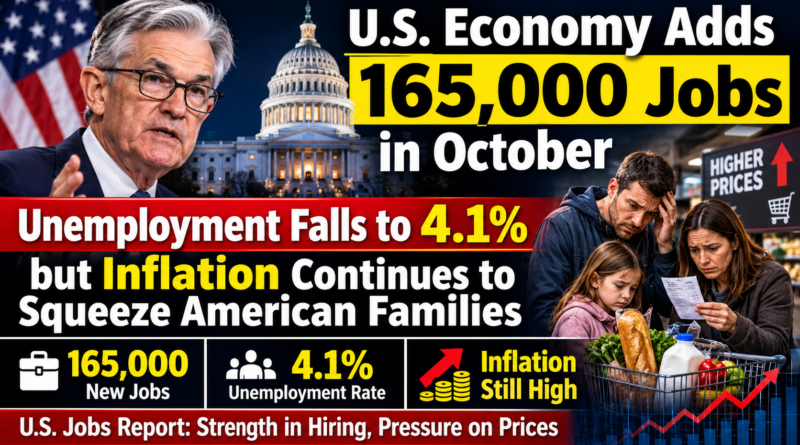
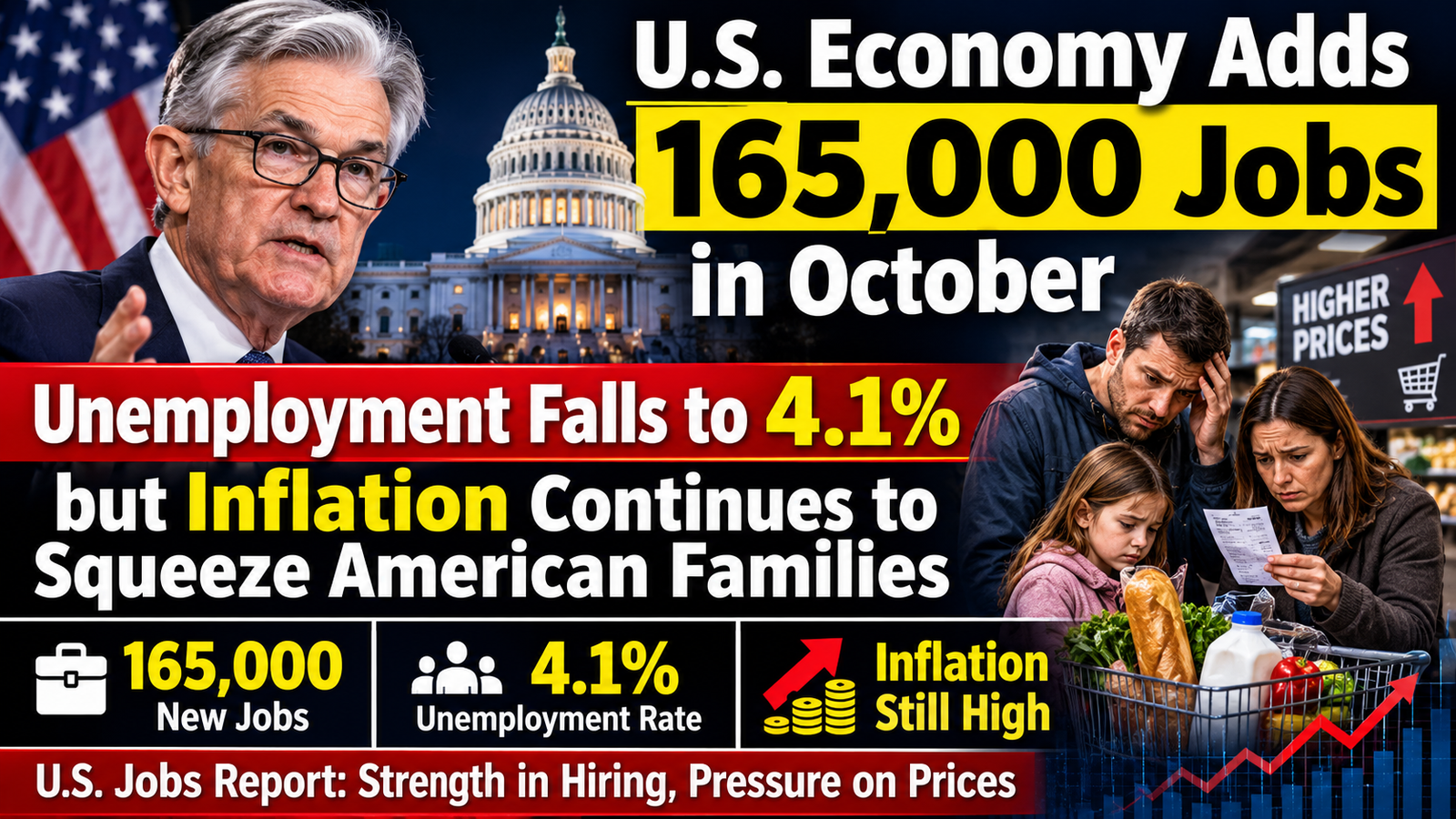
U.S. Economy Adds 165,000 Jobs in October as Unemployment Falls to 4.1%, but Inflation Continues to Squeeze American Families
WASHINGTON, November 6, 2026 — The U.S. labor market delivered a stronger-than-expected performance in October, offering fresh evidence that employers are still adding workers despite economic uncertainty, elevated living costs and growing pressure on American households.
The United States added approximately 165,000 nonfarm payroll jobs during October, according to the latest report from the Bureau of Labor Statistics (BLS), released Friday. The increase significantly exceeded economists’ expectations of approximately 65,000 jobs. The unemployment rate also edged down from 4.2% in September to 4.1% in October.
At first glance, the figures suggest that the American employment market remains more resilient than many forecasters anticipated. Businesses continued hiring, unemployment remained relatively low and employment gains appeared across several important industries. Yet the headline numbers tell only part of the economic story. For millions of Americans, the most important question is not simply whether the economy is creating jobs, but whether their earnings are keeping pace with the cost of living.
That distinction is becoming increasingly important as households continue to manage expensive groceries, housing, healthcare, transportation, utilities and other everyday necessities. The latest employment report arrives at a politically sensitive moment, just days after the November 3 midterm elections, in which economic conditions and affordability featured prominently in the national debate.
October Hiring Beats Economists’ Expectations
The October employment report provided a notable improvement over the previous month’s initial figures. Employers added 165,000 jobs, considerably more than the roughly 65,000 increase expected by economists surveyed by Reuters.
The unemployment rate declined to 4.1%, compared with 4.2% in September. The BLS reported that the number of unemployed Americans stood at approximately 7.1 million, with relatively little change during the month.
Professional and business services recorded particularly strong employment growth, adding approximately 70,000 positions. Healthcare and transportation-related industries also contributed to the increase. The gains indicate that hiring activity was not limited to one narrow part of the economy.
However, the report also showed that employment conditions remain uneven. Some industries continued to experience limited growth or job reductions, demonstrating that a strong national headline does not necessarily translate into equally strong opportunities for every worker, occupation or region.
The BLS also revised its earlier estimates. August employment growth was revised upward to 186,000 jobs, while September’s previously reported increase of 29,000 was revised to 60,000. Combined, the August and September revisions added 84,000 jobs to the previously published estimates.
These revisions matter because monthly employment reports are preliminary estimates that can change as additional information becomes available. Investors, policymakers and employers therefore examine both the latest headline figure and the direction of earlier revisions when assessing the health of the labor market.
Why the Jobs Report Matters Beyond Washington
Employment is one of the most closely watched indicators of the American economy because it connects business activity with household income and consumer spending.
When employers hire additional workers, more households may receive regular paychecks, giving them greater capacity to pay bills, purchase goods and services, save money or reduce outstanding debt. Consumer spending is an important part of the U.S. economy, making employment conditions particularly significant for retailers, restaurants, service providers and other businesses that depend on household demand.
A growing labor market can also provide workers with additional opportunities to change jobs, negotiate compensation or enter industries experiencing increased demand.
But job creation alone cannot establish whether American families are becoming financially more secure. The number of available positions, the quality of those jobs, working hours, wage increases and the prices consumers face all influence the actual financial benefits of employment.
For a household earning a regular income, a larger paycheck can provide limited relief if rent, insurance, food, fuel and medical expenses are rising at the same time.
That is why the October employment report should be viewed alongside inflation and wage data rather than as a complete measurement of household financial health.
Wages Are Rising, but Purchasing Power Remains a Concern
The BLS reported that average hourly earnings for private-sector employees increased by 14 cents, or 0.4%, in October, reaching $38.00. Over the previous 12 months, average hourly earnings increased by 3.1%.
The increase in wages is important because it indicates that workers are receiving higher nominal compensation. However, nominal wage growth does not automatically mean that households are becoming wealthier in real terms.
The critical measure is purchasing power: how much a worker can actually afford after accounting for changes in prices.
If the cost of essential goods and services increases faster than wages, families may find that their income covers fewer expenses even when their salaries have increased. This creates a difficult financial situation for workers who are employed full-time but continue to struggle with monthly bills.
Recent inflation data have shown that prices remain a significant concern. Reporting on the September inflation figures indicated that consumer prices were 3.7% higher than a year earlier, exceeding the 3.1% annual increase in average hourly earnings reported for October. These figures cover different reporting periods and are not a direct measure of an individual household’s experience, but they illustrate why rising wages may not feel like meaningful financial progress for many consumers.
The pressure is especially visible in household budgets where a large share of income goes toward necessities rather than discretionary spending.
Groceries, Housing and Healthcare Continue to Shape Household Budgets
For many Americans, economic conditions are experienced through ordinary financial decisions made every week.
A family visiting a grocery store may notice that its regular shopping basket costs more than it did a year earlier. Renters may face lease renewals at higher monthly rates, while prospective homebuyers must consider mortgage payments, insurance, property taxes and other ownership expenses.
Healthcare creates another layer of uncertainty. Insurance premiums, deductibles, prescription expenses and medical bills can make it difficult for households to predict how much money will remain available at the end of each month.
Transportation costs also influence the financial position of working families. People who depend on cars to commute may have limited flexibility when gasoline, maintenance, insurance and vehicle financing become more expensive.
These expenses do not affect every household equally. Higher-income families may have greater savings and more room in their budgets to absorb price increases. Lower-income households, by contrast, often spend a larger percentage of their earnings on basic necessities.
As a result, even when national employment figures improve, the financial experience of individual Americans can remain very different.
Affordability Became a Major Issue in the Midterm Elections
The timing of the October jobs report is politically significant.
American voters went to the polls on November 3 after months of debate about inflation, household expenses, employment opportunities and the direction of the national economy. Economic concerns were central to the election campaign, and affordability remained an important subject for voters across the political spectrum.
Pew Research Center reported before the elections that 84% of registered voters considered the economy very important to their midterm vote. Post-election reporting by The Associated Press also found widespread concern about the cost of living, with voters identifying everyday expenses as a major factor in their decisions.
The election results have placed additional attention on how elected officials respond to household financial pressures. The new employment figures provide the administration with evidence of stronger hiring, but they do not automatically resolve concerns about inflation or the cost of essential services.
There is an important difference between the national economic statistics and the way people describe their personal financial circumstances. A worker may be employed, receive a salary increase and still feel financially insecure because rent, groceries, childcare, insurance or medical expenses consume most of the household income.
That gap between economic indicators and personal experience has become a central part of the affordability debate.
What the Numbers Could Mean for the Federal Reserve
The stronger-than-expected jobs report also has implications for the Federal Reserve, which must balance its responsibility to support maximum employment with its goal of maintaining stable prices.
A labor market that remains resilient can give policymakers more flexibility to focus on inflation rather than immediately responding to signs of employment weakness. However, stronger hiring and wage growth can also influence how officials assess demand and future price pressures.
Financial markets reacted to the October report by reassessing the possibility of a Federal Reserve interest-rate increase in December. Reuters reported that Treasury yields and the U.S. dollar initially moved higher following the release, reflecting changing expectations about the central bank’s next decision.
Interest rates matter to ordinary households because they influence borrowing costs throughout the economy. Mortgage rates, credit-card interest, personal loans, automobile financing and business borrowing can all be affected by changes in market interest rates and Federal Reserve policy.
Higher interest rates may help reduce inflationary pressure by making borrowing more expensive and slowing demand. But they can also increase financial pressure on households and businesses that need credit.
The Federal Reserve will therefore need to examine several indicators, including employment, wages, inflation, consumer spending and broader economic activity. One monthly jobs report, regardless of its strength, cannot determine the direction of monetary policy on its own.
A Strong Headline Does Not Mean Every Worker Is Finding a Job
Another important detail in the October report is the difference between the official unemployment rate and broader measures of labor-market conditions.
The headline unemployment rate, commonly known as U-3, stood at 4.1%. However, the broader U-6 measure, which includes unemployed people, workers marginally attached to the labor force and people working part-time for economic reasons, increased to 7.9% in October.
The distinction matters because the official unemployment rate does not capture every person experiencing difficulty finding sufficient work.
Some Americans may have stopped actively looking for employment and therefore are not counted as unemployed under the standard definition. Others may have jobs but want additional hours or full-time positions.
The labor force participation rate increased slightly to 61.9% in October. This measure tracks the share of the civilian noninstitutional population that is either employed or actively looking for work.
These indicators provide a more detailed picture of the labor market. They help explain why a lower unemployment rate can exist alongside concerns about job availability, underemployment and the challenges faced by people trying to enter the workforce.
Businesses Face a Complicated Economic Environment
For American businesses, the latest figures offer both encouragement and questions.
Additional hiring can indicate that companies expect sufficient demand to justify expanding their workforces. Professional services, healthcare and transportation businesses may benefit from increased economic activity and continued demand for their services.
At the same time, employers must manage payroll expenses, borrowing costs, operating costs and uncertainty about future consumer spending.
Small businesses can face particular challenges because they often have fewer financial resources than large corporations. A restaurant, neighborhood retailer or independent service provider may find it difficult to raise prices without losing customers, while also facing higher wages, rent, utilities and supplier costs.
If consumer budgets remain under pressure, businesses may become cautious about expanding operations or adding permanent employees. If demand strengthens, however, employers could increase hiring and investment.
The October report provides evidence of continued employment growth, but future reports will be important in determining whether the improvement represents a sustained trend or a stronger month within an otherwise moderate hiring environment.
The Central Economic Question: Are American Families Getting Ahead?
The latest jobs report gives the United States a positive employment headline. Adding 165,000 jobs in one month, beating expectations and recording an unemployment rate of 4.1% are meaningful developments.
Yet the broader economic question remains unresolved.
For American families, economic security is not measured only by the number of people on payrolls. It also depends on whether a paycheck can cover housing, food, healthcare, transportation, education and savings without requiring households to rely increasingly on credit.
A family that spends most of its monthly income on essential expenses may not experience much improvement even when national employment figures are strong. Workers who are paid more but face higher rent and insurance premiums may continue to feel financially stretched.
This is why policymakers, economists and voters are paying attention to both employment and inflation. Job creation can strengthen household finances, but sustainable improvements in living standards also require wages and productivity to support real purchasing power.
What to Watch in the Coming Weeks
The next stage of the economic story will depend on whether hiring momentum continues, whether wage growth improves relative to inflation and whether the cost of essential goods and services begins to place less pressure on household budgets.
Investors will also watch Federal Reserve statements, Treasury yields, inflation releases and consumer-spending indicators for clues about the direction of interest rates and economic activity.
The next monthly employment report, covering November, is scheduled for December 4, 2026, according to the BLS calendar. That release will provide another opportunity to assess whether October’s stronger hiring figure was part of a broader improvement.
For American workers, the most immediate concern will remain practical rather than statistical: whether employment provides enough income to keep up with everyday expenses and build some financial stability.
The October report demonstrates that the U.S. labor market can still produce stronger hiring than economists expect. But the challenge facing policymakers and households is larger than the monthly jobs total. The real test of economic progress will be whether employment growth translates into greater financial security for ordinary Americans.
Source and reporting basis: U.S. Bureau of Labor Statistics, October 2026 Employment Situation report; Reuters employment and market coverage; Associated Press reporting on employment and voter concerns; Pew Research Center analysis of 2026 midterm voter priorities.

