
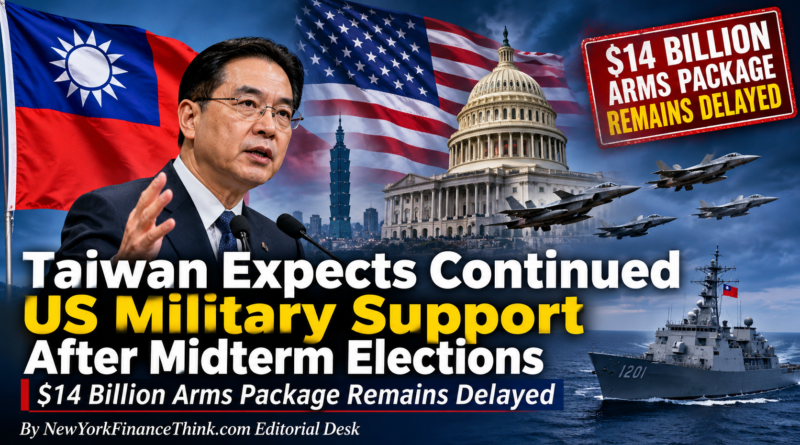
Taiwan Expects Continued US Military Support After Midterm Elections: $14 Billion Arms Package Remains Delayed
By NewYorkFinanceThink.com Editorial Desk
Date: November 5, 2026
Category: Defense and US Relations | Taiwan | Indo-Pacific Security
Taiwan is expecting continued military and political support from the United States despite a significant shift in the American political landscape following the November 2026 midterm elections. Taiwan’s Defence Minister Wellington Koo has expressed confidence that bipartisan support for Taiwan remains strong in the US Congress, suggesting that Washington’s long-standing commitment to Taiwan’s defensive capabilities is unlikely to disappear simply because control of Congress has changed. However, his remarks come at a sensitive moment for relations between Taipei and Washington, as a proposed $14 billion US arms package remains delayed and uncertainty continues over the timing and future direction of American security assistance.
The election results have created a new political environment in Washington. Democrats have secured victories that will reshape congressional leadership when the new Congress begins its work in January 2027. For Taiwan, the immediate question is not simply which political party controls the House of Representatives or the Senate. The larger issue is whether the United States will maintain a consistent approach toward Taiwan’s security, particularly as China continues to increase military pressure around the island. Koo’s comments indicate that Taiwan believes support for its defensive requirements extends beyond party politics and remains an important issue for lawmakers from both sides of the American political spectrum.
The proposed $14 billion arms package has become one of the most important unresolved questions in the relationship. Taiwan views American weapons and defense technology as essential to strengthening its ability to deter military pressure and protect its territory. The package is therefore more than a commercial transaction involving defense equipment. It represents a broader political and strategic question about the reliability of US security support at a time when tensions across the Taiwan Strait remain elevated. The delay has attracted attention because Taiwan must plan its defense requirements years in advance, while the regional security environment can change much faster.
Washington’s political transition and Taiwan’s expectations
Taiwan’s confidence in bipartisan congressional support reflects a long-standing feature of American policy toward the island. Members of both major US political parties have repeatedly expressed concern about China’s military activities and have supported measures intended to strengthen Taiwan’s defensive capabilities. Congressional backing has included legislation, arms-sale approvals, diplomatic engagement and calls for greater attention to security in the Indo-Pacific region.
For Taipei, this bipartisan foundation is important because American foreign policy does not operate through the White House alone. Congress plays a significant role in defense funding, oversight, legislation and political debate. Members of Congress can also influence how the administration approaches arms transfers and regional security commitments. Taiwan therefore has an incentive to maintain relationships across party lines rather than depending exclusively on one political administration.
Wellington Koo’s remarks suggest that Taipei intends to continue engaging with American lawmakers and relevant government departments regardless of the election outcome. This approach is strategically sensible. A relationship built around long-term security interests is generally more durable than one based entirely on short-term political relationships. Taiwan needs sustained communication with Washington because its defense planning involves procurement schedules, training, maintenance, technology cooperation and the development of domestic military capabilities.
Nevertheless, bipartisan support does not automatically guarantee that every proposed arms package will be approved immediately. American defense policy is influenced by competing priorities, budget constraints, production capacity, regional commitments and negotiations between the executive branch and Congress. A political statement supporting Taiwan may demonstrate broad agreement on the importance of the relationship, but the practical value of that support depends on decisions that result in actual equipment deliveries and operational capabilities.
Why the $14 billion arms package matters
The proposed $14 billion arms package is important because Taiwan faces a security challenge that cannot be addressed through political declarations alone. Military deterrence requires equipment, trained personnel, reliable communications, surveillance systems, ammunition stocks, maintenance facilities and the ability to coordinate different branches of the armed forces. These capabilities must function together during a crisis.
Taiwan’s defense planners must consider a wide range of potential threats, including missile attacks, air operations, naval pressure, cyber operations, disruption of communications and attempts to isolate the island economically or militarily. Modern defense planning therefore requires more than purchasing individual weapons systems. It requires an integrated structure capable of detecting threats, sharing information, responding quickly and maintaining operations under pressure.
A major arms package could contribute to that broader defensive structure, depending on the equipment included and the schedule for delivery. However, the exact composition, approval status and delivery timetable of the proposed package should not be assumed without official confirmation. The central issue is that Taiwan wants predictable access to the defensive equipment it has identified as necessary for its security.
The delay also raises questions about the difference between an arms-sale announcement and an operational military capability. Even after an agreement is approved, equipment may take months or years to manufacture, transport, install and integrate. Personnel must receive training, systems must be tested and spare parts must be available. For Taiwan, a delayed decision can therefore affect not only the date of a purchase but also the longer-term timetable for strengthening its defenses.
The Trump administration and the strategic uncertainty
The arms package has become more politically sensitive because President Donald Trump previously indicated that he was holding the proposed sale in abeyance following his May 2026 meeting with Chinese President Xi Jinping. Trump described the issue as a potential bargaining chip, connecting the arms-sale question to the wider diplomatic relationship between Washington and Beijing.
That approach has created uncertainty for Taiwan. Taipei wants its security requirements to be assessed on their own strategic merits, while Washington must also manage a complicated relationship with China involving trade, technology, regional stability and diplomatic negotiations. The United States has interests in avoiding unnecessary escalation, but it also has longstanding legal and strategic reasons to support Taiwan’s ability to defend itself.
The situation illustrates the difficulty of balancing diplomacy and deterrence. If Washington approves major arms sales, Beijing may respond with diplomatic protests or additional military pressure. If Washington delays them, Taiwan may question the consistency of American support and China may interpret the delay as an opportunity to increase pressure. Neither outcome is automatically decisive, but both carry strategic consequences.
A stable policy requires Washington to communicate clearly about its objectives. Diplomatic engagement with Beijing and defensive support for Taiwan are not necessarily mutually exclusive. The challenge is to prevent diplomatic negotiations from creating uncertainty about the basic principles guiding American policy toward the Taiwan Strait.
The Taiwan Relations Act and the limits of American commitments
The US-Taiwan security relationship is shaped in part by the Taiwan Relations Act of 1979. The legislation provides a framework for maintaining unofficial relations with Taiwan and for making defensive articles and services available to the island. It also establishes a US policy interest in maintaining the capacity to resist force or coercion that would threaten the security or social and economic system of Taiwan.
However, the Taiwan Relations Act should not be misunderstood as an automatic guarantee that the United States will enter a military conflict if Taiwan is attacked. American policy has historically included strategic ambiguity, leaving uncertainty about the precise circumstances under which Washington would intervene militarily. This ambiguity is intended to discourage unilateral changes to the status quo while preserving flexibility for American decision-makers.
For Taiwan, this means that defense preparation remains essential. American assistance can strengthen deterrence, but Taipei cannot assume that external support will replace its own military responsibilities. Taiwan must continue investing in its armed forces, improving readiness, strengthening civil resilience and preparing for disruptions that could occur during a serious crisis.
The distinction between political support and a formal defense guarantee is central to understanding the current situation. Koo’s confidence in bipartisan support is politically significant, but the practical security relationship will ultimately depend on legislation, executive decisions, equipment deliveries, military cooperation and the broader strategic calculations of both governments.
China’s reaction and the Taiwan Strait security environment
Beijing strongly opposes American arms sales to Taiwan and considers the island part of its territory. Taiwan’s government rejects Beijing’s claims and maintains that the island’s future should be determined by its people. This fundamental disagreement has shaped cross-strait relations for decades and remains one of the most sensitive security issues in the Indo-Pacific.
China has expanded and modernized its military capabilities over many years. Its military activities around Taiwan, including air and naval operations, have become an important concern for Taiwan’s defense planners and regional governments. These activities can create pressure even when they do not involve direct armed conflict. Frequent military operations may increase the burden on Taiwan’s surveillance systems, require repeated responses and make it more difficult for officials to distinguish routine activity from a developing crisis.
The challenge for Taiwan is to maintain credible deterrence without contributing unnecessarily to escalation. A stronger defensive posture may reduce the likelihood that Beijing believes military pressure can achieve its objectives quickly or at an acceptable cost. At the same time, military decisions must be supported by communication channels and diplomatic efforts that reduce the risk of miscalculation.
For the United States, the issue is equally complex. Washington wants to preserve stability in the Taiwan Strait, protect its regional interests and maintain confidence among allies and partners. Any major change in American policy could be closely watched by Japan, the Philippines, Australia and other governments that view the Taiwan Strait as an important part of regional security.
Taiwan’s defense modernization cannot depend on one arms package
The proposed $14 billion package is important, but Taiwan’s defense strategy cannot depend on a single American decision. A sustainable security policy requires investment across multiple areas, including air defense, coastal protection, surveillance, missile capabilities, cybersecurity, secure communications, ammunition production and military training.
Taiwan also needs to strengthen its domestic defense industry. Local production can help reduce dependence on external supply chains, improve maintenance capacity and provide greater flexibility during periods of international tension. Domestic manufacturing cannot replace all foreign technology or equipment, but it can make the overall defense system more resilient.
Another important priority is the ability to operate under difficult conditions. Military systems may become less effective if communications networks are disrupted, energy supplies are interrupted or critical infrastructure is damaged. Taiwan’s security planning therefore involves both military readiness and wider national resilience. Ports, airports, electricity networks, telecommunications systems, hospitals and transport infrastructure can all become important during a crisis.
Civil preparedness also matters. Public information systems, emergency planning and coordination between government agencies can help reduce confusion during periods of heightened tension. A society that understands how to respond to emergencies is better positioned to withstand pressure and maintain essential services.
Why the Indo-Pacific region is watching Washington
The Taiwan Strait is not an isolated security issue. It is connected to wider economic and strategic interests across the Indo-Pacific. Japan is particularly attentive to developments around Taiwan because of its geographic proximity and the importance of nearby sea routes. The Philippines also has significant interests in regional maritime security, while Australia views stability in the Indo-Pacific as an important element of its national security policy.
A serious crisis around Taiwan could affect shipping, insurance costs, regional investment and international supply chains. Commercial vessels operating near the Taiwan Strait and surrounding waters are part of a larger network connecting major Asian economies with markets in North America, Europe and other regions. Disruption could therefore have consequences far beyond the immediate area.
Regional governments are likely to watch not only whether the United States approves the proposed arms package but also how Washington communicates its wider security policy. Consistency matters because allies and partners make their own defense and economic decisions based partly on their understanding of American priorities.
If Washington maintains a clear approach, regional governments may have greater confidence in the durability of the existing security framework. If policy appears unpredictable, governments may reconsider their defense planning, diplomatic positions and economic exposure. The consequences would extend beyond Taiwan itself.
Semiconductor manufacturing and the global economic stakes
Taiwan’s importance to the global economy adds another dimension to the security debate. The island is a major center of advanced semiconductor manufacturing, and its technology industry is deeply connected to global supply chains. Semiconductors are essential for smartphones, computers, data centers, vehicles, telecommunications equipment and many advanced industrial systems.
A serious disruption to Taiwan’s economy or transportation networks could create significant uncertainty for manufacturers and technology companies around the world. The effects would depend on the nature, duration and scale of any disruption, as well as the ability of companies to use inventories and alternative production sources. It would be inaccurate to assume that every security incident would immediately stop semiconductor production, but the potential economic exposure is substantial.
For international investors, Taiwan-related risks are not limited to defense companies. They may also affect technology shares, semiconductor manufacturers, shipping companies, insurers, logistics providers and businesses dependent on advanced electronics. A major escalation could increase market volatility and encourage companies to reassess supply-chain concentration.
Governments and businesses have increasingly discussed diversification and supply-chain resilience. However, advanced semiconductor production cannot be moved quickly or replicated easily. Manufacturing facilities require specialized equipment, skilled workers, reliable infrastructure and substantial investment. Taiwan’s role in the semiconductor industry is therefore likely to remain strategically important even as other economies expand their own manufacturing capacity.
Three possible paths for the delayed arms package
The future of the proposed $14 billion arms package remains uncertain. Several possible developments could shape the next stage of the relationship, although these should be understood as analytical scenarios rather than confirmed government decisions.
First, Washington could move toward approval. If the administration determines that the package is consistent with its security objectives and broader regional policy, it could allow the process to advance. Such a decision would likely be welcomed in Taipei and could reinforce confidence in bipartisan congressional support. The timing and eventual delivery of equipment would still depend on the formal approval and procurement process.
Second, the package could remain delayed. Washington may continue to balance arms-sale decisions against diplomatic and economic negotiations with Beijing. If the delay continues, Taiwan could face greater uncertainty in its defense planning. Taipei would likely continue seeking congressional support, strengthening domestic production and adjusting procurement priorities where possible.
Third, the package could be divided into smaller transactions or handled through separate approvals. This possibility could allow certain defensive requirements to move forward while other elements remain under review. Whether such an approach is practical would depend on the equipment involved, production schedules and decisions by the relevant US authorities. It should not be treated as an announced plan.
The most important question in all three scenarios is whether Taiwan can maintain a predictable and sustainable process for strengthening its defenses. A large headline figure attracts attention, but the operational value of assistance depends on what is delivered, when it arrives and how effectively it can be integrated into Taiwan’s defense system.
What Taiwan needs from the United States
Taiwan’s immediate interest is continued access to defensive equipment and technology, but its broader requirement is strategic predictability. Taipei needs to understand how Washington views the security environment, how arms-sale decisions will be handled and whether existing cooperation can continue across changes in American political leadership.
That does not mean Taiwan expects every request to be approved without debate. US policymakers must consider their own defense requirements, industrial capacity, budget priorities and global commitments. However, clear communication can help reduce uncertainty and allow Taiwan to plan its defense investments more effectively.
The relationship also requires sustained engagement beyond weapons procurement. Training, intelligence cooperation where legally and politically authorized, cybersecurity, maintenance, logistics and defense-industry coordination can all contribute to Taiwan’s resilience. These areas may not always generate the same headlines as a multibillion-dollar arms package, but they are essential to building capabilities that can be maintained over time.
Taiwan also has responsibilities of its own. It must allocate sufficient resources, improve the readiness of its armed forces and build a defense structure suited to its geography and security environment. External assistance is most effective when it strengthens a credible domestic strategy rather than becoming a substitute for one.
The wider message of the 2026 midterm elections
The 2026 midterm elections have changed the composition of Congress, but they have not automatically settled the future of American policy toward Taiwan. Koo’s remarks highlight Taipei’s belief that the island’s security remains an issue with bipartisan support. That belief will be tested through the decisions made by the administration and Congress in the months ahead.
For investors, regional governments and defense planners, the distinction between political statements and practical action will be important. Public expressions of support can reassure partners, but the long-term strength of a security relationship is measured by consistent policy, reliable cooperation and the ability to deliver agreed capabilities.
The proposed $14 billion arms package will therefore remain an important indicator of how Washington intends to balance its relationship with Beijing and its security interests in the Indo-Pacific. Its eventual status may offer insight into the administration’s approach, although it should not be treated as the only measure of American policy toward Taiwan.
Editorial analysis: Consistency matters more than political headlines
Taiwan’s expectation of continued US military support reflects a strategic reality: the security of the Taiwan Strait has become a major concern for the United States and many of its regional partners. The issue involves more than relations between two governments. It touches on maritime security, regional deterrence, advanced technology, global trade and the credibility of international commitments.
At the same time, confidence should not be confused with certainty. Bipartisan support in Congress does not guarantee immediate approval of the delayed $14 billion package, and the Taiwan Relations Act does not establish an automatic US military intervention obligation. These distinctions matter because exaggerated expectations can create risks just as excessive uncertainty can weaken deterrence.
The most constructive path is one that combines clear diplomatic communication, practical defensive cooperation and responsible military preparation. Washington must consider how its decisions will be interpreted in Taipei and Beijing. Taiwan must continue strengthening its own capabilities while maintaining channels for communication. Regional partners must support stability and avoid actions that could increase the risk of miscalculation.
The coming months will reveal whether the United States can maintain a predictable approach to Taiwan security while managing its wider relationship with China. The outcome will matter not only to Taiwan but also to the future balance of power in the Indo-Pacific.
For now, Wellington Koo’s message is that Taiwan expects the American relationship to remain durable across party lines. The more important test will be whether that political support translates into timely decisions, reliable defense cooperation and a security policy that remains consistent beyond election cycles.
NewYorkFinanceThink.com Editorial Note: This article is an independent editorial analysis based on publicly reported developments and the information available on November 5, 2026. Future arms-sale decisions, delivery schedules and regional security developments remain subject to official government action and may change.
Sources and further reading
- Reuters — Reporting on Taiwan’s expectations of continued US arms-sale support following the 2026 midterm elections.
- Focus Taiwan — Coverage of Defence Minister Wellington Koo’s comments on bipartisan support.
- Central News Agency (CNA) — Reporting on Taiwan-US defense relations and the delayed arms package.
- Taiwan News — Updates on Taiwan’s defense policy and US relations.
- Associated Press — Reporting on the 2026 US midterm election results.
