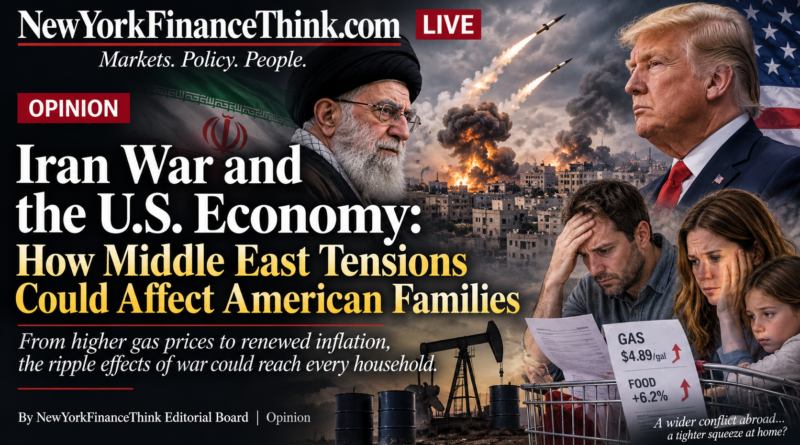
Iran War and the U.S. Economy: How Middle East Tensions Could Affect American Families
An in-depth editorial analysis of gasoline prices, household budgets, inflation, mortgages, grocery bills, employment, financial markets and the economic consequences of a prolonged Middle East conflict.
Publication date: November 4, 2026
Category: U.S. Economy | World News | Energy Markets
Focus keyword: Iran war and the U.S. economy
Introduction: A War Thousands of Miles Away Can Reach the American Kitchen Table
NEW YORK FINANCE LIVE : – For most American families, the conflict involving Iran and the United States may appear to be a distant geopolitical crisis. The fighting is taking place thousands of miles away, around the Persian Gulf and other parts of the Middle East. The diplomatic negotiations are happening between governments, military officials and international mediators. The headlines are filled with oil tankers, naval operations, sanctions, missiles and strategic shipping routes.
But the economic consequences do not remain in the Middle East.
They can appear at an American gas station, in a supermarket checkout line, on a monthly electricity bill, in the price of an airline ticket and even in the interest rate offered to someone applying for a home loan.
A family in Ohio may have no direct connection to the Middle East, but it still depends on an economy connected to international energy markets. A delivery company in Texas needs diesel to move products. A farmer in Iowa depends on fuel, fertilizer and transportation. A small business in California may pay more to receive imported materials. A household in Florida planning a vacation may discover that airline tickets have become more expensive.
This is how geopolitical conflict becomes an economic issue for ordinary people.
The relationship between war and household finances is not always immediate or straightforward. Oil prices can rise before a shortage reaches consumers. Shipping costs can increase before retailers adjust their prices. Investors can become nervous about inflation, causing financial markets and borrowing costs to move even when the average consumer has not yet noticed a change.
There is also an important distinction between a temporary market reaction and a lasting economic problem. A sudden increase in crude oil prices does not automatically mean the United States will enter a recession. Likewise, a one-day decline in oil prices does not mean the financial pressure on families has disappeared.
As of November 4, 2026, the situation presents both risks and signs of possible relief. Oil prices fell sharply after the latest U.S. midterm election results, as investors considered whether political pressure could encourage Washington to pursue a negotiated end to the conflict. Yet negotiations remain uncertain, and the future of shipping through the Strait of Hormuz remains a major concern.
The central question for American households is not simply whether the United States will win or lose a geopolitical confrontation. It is whether the economic costs of the conflict will continue to affect the purchasing power, financial security and future opportunities of ordinary Americans.
This editorial examines that question from the perspective of families, workers, homeowners, renters, retirees, business owners and investors.
1. Why the Iran War Matters to the American Economy
The United States is a major energy producer. It produces substantial quantities of crude oil and natural gas and has become much less dependent on imported petroleum than it was several decades ago.
That change provides an important layer of protection.
However, it does not isolate the American economy from global energy markets.
Oil is traded internationally. Prices respond to expectations about supply and demand across the world, not only to the amount of petroleum produced inside the United States.
If a major shipping route becomes dangerous or inaccessible, the effect can spread through international markets. Buyers compete for available supplies. Traders adjust expectations. Shipping companies reconsider routes. Insurers reassess risks. Refiners evaluate the cost and availability of crude oil.
American consumers can feel these changes even when the United States continues producing large quantities of domestic energy.
The Strait of Hormuz is particularly important. It connects the Persian Gulf with the Gulf of Oman and the wider international shipping system. A significant share of the world’s seaborne oil trade normally moves through this narrow waterway.
When shipping through the strait is disrupted, the issue is not simply the number of ships delayed. It is the uncertainty surrounding how much oil can reach international markets, how long the disruption might last and whether alternative routes can replace the lost capacity.
The economic consequences can extend beyond crude oil.
Petroleum products are used in transportation, agriculture, manufacturing, chemicals, packaging and many other industries. Energy is also a major input into the production and distribution of goods.
That means a prolonged energy disruption can create pressure across several parts of the economy at once.
The Federal Reserve Bank of Dallas has examined the inflation implications of the 2026 conflict. Its research explains how a prolonged disruption around the Strait of Hormuz could affect crude oil prices, gasoline prices, headline inflation and household inflation expectations.
The research is important because it demonstrates that the economic impact depends heavily on the duration and severity of the supply disruption. A short interruption and a prolonged closure do not produce the same outcome.
For American families, duration may ultimately matter more than the most dramatic headline of a particular day.
2. Gasoline Prices: The Most Visible Cost for American Families
The first place many households notice an energy shock is the gas station.
Unlike some economic indicators, gasoline prices are visible every day. Drivers see the number displayed outside stations and immediately understand whether filling the tank has become more expensive.
For a household that drives to work, takes children to school, buys groceries and travels to medical appointments, gasoline is not always an optional expense.
A higher price per gallon can reduce the amount of money available for other needs.
Consider a simple example.
A household that purchases 50 gallons of gasoline each month would pay an additional $25 if the price increased by 50 cents per gallon. If the increase reached one dollar per gallon, the additional monthly cost would be $50.
That may not sound enormous to a high-income household. But for a family already balancing rent, insurance, groceries, childcare, credit-card payments and utility bills, another $50 can matter.
The pressure becomes greater for workers who drive long distances.
Some households have two or three vehicles. Others live in areas where public transportation is limited. A worker who commutes 40 miles each day may have very little flexibility when gasoline prices rise.
The impact also differs across the country.
A resident of a large city with access to public transportation may have more options than a rural worker who must drive to reach employment. Families in suburban communities may be particularly exposed if employment, schools and shopping are spread across long distances.
What happened to oil prices on November 4?
The latest market movement offered a possible sign of relief.
Reuters reported that Brent crude settled at $94.62 per barrel on November 4, down 8.7%, while U.S. West Texas Intermediate fell 8.3% to $88.12. The report linked the decline to market expectations that the U.S. midterm election results could increase pressure for an end to the Iran conflict.
That decline matters because lower crude oil prices can eventually reduce the cost of producing gasoline and other petroleum products.
But consumers should not expect the price at the pump to fall immediately by the same percentage as crude oil.
Retail gasoline prices reflect several factors, including:
- Crude oil acquisition costs
- Refinery operating costs
- Distribution and transportation
- Wholesale fuel market conditions
- Taxes
- Retail station margins
- Seasonal fuel specifications
- Regional supply conditions
There can also be a delay between a decline in wholesale prices and a change in retail prices.
The direction of the market is encouraging, but the durability of the decline will depend on what happens next in the conflict and in international shipping.
Why gasoline is more than a transportation expense
Higher gasoline prices can influence household spending in two ways.
First, they directly increase the cost of driving.
Second, they reduce the amount of disposable income available for other purchases.
A family may respond by delaying a restaurant visit, reducing entertainment spending, postponing a purchase or choosing a cheaper product at the supermarket.
When millions of households make similar decisions, the effect can spread to businesses that depend on consumer spending.
Gasoline is therefore not only an energy-market issue. It is also a consumer-confidence and retail-spending issue.
Gasoline receives most of the attention because millions of Americans purchase it regularly.
But diesel can be just as important to the wider economy.
Diesel powers many commercial trucks, agricultural machines, construction vehicles, delivery fleets and industrial operations. When diesel becomes more expensive, the cost of moving goods can rise.
The consequences are not limited to transportation companies.
A grocery store receives products through distribution networks. A furniture retailer relies on trucks to move inventory. A construction company uses heavy equipment to build homes and infrastructure. A farm needs fuel to operate machinery and transport crops.
If fuel expenses increase throughout these supply chains, businesses face a choice.
They can absorb the additional expense, reduce their profit margins or pass some of the cost to customers.
In practice, companies often use a combination of these responses.
A business with strong pricing power may raise prices more quickly. A small company operating on narrow margins may have less room to absorb higher expenses.
This is why a family can experience the economic impact of an oil shock without driving more miles or purchasing more gasoline.
The cost may appear in the price of a delivered package, a household appliance, construction materials, food products or other goods.
An Associated Press report published in October described the uneven effects of the Iran conflict on American consumers. It reported that gasoline had reached $4.33 per gallon, 45% above prewar levels, while diesel was up 68% in the period covered by that report.
Those figures are a dated snapshot, not a statement of today’s national fuel prices. They nevertheless illustrate how strongly the conflict had affected fuel costs during that period.
The larger lesson is that diesel prices can transmit energy-market pressure into the wider consumer economy.
4. Grocery Bills: Why Food Prices Can Rise After an Oil Shock
For American families, groceries are among the most important monthly expenses.
A household can postpone buying a new television. It can delay replacing furniture. It may cancel a vacation.
But food is different.
Families need to purchase groceries regardless of whether the economy is performing well or poorly.
That makes food inflation particularly sensitive for households with limited savings.
The connection between oil prices and grocery bills is not always obvious. A loaf of bread does not contain a large amount of gasoline, and a supermarket does not directly price every product according to the daily crude oil market.
The relationship operates through a network of production and distribution costs.
Farming and agricultural equipment
Modern agriculture relies on energy.
Farmers use fuel to operate tractors, harvesters, irrigation systems and other machinery. Higher fuel costs can increase the expense of preparing fields, planting crops, harvesting produce and transporting agricultural products.
Fertilizer and agricultural chemicals
Natural gas is an important input in the production of many nitrogen-based fertilizers.
Oil and gas market disruptions can influence the cost of agricultural inputs, although the precise effect depends on the type of fertilizer, production location, trade routes and market conditions.
If farmers face higher input costs, they may eventually adjust planting decisions, reduce other expenses or seek higher prices for their products.
Refrigeration and transportation
Food products often require temperature-controlled storage and transportation.
Meat, dairy products, seafood, fruits and vegetables can be especially sensitive to distribution costs and delays.
A disruption in transportation can increase expenses and, in some circumstances, contribute to spoilage or reduced availability.
Packaging
Many food products are sold in plastic containers, films, bottles and other packaging materials derived from petrochemical industries.
Higher energy and raw-material costs can affect packaging manufacturers.
The effect is not necessarily immediate, but it creates another channel through which energy-market pressure can reach consumers.
Why grocery prices may not move immediately
Retailers do not necessarily change prices every time energy markets fluctuate.
Large supermarket chains may have long-term supply contracts. They may absorb some increases to protect market share. Suppliers may have inventory purchased at earlier prices.
However, if higher costs persist, the pressure can eventually become harder to absorb.
This means families should distinguish between a short-term oil-price spike and a sustained period of higher energy costs.
The second situation is more likely to create persistent pressure on grocery budgets.
5. Inflation: The Wider Economic Problem
Inflation is one of the most important economic risks associated with a prolonged conflict.
When energy prices rise, the immediate effect appears in gasoline, diesel, heating fuel and other energy-related categories.
But the broader impact depends on whether those increases spread into the prices of other goods and services.
Economists often distinguish between headline inflation and core inflation.
Headline inflation includes food and energy. Core inflation excludes those categories to help analysts understand underlying price pressures.
An energy shock can increase headline inflation directly. It can also influence core inflation indirectly if businesses pass higher transportation, production and distribution expenses to consumers.
The second effect is particularly important for the Federal Reserve.
If oil prices rise temporarily and then fall, the inflation impact may be relatively short-lived.
If energy costs remain high for months, businesses may adjust prices, workers may seek higher wages and households may begin expecting inflation to remain elevated.
Those expectations can influence future pricing and wage decisions.
What the Dallas Fed research suggests
Research published by the Federal Reserve Bank of Dallas on April 17, 2026, modeled different scenarios involving disruptions to Persian Gulf oil exports.
In one scenario involving a 15% oil supply shortfall and a one-quarter Strait of Hormuz closure, the researchers estimated that WTI crude could peak at $94 per barrel in April and May and remain above $80 for the rest of 2026.
Their model estimated that the shock could add 0.6 percentage points to fourth-quarter-over-fourth-quarter headline inflation in 2026 under that scenario.
In a more severe scenario involving a three-quarter closure, the model estimated a larger effect, with WTI reaching $115 per barrel in October and the increase in headline inflation reaching 1.1 percentage points for the fourth quarter compared with the baseline.
These are scenario estimates produced by an economic model. They are not confirmed measurements of the actual inflation contribution or guaranteed predictions of future oil prices.
Their importance lies in showing how a longer disruption can produce a larger and more persistent inflation problem.
Why inflation can hurt families even when wages increase
Suppose a worker receives a 3% annual pay increase.
If essential household expenses rise by a larger amount, the worker may still lose purchasing power.
The family has more dollars coming in, but those dollars buy less.
This is particularly difficult for households whose budgets are dominated by essentials:
- Rent or mortgage payments
- Food
- Fuel
- Electricity and heating
- Insurance
- Childcare
- Medical expenses
- Debt payments
Families with higher incomes may have more flexibility to adjust spending. Lower-income households generally have less room because a larger share of their earnings is already committed to basic needs.
An energy-driven inflation shock can therefore have unequal consequences.
6. Rent and Housing: The Indirect Effect of Higher Energy Costs
Housing is often the largest monthly expense for American households.
At first glance, the Iran conflict may appear unrelated to rent or home prices. Yet the relationship can operate through inflation, construction costs, interest rates and household purchasing power.
Construction costs
Building a home requires materials, transportation, machinery and energy.
Construction companies use fuel to move workers and materials. Manufacturers use energy to produce steel, cement, insulation, glass, plastics and other building products.
If energy and transportation costs remain elevated, some construction expenses may increase.
That does not mean every building material will automatically become more expensive. Prices depend on supply, demand, inventories, labor costs and regional market conditions.
However, a prolonged energy shock can add another layer of pressure to an already complicated housing market.
Mortgage rates and bond markets
Mortgage rates are influenced by several factors, including Treasury yields, inflation expectations, lender funding costs and mortgage-market conditions.
If investors believe that energy disruptions will keep inflation elevated, they may demand higher yields on longer-term government bonds.
Higher Treasury yields can place upward pressure on mortgage rates.
The opposite can also happen.
If investors expect the conflict to end and inflation to ease, bond yields may fall, potentially creating more favorable conditions for mortgage borrowers.
The November 4 decline in oil prices could therefore be economically relevant beyond gasoline. But it is too early to conclude that mortgage rates will fall simply because crude oil prices declined on one trading day.
Renters face a different challenge
Renters do not directly pay a mortgage interest rate, but they can still be affected by higher energy costs.
Landlords face expenses for maintenance, repairs, property management, utilities in some buildings, insurance and transportation.
Those costs can influence rental decisions over time, although local housing supply and demand are generally much more important to the actual rent a tenant pays.
For a renter already spending a large portion of income on housing, an increase in transportation or grocery costs can make the monthly budget more difficult even if the rent remains unchanged.
The combined pressure matters more than any single expense.
7. The Federal Reserve: Why an Overseas War Can Complicate U.S. Interest Rates
The Federal Reserve does not set interest rates based on the price of gasoline alone.
Its decisions are influenced by the broader economy, including inflation, employment, economic growth and financial conditions.
Nevertheless, an oil shock can make the central bank’s job more difficult.
Imagine two possible economic conditions.
In the first, inflation is declining, employment is stable and consumer spending is growing at a sustainable pace. The Federal Reserve may have more flexibility to reduce interest rates if economic conditions justify it.
In the second, energy prices rise sharply, inflation expectations increase and businesses begin passing higher costs to consumers. The central bank may become more cautious about lowering rates.
The second situation can create a difficult combination for households.
Families face higher living expenses while borrowing costs remain elevated.
The risk of a policy dilemma
An energy shock can create inflation even when consumer demand is not particularly strong.
If the Federal Reserve responds too aggressively to temporary energy inflation, it could weaken economic activity unnecessarily.
If it ignores a persistent increase in inflation expectations, it could allow broader price pressures to become more entrenched.
There is no simple solution.
Central bankers must assess whether higher energy prices are a temporary shock or the beginning of a more persistent inflation process.
They also need to consider employment and financial stability.
For American families, the result can influence the cost of credit cards, auto loans, home loans and business financing.
The key point is that the Federal Reserve cannot directly reopen the Strait of Hormuz or restore international oil supplies. It can respond to the economic consequences, but it cannot remove the geopolitical source of the shock.
8. Credit Cards, Auto Loans and Household Debt
American households already manage a wide range of financial obligations.
Many families carry credit-card balances, auto loans, student loans or personal loans. When essential expenses increase, some households rely more heavily on credit to cover the difference.
This can create a dangerous cycle.
A family faces a higher gasoline bill. It uses a credit card to pay for groceries. The balance increases. Interest charges accumulate. The next month’s budget becomes tighter.
If interest rates remain high, carrying that balance becomes more expensive.
Credit-card interest rates are influenced by the Federal Reserve’s policy rate, lender pricing, credit risk and other factors. A change in the federal funds rate does not translate one-for-one into every cardholder’s annual percentage rate, but it can influence borrowing costs.
Auto-loan rates also depend on lender funding costs, vehicle prices, credit scores, loan terms and market conditions.
For families planning to purchase a vehicle, a combination of expensive fuel and high financing costs can create a difficult decision.
A fuel-efficient vehicle may reduce future gasoline expenses, but the monthly loan payment could be higher.
For a household with an existing vehicle loan, selling the car or replacing it may not be financially practical.
The most important protection is to avoid treating temporary price relief as permission to take on new debt that the household cannot comfortably afford.
9. Small Businesses: The Economic Pressure Beyond Big Corporations
Small businesses are an essential part of the American economy.
They include restaurants, repair shops, local delivery services, independent retailers, construction companies, farms, trucking operators and thousands of other businesses.
Many operate with limited cash reserves.
A large corporation may have the financial capacity to absorb several months of higher energy costs. A small business may not.
Consider a local delivery company.
It has to pay for fuel, vehicle maintenance, insurance, wages and replacement parts. If diesel prices increase, the business must decide whether to raise delivery fees, reduce its profit margin or change its operating schedule.
A restaurant faces a different set of pressures.
It may pay more for food deliveries, packaging, utilities and employee transportation. Yet raising menu prices too quickly could discourage customers.
A small manufacturer may face higher freight expenses for imported components and domestic deliveries.
These pressures can influence hiring and investment decisions.
Some businesses may postpone expansion. Others may reduce operating hours or delay replacing equipment. Companies with very narrow margins may find it difficult to retain employees if their expenses continue increasing.
Why small businesses matter to household finances
When a small business reduces its operations, the impact can reach workers and families.
Employees may receive fewer hours. New hiring may be postponed. Owners may reduce their own income. Local suppliers may lose customers.
This can create a broader economic effect that is not immediately visible in national oil-price statistics.
A prolonged energy shock can therefore affect local employment and community spending even if the overall U.S. economy remains resilient.
10. Airlines, Travel and the Cost of Family Holidays
Air travel is another industry exposed to fuel costs.
Jet fuel is a major operating expense for airlines. When fuel prices increase, carriers may respond by raising ticket prices, reducing less profitable routes, changing schedules or accepting lower profit margins.
The exact response varies by airline and market conditions.
An Associated Press report in October described higher airfares and airline cost pressures during the conflict. It reported that airfares were about 22% higher than a year earlier in the period covered by the report.
That figure should not be treated as a universal price increase for every route or as a current November 4 fare quotation.
For American families, the practical effect may be felt when planning holidays, visiting relatives or traveling for work.
A family of four can face a substantial increase in total travel expenses even when the price of an individual ticket rises by a relatively modest amount.
Travel companies also face higher costs for transportation, ground services and supplies.
The effect can extend to hotels, tour operators and local businesses that depend on visitors.
However, travel prices are influenced by many factors besides fuel, including seasonal demand, available seats, labor costs and competition.
11. Employment and Wages: Could the Conflict Affect American Jobs?
The impact of the Iran conflict on employment is likely to vary significantly by industry.
Some energy producers and related companies may benefit from higher oil prices, depending on their production costs and market exposure.
Other industries may face higher expenses.
Transportation, logistics, manufacturing, agriculture, airlines and energy-intensive businesses could experience pressure if fuel and shipping costs remain elevated.
When businesses face rising expenses, they may respond by:
- Reducing discretionary spending
- Delaying new projects
- Cutting travel and operating budgets
- Slowing hiring
- Reducing overtime
- Raising prices
- Restructuring operations
Not every company will take these steps, and higher oil prices do not automatically cause layoffs.
The broader concern is the cumulative effect.
If households spend more on fuel and groceries, they may spend less on restaurants, clothing, entertainment and other services. Businesses in those sectors could then experience weaker demand.
This is one way an energy shock can spread beyond the industries directly connected to petroleum.
Wage increases may not solve the problem
Workers may request higher pay when the cost of living rises.
Employers may agree to wage increases if they can afford them and need to retain staff.
But businesses facing weaker sales and higher operating expenses may have limited flexibility.
If wages rise more slowly than essential household costs, workers can experience a decline in real purchasing power.
That is why inflation and employment need to be considered together.
A family does not simply need a job. It needs reliable income that can cover basic expenses and allow some savings for emergencies and the future.
12. The Stock Market: How Investors Interpret the Iran Conflict
Financial markets react to both economic facts and expectations.
An increase in geopolitical risk can influence stock prices, oil futures, Treasury yields, currencies and other assets.
Investors may become concerned about:
- Higher energy costs
- Persistent inflation
- Slower economic growth
- Reduced corporate profit margins
- Higher borrowing costs
- Further military escalation
- Disruption to international trade
Energy companies may benefit from higher crude prices if they are able to produce and sell oil profitably.
Airlines and transportation businesses may face pressure from higher fuel expenses.
Retailers may struggle if consumers reduce discretionary spending.
Manufacturers may face higher input costs.
The market impact is therefore not uniform.
Why the November 4 oil decline matters
On November 4, Reuters reported a sharp decline in crude oil prices following the U.S. midterm election results.
Investors appeared to consider whether the political shift could make a negotiated exit from the conflict more likely.
This is an example of markets responding to expectations about future events rather than waiting for a final agreement.
But investors must be careful.
A decline in oil prices based on hopes of diplomacy is not the same as a confirmed restoration of normal shipping.
If negotiations fail or military escalation resumes, market expectations could change quickly.
What ordinary investors should understand
A household’s retirement account may contain mutual funds, index funds, exchange-traded funds or individual stocks.
Those investments can be affected by geopolitical uncertainty.
However, making major portfolio decisions in response to every breaking headline can be risky.
A long-term investor should consider investment goals, time horizon, diversification, risk tolerance and personal financial needs.
A conflict can create market volatility without permanently changing the long-term outlook for every company or sector.
Investors should distinguish between short-term market reactions and changes in the underlying financial health of businesses.
13. Retirement Savings and Older Americans
Retirees can be particularly sensitive to inflation because many depend on fixed or relatively predictable sources of income.
A retired household may receive Social Security benefits, pension income, retirement-account withdrawals or a combination of these sources.
When essential expenses increase, the household may have limited opportunities to earn additional income.
Higher gasoline prices can affect retirees who drive to medical appointments, grocery stores and family gatherings.
Higher food prices can reduce the purchasing power of retirement income.
Higher utility expenses can be particularly difficult for older households that need consistent heating or cooling.
Social Security benefits include cost-of-living adjustments intended to help protect beneficiaries against inflation.
However, the timing and calculation of those adjustments mean that they do not necessarily match every individual’s actual increase in living expenses.
A retiree whose largest expenses are housing, medical care and transportation may experience a different inflation rate from the national average.
This is why headline inflation figures do not tell the entire story of household financial pressure.
Retirement portfolios
Financial-market volatility can also affect retirement accounts.
A person who is still decades away from retirement may have more time to recover from market declines than someone who is already withdrawing money.
Retirees should be cautious about making sudden investment changes based solely on geopolitical headlines.
The appropriate approach depends on the individual’s financial plan, spending needs, asset allocation and ability to tolerate market fluctuations.
14. American Farmers: Fuel, Fertilizer and Food Security
Agriculture is one of the industries where energy and international trade intersect.
American farmers depend on fuel for machinery, transportation and field operations. They also rely on fertilizer, chemicals, equipment and other inputs that are influenced by energy markets.
A prolonged Middle East energy disruption can therefore affect agriculture through several channels.
Higher diesel prices can increase operating expenses.
Higher natural gas prices can influence fertilizer production costs.
Higher transportation costs can affect the movement of crops from farms to processing facilities, storage locations, ports and consumers.
The impact will vary by crop, region, farm size and the timing of the disruption.
Farmers may have purchased fuel or fertilizer under earlier contracts. Others may face current market prices.
The timing matters because agricultural production operates on seasonal cycles.
If costs rise during a critical planting or harvesting period, farmers may have fewer opportunities to adjust.
The connection to American food prices
Farmers are not the only businesses involved in the price of food.
Food processors, wholesalers, trucking companies, packaging manufacturers, warehouses and retailers all contribute to the final cost.
An energy shock can affect multiple stages of that chain.
However, it is important not to assume that every increase in grocery prices is caused by the Iran conflict.
Weather, labor expenses, domestic supply conditions, trade policy, animal disease, crop yields and competition also influence food prices.
The conflict is one possible source of pressure, not a complete explanation for every change in the supermarket.
15. The U.S. Energy Advantage: Why America Is Not in the Same Position as Every Other Country
One important feature of the modern American economy is its energy production capacity.
The United States has become a major producer of crude oil and natural gas. This gives it a different level of exposure to international supply disruptions than countries that depend heavily on imported energy.
Research from the Federal Reserve Bank of Dallas published in June 2026 examined this issue.
The researchers found that the response of U.S. real GDP growth to geopolitical oil-price shocks is now substantially smaller than it was in 1980. Their analysis estimated that the response is only one-twentieth of the historical response in that comparison.
The researchers also found that the U.S. economy’s response is smaller than the impact on the rest of the world.
That is an important source of resilience.
But resilience is not immunity.
American consumers still buy fuel at prices influenced by international markets. U.S. businesses still depend on global supply chains. Financial markets still react to geopolitical risk. Some regions and industries are more exposed than others.
The United States may be better positioned than some energy-importing economies, but American households can still experience meaningful financial pressure.
16. The Political Economy: Why the War Has Become a Domestic Issue
Foreign policy decisions can have domestic economic consequences.
When an international conflict lasts for an extended period, voters may begin evaluating it not only through national security but also through household finances.
They may ask:
- Why are fuel costs higher?
- How much is the conflict costing taxpayers?
- Could the money be used for domestic priorities?
- Is the conflict likely to end soon?
- What are the risks of further escalation?
- How will the government protect American businesses and consumers?
These questions can become politically important when households are already concerned about inflation and the cost of living.
The November 4 political developments are therefore relevant to the economic outlook.
Reuters reported that the midterm results weakened President Donald Trump’s political position and increased the pressure to choose between a negotiated exit and further escalation.
The report also described the continuing uncertainty around negotiations and the risk that either side could misread the other’s intentions.
For the economy, the key issue is whether political pressure translates into a durable diplomatic arrangement.
Markets may react positively to signs of progress. But businesses and households need more than market optimism. They need reliable supply chains, safer shipping conditions and a reduction in uncertainty.
17. The Cost to American Taxpayers
A military conflict also raises questions about public spending.
Military operations require personnel, equipment, fuel, logistics, maintenance, intelligence, transportation and other resources.
Some costs may appear directly in defense spending. Others can emerge through equipment replacement, support for military personnel, regional security commitments and long-term obligations.
The total cost of a conflict can be difficult to calculate while operations are continuing.
Different estimates may use different definitions and time periods.
For example, one estimate may include direct operating expenses while another may include equipment losses, long-term maintenance and future obligations.
It is therefore important not to present a single number as the final cost unless the methodology and scope are clear.
Why defense spending matters to the wider economy
Government spending can support some businesses and workers.
Defense contractors, logistics providers and manufacturers may receive additional orders.
But public resources are limited.
Money used for military operations is money that cannot simultaneously be spent on other priorities without increasing borrowing or changing the government’s overall budget.
Those alternative priorities may include infrastructure, education, healthcare, disaster response and domestic programs.
This does not mean defense spending is automatically economically harmful. National security is a core responsibility of the government.
It means that military decisions have financial trade-offs that taxpayers and policymakers should understand.
18. Three Possible Economic Scenarios for American Families
The future impact of the Iran conflict depends heavily on whether the fighting continues, whether diplomacy advances and whether international shipping returns to more normal conditions.
Three broad scenarios help explain the range of possible outcomes.
Scenario One: A Diplomatic Agreement and Gradual Economic Relief
In this scenario, negotiations make progress and both sides reach an arrangement that reduces the risk of renewed attacks.
Shipping through the Strait of Hormuz becomes safer and more predictable.
Oil exports recover gradually. Shipping companies and insurers reassess regional risk. Energy markets become less concerned about a sudden supply shortage.
Under these conditions, crude oil prices could remain lower than they were during the most severe periods of the conflict.
Gasoline and diesel costs could ease over time, although the speed of retail price reductions would vary.
Businesses could begin planning with greater confidence.
Airlines, trucking companies and manufacturers might see some relief in fuel and transportation expenses.
For households, the benefits could include:
- Lower gasoline expenses over time
- Less pressure from transportation costs
- Reduced risk of further energy-driven inflation
- Improved business confidence
- Potentially better conditions for borrowing if inflation expectations ease
However, a peace agreement would not immediately reverse every price increase.
Businesses may still face earlier cost increases, contracts and supply-chain delays. Some infrastructure may require repairs. Insurance costs may remain elevated until shipping risks decline consistently.
The economic recovery from a supply shock can take longer than the initial market reaction.
Scenario Two: A Prolonged Stalemate
In this scenario, neither side reaches a durable agreement, but the conflict does not expand into a much larger regional war.
Shipping remains uncertain. Some vessels continue operating, while others avoid the area or face higher insurance and transportation expenses.
Oil prices remain volatile.
American families may experience periods of lower gasoline prices followed by renewed increases whenever the situation deteriorates.
Businesses could face difficulty planning inventory, fuel purchases and transportation budgets.
Inflation may remain more persistent than policymakers would prefer.
The Federal Reserve could be cautious about reducing interest rates if energy-related inflation continues to influence prices and expectations.
For households, the main problem would be uncertainty.
A family may find that the monthly cost of driving changes significantly. A small business may struggle to determine whether it should raise prices. A company considering new hiring may postpone its decision.
A prolonged stalemate does not necessarily mean a recession. But it can make economic planning more difficult and keep pressure on already stretched household budgets.
Scenario Three: Renewed Escalation and a Larger Energy Shock
The most damaging scenario would involve a renewed escalation that further disrupts energy infrastructure, shipping or regional exports.
If international oil supplies become more constrained, crude prices could rise again.
Insurance premiums and freight costs could increase. Shipping routes could become longer or less reliable. Businesses might face higher costs for fuel, materials and inventory.
The inflation consequences could become more persistent.
If households reduce spending and companies postpone investment, the conflict could contribute to weaker economic growth.
This would be particularly difficult for lower-income families, small businesses and workers in industries exposed to transportation and energy expenses.
The economic danger is not simply that oil becomes expensive.
It is that several negative developments occur together:
- Higher fuel costs.
- Higher transportation expenses.
- More expensive imported materials.
- Persistent inflation.
- Higher borrowing costs.
- Weaker consumer spending.
- Reduced business investment.
That combination could create a more serious economic challenge than a temporary increase in gasoline prices.
These scenarios are analytical possibilities, not predictions about what governments will decide.
19. What American Families Can Do to Protect Their Budgets
Individual households cannot control military decisions, global oil markets or international shipping routes.
But families can take practical steps to reduce the financial damage from economic uncertainty.
The goal should not be to predict the next oil-price movement. It should be to make household finances more resilient.
Review monthly transportation expenses
Start by calculating how much the household spends on gasoline, vehicle maintenance, parking, tolls and transportation-related costs.
Look for realistic ways to reduce unnecessary trips.
Combining errands, carpooling where practical and maintaining correct tire pressure may help reduce fuel consumption.
Workers who have flexible schedules may be able to discuss occasional remote work with their employers.
However, families should avoid making expensive vehicle purchases simply because gasoline prices have risen temporarily.
Build an emergency fund
An emergency fund can help a household manage unexpected expenses without relying entirely on credit cards.
Even a modest amount of savings can provide some protection.
Families can begin with a manageable target and increase it gradually as their financial position improves.
A commonly used long-term goal is to build savings sufficient to cover several months of essential expenses, although the appropriate amount depends on income stability, household responsibilities and personal circumstances.
Review subscriptions and discretionary spending
When essential expenses rise, reviewing recurring payments can create room in the budget.
Households can examine streaming services, unused memberships, delivery subscriptions and other recurring expenses.
The objective is not to eliminate every enjoyable purchase.
It is to identify spending that provides little value compared with the financial flexibility it consumes.
Avoid unnecessary high-interest debt
Using credit cards to cover a temporary budget gap can become expensive if balances are not paid off.
Families should understand the interest rate, fees and repayment terms before borrowing.
Where possible, prioritize essential expenses and avoid taking on new debt for nonessential purchases during a period of financial uncertainty.
Compare insurance and utility costs
Household budgets can also benefit from reviewing auto insurance, home insurance, internet plans and electricity arrangements.
Consumers should compare coverage and terms rather than choosing solely on the basis of the lowest advertised price.
Plan major purchases carefully
A family considering a home, vehicle or major appliance purchase should evaluate the full cost.
That includes the purchase price, financing, insurance, fuel, maintenance and operating expenses.
Waiting for a more stable financial position may be sensible if the purchase is not urgent.
Keep financial decisions separate from breaking headlines
A news report about a possible peace agreement or military escalation can produce a sharp market reaction.
It should not automatically determine a household’s investment or borrowing decisions.
Long-term financial plans should be based on individual goals and circumstances rather than daily geopolitical headlines.
20. What Investors and Business Owners Should Watch Next
The coming weeks will be important for understanding whether the November 4 decline in oil prices represents a durable change in expectations or a temporary market reaction.
Several indicators deserve attention.
1. Brent crude and WTI prices
These benchmarks provide a useful view of international and U.S. crude oil markets.
A sustained decline could indicate improving supply expectations. A renewed increase could suggest that market concerns remain elevated.
2. Shipping through the Strait of Hormuz
The number of vessels transiting the route, the safety of those movements and the willingness of shipping companies to operate in the region are important indicators.
A diplomatic announcement is not enough if commercial shipping remains exposed to serious risks.
3. War-risk insurance premiums
Insurance costs can influence whether shipowners are willing to send vessels through a dangerous region.
A meaningful reduction in premiums could indicate improving confidence, although insurance pricing may respond more slowly than financial markets.
4. U.S. gasoline and diesel prices
Retail fuel prices provide a direct indication of how energy-market movements are reaching consumers.
Regional differences should be considered when interpreting national averages.
5. Consumer inflation data
The monthly inflation reports can help show whether higher energy costs are spreading into other categories.
Food, transportation services and other household expenses deserve particular attention.
6. Treasury yields and mortgage rates
These indicators can help show how investors are assessing inflation, economic growth and interest-rate expectations.
7. Employment and consumer spending
If households reduce discretionary purchases and businesses slow hiring, the economic consequences may become broader than the original energy shock.
8. Corporate earnings
Transportation, airlines, logistics, retail, agriculture and manufacturing companies can provide useful information about the real-world cost of the conflict.
21. Why a Lower Oil Price Does Not Automatically Mean the Crisis Is Over
One of the most important mistakes in interpreting financial news is confusing a market reaction with a completed economic recovery.
Oil prices can fall because traders expect a diplomatic breakthrough.
But expectations can change.
A political development may encourage investors to believe that the conflict is moving toward an end. If negotiations fail, the market may quickly reconsider.
Even if a formal agreement is reached, the economic consequences may continue.
Shipping companies may need time to restore normal schedules. Insurers may require evidence that the security environment has improved. Exporters may need to rebuild disrupted logistics. Refineries and buyers may need time to adjust their supply arrangements.
The same principle applies to household budgets.
A family that has paid higher gasoline and grocery bills for several months does not automatically recover that lost money when prices begin falling.
Lower inflation means prices are increasing more slowly. It does not necessarily mean prices return to their previous levels.
This distinction is essential.
A slowdown in inflation is not the same as a reversal in the cost of living.
For many American families, the financial damage of a prolonged period of higher prices can remain visible long after the original shock has faded from the headlines.
22. The Unequal Impact: Which American Households Are Most Vulnerable?
The economic impact of the conflict will not be distributed equally.
A household’s exposure depends on income, location, occupation, transportation needs, savings and debt.
Lower-income households
Lower-income families generally spend a larger share of their income on essentials.
An increase in gasoline, groceries or utilities can therefore consume a larger portion of their available budget.
They may also have fewer savings to manage unexpected expenses.
Rural households
Many rural residents have limited access to public transportation and may need to drive long distances for work, healthcare and shopping.
Higher fuel prices can create a direct financial burden.
Commuters
Workers with long daily commutes can be exposed to gasoline and vehicle expenses.
Some may have limited ability to change their work location or schedule.
Retirees
Retirees living on fixed or predictable income may find it difficult to absorb sustained increases in essential expenses.
Small-business owners
Businesses with limited cash reserves may have little room to absorb higher fuel, freight and material costs.
Families with high debt
Households already paying substantial amounts toward credit cards, auto loans and other debt may have limited financial flexibility.
The most vulnerable households are often those facing several pressures at once.
A family that pays high rent, carries credit-card debt and relies on two vehicles may be much more exposed than a household with low debt, stable income and access to public transportation.
23. The Global Dimension: Why American Consumers Cannot Ignore International Markets
The United States is deeply connected to the international economy.
Even products manufactured domestically can depend on imported components, foreign raw materials, international shipping and global energy markets.
The Middle East is important not only because of its oil exports but also because regional instability can affect the wider transportation system.
If shipping becomes more expensive or unpredictable, businesses may face higher costs for materials and finished products.
Some companies may change suppliers or routes. Others may increase inventory to protect against delays.
These decisions can require additional capital.
The cost may eventually be reflected in prices paid by consumers.
This is one reason the Iran conflict should be understood as an international economic issue rather than only a regional military confrontation.
American households are connected to the global economy through the products they buy, the businesses they work for and the investments they own.
24. What the Current Situation Means for the U.S. Economic Outlook
As of November 4, 2026, the American economy faces a complicated combination of risks and potential relief.
The conflict has created serious energy-market disruption and pressure on household expenses.
At the same time, the latest decline in crude oil prices suggests that investors are considering the possibility of a diplomatic path forward.
The United States also has structural advantages compared with earlier periods of oil-market vulnerability, particularly its domestic energy production.
Those advantages may reduce the effect on overall economic growth.
But they do not remove the risk of higher consumer prices, financial-market volatility or pressure on businesses.
The most important variables are likely to be:
- Whether the conflict moves toward a durable settlement.
- Whether shipping through the Strait of Hormuz becomes safer and more reliable.
- Whether global oil exports recover.
- Whether gasoline and diesel prices continue to ease.
- Whether inflation expectations decline.
- Whether the Federal Reserve sees enough evidence to adjust monetary policy.
- Whether American households regain confidence in their financial position.
The coming economic data will help show whether the shock is fading or becoming a longer-term problem.
Conclusion: The Real Economic Test Is What Happens to American Families
The Iran conflict is a reminder that the modern American economy is connected to events far beyond U.S. borders.
A disruption in the Middle East can influence the price of oil. Higher oil prices can increase transportation and production expenses. Businesses may pass some of those costs to customers. Families may then face higher gasoline, grocery, travel and household expenses.
The process is not always immediate, and it does not affect every household in the same way.
The United States has important advantages, including its domestic energy production and the flexibility of its broader economy. Those advantages can help absorb some of the pressure.
But the financial experience of ordinary families is measured in monthly bills, not national production statistics.
A worker wants to know whether the next paycheck will cover transportation and groceries. A homeowner wants to know whether mortgage payments will remain affordable. A retiree wants to protect the purchasing power of savings. A small-business owner wants to know whether customers will continue spending.
Those are the practical questions behind the geopolitical headlines.
The November 4 decline in oil prices is encouraging, but it should be treated as a market development rather than proof that the crisis has ended.
A durable improvement will require more than lower futures prices. It will require safer shipping, reliable energy supplies, reduced geopolitical risk and greater confidence among businesses and consumers.
For American families, the best outcome would be a lasting diplomatic solution that reduces the risk of further escalation and allows international trade to recover.
Until that happens, households and businesses will need to pay attention to energy prices, inflation, borrowing costs and their own financial resilience.
The ultimate measure of whether the crisis is easing will not be found in a single trading session. It will be seen over time in the cost of living, the strength of employment, the stability of businesses and the financial security of American families.
Editorial Note
This article is an economic analysis, not investment, tax or legal advice. Oil prices, fuel costs, inflation and interest rates can change quickly. The November 4, 2026 oil-price figures are reported market results; the economic scenarios discussed above are estimates or possible outcomes, not guarantees. Readers should consult current official data before making financial decisions.
About This Report
New York Finance Think examines the connections between international developments, financial markets and everyday economic decisions. Our goal is to explain how major global events may affect American households, businesses and investors.