
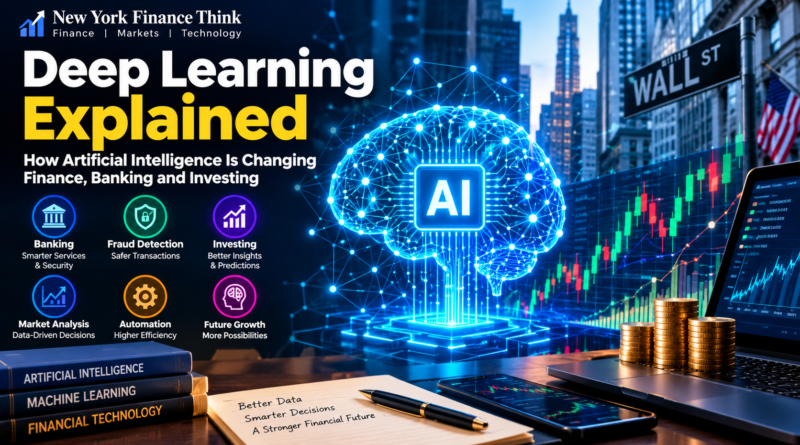
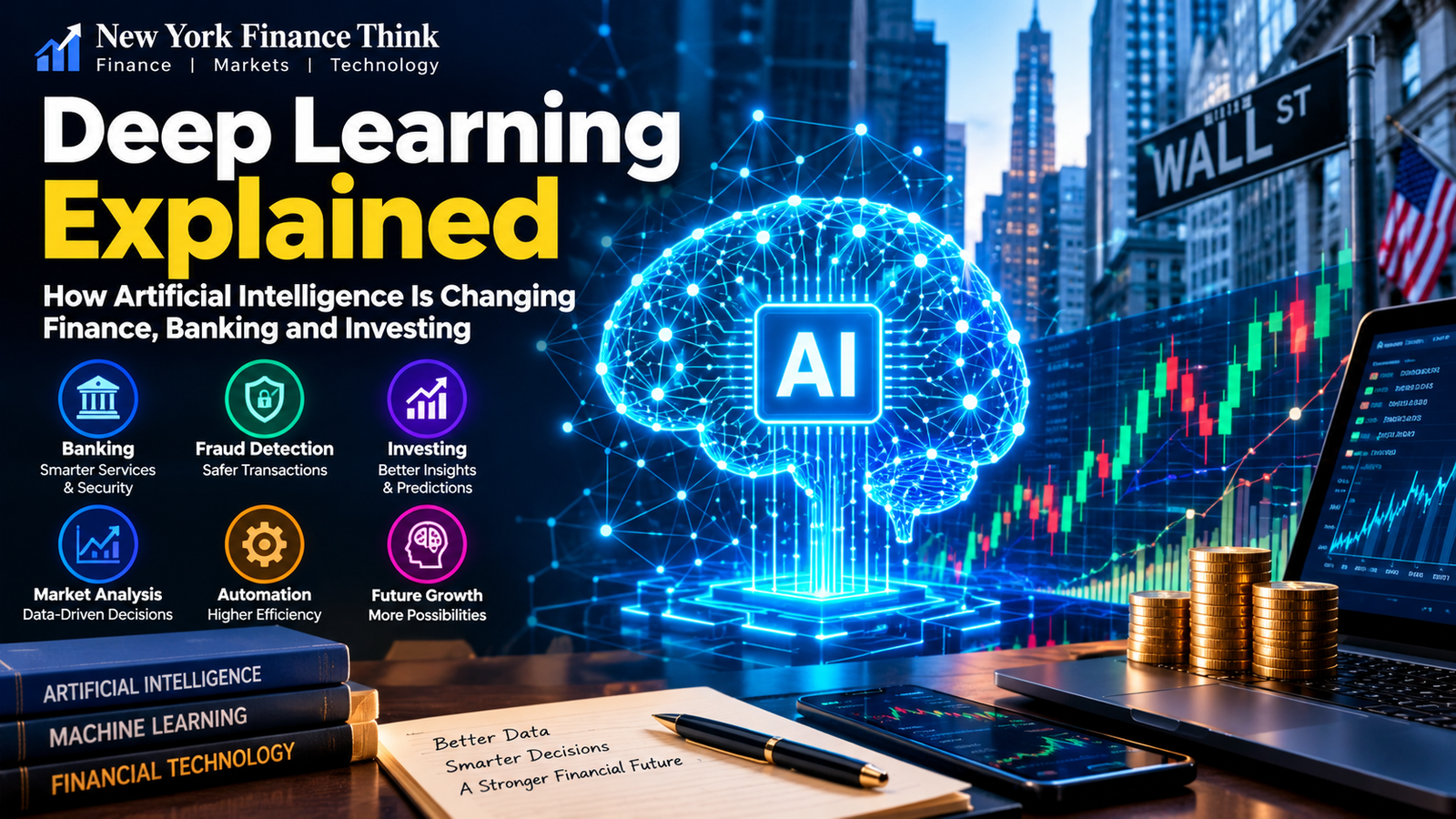
Deep Learning Explained: How It Works, Real-World Applications, Benefits, and Future Opportunities
newyork finance think 10/29/2026
Deep learning has become one of the most important technologies behind modern artificial intelligence. It helps computers recognize objects in photographs, understand spoken language, translate text, recommend videos, detect suspicious financial transactions, and generate new content. Many people use deep learning every day without realizing it.
When a smartphone recognizes a face, a navigation application identifies traffic patterns, or a streaming platform suggests a film, artificial intelligence may be working behind the scenes. Deep learning is one of the techniques that makes many of these capabilities possible.
Yet the technology is often discussed as if it were too complicated for ordinary people to understand. Technical terms such as neural networks, model training, parameters, and algorithms can make the subject seem inaccessible. The basic idea is much simpler: a computer system examines examples, identifies patterns, adjusts its internal calculations, and uses what it has learned to make predictions about new information.
That does not mean deep learning thinks exactly like a human being. It does not automatically understand the world, possess common sense, or guarantee correct answers. Its performance depends on the data, model design, computing resources, and evaluation methods used to develop it.
This guide explains deep learning from the beginning, with practical examples that show where it is used, why it matters, what its limitations are, and how beginners can start learning the technology.
What Is Deep Learning?
Deep learning is a branch of machine learning, which is itself a branch of artificial intelligence. It uses artificial neural networks containing multiple layers of mathematical processing units to learn patterns from data.
Traditional software usually follows rules written by developers. A simple calculator, for example, performs calculations according to clearly defined mathematical operations. A basic rule-based email filter might block messages containing certain words or coming from specific addresses.
Deep learning works differently. Instead of requiring developers to write a separate rule for every possible situation, engineers train a model using examples. The model adjusts its internal parameters to improve its predictions during training.
Consider an application designed to recognize cats in photographs.
A traditional approach might depend on manually written rules about ears, whiskers, eye shapes, and other visible features. Such rules would quickly become difficult to manage because cats appear in different positions, lighting conditions, colors, and backgrounds.
A deep learning model can instead learn from many labeled photographs. During training, it gradually develops internal representations that help distinguish cats from other objects. After training, it can analyze a photograph it has never encountered and estimate whether a cat is present.
Its answer is not guaranteed to be correct. An unusual image, poor lighting, or unfamiliar subject can still cause errors. Nevertheless, learning patterns from examples makes deep learning useful for problems that are difficult to describe through simple rules.
According to IBM and Google Cloud, deep learning relies on multilayered neural networks and is widely used for tasks involving images, language, speech, and other complex forms of data.
Reference: https://www.ibm.com/think/topics/deep-learning
Understanding Artificial Intelligence, Machine Learning, and Deep Learning
These three terms are closely connected, but they do not mean the same thing.
Artificial intelligence
Artificial intelligence, commonly called AI, is the broad field of building computer systems that perform tasks associated with abilities such as reasoning, language processing, planning, recognition, and decision-making.
AI includes many different approaches. Some systems rely on explicit rules, some use statistical techniques, and others learn patterns from data.
Machine learning
Machine learning is a part of AI in which systems learn patterns from data rather than relying entirely on manually written rules.
For example, a bank might train a machine learning model to identify transactions that appear unusual compared with a customer’s normal spending patterns.
The model learns from historical examples and uses those patterns to flag transactions for further review.
Deep learning
Deep learning is a specialized area of machine learning that uses neural networks with multiple layers. It is particularly useful when the relationships in the data are complicated or when the input consists of images, audio, video, or language.
The difference can be understood through a simple example.
Imagine building a system that identifies fraudulent credit card transactions. A rule-based program might flag every transaction above a particular amount. A conventional machine learning model might learn from transaction features selected by analysts. A deep learning model could learn complex relationships across large volumes of transaction data.
The best solution depends on the problem. Deep learning is not automatically better than every other method. For smaller datasets or problems with clear rules, simpler systems may be less expensive, easier to explain, and just as effective.
How Does Deep Learning Work?
A deep learning system is built around a neural network. The network receives information, processes it through multiple layers, and produces an output.
The training process then adjusts the network so that its predictions become more useful for the task.
1. Collecting and preparing data
Data is the starting point for most deep learning projects.
A model designed to identify damaged products might require photographs of products in good condition and photographs showing different kinds of damage. A speech recognition system needs audio recordings paired with suitable transcripts or other training signals. A language model may be trained on large collections of text and additional examples designed for particular tasks.
The quality of this material matters enormously.
If a dataset contains incorrect labels, duplicated examples, missing information, or a narrow range of situations, the resulting model may learn misleading patterns. A model trained on photographs taken in bright daylight, for example, might perform poorly on dark or blurry images.
Before training begins, developers may resize images, normalize numerical values, remove duplicates, correct labels, and check whether the dataset represents the conditions the model will encounter.
Data preparation can require substantial effort. A powerful algorithm cannot automatically compensate for every weakness in its training material.
2. Building a neural network
An artificial neural network contains interconnected mathematical units, commonly called neurons or nodes.
These units are arranged into layers. The input layer receives information, hidden layers transform it, and the output layer produces a result.
For a simple image classification task, the input might be a numerical representation of an image. Hidden layers process that representation, and the output layer might produce scores for categories such as cat, dog, and bird.
Each connection has a numerical value known as a weight. Neurons also commonly use bias terms and activation functions. Together, these components determine how information moves through the network.
The word “deep” refers to the multiple layers through which information passes. Different layers can learn different levels of representation, allowing a model to combine simple patterns into more complex ones.
The network is not manually taught every visual feature. Training helps it discover useful internal patterns from examples.
3. Making an initial prediction
At the beginning of training, a model generally has not learned the task successfully. Its parameters are initialized, and its first predictions may be inaccurate.
Suppose a model must classify photographs as either cats or dogs. It receives an image and calculates scores for the possible categories.
The system then compares its prediction with the correct label, assuming a labeled training example is being used.
A mathematical function called a loss function measures how far the prediction is from the target according to the training objective.
The loss provides a signal that can be used to improve the model.
4. Calculating the error
A model cannot improve simply because a computer tells it that an answer is wrong. It needs a method for determining how changes to its parameters might reduce the error.
During training, the system calculates the loss and estimates how the model’s parameters contributed to it.
One widely used technique is backpropagation. It calculates gradients that indicate how the loss changes with respect to different parameters in the network.
An optimization algorithm then uses these gradients to adjust the parameters.
This process is repeated across many training examples. Gradually, the model may learn patterns that help it perform the task more accurately.
5. Repeating the training process
Deep learning models often require many training iterations.
During each iteration, the network processes data, calculates predictions, measures the loss, and updates its parameters. Training data is typically processed in batches, and a complete pass through the training dataset is commonly called an epoch.
Training may take minutes, hours, days, or longer, depending on the size of the model, the dataset, the hardware, and the training method.
More training does not always mean better performance. If a model begins memorizing details of the training data instead of learning patterns that generalize, its performance on new examples may deteriorate.
Developers therefore monitor training and evaluate the model on separate validation data.
6. Testing the model
After training, a model needs to be evaluated on data that was not used to adjust its parameters.
This helps developers estimate how well the model may perform in unfamiliar situations.
For an image classifier, useful tests might include photographs taken in different lighting conditions, images containing multiple objects, and examples with unusual backgrounds.
For a fraud detection model, testing might examine how effectively the system identifies suspicious transactions without generating an unmanageable number of false alarms.
A high score on a training dataset is not enough to prove that a model will work well in the real world.
7. Using the trained model
Once a model meets the project’s requirements, developers can deploy it in an application, website, mobile device, or cloud service.
The process of using a trained model to generate a prediction is called inference.
For example, a customer uploads a product photograph to an online store. The trained model processes the image and returns a list of likely product categories.
The model does not normally need to repeat its entire training process for every photograph. It uses the parameters learned during training to produce a result.
However, real-world systems still require monitoring. Data can change, user behavior can shift, and new situations can expose weaknesses that were not obvious during development.
A Simple Example: Teaching a Computer to Recognize Handwritten Numbers
Handwritten digit recognition is a useful way to understand the entire deep learning process.
Imagine building a system that reads numbers written on forms. People write the same digit in different ways. Some write a narrow number 7, while others draw a line through it. Handwriting also varies in size, shape, and clarity.
A deep learning project might follow these steps:
- Collect thousands of images of handwritten digits.
- Label each image with the correct number.
- Divide the dataset into training, validation, and test sets.
- Build a neural network that accepts the image data.
- Train the model by comparing its predictions with the correct labels.
- Adjust the network’s parameters to reduce its training loss.
- Evaluate performance on images the model has not seen during training.
- Integrate the model into a form-processing application.
If the model performs well, it can help digitize handwritten forms, organize documents, or reduce manual data entry.
But an unclear handwritten digit may still be misclassified. A reliable application should have a way to flag uncertain results or send difficult cases to a person for review.
That final step illustrates an important principle: useful AI systems are designed around both the capabilities and the limitations of the model.
Major Types of Deep Learning Models
Deep learning is not one single algorithm. Different neural network architectures are designed to handle different kinds of information.
Artificial neural networks
Feedforward neural networks pass information from input layers through hidden layers to an output layer.
They are used for classification, prediction, and other tasks involving structured or numerical data. A network might estimate the likelihood that a customer will cancel a subscription or predict equipment failure using sensor measurements.
These models are flexible, but their usefulness depends on the available data and the nature of the problem.
Convolutional neural networks
Convolutional neural networks, or CNNs, became especially important in computer vision.
They use operations that help identify local patterns in images. Early layers may respond to edges or textures, while later layers can combine those signals into more complex visual representations.
CNNs have been used for image classification, object detection, industrial inspection, and medical image analysis.
For example, a manufacturing company could use a camera and a trained model to flag scratches or irregularities on products moving along a production line.
The system would still need testing across different product types, lighting conditions, and defect categories before being trusted in production.
Recurrent neural networks
Recurrent neural networks, or RNNs, were designed to process sequences of information. Their internal state allows information from earlier parts of a sequence to influence later processing.
They have been used in speech recognition, language modeling, and time-series analysis.
For example, a model processing daily energy demand may use information from previous days to estimate future consumption.
RNNs remain useful in some settings, although newer architectures have replaced them in many large-scale language and sequence-processing applications.
Long short-term memory networks
Long short-term memory networks, commonly called LSTMs, are a type of recurrent neural network designed to help preserve useful information across longer sequences.
They use specialized gates to control which information is retained or discarded.
LSTMs have been used in applications involving speech, text, sensor readings, and forecasting. Their performance depends on the task and the way the data is prepared.
Transformers
Transformers are a major neural network architecture for processing sequences. They use attention mechanisms to model relationships between elements of the input.
In language processing, attention helps a model weigh the relevance of different words or tokens when processing a passage.
Transformers underpin many modern large language models and are also used in image processing, speech applications, and multimodal systems that handle several kinds of input.
Their effectiveness comes with trade-offs. Training and operating large transformer models can require substantial computing power, memory, and energy.
Autoencoders
Autoencoders learn to encode data into a representation and then reconstruct the original input from that representation.
They can be used for tasks such as dimensionality reduction, representation learning, and certain types of anomaly detection.
For example, an industrial monitoring system might learn patterns associated with normal equipment behavior and flag unusual observations for investigation.
An unusual observation is not necessarily a fault. The model’s output must be interpreted alongside other evidence.
Generative adversarial networks
Generative adversarial networks, or GANs, use two competing neural networks: a generator and a discriminator.
The generator creates synthetic examples, while the discriminator attempts to distinguish generated examples from real ones. Through training, the generator learns to produce increasingly convincing outputs under suitable conditions.
GANs have been used for image generation, image translation, and synthetic data research. Other generative approaches, including diffusion models, have also become important in modern image generation.
Deep reinforcement learning
Deep reinforcement learning combines deep neural networks with reinforcement learning.
An agent interacts with an environment and receives rewards or penalties based on its actions. It learns a strategy intended to maximize cumulative reward.
This approach has been applied to games, robotics research, control systems, and simulated environments.
Real-world use can be challenging because mistakes may be expensive or dangerous. Simulations, carefully designed rewards, and safety constraints are important when developing such systems.
Where Is Deep Learning Used in Everyday Life?
Deep learning is no longer limited to research laboratories. It supports features in consumer products, business software, industrial systems, and online services.
1. Smartphones and facial recognition
Modern phones may use neural networks to recognize faces, organize photographs, improve image quality, and support voice interactions.
Facial recognition systems examine visual patterns and compare them with representations learned during training.
The exact design varies by device and application. Some processing occurs locally on the phone, while other services may use cloud infrastructure.
Biometric technology also raises privacy and security questions. A face is sensitive personal information, and users should understand how a system stores, processes, and protects it.
2. Voice assistants and speech recognition
Voice interfaces help people search for information, set reminders, dictate messages, and control connected devices.
Deep learning models can convert speech into text, interpret spoken commands, and generate spoken responses.
Background noise, accents, speech disorders, and unfamiliar words can reduce accuracy. Systems should be evaluated across different speakers rather than only under ideal conditions.
3. Search engines
Search systems use many techniques to understand queries, identify relevant pages, rank results, and improve the usefulness of search experiences.
Deep learning can help represent language, interpret intent, and match related concepts even when a query does not use the exact words found on a page.
However, search quality depends on much more than deep learning. Indexing, ranking systems, content quality, freshness, and many other factors also matter.
4. Online shopping recommendations
Online retailers use recommendation systems to help customers discover products.
A system might consider browsing history, previous purchases, product descriptions, and patterns among users with similar interests.
Deep learning can identify complex relationships in this information, but recommendations are not always accurate or neutral. They may reflect incomplete data, popularity patterns, or commercial objectives.
Customers should still compare products and review important specifications before making purchases.
5. Streaming services
Video and music platforms can use machine learning to estimate what a user might enjoy watching or listening to.
A recommendation model may analyze previous interactions, content characteristics, and broader viewing patterns.
These systems can save time by making large libraries easier to explore. They can also narrow a person’s exposure to unfamiliar material if recommendations repeatedly reinforce existing preferences.
Many recommendation systems therefore combine several signals and ranking methods rather than depending on a single deep learning model.
6. Email filtering
Email services use automated systems to identify spam, phishing attempts, and suspicious messages.
A model can examine text patterns, sender information, links, attachments, and other signals to estimate whether a message is dangerous.
Criminals constantly change their tactics, so filtering systems require ongoing evaluation. A legitimate email may occasionally be blocked, while a convincing malicious message may escape detection.
Users should remain cautious with unexpected links, payment requests, and requests for passwords or verification codes.
7. Translation tools
Deep learning has improved machine translation by helping models represent words and sentences in context.
A translation system can use these representations to produce text in another language. Modern systems may also support speech translation and multilingual communication.
Accuracy varies by language pair, writing style, and subject. Idioms, legal terms, cultural references, and specialized technical material may require human review.
8. Maps and transportation
Transportation systems can use machine learning to estimate traffic conditions, predict arrival times, and identify patterns in movement.
Deep learning may help process camera feeds, sensor information, and complex sequences of traffic data.
In autonomous driving research, neural networks can help identify lanes, vehicles, pedestrians, signs, and other elements in a scene.
Driving decisions are safety-critical, however. Reliable autonomous systems require extensive testing, redundancy, operational limits, and safeguards beyond a model’s raw accuracy.
Deep Learning in Healthcare
Healthcare is one of the most closely watched areas for deep learning because medical professionals work with large volumes of complex information.
Medical image analysis
Neural networks can help analyze X-rays, CT scans, MRI images, and other medical images.
Depending on the application, a model might identify areas that deserve closer attention, measure a structure, or help categorize a scan.
Such tools can support clinical workflows, but they do not eliminate the need for qualified medical judgment. Performance may differ across hospitals, equipment, patient populations, and imaging protocols.
Supporting research
Deep learning can assist researchers in analyzing biological data, identifying patterns in laboratory results, and exploring possible relationships that would be difficult to examine manually.
In drug research, machine learning methods can help prioritize candidate molecules or estimate certain molecular properties.
These predictions do not establish that a treatment is safe or effective. Laboratory experiments, clinical studies, and regulatory review remain essential.
Patient monitoring
Wearable devices and hospital equipment can generate continuous streams of measurements. Machine learning may help identify patterns that warrant closer attention.
For example, a monitoring system might flag a change in a patient’s readings for clinical review.
False alarms, missing data, and differences between patients can affect performance. Healthcare systems need clear escalation procedures and careful validation before relying on automated alerts.
Privacy and responsible use
Medical information requires strong protection. Developers must consider consent, data access, security, and applicable privacy laws.
A model should not be treated as reliable merely because it performs well on one dataset. Independent validation and appropriate clinical oversight are necessary for meaningful medical use.
Deep Learning in Finance and Banking
Banks, insurers, payment companies, and investment firms analyze large amounts of numerical and behavioral information. Deep learning can help them identify patterns, but its usefulness depends on the task.
Fraud detection
A fraud detection model can examine transaction amounts, timing, location-related signals, account history, and other available information.
It may identify activity that differs from a customer’s normal pattern and send the transaction for additional review.
A flagged transaction is not automatically fraudulent. Systems must balance missed fraud against false alarms that inconvenience legitimate customers.
Fraud patterns also change as criminals adapt, so monitoring and retraining may be needed.
Customer service
Financial institutions use automated assistants to answer routine questions, direct customers to relevant services, and help with common account tasks.
A carefully designed assistant can reduce waiting times. More complicated issues may still require a human representative, especially when the customer faces a disputed transaction or a financial hardship.
Risk assessment
Machine learning can help financial organizations analyze patterns related to credit risk, insurance claims, or operational risk.
These applications require particular care because inaccurate or biased predictions can affect access to financial services.
Models should be evaluated for fairness, reliability, explainability, and compliance with relevant rules. Historical data may reflect existing inequalities, and simply learning from that data can reproduce them.
Financial market analysis
Deep learning researchers have explored forecasting prices, analyzing news, estimating volatility, and detecting patterns in financial time series.
However, financial markets are influenced by many changing factors, including interest rates, economic releases, corporate earnings, investor expectations, and unexpected events.
A model that identifies historical patterns may fail when conditions change. Backtested results can also be misleading if the evaluation process contains data leakage, unrealistic assumptions, or trading costs are ignored.
Deep learning cannot guarantee profitable trades or reliably predict every market move. Investors should treat model-generated forecasts as uncertain estimates rather than financial certainty.
Deep Learning in Manufacturing and Industry
Factories can use deep learning to improve inspection, monitor equipment, and analyze sensor data.
Automated quality inspection
A camera-based system can examine products as they move along a production line. The model may identify visible defects such as cracks, scratches, missing components, or irregular shapes.
This can help manufacturers inspect large numbers of products consistently.
The system still needs representative examples of defects, suitable cameras, controlled image capture, and a process for handling uncertain cases.
Predictive maintenance
Industrial equipment generates signals such as vibration, temperature, pressure, and sound. Models can analyze these signals to identify patterns associated with abnormal behavior.
A warning may help a maintenance team inspect a machine before a problem becomes more serious.
But a prediction is not a guarantee that a machine will fail at a specific time. Maintenance decisions should combine model outputs with engineering knowledge, equipment history, and safety requirements.
Supply chain planning
Deep learning can help analyze demand patterns, shipping information, and operational data.
Businesses may use these predictions alongside conventional forecasting tools to estimate demand or identify possible delays.
Sudden disruptions, new regulations, and unexpected consumer behavior can make historical patterns less reliable. Human planning and alternative scenarios remain important.
Deep Learning in Cybersecurity
Cybersecurity teams face a steady stream of suspicious emails, software vulnerabilities, unusual network activity, and attempts to steal credentials.
Deep learning can help analyze large volumes of information and identify patterns that deserve investigation.
For example, a model might examine network behavior to flag activity that differs from established patterns. Another system might help classify suspicious files or detect potentially harmful messages.
These applications have limitations. Attackers deliberately change their methods, and unusual activity is not always malicious. A model may also overlook a new threat that differs from its training examples.
Deep learning is therefore best treated as one part of a broader security program that includes software updates, access controls, multifactor authentication, logging, incident response, and trained security professionals.
Organizations should also consider whether attackers could manipulate model inputs or exploit weaknesses in the data pipeline.
What Are the Main Benefits of Deep Learning?
Deep learning offers several practical advantages when the problem, data, and computing resources are suitable.
It can learn complex patterns
A deep neural network can represent complicated relationships between features. This makes it useful for tasks such as image recognition, language processing, and audio analysis.
The benefit is especially valuable when manually writing rules for every possible situation would be impractical.
It reduces some manual feature engineering
Traditional machine learning projects often require experts to select or design useful input features.
Deep learning can learn useful representations directly from raw or lightly processed data. This can simplify some parts of development, although data preparation, architecture design, evaluation, and monitoring still require substantial work.
It can work across different data types
Neural networks can be designed for images, audio, text, video, numerical measurements, and combinations of these formats.
This flexibility allows organizations to explore different applications using related techniques.
It can improve with suitable training data
When additional data is relevant, accurate, and representative, a model may learn more useful patterns.
More data alone does not guarantee improvement. Poor-quality or biased data can make a model worse, and some tasks reach a point where extra training examples provide limited benefit.
It can automate repetitive analysis
A trained model can process many examples quickly once it is deployed.
For example, an image classification service can analyze large batches of photographs without requiring a person to inspect every image individually.
Automation does not mean eliminating human responsibility. Organizations still need processes for checking errors, handling exceptions, and deciding how predictions will be used.
What Are the Limitations of Deep Learning?
The technology has significant limitations that are easy to overlook when demonstrations focus only on successful examples.
Large data requirements
Many deep learning models require substantial amounts of training data to achieve good performance.
Collecting and labeling that information can be expensive. In some fields, such as rare medical conditions or unusual industrial failures, there may be too few reliable examples.
Pretrained models, transfer learning, and data augmentation can reduce the amount of task-specific data needed, but they do not remove the need for careful evaluation.
Computing costs
Training large models can require specialized hardware, substantial memory, electricity, and engineering time.
Even when a pretrained model is available, running it at scale may involve ongoing infrastructure costs.
Smaller models or conventional machine learning approaches may be more practical when resources are limited.
Limited explainability
Deep neural networks can contain millions or billions of adjustable parameters. Understanding exactly why a particular prediction was made can be difficult.
Developers can use diagnostic tools and explanation techniques to investigate model behavior, but these methods do not always provide a complete or definitive account of a decision.
This is especially important when a prediction affects someone’s health, employment, credit access, or legal rights.
Overfitting
Overfitting occurs when a model learns details of its training data that do not generalize well to new examples.
A model may perform impressively on familiar examples but struggle when the inputs change.
Separate validation and test sets, regularization, appropriate data collection, and realistic evaluation can help reduce this problem.
Bias and unequal performance
Training data may not represent every group, location, language, or situation equally.
As a result, a model may perform better for some users than others. In applications involving people, these differences can create serious fairness concerns.
Developers should test performance across relevant groups, investigate data gaps, document limitations, and monitor outcomes after deployment.
Predictions can be wrong
Deep learning systems produce outputs based on learned patterns, not guaranteed truths.
A model may misidentify an image, misunderstand a question, or generate a plausible but inaccurate answer.
The risk is greater when users treat confident language or a high numerical score as proof that the system is correct.
Changing real-world conditions
A model trained on historical information may become less effective when the environment changes.
Consumer behavior shifts, fraud techniques evolve, medical practices change, and new products enter the market.
Organizations need to monitor deployed systems and determine when updated data, retraining, or a different approach is necessary.
How Is Deep Learning Different From Traditional Programming?
Traditional programming and deep learning solve problems in different ways.
In traditional programming, a developer defines rules and writes code that applies them to input data. The program produces an output according to those rules.
In supervised deep learning, developers provide examples and target outputs. The model adjusts its parameters during training to learn a mapping from inputs to outputs.
For instance, a traditional program might flag a transaction whenever its value exceeds a fixed threshold. A trained model might consider several patterns together, including transaction frequency and other signals.
The second approach can capture more complicated relationships, but it may be harder to explain and may fail in unfamiliar circumstances.
In practice, production systems often combine both methods. A deep learning model may make a prediction while ordinary software handles authentication, data validation, business rules, and safety checks.
Deep Learning vs. Machine Learning: Which Is Better?
There is no universal winner.
Deep learning is often useful for complex data such as images, audio, video, and natural language. It can learn representations that would be difficult to design manually.
Other machine learning techniques can perform very well on structured data such as spreadsheets, customer records, and relatively small business datasets.
A simpler model may also be easier to train, faster to run, less expensive to maintain, and easier to interpret.
Before selecting a method, a team should define the problem, establish a baseline, inspect the available data, and compare several approaches using a fair evaluation process.
The right question is not whether deep learning is more advanced. It is whether it solves the specific problem more reliably and economically than the alternatives.
How to Start Learning Deep Learning
Beginners do not need to master every mathematical concept before writing their first program. However, a basic foundation makes the subject much easier to understand.
Step 1: Learn Python
Python is widely used in machine learning and deep learning because it has a large ecosystem of libraries and educational resources.
Start with variables, conditions, loops, functions, lists, dictionaries, and reading files.
Then learn how to work with numerical arrays and tabular data using libraries such as NumPy and pandas.
You do not need to become an expert programmer immediately. The goal is to become comfortable writing and understanding small programs.
Step 2: Study basic mathematics
Linear algebra, calculus, probability, and statistics help explain how neural networks work.
Useful starting topics include vectors, matrices, averages, probability distributions, derivatives, and gradients.
For example, understanding a derivative helps explain how an optimizer estimates which direction to move a model’s parameters to reduce the loss.
A beginner can learn these ideas gradually while building projects. There is no need to memorize advanced equations before attempting a simple model.
Step 3: Understand machine learning fundamentals
Before moving to large neural networks, learn the purpose of training, validation, and testing.
Understand the difference between classification and regression, what a loss function measures, why models overfit, and how evaluation metrics are selected.
These concepts help prevent common mistakes, including judging a model only by its performance on training data.
Step 4: Build a simple neural network
Choose a small educational project, such as recognizing handwritten digits or classifying basic images.
Libraries such as PyTorch and TensorFlow provide tools for defining neural network layers, training models, and evaluating predictions.
Start with a small dataset and a simple architecture. Focus on understanding the workflow rather than chasing the highest possible score.
Step 5: Learn to evaluate results
A working model is not necessarily a useful model.
Compare its predictions with correct labels, examine examples it gets wrong, and check whether its errors follow a pattern.
For a classification problem, accuracy may be useful, but precision, recall, and a confusion matrix can provide additional information.
The best metric depends on the application. Missing a serious security threat may have different consequences from incorrectly categorizing a photograph.
Step 6: Complete practical projects
Projects help turn abstract concepts into skills.
Beginners might build a handwritten-digit classifier, a simple image classifier, a basic text sentiment model, or a small forecasting experiment using a public dataset.
Document the data source, the model design, the evaluation method, and the limitations. This makes a project more useful than simply reporting one accuracy number.
Step 7: Learn about deployment
Once a model performs reasonably well, learn how to make it available through a simple application or API.
Deployment introduces questions about latency, memory usage, security, monitoring, data privacy, and maintenance.
A model that works in a notebook may require significant changes before it can support a reliable production service.
Popular Tools and Frameworks
Several tools make deep learning development more accessible.
PyTorch: A widely used framework for building and training neural networks. It is popular in research and production development.
Official website: https://pytorch.org/
TensorFlow: A machine learning platform with tools for model development, training, and deployment.
Official website: https://www.tensorflow.org/
Keras: A high-level interface for building neural network models with a focus on accessible development.
Official website: https://keras.io/
Hugging Face: A platform and collection of libraries for working with pretrained models, including language and other transformer-based systems.
Official website: https://huggingface.co/
Google Colab: A browser-based notebook environment that can be useful for experiments and learning. Available hardware and usage limits depend on the service and account.
Official website: https://colab.research.google.com/
Beginners should choose tools based on their learning goals, available hardware, documentation, and project requirements. Installing every framework is unnecessary.
Career Opportunities in Deep Learning
Deep learning skills can be relevant to several technical careers, although employers generally look for more than familiarity with a particular library.
Machine learning engineer
Machine learning engineers develop, test, deploy, and maintain models used in software products and business processes.
The role often combines programming, data processing, model evaluation, software engineering, and production monitoring.
Deep learning engineer
Deep learning engineers focus on neural network architectures, training methods, optimization, and deployment.
Depending on the employer, the work may involve computer vision, language models, speech technology, recommendation systems, or other applications.
Data scientist
Data scientists use statistics, programming, and machine learning to investigate data and support decisions.
Some positions involve deep learning, while others rely more heavily on statistical analysis, experimentation, and traditional machine learning.
Computer vision engineer
Computer vision engineers develop systems that process images and video. Their projects may involve object detection, image classification, industrial inspection, robotics, or medical imaging.
Natural language processing engineer
Natural language processing engineers build systems that work with human language. Their responsibilities may include text classification, information extraction, search, translation, and language-model applications.
Research scientist
Research scientists investigate new methods, architectures, and training techniques. Many research roles require strong mathematical knowledge, experimental skills, and, depending on the position, graduate-level study.
How beginners can prepare
A useful portfolio should demonstrate a complete problem-solving process.
Include the project’s goal, the data used, the method selected, the evaluation results, and the limitations. Explain why you chose a particular model and what you would improve with more time.
A few well-documented projects can demonstrate more practical understanding than a long list of tools that have only been used briefly.
Career outcomes depend on experience, location, qualifications, communication skills, and employer requirements. Learning deep learning is not a guarantee of employment or a particular salary.
The Future of Deep Learning
Deep learning continues to develop, but its future will not be determined by model size alone.
One important direction is the development of more efficient models. Researchers and engineers are exploring ways to reduce memory use, training costs, and the computing required to produce predictions.
Smaller models can be useful when applications need to operate on mobile devices, embedded systems, or environments with limited internet connectivity.
Another direction involves multimodal AI. These systems combine information such as text, images, audio, and video. A multimodal model may be able to interpret a photograph alongside a written question or process speech and visual information together.
There is also growing interest in making models more dependable. This includes better evaluation, stronger safeguards, clearer documentation, improved monitoring, and methods for reducing harmful errors.
In scientific research, deep learning may help researchers explore complicated datasets and develop hypotheses. Such outputs still need to be checked through appropriate scientific methods.
Robotics is another area of development. Neural networks can help robots perceive their surroundings and learn certain behaviors. Physical environments remain difficult because objects move unpredictably, sensors are imperfect, and mistakes can have real consequences.
Efficiency and environmental impact will remain important considerations. Training and operating large models can consume substantial energy and computing resources. Choosing a model that matches the actual task can reduce unnecessary cost.
The direction of progress will depend on technical advances, practical demand, regulation, safety, and whether systems deliver enough value to justify their expense.
Responsible Use of Deep Learning
A model’s ability to produce a prediction does not automatically make that prediction suitable for every decision.
Organizations should consider several questions before deploying a deep learning system.
Is the data appropriate? The dataset should be relevant, sufficiently representative, and collected in a lawful and responsible way.
How will errors affect people? A mistake in a movie recommendation is usually less serious than a mistake in a medical assessment or credit decision.
Can users challenge a decision? In high-impact settings, people may need an explanation, a review process, or access to a human decision-maker.
How is private information protected? Data access, storage, retention, and sharing should be handled carefully.
Who is responsible for monitoring the system? There should be a clear process for investigating incidents, detecting performance changes, and correcting problems.
Does the model actually improve the task? Performance should be compared with realistic alternatives, including existing processes and simpler models.
Responsible development is not a separate step that can be added after everything else is finished. It should influence data collection, model design, testing, deployment, and maintenance.
Common Myths About Deep Learning
Myth 1: Deep learning works like the human brain
Artificial neural networks take inspiration from biological neural systems, but they are mathematical models running on computers. Their operation is not the same as the complex processes of a human brain.
Myth 2: More data always produces a better model
Additional data can help when it is relevant and representative. Noisy, biased, duplicated, or unsuitable data can reduce performance rather than improve it.
Myth 3: Deep learning always outperforms traditional algorithms
The result depends on the task, dataset, and evaluation method. Simpler approaches can be more effective or economical for many problems.
Myth 4: A high accuracy score means the model is reliable
A single score may hide important weaknesses. A model should be tested on suitable data, evaluated using relevant metrics, and examined for failure cases.
Myth 5: Deep learning can predict the future with certainty
Forecasts are estimates based on learned patterns. Unforeseen events and changing conditions can make predictions inaccurate.
Myth 6: Anyone can build a powerful model instantly
Pretrained tools make experimentation easier, but developing a dependable system still requires problem definition, testing, data handling, and ongoing maintenance.
Frequently Asked Questions About Deep Learning
What is deep learning in simple words?
Deep learning is a type of machine learning that uses multilayered neural networks to learn patterns from examples. It is used for tasks such as image recognition, speech processing, translation, and content generation.
Is deep learning the same as artificial intelligence?
No. Artificial intelligence is the broader field. Machine learning is one part of AI, and deep learning is a specialized area within machine learning.
Does deep learning require coding?
Building and training custom models usually requires programming, commonly in Python. However, some applications let people use pretrained models through visual interfaces or existing software without writing much code.
Is Python necessary for learning deep learning?
Python is a practical starting point because it is widely supported by deep learning libraries and educational resources. Other programming languages can also be used, depending on the project.
Does deep learning require a powerful computer?
Not always. Small educational models can run on an ordinary computer, and some browser-based services offer access to computing resources. Large-scale training may require specialized accelerators and substantial infrastructure.
How long does it take to learn deep learning?
The time varies with your programming experience, mathematical background, study schedule, and goals. A beginner may learn basic concepts and build a small project within weeks, while advanced research and production skills require much longer.
Can deep learning be used for business?
Yes. Businesses use it for image inspection, recommendations, document processing, fraud detection, forecasting, customer support, and other tasks. A business should first establish whether a model solves a real problem and whether its benefits justify the costs.
Is deep learning useful for finance?
It can support fraud detection, risk analysis, document processing, and some forecasting tasks. Financial predictions remain uncertain, and a deep learning model cannot guarantee investment profits.
What is the difference between training and inference?
Training adjusts a model’s parameters using data and a learning algorithm. Inference is the process of using the trained model to produce an output for new input.
What are the biggest challenges in deep learning?
Common challenges include obtaining suitable data, computing costs, overfitting, limited explainability, biased results, privacy concerns, and performance changes after deployment.
Final Thoughts
Deep learning has changed what computer systems can do with images, language, sound, and other complex information. It powers many capabilities people use in everyday life and offers useful tools for businesses, researchers, developers, and public services.
Its underlying process is based on learning patterns from examples. A neural network makes predictions, compares them with a training objective, and adjusts its parameters to improve. After testing, the model may be deployed in a real application.
That process can produce impressive results, but it does not remove uncertainty. Models can make mistakes, reflect weaknesses in their data, and fail when they encounter unfamiliar situations. Their performance must be evaluated against the needs and risks of the actual application.
For beginners, the best way to understand deep learning is to start with the fundamentals, write small programs, study model errors, and gradually work on more complex projects. For businesses, the priority should be finding a clearly defined problem and testing whether deep learning offers a meaningful improvement over simpler alternatives.
The technology is powerful, but its real value comes from applying it carefully. A well-tested model that solves a specific problem is often more useful than a complicated system built simply because deep learning is popular.
Sources and Further Reading
- IBM — What Is Deep Learning?
https://www.ibm.com/think/topics/deep-learning - Google Cloud — What Is Deep Learning?
https://cloud.google.com/discover/what-is-deep-learning - Microsoft Azure — What Is Deep Learning?
https://azure.microsoft.com/en-us/resources/cloud-computing-dictionary/what-is-deep-learning - NVIDIA — Deep Learning Explained
https://www.nvidia.com/en-in/glossary/deep-learning/ - PyTorch — Official Documentation
https://pytorch.org/docs/stable/index.html - TensorFlow — Official Tutorials
https://www.tensorflow.org/tutorials
Editorial note: This article is educational and does not replace professional advice for medical, financial, legal, or safety-critical decisions.
