
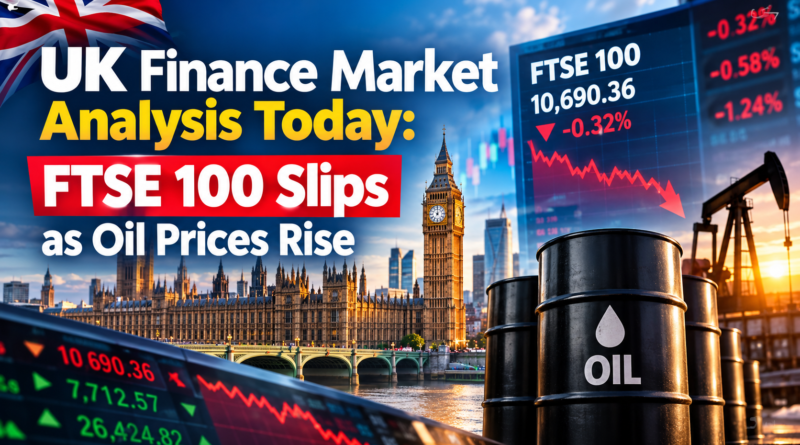
UK Finance Market Analysis Today: FTSE 100 Slips as Oil Prices Rise
The UK stock market ended the week on a weaker note as rising oil prices, stubborn inflation and uncertainty about interest rates kept investors cautious.
The FTSE 100 closed at 10,690.36 on Friday, October 23, 2026, down 0.32%. The index had reached an intraday high of 10,748.42 and a low of 10,630.00 before finishing lower. The FTSE 250, which is more focused on medium-sized UK companies, moved in the opposite direction and finished 0.1% higher.
The weekly picture was less encouraging. The FTSE 100 lost about 1.8% over the week, ending a two-week run of gains. The FTSE 250 also recorded its first weekly decline in three weeks.
There were several reasons behind the cautious mood.
Oil prices moved above $115 a barrel, increasing concerns about inflation. UK inflation had already risen to 3.5% in September, well above the Bank of England’s 2% target. At the same time, investors were preparing for the government’s upcoming budget and considering what the latest economic figures could mean for interest rates.
For investors, the current market is not simply about whether the FTSE 100 goes up or down. The bigger question is how companies will deal with higher energy costs, borrowing costs and changes in consumer demand.
FTSE 100 Ends a Difficult Week
Friday’s decline was relatively small on its own, but it came after several weaker sessions.
The FTSE 100 closed at 10,690.36, compared with 10,725.03 on Thursday. The index had started the week at a much higher level and gradually lost ground as investors became more concerned about inflation, oil and interest-rate expectations.
The market’s performance also showed an important difference between sectors.
Energy companies performed well because higher crude prices can improve revenue expectations for oil producers. Meanwhile, several other parts of the market struggled.
Aerospace and defence stocks were among the weakest areas. Banks and healthcare shares also came under pressure. Rolls-Royce recorded a particularly sharp decline, while oil companies such as BP benefited from the rise in crude prices.
This split tells us something important about the FTSE 100.
The index contains companies with very different sources of revenue. Some benefit from higher commodity prices, while others face higher costs because of them.
That makes the overall index harder to interpret during periods of economic uncertainty.
Why Oil Prices Matter So Much
Oil has become one of the biggest stories for financial markets this month.
Brent crude moved above $115 a barrel during the week, reaching its highest level in more than five months. That helped energy shares but increased concerns about inflation across the wider economy.
For consumers, expensive oil can mean higher fuel costs.
For businesses, it can mean higher transportation and production expenses.
For investors, it raises an even bigger question: will higher energy prices force central banks to keep interest rates higher for longer?
That is particularly important in the UK because inflation is already above the Bank of England’s target.
If energy prices remain elevated for an extended period, companies may have to choose between raising prices and accepting lower profit margins.
Neither option is particularly attractive.
Energy Companies Are Benefiting
The rise in oil prices has created a clear advantage for energy producers.
Shares in major oil companies have performed relatively well as investors consider the possibility of stronger revenue and cash flow.
BP was one of the notable gainers on Friday. Its shares rose 4.35% and reached a new 52-week high, according to MarketWatch data.
For large energy producers, higher crude prices can provide a substantial boost.
But investors should also remember that oil prices can move quickly.
If geopolitical conditions improve or supply increases, crude prices could fall just as quickly.
That means energy stocks can benefit from the current environment while still facing considerable uncertainty.
Higher Oil Prices Are Not Good for Everyone
What helps an oil producer can hurt another company.
Airlines, delivery businesses, logistics companies and manufacturers can face higher operating costs when fuel prices rise.
A company may not be able to pass all of those costs on to customers.
That can squeeze profit margins.
The impact can also reach consumers.
When households spend more on petrol, heating and transportation, they may have less money available for restaurants, clothing, entertainment and other discretionary purchases.
That is why energy prices can have a much wider economic effect than the headline oil price suggests.
UK Inflation Rises Again
Inflation is one of the most important issues for the UK economy right now.
The Office for National Statistics reported that the UK Consumer Prices Index rose 3.5% in the 12 months to September 2026, up from 3.1% in August. CPIH, which includes owner-occupiers’ housing costs, rose 3.6%.
Core CPI increased to 2.8%.
The ONS said transport, particularly motor fuels, made the largest upward contribution to the monthly change in the CPI and CPIH annual rates.
This is significant because it shows how energy prices are beginning to influence the inflation picture.
The Bank of England wants inflation to return to 2%.
But if fuel and energy costs continue to rise, getting inflation back to that level becomes more difficult.
What Inflation Means for Interest Rates
The inflation numbers have changed the conversation around UK interest rates.
The Bank of England currently has Bank Rate at 3.75%. At its September meeting, six members of the Monetary Policy Committee voted to keep the rate at 3.75%, while three voted for a 0.25 percentage-point increase to 4%. The next scheduled decision is November 5.
Investors are now paying close attention to whether inflation remains high enough to justify another rate increase.
Higher interest rates can help slow inflation because borrowing becomes more expensive.
But there is a cost.
Businesses may delay investment.
Households may reduce spending.
Mortgage payments can become more expensive for borrowers when rates reset.
Property markets can also come under pressure.
This is why the Bank of England has to balance two competing concerns: controlling inflation without putting unnecessary pressure on economic growth.
Why the Bank of England Matters to Investors
Central-bank decisions can affect almost every part of the financial market.
When investors expect higher rates, government bond yields can rise and borrowing costs can increase.
That can affect company valuations.
Growth companies are particularly sensitive because much of their expected value comes from future earnings.
Higher interest rates reduce the present value investors place on those future profits.
Banks can have a more complicated relationship with interest rates.
Higher rates can support lending income, but they can also reduce loan demand and increase pressure on borrowers.
The impact therefore depends on the economic environment.
The Pound Is Another Piece of the Puzzle
The British pound is also important for UK investors.
The FTSE 100 includes many large companies that earn substantial amounts of money outside Britain.
That means changes in the pound can influence the value of overseas revenue when it is converted back into sterling.
A weaker pound can increase the value of overseas earnings for some FTSE 100 companies.
A stronger pound can have the opposite effect.
But a weaker pound can also make imported goods and energy more expensive.
So currency movements affect the market in different ways depending on the company.
This is one reason investors should not treat the FTSE 100 as a simple measure of the health of the UK domestic economy.
The FTSE 100 Is Not the Same as the UK Economy
This distinction is important.
The FTSE 100 contains many multinational companies.
Large energy firms, pharmaceutical businesses, banks, miners and consumer companies often generate revenue across multiple continents.
Their performance depends on global economic conditions as much as British conditions.
The FTSE 250 is somewhat different.
It has more companies whose business activity is connected to the UK economy.
That means the two indexes can behave differently when domestic conditions change.
Friday provided a good example.
The FTSE 100 fell 0.3%, while the FTSE 250 gained 0.1%.
UK Retail Sales Show a Mixed Picture
The latest retail data provide another reason for investors to remain cautious.
According to the ONS, retail sales volumes fell 0.4% in September 2026 compared with August. However, over the third quarter as a whole, retail sales volumes increased 0.7%.
That means the consumer picture is not entirely negative.
The broader quarter showed growth, but September was weaker.
The ONS noted that warmer weather affected some sales patterns, including autumn and winter clothing purchases. Supermarket sales also declined after stronger activity in July and August.
For investors, this matters because consumer spending is an important part of economic growth.
Retailers need households to continue spending.
If inflation remains high, however, consumers may become more selective about what they buy.
Consumers Are Facing Higher Costs
The average household has to deal with several pressures at the same time.
Food costs remain important.
Energy prices can change household budgets.
Mortgage and borrowing costs can affect monthly payments.
Fuel prices influence commuting and transportation expenses.
When these costs rise together, households may reduce spending elsewhere.
That can create problems for companies that depend on discretionary purchases.
Businesses therefore need to pay close attention not only to sales growth but also to consumer behavior.
A company can have strong revenue and still struggle if costs rise faster than sales.
What Higher Rates Mean for Households
Interest rates have a direct effect on households with mortgages and other forms of borrowing.
When borrowing becomes more expensive, people may have less money available for other purchases.
This can affect retailers, restaurants, travel companies and entertainment businesses.
It can also affect house prices.
Higher mortgage costs can reduce the amount buyers are willing or able to spend on property.
For investors, the property market is therefore another area worth watching.
A prolonged period of higher rates could have a different effect on companies depending on their exposure to property, consumer credit and domestic demand.
Banks Face a Complicated Environment
UK banks are closely linked to the interest-rate cycle.
At first glance, higher rates can appear positive for banks because lending can generate more income.
But the story is more complicated.
If borrowing becomes too expensive, customers may borrow less.
Some households and companies may also struggle to make payments.
Banks must therefore balance stronger interest income against credit risk.
Recent market trading has reflected some of these concerns.
Banks were among the sectors weighing on the FTSE 100 during the week.
Investors will be watching upcoming earnings reports for signs of how lenders are handling the current environment.
Corporate Earnings Become More Important
Market attention is gradually shifting toward company earnings.
This is especially important after periods of strong share-price gains.
Investors want to know whether profits are growing quickly enough to justify current valuations.
A company with strong revenue growth, healthy margins and a solid outlook may continue to attract buyers.
A company that misses expectations can face a much sharper reaction.
That is why earnings season can create large daily moves even when the wider FTSE 100 is relatively stable.
Rolls-Royce Becomes a Market Focus
Rolls-Royce was one of the biggest individual fallers on Friday.
Its shares dropped about 7.6%, their largest one-day decline since April 2025, according to Reuters reporting.
The decline came as investors considered concerns around the aerospace business and the outlook for aftermarket sales.
This is a useful example of how individual company news can overpower broader market trends.
The FTSE 100 can fall only a fraction of a percent while a major company loses several percentage points in one session.
That is why investors should look beyond the index itself.
Aerospace and defence stocks were among the weakest parts of the market during Friday’s session.
The sector fell sharply, with the wider aerospace and defence group reaching its lowest level in more than five months.
The move highlights how quickly investors can reassess companies when growth expectations change.
Defence companies have attracted significant attention in recent years because governments have increased spending in several areas.
But higher expectations can also create higher valuations.
When a company reports weaker growth or investors become less confident about future orders, the share price can react strongly.
Gold and Mining Stocks Also Matter
Mining companies are another important part of the London market.
The UK stock market has considerable exposure to commodity producers.
That can be an advantage when commodity prices rise.
But it can become a weakness when metal prices fall.
During the latest week, precious-metal and industrial-metal miners were among the weakest groups.
Gold prices also declined during Friday’s trading, putting additional pressure on gold-mining shares.
This is another reason why the FTSE 100 can behave differently from other major stock indexes.
Its large exposure to energy and mining companies makes commodity prices especially important.
The Upcoming UK Budget
The government’s upcoming budget is another major issue for financial markets.
Investors are looking for details about taxes, spending, borrowing and measures designed to support economic growth.
The budget can affect several markets at the same time.
The pound may react to changes in expectations for government finances.
Government bond yields can move as investors assess borrowing plans.
Shares can react to changes in corporate taxes, consumer spending and public investment.
That means the budget is not simply a political event.
It can become an important market event.
Why Investors Are Watching Government Borrowing
Government borrowing is closely connected to bond markets.
If investors believe borrowing will increase significantly, they may demand higher yields to hold government debt.
Higher yields can then influence borrowing costs elsewhere in the economy.
Mortgage rates, corporate financing and investment decisions can all be affected by changes in government bond yields.
This is why the bond market often reacts strongly to major fiscal announcements.
For stock-market investors, movements in government bond yields are worth monitoring even if their primary interest is equities.
UK Bonds and Interest Rates
Government bonds remain a key part of the financial picture.
Bond yields reflect expectations about inflation, economic growth and future interest rates.
If inflation expectations rise, bond yields can increase.
If investors expect economic weakness or lower interest rates, yields can fall.
The Bank of England’s decisions therefore influence both stocks and bonds.
The current environment is particularly difficult because inflation is still above target while economic growth remains a concern.
That combination can create uncertainty for investors.
Global Markets Are Also Influencing London
The UK market does not move independently.
Investors in London are watching Wall Street, Europe and Asia.
A large move in US technology stocks can influence sentiment in Europe.
Changes in US Treasury yields can affect global borrowing costs.
Oil prices are determined by global supply and demand.
Currency markets respond to developments across multiple economies.
That means international events can quickly become relevant to UK stocks.
US Markets Remain Important
The United States continues to be the largest influence on global investor sentiment.
US interest rates, technology earnings and Treasury yields can affect markets around the world.
If American investors become more cautious about expensive technology stocks, that sentiment can spread to European markets.
Likewise, stronger-than-expected US economic data can influence expectations for global interest rates.
UK investors therefore need to look beyond London when assessing market conditions.
Europe Adds Another Layer of Uncertainty
European markets also play a role.
The FTSE 100 competes for international capital with indexes such as Germany’s DAX and France’s CAC 40.
On Friday, the DAX fell 0.75% and the CAC 40 declined 0.36%, showing that weakness was not limited to London.
European investors are dealing with many of the same problems: energy prices, inflation, interest rates and global growth concerns.
This makes the current market environment broader than the UK alone.
What Could Happen if Oil Prices Stay High?
This is one of the biggest questions for investors.
If oil remains above $115 for an extended period, the effect could spread through the economy.
Transport costs could rise.
Manufacturing costs could increase.
Household fuel expenses could become more expensive.
Businesses might raise prices to protect margins.
That could keep inflation higher for longer.
The Bank of England would then have to decide whether additional monetary tightening is needed.
Such a scenario could create more pressure on interest-sensitive areas of the stock market.
What If Oil Prices Fall?
The opposite scenario would provide some relief.
Lower oil prices could reduce fuel costs and ease pressure on inflation.
Companies would have lower transportation and production expenses.
Consumers could have more money available for other spending.
Lower inflation could also give central banks more freedom to reduce interest rates.
That could support stock valuations.
This is why oil prices are currently one of the most important variables for financial markets.
The Housing Market Needs Attention
UK housing is another area affected by interest rates.
Mortgage costs influence what buyers can afford.
If rates remain high, property demand can weaken.
That can affect construction companies, estate agents, banks and household spending.
A weaker housing market can also make consumers more cautious.
People often spend more when they feel financially secure and less when they are worried about the value of their home or the cost of their mortgage.
For this reason, housing data can provide useful clues about the wider UK economy.
Small and Medium-Sized Companies Could Feel the Pressure
The FTSE 250 is more sensitive to the domestic economy than the FTSE 100.
Medium-sized companies often depend more heavily on UK consumers and businesses.
That means higher borrowing costs and weaker domestic demand can have a noticeable effect.
The FTSE 250 rose 0.1% on Friday, but it still recorded its steepest weekly fall in six weeks.
Investors should therefore avoid assuming that a stronger day in the FTSE 250 means the economic outlook has suddenly improved.
The weekly performance tells a different story.
Why the FTSE 250 Matters
The FTSE 250 is often viewed as a useful indicator of domestic investor confidence.
Its companies include retailers, property businesses, financial firms, industrial companies and other businesses with greater exposure to the British economy.
When domestic conditions improve, these companies can benefit.
When consumer spending and business investment weaken, they can feel the pressure.
That makes the FTSE 250 worth watching alongside the FTSE 100.
The Consumer Confidence Question
Consumer confidence has also weakened.
Reuters reported that confidence suffered its steepest monthly decline since the early stages of the pandemic in October.
Confidence does not always translate directly into spending.
People can feel pessimistic and still spend money on essential goods.
However, a sharp decline in confidence can become a problem if it leads households to delay larger purchases.
Businesses then have to adjust their expectations.
UK Businesses Face Higher Costs
Companies are dealing with several cost pressures at the same time.
Energy is one.
Wages are another.
Financing costs are also important.
If a company has large amounts of debt, higher interest rates can increase its expenses.
If it imports products or materials, currency movements can affect costs.
The challenge for management teams is maintaining profitability while keeping prices competitive.
Companies with strong brands or limited competition may have more ability to raise prices.
Smaller businesses may not have the same flexibility.
Why Profit Margins Matter
Revenue growth is only one part of the picture.
Investors also need to look at margins.
A company can report higher sales while profits fall if costs are increasing faster than revenue.
That is why the current inflation environment is important for corporate earnings.
Companies that control costs successfully could perform better than competitors.
Investors are likely to reward businesses that show strong cash flow and disciplined spending.
Dividends Could Attract Investors
UK stocks have traditionally attracted investors looking for income.
Many FTSE 100 companies pay dividends.
When bond yields are high, dividend-paying shares must compete with government bonds and other income-producing assets.
But if a company has a strong balance sheet and a reliable dividend, it can still attract long-term investors.
Dividend sustainability is therefore important.
A high dividend yield is not automatically a sign of a good investment.
Investors should also consider whether the company generates enough cash to support the payment.
Valuations Are Becoming More Important
After a strong period for stocks, valuation becomes increasingly important.
Investors may be willing to pay higher prices for companies with strong growth prospects.
But they become less forgiving when growth slows.
The FTSE 100 reached a record high earlier in 2026, according to market data, so the recent pullback should be viewed against that broader rise.
A decline from a record does not automatically mean the longer-term trend has changed.
Markets regularly experience corrections.
The important question is whether earnings and economic conditions continue to support current valuations.
Is This the Start of a Bigger Market Correction?
It is too early to know.
The FTSE 100 has declined during the latest week, but one losing week does not establish a new long-term trend.
Investors should look at several indicators.
Are oil prices continuing to rise?
Is inflation moving higher?
Are bond yields increasing?
Are corporate earnings estimates falling?
Is consumer spending weakening?
Are investors reducing exposure to risky assets?
The answers to those questions will provide more useful information than any single daily move.
Could the Market Recover?
A recovery is certainly possible.
If oil prices stabilize and inflation begins to cool, pressure on interest-rate expectations could ease.
Strong company earnings could also bring buyers back into the market.
The FTSE 100 contains many globally diversified companies, and a weaker pound can sometimes support the value of their overseas earnings.
But investors may remain cautious until there is greater clarity about inflation and government policy.
What International Investors Should Know
For investors outside Britain, the UK market offers a different mix from US technology-heavy indexes.
The FTSE 100 has large exposure to energy, mining, banks, pharmaceuticals and multinational consumer companies.
That can make the index attractive during periods when commodity prices and global demand are strong.
It can also make the index vulnerable when commodity prices fall.
The UK market therefore needs to be understood on its own terms.
Comparing it directly with the Nasdaq or S&P 500 can miss important differences in sector composition.
The Importance of Currency for Foreign Investors
International investors also need to consider currency risk.
A US investor buying a UK stock is not only exposed to the company’s share price.
They are also exposed to the pound-dollar exchange rate.
If the stock rises but the pound weakens against the dollar, part of the investment gain can disappear when converted back into dollars.
The same applies to investors using euros, yen or other currencies.
Currency movements can therefore have a significant effect on international returns.
UK Market Outlook for the Coming Week
The coming week could be particularly busy.
Investors will be watching the government’s budget, corporate earnings, oil prices and expectations for the Bank of England.
Any major surprise could cause sharp moves in the pound, bonds and stocks.
The budget will probably receive the most immediate attention.
But the inflation story is likely to remain important because it directly affects expectations for monetary policy.
What to Watch in the FTSE 100
The first thing to watch is whether the index can stabilize after the weekly decline.
A recovery above recent levels could improve confidence.
A further break lower could encourage more investors to reduce risk.
But technical levels should not be considered in isolation.
Fundamental developments will ultimately matter more.
If earnings remain strong and inflation starts to cool, the market could recover.
If inflation rises further and economic growth weakens, investors may become more defensive.
What to Watch in the FTSE 250
The FTSE 250 deserves separate attention.
Because its companies are generally more exposed to the UK economy, its performance can offer clues about domestic investor confidence.
If the FTSE 250 begins to recover strongly, it could indicate improving expectations for UK growth.
If it continues to fall while the FTSE 100 remains relatively stable, it may suggest investors are still concerned about domestic economic conditions.
The Role of the Bank of England
The Bank of England remains central to the market outlook.
Its main responsibility is monetary stability, with an inflation target of 2%.
The latest official data show inflation at 3.5%, meaning the bank still has work to do.
At the same time, policymakers need to consider economic growth.
Keeping rates high for too long could weaken demand.
Cutting rates too quickly could allow inflation to remain above target.
That is why every new inflation, wage and economic-growth figure matters.
Why November Could Be Important
The Bank of England’s next scheduled policy decision is November 5.
By then, policymakers will have additional information about inflation, economic activity and energy prices.
Markets are already watching for signs of a possible rate increase.
The September meeting showed that policymakers were divided, with three members voting for a 25-basis-point increase while six preferred to hold rates at 3.75%.
That split shows how difficult the current environment is.
What Higher Inflation Could Mean
If inflation remains above 3%, investors may have to rethink expectations for future interest-rate cuts.
That could put pressure on rate-sensitive stocks.
It could also support the pound if markets expect higher UK interest rates relative to other countries.
But a stronger pound can create challenges for some large exporters when foreign revenue is converted into sterling.
Again, there is no single simple relationship.
The market reaction depends on why inflation is rising and how investors interpret the central bank’s response.
The Oil-Inflation Connection
The relationship between oil and inflation deserves particular attention.
Higher fuel prices directly increase transportation costs.
They can also raise the cost of moving goods around the country.
Businesses may then increase prices.
If those price increases spread through the economy, inflation can become more persistent.
That is one reason the Bank of England has been paying close attention to energy markets.
The central bank has already warned that higher energy prices can push inflation higher and make the path back to the 2% target more difficult.
What Businesses Can Do
Companies cannot control oil prices or interest rates.
They can control how they respond.
Some businesses may lock in energy costs.
Others may reduce spending or improve efficiency.
Some may increase prices.
Companies with strong balance sheets may have more room to absorb temporary increases.
Those with heavy debt may have less flexibility.
This is why investors should pay attention to management commentary during earnings season.
What Consumers Can Do
Households are also adapting.
When prices rise, consumers often change what they buy.
They may choose cheaper brands, postpone large purchases or reduce spending on non-essential items.
That behavior can influence company earnings.
A retailer that depends on premium products may experience a different environment from a discount retailer.
Investors need to understand those differences.
The Importance of Company Guidance
Corporate guidance can be more important than the latest quarterly result.
A company may report strong earnings but warn that costs are rising.
Another may report weaker earnings but say demand is improving.
Investors usually care about what comes next.
That is why earnings calls and management statements can move share prices sharply.
What Could Help the UK Market?
Several developments could improve sentiment.
A decline in oil prices would be positive.
Lower inflation would reduce pressure on interest rates.
A supportive government budget could improve confidence.
Strong corporate earnings could attract buyers.
A stable pound could reduce uncertainty for businesses.
Improving consumer confidence could support domestic companies.
None of these developments is guaranteed, but they are the areas investors will be watching.
What Could Hurt the Market?
The risks are also clear.
Oil could rise further.
Inflation could remain high.
Interest rates could stay elevated.
Consumer spending could weaken.
The budget could disappoint investors.
Global markets could experience a larger correction.
Geopolitical developments could create additional volatility.
A combination of several risks would be more serious than any single problem.
A Market That Requires Patience
The current environment is not necessarily a reason for investors to panic.
Markets go through periods of uncertainty.
The important thing is to separate short-term volatility from long-term changes in company fundamentals.
A strong business can experience a temporary share-price decline without its underlying business being damaged.
Likewise, a rising stock price does not necessarily mean a company has become more valuable fundamentally.
Investors need to consider both price and business performance.
Long-Term Investors May See Opportunities
Market corrections can sometimes create opportunities for long-term investors.
If a high-quality company falls because of broad market weakness rather than company-specific problems, its valuation may become more attractive.
But investors should not assume every falling stock is a bargain.
Some companies fall because their earnings outlook has genuinely deteriorated.
The key is understanding the reason behind the decline.
Why Diversification Still Matters
The latest market moves also highlight the importance of diversification.
Investors who hold only energy companies may benefit when oil rises but suffer when crude prices fall.
Those heavily invested in banks are more exposed to interest-rate expectations.
Technology investors face a different set of risks.
Holding companies across different sectors can reduce dependence on one particular economic outcome.
International diversification can also help.
The Bigger Picture for the UK Economy
Britain is currently facing a complicated economic mix.
Inflation is above target.
Energy prices are elevated.
Interest rates remain relatively high.
Consumers are under pressure.
At the same time, parts of the economy continue to grow.
The ONS estimated that retail sales volumes increased 0.7% over the third quarter despite the September decline.
That suggests the economy is not simply moving in one direction.
Some areas are holding up better than others.
Why the Latest Data Need Context
One monthly figure should not be treated as a complete picture.
Retail sales fell in September, but the third quarter as a whole showed growth.
The FTSE 100 fell during the week, but it remains well above levels seen a year earlier.
Inflation is high, but the central bank continues to monitor whether price pressures will eventually ease.
Financial markets are complicated because different pieces of data can point in different directions.
That is why investors need to look at trends rather than one headline.
What the Latest FTSE Move Really Means
Friday’s decline tells us that investors have become more cautious.
It does not prove that the UK market is entering a major bear market.
The FTSE 100 was down 0.32% on Friday and 1.8% for the week.
That is a noticeable pullback, but not enough by itself to establish a long-term change.
The next several sessions will be more informative.
If selling continues despite strong earnings and stable economic data, investors may be reassessing valuations.
If buyers return quickly, the latest decline may prove to be a normal correction.
Final Outlook for UK Stocks
The UK stock market enters the next week with several important questions still unanswered.
Will oil prices remain above $115?
Will inflation continue to rise?
Will the Bank of England raise rates in November?
What will the government announce in its budget?
Will consumers continue spending?
Will corporate earnings meet expectations?
And perhaps most importantly, will investors remain willing to buy shares after the recent decline?
There are no easy answers yet.
The FTSE 100 has benefited from strong global companies, commodity exposure and international revenue.
But the market is now facing a more difficult combination of high energy prices and inflation concerns.
Final Thoughts
The latest UK market session was a reminder that stock prices can be influenced by several forces at once.
The FTSE 100 closed at 10,690.36 on October 23, down 0.32%, while the FTSE 250 gained 0.1%. Over the week, the FTSE 100 fell about 1.8%.
Oil prices were one of the biggest drivers of sentiment. Brent crude moved above $115 a barrel, helping energy companies but creating fresh concerns about inflation.
Those concerns matter because UK CPI inflation rose to 3.5% in September, well above the Bank of England’s 2% target.
The central bank currently has Bank Rate at 3.75%, with its next scheduled decision on November 5.
Meanwhile, consumers are showing mixed signs. Retail sales volumes fell 0.4% in September but were still 0.7% higher across the third quarter.
For investors, the next phase of the UK market will probably be shaped by inflation, energy prices, interest rates, the government budget and company earnings.
There is no need to turn every daily market move into a prediction about the future.
The more useful approach is to watch the underlying numbers.
If inflation starts moving lower, oil prices stabilize and company profits remain healthy, the market could find support.
If energy prices continue rising and interest-rate expectations become more restrictive, stocks could face additional pressure.
For now, the UK market is in a period where patience matters.
The FTSE 100 remains an important market for international investors, but the next direction will depend on whether companies can continue producing solid earnings while dealing with higher costs and a more uncertain economic environment.
