
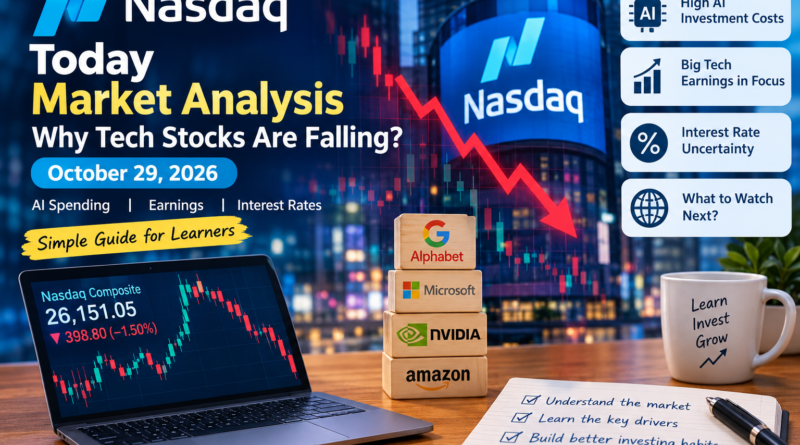
Nasdaq Today Live Analysis: Why Technology Stocks Are Falling on October 29, 2026
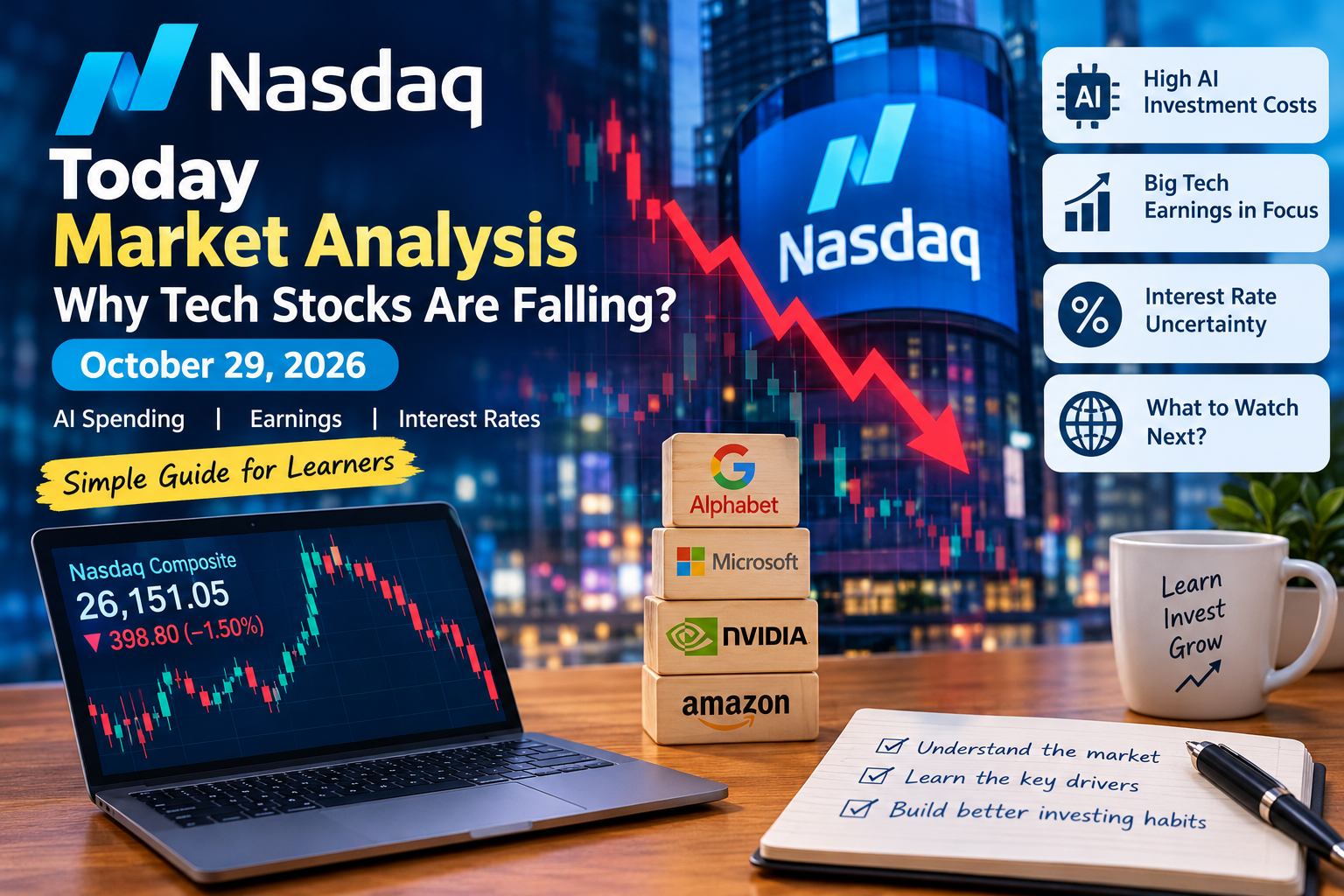
The Nasdaq market is facing fresh pressure on Thursday as investors reconsider the cost of artificial intelligence, the outlook for major technology companies and the possibility of interest rates staying higher for longer. The latest market reporting shows the Nasdaq Composite falling around 1.2%, with Alphabet shares suffering a sharp decline after its earnings report raised concerns about advertising growth and AI investment costs. Reuters market report
For everyday investors and people learning about the stock market, today’s movement offers an important lesson: even when a company invests billions of dollars in a promising technology, its share price can fall if investors become uncertain about future profits.
What Is Happening in the Nasdaq Market Today?
The Nasdaq Composite is one of the most closely watched U.S. stock market indexes. It includes thousands of companies listed on the Nasdaq exchange, with a significant influence from technology, semiconductor, software and internet businesses.
On October 29, investors are paying close attention to quarterly earnings, AI infrastructure spending and the direction of interest rates. Technology shares are under pressure, although other parts of the stock market have shown more resilience.
This difference matters. When the Nasdaq falls more sharply than other major indexes, it can indicate that investors are reducing exposure to growth-oriented technology companies rather than selling every type of stock equally.
Market prices change throughout the trading session. Readers should check the latest quote before treating any reported price or percentage change as current.
Why Are AI Stocks Facing Pressure?
Artificial intelligence has become a major source of investment across the technology industry. Companies are building data centres, purchasing advanced chips and expanding cloud computing capacity to meet demand for AI services.
However, these investments are expensive. Investors want to know whether the revenue generated by AI products will eventually justify the cost.
There are three main questions behind the current uncertainty.
First, will AI generate enough revenue? Companies need to demonstrate that customers are willing to pay for AI tools, cloud services and computing capacity.
Second, will profits grow alongside revenue? A business may increase sales while its expenses rise even faster. That can limit profit margins.
Third, how will companies finance future expansion? If businesses rely more heavily on borrowing, higher interest rates may increase financing costs.
These concerns do not mean that AI has no future. Instead, investors are becoming more selective about which companies can turn AI demand into sustainable profits.
Alphabet’s Earnings Put the AI Business Model Under the Spotlight
Alphabet, the parent company of Google, is one of the main companies investors are watching today.
Its latest results highlighted a difficult balance between investing for future growth and delivering financial results that satisfy shareholders. Revenue from search advertising fell short of expectations, while spending on AI infrastructure continued to attract attention.
Reuters reported that Alphabet shares fell 11.7% following the results, raising concerns about the returns on its AI investments.
For investors, the important question is not simply whether Alphabet is spending more money. It is whether that spending will improve its competitive position and generate sufficient future cash flow.
The same question applies to other major technology businesses. Strong demand for AI does not automatically guarantee that every company involved will deliver strong investment returns.
Microsoft, Nvidia and Amazon: What Investors Should Watch
Microsoft remains important because its cloud computing business and AI products are central to the industry’s expansion. Investors will want to see whether cloud growth can support the cost of building additional infrastructure.
Nvidia is another key company to watch because its processors are widely used for AI training and computing. Strong demand for its chips can support revenue, but semiconductor shares can still fall when investors worry about valuations, competition or future spending.
Amazon also matters because its cloud computing division is a major part of the AI infrastructure market. Its earnings and outlook could influence how investors assess demand for cloud services and the industry’s spending plans.
These companies operate different businesses, so their results should not be treated as interchangeable. Investors should examine revenue growth, operating margins, cash flow and management guidance rather than relying on share-price movements alone.
How Interest Rates Affect the Nasdaq
Interest rates are another important part of today’s market story.
Technology companies often receive high valuations because investors expect them to generate significant profits in the future. When interest rates rise or are expected to remain elevated, those future earnings may be worth less in today’s calculations.
Higher borrowing costs can also make it more expensive for companies to finance new projects.
The Federal Reserve’s recent decision to keep interest rates unchanged has therefore not removed uncertainty from the market. Investors are still assessing inflation, economic growth and the likely direction of monetary policy.
If inflation cools and interest-rate expectations improve, technology shares could receive support. If inflation remains stubbornly high, investors may demand stronger earnings before paying premium prices for growth stocks.
Nasdaq Technical Analysis: What the Price Action Means
Technical analysis studies price movements, trends and trading activity to help investors understand market behaviour.
For beginners, three signals are particularly useful.
Support is a price area where buyers have previously appeared and selling pressure may slow.
Resistance is a price area where sellers have previously emerged and a recovery may struggle.
Trading volume measures how many shares are traded. A price move accompanied by unusually strong volume can indicate greater participation, although volume alone does not determine the next direction.
During a decline, traders often watch whether the Nasdaq stabilises near support or continues making lower lows. A recovery above resistance may indicate improving momentum, but it does not guarantee that the broader trend has changed.
Technical levels should be calculated from a current, timestamped chart. They should not be treated as fixed predictions because market conditions can change quickly.
What Could Happen in the Next Trading Session?
There are three broad possibilities for the Nasdaq.
Scenario One: Technology Stocks Continue to Fall
If investors remain concerned about AI spending and earnings disappointments spread to other companies, the Nasdaq could face additional selling pressure.
A sustained break below a recent support area would be a warning sign, particularly if semiconductor and software stocks also weaken.
Scenario Two: The Market Stabilises
The Nasdaq could find support if investors decide that the recent decline has gone far enough or if earnings from other companies provide reassurance.
In this situation, prices may move sideways as traders wait for clearer information about profits, inflation and interest rates.
Scenario Three: Technology Stocks Recover
A stronger recovery could develop if company guidance improves, AI demand remains robust and investors become more confident about future returns.
For a more convincing recovery, traders would look for participation from several major technology companies rather than relying on a single stock to lift the index.
These are possible scenarios, not guaranteed forecasts. The market’s next move will depend on new information and how investors interpret it.
What Beginners Can Learn From Today’s Nasdaq Decline
Today’s market provides several useful lessons for people who are learning about investing.
First, a well-known company is not automatically a good investment at every price. Valuation matters, even when the business has strong technology and a promising future.
Second, revenue growth and profit growth are different. Investors should understand whether a company’s costs are increasing faster than its sales.
Third, market indexes can hide differences between individual companies. One large technology stock can influence the Nasdaq substantially, so it is important to look beyond the headline number.
Finally, short-term price movements are difficult to predict. A falling market does not necessarily mean that investors should sell everything, just as a rising market does not guarantee further gains.
A sensible approach is to understand the business, examine financial results, consider risk and avoid making decisions based solely on one day’s market news.
Final Outlook: Is the Nasdaq Bullish or Bearish Today?
The short-term outlook for the Nasdaq is cautious because investors are reassessing AI investment costs, company earnings and the interest-rate environment.
The key issue is whether major technology companies can convert their enormous AI investments into reliable revenue, profits and cash flow. If they demonstrate stronger returns, confidence could improve. If costs continue rising without sufficient financial benefits, valuations may remain under pressure.
For learners, the most important takeaway is simple: the stock market responds not only to how well a company performs, but also to whether its results meet investors’ expectations.
Keep monitoring the Nasdaq Composite, major technology earnings, inflation data and Federal Reserve developments before drawing conclusions about the market’s next move.
Sources
- Nasdaq: https://www.nasdaq.com/
- Reuters: https://www.reuters.com/markets/
- CNBC: https://www.cnbc.com/markets/
- Yahoo Finance: https://finance.yahoo.com/
- Bloomberg: https://www.bloomberg.com/markets
- MarketWatch: https://www.marketwatch.com/
- Investing.com: https://www.investing.com/
- Financial Times: https://www.ft.com/markets
- The Wall Street Journal: https://www.wsj.com/news/markets
- Investopedia: https://www.investopedia.com/
Official Nasdaq Composite Index Data: https://indexes.nasdaq.com/Index/Overview/COMP
Disclaimer: This article is for educational and informational purposes only. It is not personalised investment advice. Market prices and forecasts can change, and all figures should be checked against a current market-data source before publication.
