
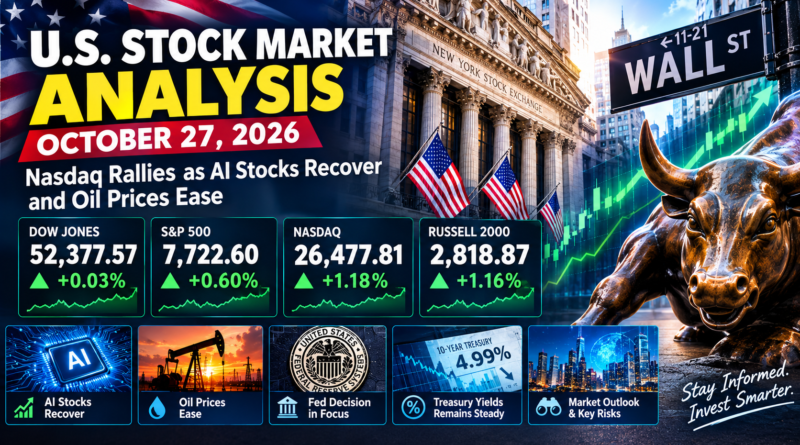
U.S. Stock Market Analysis October 27, 2026: Nasdaq Rallies as AI Stocks Recover and Oil Prices Ease
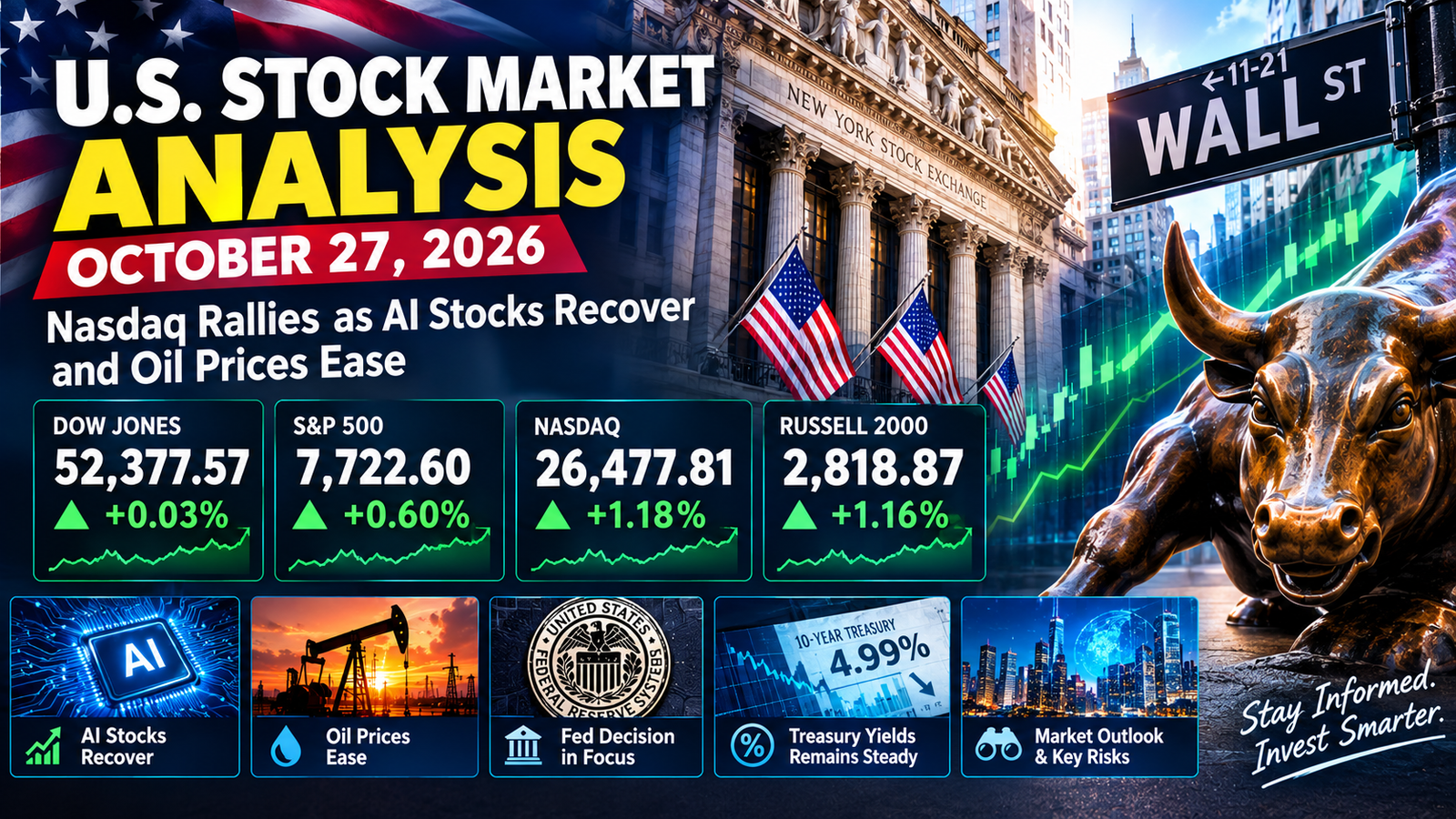
U.S. stocks finished mostly higher on Tuesday, October 27, 2026, as technology shares recovered, smaller-company stocks advanced, and investors looked ahead to the Federal Reserve’s interest-rate decision. The Nasdaq Composite delivered the strongest performance among the major indexes, while the Dow Jones Industrial Average ended nearly flat.
The session offered some relief for investors who had watched technology shares come under pressure in recent weeks. Semiconductor stocks continued their recovery, optimism surrounding artificial intelligence returned to parts of the market, and easing oil prices helped improve sentiment before the Federal Reserve’s policy announcement.
Yet the rally did not mean every part of the market was healthy. The Associated Press reported that most S&P 500 stocks declined despite gains in the major indexes, as influential AI-related companies helped lift the broader benchmarks. That distinction matters because a market can look strong on the surface while many individual companies are losing value.
For American households, investors, and business owners, October 27 was a reminder that stock prices respond to more than economic growth alone. Interest rates, inflation, energy costs, corporate earnings, and expectations about future profits can all influence the market’s direction.
This analysis examines the closing numbers, the technology rebound, the Federal Reserve outlook, Treasury yields, oil prices, corporate earnings, and the risks investors should monitor as the week continues.
U.S. Stock Market Snapshot: October 27, 2026
The major U.S. indexes finished Tuesday with gains, although performance varied considerably between the Dow and the more technology-sensitive indexes.
| Market index | Closing level | Daily change |
|---|---|---|
| Dow Jones Industrial Average | 52,377.57 | +0.03% |
| S&P 500 | 7,722.60 | +0.60% |
| Nasdaq Composite | 26,477.81 | +1.18% |
| Russell 2000 | 2,818.87 | +1.16% |
Source: Associated Press and The Street market coverage for October 27, 2026.
The numbers reveal three important developments.
First, the Nasdaq outperformed the Dow by a wide margin. That suggests technology and growth-oriented shares played a major role in the session’s advance.
Second, the Russell 2000 rose more than 1%, indicating strength among smaller listed companies. This is worth monitoring because small-cap businesses can respond differently to changes in credit conditions, domestic demand, and investor confidence.
Third, the Dow’s gain was almost negligible. The index’s performance reflected a more mixed picture among established companies, including pressure on individual industrial stocks.
The overall result was positive, but it was not a broad, uniform rally across every company and sector. Investors need to look beyond the headline index movements to understand the quality of a market advance.
1. Why the Nasdaq Led the Market Higher
The Nasdaq Composite gained 1.18% on October 27, finishing at 26,477.81. Technology shares and semiconductor companies were important contributors to the recovery.
The market had recently faced concerns about whether heavy spending on artificial intelligence infrastructure would produce sufficient financial returns. Investors were also evaluating company earnings, financing costs, and the possibility that elevated interest rates could make expensive growth stocks less attractive.
On Tuesday, the balance shifted toward buying in parts of the technology sector. The Street reported that enthusiasm around Anthropic’s potential initial public offering helped revive interest in AI-related stocks, while chip shares continued their recovery.
However, it is important to distinguish a rebound from a complete change in market direction.
A stock that falls sharply can rise the following day as investors buy at lower prices, short sellers close positions, or new information changes expectations. That recovery does not necessarily mean the original concerns have disappeared.
For example, a semiconductor company may benefit from growing demand for AI computing while still facing questions about production costs, customer concentration, competition, or the price investors are willing to pay for its future earnings.
The same applies to cloud providers and software businesses. Demand for AI products may increase, but the financial benefits depend on how much customers are willing to pay and how efficiently companies can deliver those services.
What investors should learn from the technology rebound
The strongest long-term technology businesses are not necessarily the companies attracting the most attention on social media or financial television. Investors should examine the underlying financial results.
Important questions include:
- Is revenue growing at a sustainable rate?
- Are operating margins improving or deteriorating?
- Is free cash flow keeping pace with reported earnings?
- How much capital expenditure is required to maintain growth?
- Are customers paying for AI services, or are companies still spending heavily to build capacity?
- Does management provide evidence that new investments are producing measurable returns?
These questions are particularly relevant when stock valuations already assume strong future growth.
If a company delivers solid results but management warns that infrastructure costs will rise faster than expected, investors may reconsider the value of its shares. Conversely, evidence of stronger demand and improving margins can support a more positive assessment.
The October 27 rally showed that confidence in technology had improved for the session. The next challenge is determining whether earnings and cash flow can support that confidence over time.
2. Artificial Intelligence Remains a Major Market Theme
Artificial intelligence continued to influence investor sentiment, particularly in semiconductor and cloud-computing businesses.
The investment cycle involves much more than software companies launching new chatbots. It includes data centers, advanced processors, networking equipment, electricity infrastructure, cooling systems, cloud platforms, and enterprise applications.
That creates opportunities for companies across several industries. It also requires substantial spending before all the potential financial benefits become clear.
The opportunity behind AI investment
Businesses are investing in AI because they expect it to improve productivity, automate selected tasks, enhance customer service, and create new products.
For technology suppliers, this demand can translate into orders for chips, servers, networking equipment, and cloud services. For companies adopting AI, the potential benefits include faster workflows and lower costs in specific operations.
However, an increase in spending by one company becomes revenue for another company. It does not automatically mean the entire investment cycle will generate attractive returns for every participant.
The ultimate test is whether customers receive enough value to justify their spending and whether suppliers can earn profits after accounting for development, equipment, energy, staffing, and financing costs.
Why the AI trade can be volatile
AI-related stocks can react strongly to small changes in expectations because their valuations may depend on rapid growth continuing for years.
If investors expect demand to accelerate, they may be willing to pay a high valuation for a company. If future spending or revenue growth appears less certain, that valuation can change quickly.
Interest rates add another layer of uncertainty. Higher borrowing costs can make it more expensive to finance infrastructure and can reduce the present value investors assign to profits expected far into the future.
This is why the same AI-related company can rise sharply on one day and fall on another without a dramatic change in its core business.
For long-term investors, the useful distinction is between companies with demonstrable earnings power and companies whose valuations depend mainly on expectations that have not yet been proven.
Anthropic and investor interest
Anthropic’s planned public listing attracted attention during the October 27 session. The Street linked renewed enthusiasm around the company with improved sentiment toward AI-related stocks.
An anticipated listing can draw attention to an entire sector by giving investors another way to assess the commercial value of AI technology. It can also encourage comparisons between private AI companies and publicly traded suppliers.
But excitement around a potential IPO should not be confused with proof that every company in the AI ecosystem is attractively valued.
Investors still need to consider business models, financial disclosures, competition, funding requirements, profitability, and the risks of relying on continued investor enthusiasm.
3. Semiconductor Stocks Continue Their Recovery
Semiconductor companies were among the important technology names in focus as the sector extended its recovery.
Chips are essential to AI training, inference, cloud computing, personal electronics, industrial equipment, and a wide range of other technologies. Demand for advanced processors has made semiconductor companies central to the current investment cycle.
Yet semiconductor stocks can be unusually sensitive to expectations because the industry is cyclical. Companies must invest in research, production capacity, and equipment, often long before all the returns are realized.
Why chip stocks matter to the wider market
Large semiconductor companies carry significant weight in important stock indexes. When their share prices move sharply, they can influence the Nasdaq and S&P 500 even if many other companies are struggling.
This helps explain why major indexes can rise while the majority of their constituent stocks decline.
Investors should therefore distinguish between index performance and market breadth. Index performance measures the change in a benchmark, while market breadth considers how many individual stocks participate in the move.
A rally supported by a small number of influential stocks may be more vulnerable if those leaders reverse direction.
The risks behind semiconductor growth
The industry’s long-term opportunity does not eliminate short-term business risks.
Potential challenges include:
- Slower-than-expected demand from large customers.
- High capital expenditure and equipment costs.
- Strong competition between chip designers and manufacturers.
- Export restrictions and geopolitical tensions.
- Electricity and data-center capacity constraints.
- Customer concentration.
- Changes in technology standards.
- Valuations that already assume exceptional future growth.
A company can operate in an attractive industry and still be a poor investment at an excessive price. Likewise, a temporary decline does not automatically mean its underlying business has weakened.
Investors should compare a company’s valuation with its earnings outlook, cash generation, competitive position, and ability to withstand a slower period in the industry.
4. The Dow Jones Finished Almost Flat
While technology shares advanced, the Dow Jones Industrial Average gained only 0.03%, closing at 52,377.57.
The Dow has a different composition from the Nasdaq. It includes established companies across industrial, financial, healthcare, consumer, and other sectors. Its performance can therefore differ from the technology-heavy benchmarks.
Individual company news contributed to the mixed session. The Street reported that Boeing shares fell after the company indicated that it would miss a delivery target, while other corporate results influenced movements across the market.
This illustrates why investors should avoid treating the Dow as a complete representation of every business in the United States.
A company can experience strong demand in one division while facing production delays or rising costs in another. Such developments can influence share prices even when the wider economy appears stable.
What the Dow’s performance tells us
The nearly flat close suggests that Tuesday’s gains were not equally distributed across all major companies.
Investors were willing to buy certain growth-oriented shares, but concerns affecting individual businesses and sectors continued to matter.
For people following the market, this is a reason to examine earnings reports and company-specific news rather than relying solely on a single index.
It is also a reminder that a diversified portfolio can contain investments that behave differently on the same trading day. Diversification does not eliminate losses, but it can reduce dependence on one company, industry, or market theme.
5. S&P 500 Advances as Technology Helps Offset Weakness Elsewhere
The S&P 500 gained 0.60%, finishing at 7,722.60.
The index includes companies from many sectors, making it a widely followed measure of large-cap U.S. equities. However, it is weighted by market capitalization, so the largest companies have a greater influence on its performance than smaller constituents.
This weighting can produce a misleading impression of how the average stock is performing.
On October 27, the Associated Press reported that most S&P 500 stocks declined even though the index advanced. Influential AI-related companies helped support the benchmark.
For market analysts, that is an important detail.
If the index rises while a majority of its stocks fall, the advance may depend heavily on a limited group of companies. That does not guarantee a reversal, but it suggests investors should investigate whether the gains are spreading to more sectors and businesses.
How market breadth can help investors
Market breadth is one way to assess the strength of a rally.
Analysts may look at the number of advancing versus declining stocks, the number of companies reaching new highs and lows, and whether gains extend beyond a few dominant sectors.
Broad participation can indicate that investors are becoming more confident across a range of businesses. Narrow participation may mean the market is relying heavily on a handful of companies.
Neither measure predicts the future with certainty. A narrow rally can continue, and a broad rally can reverse. Still, breadth offers useful context that a headline index number alone cannot provide.
6. Small-Cap Stocks Rise as the Russell 2000 Gains 1.16%
The Russell 2000 advanced 1.16% on October 27, closing at 2,818.87.
That was a stronger performance than the Dow and close to the Nasdaq’s gain. The move drew attention because smaller listed companies often have different financing needs and revenue sources from the largest U.S. corporations.
Many small businesses depend more heavily on domestic customers and bank lending. They may have less access to inexpensive financing and fewer resources to absorb a prolonged increase in operating costs.
As a result, small-cap stocks can be sensitive to expectations about interest rates, credit availability, and the strength of the U.S. economy.
Why small-cap performance matters
When investors become more optimistic about domestic growth and financing conditions, smaller companies may attract additional interest.
A stronger economy can support customer demand, while lower borrowing costs can make it easier for businesses to refinance debt and fund expansion.
However, the opposite is also true. Persistent inflation, higher financing costs, or weaker demand can place pressure on smaller firms, particularly those with limited cash reserves.
The Russell 2000’s gain on October 27 was a positive development for the session, but one day’s performance does not establish a lasting trend.
Investors should monitor whether small-cap strength continues and whether the improvement is supported by earnings, cash flow, and credit conditions.
What smaller companies need to manage
For a small business, a rise in its stock price is only one aspect of financial health. Cash flow, customer retention, debt payments, staffing costs, and inventory management may be more important to daily operations.
Businesses that plan to expand should test their budgets against several scenarios, including slower sales and higher financing costs.
A company that remains profitable under difficult conditions may be better positioned than one that requires rapid growth simply to cover its fixed expenses.
7. Oil Prices Ease, Offering Some Relief to Markets
Oil prices moved lower for a second consecutive session as investors assessed supply risks and the outlook for the Federal Reserve’s decision.
Reuters reported that easing crude prices supported risk appetite ahead of the central bank announcement, although oil remained elevated relative to its recent history.
The decline was important because energy prices influence a wide range of economic activity.
Crude oil is used to produce gasoline, diesel, jet fuel, and other petroleum products. Transportation companies, airlines, manufacturers, and delivery businesses can be affected by changes in fuel prices.
Higher energy costs can also feed into the prices consumers pay for goods and services, although the timing and size of those effects vary.
Why falling oil prices can help
If oil prices decline and the reduction continues, businesses may eventually face lower fuel and transportation costs. Households may also see some relief at the pump, depending on local fuel prices, refining costs, taxes, and distribution expenses.
Lower energy prices can help ease inflation pressures. That can be positive for consumer spending and may give policymakers more flexibility if other inflation measures are also improving.
But one or two sessions of lower oil prices do not establish a durable decline.
Energy markets respond to geopolitical developments, production decisions, shipping conditions, inventory levels, and expectations about global demand. Prices can change rapidly when supply risks increase.
The risk of renewed energy inflation
If oil prices rise again and remain elevated, the consequences could extend beyond gasoline.
Businesses may face higher delivery costs, airlines may encounter pressure on operating margins, and manufacturers may have to absorb higher input expenses.
Some companies can pass higher costs on to customers. Others may struggle to do so because of competition or weak demand.
Investors should therefore consider energy prices alongside company earnings, consumer inflation, and broader economic indicators.
The October 27 decline helped sentiment, but the long-term impact will depend on whether energy costs continue to moderate.
8. Treasury Yields Remain Central to the Market Outlook
The U.S. Treasury market was relatively steady ahead of the Federal Reserve’s decision.
Market commentary placed the 10-year Treasury yield around 4.99% at the October 27 close, while the two-year yield was around 4.73%. These figures refer to specific market measures and can differ slightly by source and timing.
Treasury yields matter because they influence the returns investors demand from other investments and help shape borrowing costs across the economy.
The 10-year yield is closely watched in mortgage markets and long-term valuation models. Shorter-term Treasury yields are generally more sensitive to expectations about Federal Reserve policy.
Why bond yields influence stocks
Stocks represent claims on future corporate earnings. When interest rates and bond yields rise, investors may demand a lower price for those future earnings because safer investments offer more competitive returns.
Higher yields can also increase the cost of financing business investment. Companies that depend on borrowing to fund expansion may face more expensive debt, while highly valued growth companies can be especially sensitive to changes in discount rates.
However, the relationship is not automatic. Strong economic growth can push yields higher while also supporting corporate earnings. In that situation, some companies may benefit from stronger demand even as financing becomes more expensive.
The important question is why yields are moving.
A decline driven by easing inflation can support markets. A decline caused by fears of a severe economic slowdown may be less positive because falling yields could coincide with weaker earnings.
Similarly, rising yields associated with stronger growth may have different implications from rising yields caused by persistent inflation concerns.
Investors should examine the economic context rather than interpreting every movement in yields as a straightforward signal.
9. The Federal Reserve Decision Was the Main Event Ahead
The October 27 session took place just before the Federal Reserve’s scheduled policy announcement on October 28.
Investors were widely expecting the central bank to leave its benchmark interest rate unchanged. At the same time, financial markets were assessing the possibility that rates might remain restrictive for longer if inflation failed to ease.
This uncertainty influenced trading because interest-rate expectations affect almost every major financial market.
A change in the expected policy path can affect stock valuations, bond yields, the U.S. dollar, mortgage pricing, corporate borrowing, and demand for interest-sensitive products.
Why investors were waiting for the Fed
The Federal Reserve’s decisions depend on its assessment of inflation, employment, economic growth, and financial conditions.
If inflation remains too high, policymakers may be reluctant to reduce rates. If the economy weakens substantially and price pressures ease, the case for lower rates may become stronger.
The central bank must balance these considerations rather than responding to stock market movements alone.
Investors therefore pay attention to the policy statement, the voting record, and the chair’s comments. Even when rates do not change, the central bank’s explanation can alter expectations about future decisions.
What a rate pause means for consumers
An unchanged policy rate does not mean that all borrowing costs will stay exactly the same.
Credit card rates, personal loans, auto financing, mortgages, and business credit depend on different benchmarks and lender decisions. Some rates respond more quickly to changes in short-term policy, while others reflect longer-term bond yields and borrower-specific risk.
For households, the most useful approach is to evaluate the actual rate and total cost of borrowing rather than assuming that a future Fed decision will immediately make loans cheaper.
For businesses, it is sensible to consider whether planned investments can generate sufficient returns under current financing conditions.
10. Corporate Earnings Remain a Major Market Driver
The October 27 session occurred during a busy period for corporate earnings, with investors looking for evidence that company profits could justify current valuations.
Earnings reports provide more than a snapshot of past performance. Investors also examine management guidance, sales trends, operating expenses, margins, cash flow, and demand in major business divisions.
A company can report higher revenue but still disappoint if costs rise faster than sales. Another company may post modest revenue growth yet receive a positive response if profitability improves or its outlook becomes more encouraging.
Revenue is not the whole story
Revenue indicates how much a company sells, but it does not reveal how much money the company ultimately keeps.
Operating margins show how efficiently a business converts sales into operating profit. Free cash flow helps investors evaluate how much cash remains after necessary capital spending.
These measures are particularly important for companies investing heavily in AI infrastructure, factories, logistics, and other long-term projects.
A business may report strong demand while simultaneously spending large sums to build capacity. Whether that spending creates value depends on future customer demand, competitive conditions, and the return on the investment.
Guidance can move a stock more than past results
Investors often look beyond the previous quarter to the next few months or years.
If management raises its revenue outlook, the market may interpret the announcement as evidence of stronger demand. If management lowers guidance because of weaker orders or rising costs, the share price may decline even when the most recent quarter was profitable.
Guidance is not a guarantee. Economic conditions can change, and management estimates may prove too optimistic or too cautious.
Still, understanding the outlook helps investors assess what a company’s current share price may already assume about its future.
11. Boeing and the Importance of Company-Specific Risks
Boeing was among the individual companies attracting attention during Tuesday’s session. The Street reported that its shares fell after the company indicated that it would miss a delivery target.
Developments like this show why company-specific factors can outweigh broad market strength.
For manufacturers, delivery schedules are linked to production capacity, supply chains, quality processes, customer commitments, and revenue recognition. Delays can affect cash flow and customer confidence, depending on their scale and duration.
The implications of a missed target depend on the circumstances. Investors need to understand whether the issue is temporary, whether it creates additional costs, and whether management can restore its operating plan.
This lesson applies well beyond aerospace.
A retailer may face inventory problems, a software company may lose a major customer, or a manufacturer may experience a supply shortage. Such developments can affect an individual stock even if the overall market is rising.
For long-term investors, company research should include operational risks as well as headline financial results.
12. What the October 27 Rally Means for American Households
Stock market headlines often focus on index points and percentage gains. For many households, the more important question is how market conditions affect monthly expenses, borrowing decisions, savings, and retirement plans.
The link between markets and household finances is real, but it is not always immediate.
Credit card debt
People carrying variable-rate credit card balances may continue to face high interest costs while borrowing conditions remain restrictive.
Paying down expensive debt can provide a more predictable financial benefit than attempting to time the stock market. Households should review interest rates, minimum payments, and the total amount owed.
A debt repayment plan should be realistic enough to maintain essential expenses and avoid replacing paid-off debt with new borrowing.
Mortgage and housing costs
Mortgage rates are influenced by long-term bond yields, lender pricing, inflation expectations, and conditions in mortgage markets.
A stable Federal Reserve policy rate does not guarantee that mortgage rates will decline. Homebuyers should calculate affordability using the actual quoted rate, property taxes, insurance, maintenance, and other ownership costs.
Existing homeowners with fixed-rate mortgages may be less directly affected by short-term policy changes than people seeking new financing or holding adjustable-rate loans.
Fuel and transportation
Changes in crude oil prices can eventually affect gasoline and other energy costs. The effect is not one-for-one because refining, distribution, taxes, and regional conditions also matter.
Households that spend a large portion of their budget on transportation may benefit when fuel costs decline, but should avoid assuming that a brief oil-market move will produce immediate savings.
Retirement investments
For people saving for retirement, one trading session is rarely a sufficient reason to change a long-term plan.
Portfolio decisions should reflect time horizon, income needs, risk tolerance, diversification, and the role of different assets in the overall plan.
Someone who needs money soon may have different priorities from someone investing for decades. The right allocation depends on personal circumstances, not just whether the Nasdaq rises on a particular day.
13. What Small Businesses Should Learn From the Market
Small businesses do not need to follow every market movement, but they should understand the economic forces that affect customers, financing, and operating expenses.
The October 27 session highlighted several issues that matter beyond Wall Street: borrowing costs, energy prices, technology investment, and uncertainty about future demand.
Review financing needs
Businesses planning to borrow should examine interest rates, repayment schedules, fees, collateral requirements, and the impact of debt payments on cash flow.
A project that appears profitable under optimistic assumptions may become difficult if sales are weaker or financing costs are higher than expected.
Monitor operating costs
Energy prices, wages, rent, insurance, and supplier expenses can change the financial outlook for a business.
Owners should identify the costs most likely to affect their margins and create a practical plan for managing them.
Evaluate technology spending carefully
AI tools and other digital systems may help businesses improve customer service, manage inventory, automate repetitive work, or analyze sales.
But technology spending should be linked to a defined business objective. Owners should consider implementation costs, subscriptions, staff training, data protection, and whether the expected benefit can be measured.
Protect cash flow
Cash flow is essential for meeting payroll, paying suppliers, covering rent, and servicing debt.
Businesses can strengthen their resilience by maintaining realistic forecasts, reviewing outstanding invoices, controlling unnecessary expenses, and preparing for a slower sales period.
A strong stock market does not guarantee that every small business will experience growth. Local demand, competition, credit availability, and operating decisions remain important.
14. Three Possible Scenarios for the U.S. Market
Investors should avoid assuming that the October 27 rally determines what happens next. Several different paths remain possible, depending on inflation, earnings, interest rates, and economic growth.
Scenario One: Earnings remain strong and inflation cools
If companies continue to produce healthy profits while inflation moderates, investors may become more comfortable with stock valuations.
Lower inflation could eventually create more flexibility for monetary policy, while strong corporate results could help support earnings expectations.
In this scenario, market gains might broaden beyond a small number of influential technology companies.
However, positive economic news may already be reflected in prices. Even a healthy business can disappoint investors if its results fall short of unusually high expectations.
Scenario Two: Inflation remains persistent
If inflation stays elevated, the Federal Reserve may have less room to reduce rates. Treasury yields could remain high or rise further, depending on expectations about future policy and economic conditions.
Higher financing costs could pressure businesses that depend on borrowing. Expensive growth stocks might also face valuation challenges.
Some companies could continue to perform well because of strong demand or pricing power, but the market could become more selective.
Investors would need to focus closely on earnings quality, debt levels, cash generation, and the prices they pay for future growth.
Scenario Three: Economic growth weakens
If consumers reduce spending and businesses slow investment, corporate revenue and earnings expectations could deteriorate.
In that environment, investors might seek safer assets, and Treasury yields could decline if markets anticipate weaker growth or future rate cuts.
However, lower yields would not necessarily mean the stock market was safe. If the decline reflected a significant economic slowdown, weaker earnings could offset the benefit of lower financing costs.
These scenarios are analytical frameworks, not predictions. New data and unexpected developments can change the outlook quickly.
15. Key Indicators to Watch After October 27
Investors following U.S. markets should pay attention to several indicators in the coming sessions.
Federal Reserve communications: The policy decision and subsequent explanations can change expectations about future interest rates.
Treasury yields: Movements in short- and long-term yields can affect financing costs and stock valuations.
Inflation data: Consumer and producer prices help investors evaluate whether price pressures are easing.
Corporate earnings: Revenue, margins, cash flow, and management guidance remain essential to understanding company performance.
AI-related capital spending: Investors should assess whether large investments are translating into customer demand and sustainable profits.
Oil prices: Energy costs can influence inflation, household budgets, and business margins.
Market breadth: The number of stocks participating in a rally can help investors understand whether gains are concentrated or widespread.
Small-cap performance: The Russell 2000’s movement can provide additional information about investor sentiment toward smaller companies and domestic economic conditions.
Consumer spending and employment: These indicators help show whether the economy is maintaining momentum.
No single indicator can reliably predict the market’s next move. The value comes from examining several sources of information together.
16. How Long-Term Investors Can Respond to Volatility
Market volatility can encourage investors to make decisions based on fear or excitement. A technology rally may create pressure to buy quickly, while a sudden decline can encourage selling at an unfavorable time.
A disciplined approach begins with understanding the purpose of the money being invested.
Separate short-term needs from long-term goals
Money needed soon for essential expenses may not be suitable for exposure to substantial stock-market risk.
Long-term investments can tolerate different levels of volatility, depending on the investor’s circumstances, but a long time horizon does not eliminate the possibility of losses.
Avoid concentrating on one market theme
Technology and AI have attracted considerable attention, but a portfolio concentrated in one sector can be vulnerable if investor expectations change.
Diversification across asset classes, sectors, and companies can reduce dependence on a single source of returns. It does not guarantee profits or protect against every loss.
Understand valuation
A company’s business prospects and its stock price are two different things.
A business may have a strong competitive position, but its shares can still be expensive relative to future earnings. Conversely, a lower share price does not automatically mean a company is undervalued.
Investors should examine financial performance, future risks, debt, cash generation, and valuation before making decisions.
Keep expectations realistic
No one can consistently predict every market movement. Even professional investors can misjudge the timing or impact of economic developments.
A plan based on reasonable assumptions and risk management is generally more useful than trying to react to every headline.
17. The Bigger Economic Picture Behind Wall Street
The October 27 session reflected several forces operating at the same time.
Technology investors were weighing the commercial potential of AI against the cost of building infrastructure. The Federal Reserve’s decision created uncertainty about future borrowing costs. Oil prices influenced inflation concerns, while corporate earnings revealed different levels of strength across industries.
These factors do not operate independently.
For example, rising oil prices can increase business costs and contribute to inflation. Persistent inflation can influence central bank policy. Higher interest rates can increase financing expenses, which may affect corporate investment and consumer demand.
Meanwhile, strong productivity growth could help some businesses produce more with fewer resources, potentially supporting profitability. But productivity gains do not benefit every industry or worker equally, and the financial impact depends on how businesses implement new technology.
The economy is therefore better understood as a collection of connected developments rather than a single headline number.
For investors, this means examining how interest rates, earnings, inflation, energy costs, and business investment interact over time.
Conclusion: Nasdaq Leads as Investors Prepare for the Fed
The U.S. stock market finished mostly higher on October 27, 2026, as technology and semiconductor shares recovered, oil prices eased, and investors prepared for the Federal Reserve’s policy announcement.
The Nasdaq Composite climbed 1.18% to 26,477.81, the S&P 500 gained 0.60% to 7,722.60, and the Russell 2000 advanced 1.16% to 2,818.87. The Dow Jones Industrial Average edged up just 0.03% to 52,377.57.
The session showed how technology stocks can lift major benchmarks even when many individual shares decline. It also highlighted the importance of oil prices, Treasury yields, corporate earnings, and central bank expectations in shaping investor sentiment.
For American households, the most relevant issues remain borrowing costs, fuel expenses, savings, and long-term financial security. For businesses, the focus is on managing operating costs, protecting cash flow, and investing carefully. For investors, the priority is to distinguish a short-term market rebound from lasting improvements in corporate earnings and economic conditions.
The next stage of the market will depend on new information, not simply on Tuesday’s gains. Investors should follow verified data, examine company fundamentals, understand their own risk tolerance, and avoid making major financial decisions based on a single trading session.
Disclaimer: This article is for informational and educational purposes only. It does not provide personalized investment, tax, or financial advice. Market conditions can change quickly. Conduct independent research or consult a qualified financial professional before making investment decisions.
Sources and Further Reading
- Associated Press — How major U.S. stock indexes fared Tuesday, October 27, 2026
- TheStreet — Stock Market Today, October 27, 2026
- MarketWatch — October 27 market coverage
- Reuters via Kitco — S&P 500 and Nasdaq advance as oil eases ahead of Fed decision
- U.S. Treasury — Daily Treasury yield curve rates
- Federal Reserve — Monetary policy information
