
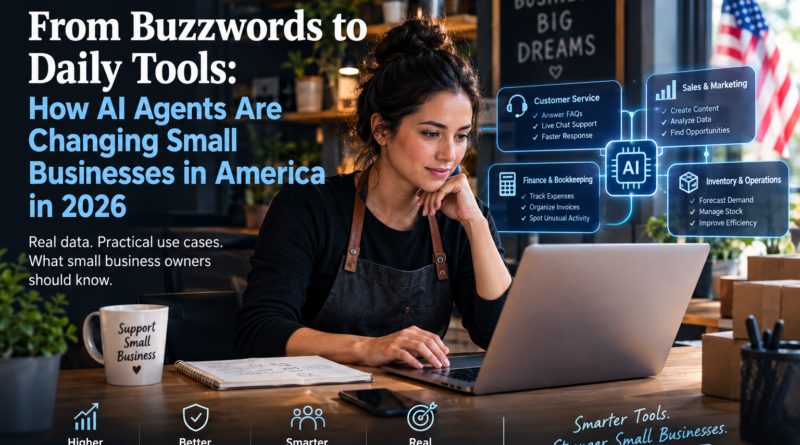
From Buzzwords to Daily Tools: How AI Agents Are Changing Small Businesses in America in 2026
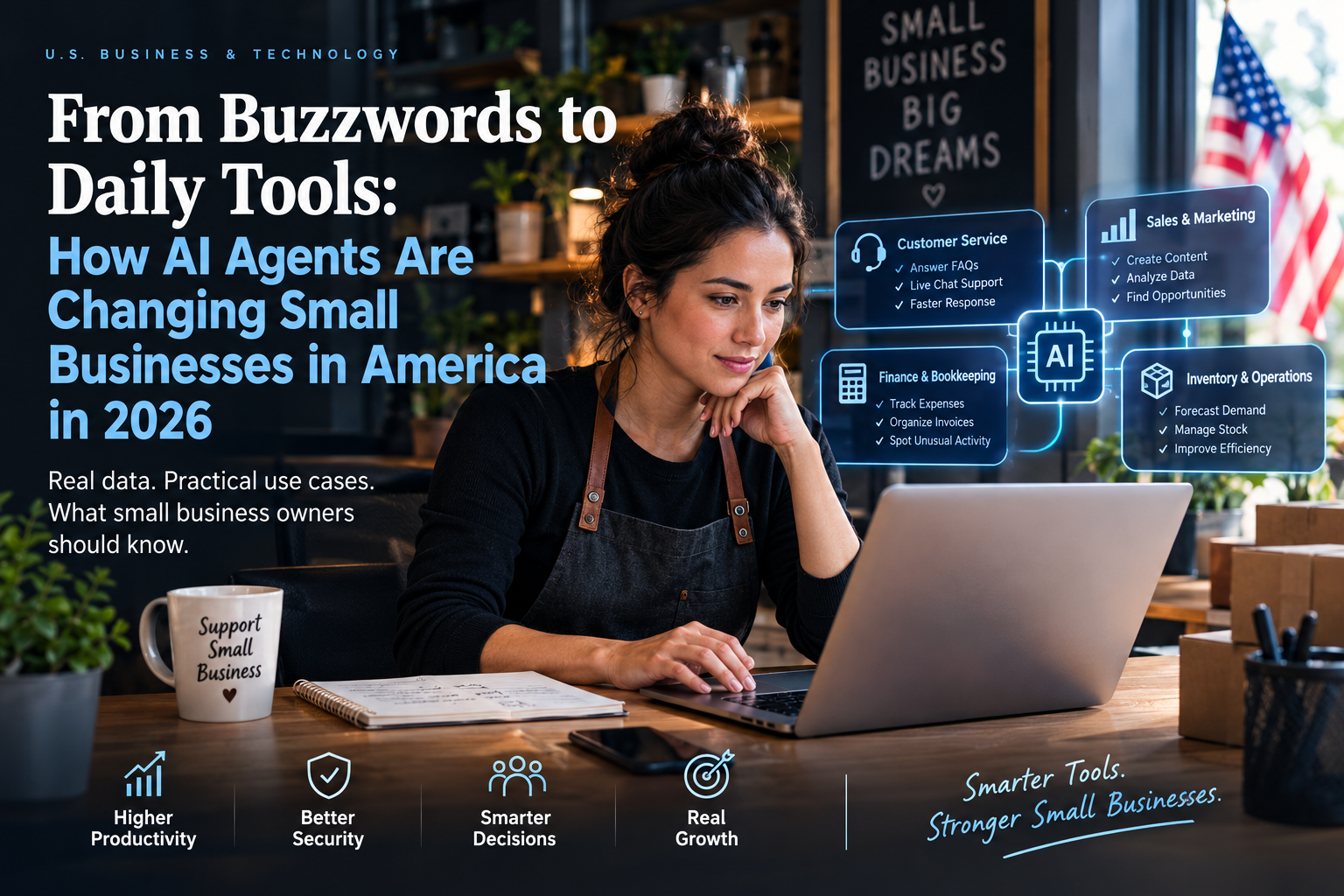
Artificial intelligence is moving beyond the hype. For some American small businesses, AI tools are becoming part of everyday work, from answering customer questions to organizing information and supporting routine business tasks. But adoption figures tell different stories depending on what researchers measure. Here is what the evidence actually shows, where AI can help, and what business owners should consider before relying on it.
Introduction: AI Is Becoming a Practical Business Tool
Artificial intelligence has become one of the most discussed technologies in the business world. Until recently, many conversations focused on futuristic possibilities, expensive systems, and the potential for machines to replace human workers. Today, the discussion is becoming more practical.
Small businesses across the United States are exploring how AI can help them manage customer inquiries, prepare marketing materials, organize business information, analyze sales, and reduce repetitive administrative work.
For a small business owner, the attraction is easy to understand. A local retailer may not have a large customer support team. An independent consultant may spend hours responding to emails. A family-owned company may struggle to keep its inventory records updated while serving customers. AI tools can potentially help with some of these tasks without requiring a large technology department.
However, the growing interest in AI does not mean every business has adopted it, every AI system is an autonomous agent, or every company is achieving measurable savings. Understanding those distinctions is essential to making sense of the latest adoption figures.
Research published by the Small Business & Entrepreneurship Council (SBE Council), the U.S. Chamber of Commerce, the U.S. Census Bureau, and other organizations points to increasing interest in AI. Their findings also show why survey results must be read carefully: the organizations ask different questions, survey different populations, and sometimes use different definitions of AI adoption.
The real story is not simply that small businesses are using more technology. It is that owners are trying to determine which tools solve real problems, which ones justify their cost, and where human judgment remains essential.
What Does the 58% AI-Agent Figure Actually Mean?
A figure that has attracted attention is the SBE Council’s report that 58% of surveyed small-business employers were already using AI agents regularly or occasionally.
The organization published this finding in its September 30, 2026, report, “AI Agents Are Moving into the Small Business Mainstream”.
The report also said that another 14% were considering or planning to use AI agents. Combining those two categories produces a total of 72% of respondents who were either using agents or considering or planning their use.
That combined figure needs an important qualification. It does not mean 72% of all small businesses in America already use AI agents. The first group reported existing use, while the second group included businesses considering or planning adoption. Those are different stages of technology adoption.
The 58% figure also belongs to the SBE Council’s survey. It should not be presented as a government census finding or as a verified count of every small business in the country.
This distinction matters because a survey result is meaningful only when readers understand who was surveyed and what question was asked. A percentage can accurately describe one survey without representing the entire American economy.
The report supports a useful conclusion: AI agents are attracting attention among surveyed small-business employers, and a substantial share of respondents reported some level of use. It does not prove that every business is using autonomous systems, that all users are satisfied, or that adoption automatically improves profitability.
Source: SBE Council — AI Agents Are Moving into the Small Business Mainstream
Why Other Surveys Report Different AI Adoption Rates
Readers may encounter another figure from the U.S. Chamber of Commerce: its 2026 small-business technology report said 66% of small businesses used AI, compared with 58% in 2025 and 23% in 2023.
These numbers are useful, but they should not be treated as direct confirmation of the SBE Council’s AI-agent statistic. The Chamber report measures small-business AI use more broadly, while the SBE Council’s September 2026 report specifically discusses AI agents.
A business might use AI to draft an email or summarize a document without using an agent that carries out a sequence of tasks. A company using a chatbot may also count as an AI user in a broad survey, even if the chatbot cannot independently complete a business workflow.
The difference is similar to measuring how many people use smartphones and how many use a particular smartphone application. The numbers describe related activities, but they are not interchangeable.
The U.S. Chamber of Commerce’s report, “Empowering Small Business: The Impact of Technology on U.S. Small Business”, also discusses business attitudes toward technology, workforce development, and future investment. Its findings reflect the survey’s respondents and methodology, not a universal measurement of every small business in the United States.
Another useful source is the U.S. Chamber Foundation’s research on workers at small businesses. Its June 2026 report found that half of surveyed small-business workers used AI at work. Among those who used AI, many described using it to support personal productivity, such as drafting, summarizing, and brainstorming.
That research also found that only a small proportion of the AI-using workers surveyed reported using AI to automate workflows with minimal human involvement. This is an important reminder that everyday AI use and advanced automation are not the same thing.
In other words, AI can become part of a workday long before a business hands an entire process over to an autonomous agent.
Sources:
- U.S. Chamber of Commerce — 2026 Small Business Technology Report
- U.S. Chamber Foundation — Half of Small Business Workers Use AI
What the U.S. Census Bureau’s Data Tell Us
The U.S. Census Bureau provides another perspective on business AI adoption. Its May 2026 analysis, “Large Firms With at Least 20 Employees Biggest AI Users,” drew on the Business Trends and Outlook Survey.
For the period covered in that analysis, the Census Bureau reported that roughly 17% to 20% of businesses were using AI, depending on the survey period. The data also showed that adoption varied substantially by business size and industry. Larger firms were generally more likely to report AI use than the smallest businesses.
At first glance, this range may appear inconsistent with the higher percentages reported by small-business organizations. It is not necessarily a contradiction.
The Census Bureau’s survey has its own business population, questions, reference periods, and definitions. Other organizations may survey small-business owners or employers and ask whether they use particular tools, including AI agents. Some surveys may also count occasional use, planned adoption, or workers’ individual use of AI.
The percentages cannot be compared fairly unless those differences are considered.
The Census Bureau’s findings are valuable because they provide a broad, official view of business activity. They also caution against assuming that AI adoption is uniform. Company size, industry, available resources, and the nature of the work all influence whether AI is useful and practical.
A small online retailer, for example, may find a customer-support assistant useful. A construction company may have different priorities, such as organizing project documents or preparing routine administrative reports. A business that relies heavily on physical work may have fewer immediate opportunities for software-based automation than a company handling large volumes of digital information.
The more accurate conclusion is that AI adoption is growing in several business surveys, but its measured scale varies according to the population and type of use being studied.
What Is an AI Agent, and How Is It Different From a Chatbot?
The term “AI agent” is often used loosely in marketing. To understand the technology, business owners should distinguish between a conventional AI assistant, a chatbot, a workflow automation tool, and an agent capable of taking multiple steps toward a goal.
A basic chatbot responds to a user’s message. It might answer a frequently asked question, explain a return policy, or help a visitor find information on a website.
A generative AI assistant can do more. It may draft an email, summarize a report, suggest a marketing campaign, or analyze information provided by a user. However, it may still require a person to review the result and carry out the next action.
A workflow automation system follows predefined rules. For example, it might send a confirmation email after a customer completes a form or move a record from one software system to another when a specified condition is met.
An AI agent generally goes a step further. Depending on its design, permissions, and integrations, it may interpret a goal, decide which permitted steps to take, use connected tools, and report the result. Some agents can complete several related tasks without requiring a person to approve every intermediate step.
Imagine a customer asks a retailer about an order. A chatbot may explain how to check the order status. A more capable agent might retrieve the order information from an approved system, identify a delay, prepare a customer response, and recommend an appropriate next step.
That example describes a possible setup, not a guarantee that every agent can perform those actions. The actual capabilities depend on the software, integrations, access permissions, and rules configured by the business.
Agents can also make mistakes. They may misinterpret a request, retrieve incorrect information, or attempt an action that requires human approval. Businesses should therefore define exactly what an agent is allowed to do before giving it access to important systems.
The practical question is not whether a product calls itself an agent. It is whether the system reliably completes a useful task, works with the business’s existing tools, and operates within appropriate safeguards.
Where Small Businesses Can Use AI in Everyday Operations
AI is most useful when it addresses a specific, recurring problem. For a small business, that problem may be the time spent answering similar questions, preparing routine documents, organizing records, or reviewing large amounts of information.
1. Customer service and frequently asked questions
Customer service is a natural starting point because many businesses receive repeated questions about opening hours, shipping, appointments, product availability, return policies, and service options.
A properly configured chatbot can answer approved questions at any hour, reducing the need for staff to respond manually to every basic inquiry. More advanced systems may help categorize incoming messages, retrieve relevant order details, or prepare draft responses for an employee to review.
This does not mean a chatbot can replace a knowledgeable support team. Customers still need access to a person when a problem is unusual, emotionally sensitive, financially significant, or outside the system’s approved knowledge.
A small business should make its chatbot’s limitations clear and provide an easy route to human support. It should also review answers regularly so that outdated prices, policies, or product information do not mislead customers.
2. Marketing and content preparation
Independent businesses often have limited time for marketing. AI can help generate initial drafts for product descriptions, newsletters, social media posts, advertisements, and customer emails.
For example, a neighborhood bakery might use an AI assistant to prepare a first draft of a weekly menu announcement. A consultant might use one to outline a newsletter. An online seller might create alternative product descriptions for different audiences.
These uses can speed up drafting, but publication should still involve a human review. AI-generated material may contain inaccurate claims, generic language, inappropriate wording, or information that does not reflect the business’s actual products and services.
Businesses should also verify any factual claims before publishing them. A polished sentence is not necessarily a correct sentence, and AI-generated text should not be treated as proof of a product’s performance or a service’s results.
3. Bookkeeping and financial administration
AI-enabled software may help categorize transactions, identify unusual entries, organize receipts, summarize financial information, and prepare draft reports.
For a business owner who handles administration personally, these features may reduce repetitive work. They may also help organize information before it is reviewed by a bookkeeper or accountant.
However, financial tasks require care. A tool can classify a transaction incorrectly, misunderstand a document, or overlook a detail that affects tax reporting. A business should not assume that an AI-generated report is accurate simply because it appears professional.
Sensitive financial data should be handled only through appropriately secured systems. Access should be limited to people and tools that need it, and important entries should be checked against original records.
AI can assist with financial administration, but it should not replace qualified professional advice where that advice is needed.
4. Sales and customer follow-up
AI tools can help summarize customer interactions, draft follow-up emails, organize sales inquiries, and identify questions that remain unanswered.
For example, an agent connected to an approved customer relationship management system might prepare a list of leads that have not received a response. A salesperson could review the list and decide which customers should be contacted.
The system’s value depends on the quality of its data. If customer records are incomplete or outdated, AI may produce misleading summaries or recommend the wrong action.
Businesses should also consider privacy and communication rules before automating outreach. A system that sends messages without suitable controls can damage customer relationships and create compliance risks.
5. Inventory and purchasing support
Retailers and other businesses that manage stock may use data analysis and AI-enabled tools to identify sales patterns, flag low inventory, or estimate future demand.
These tools may help owners spot trends that are difficult to notice when reviewing many records manually. For example, a retailer might compare sales across weeks and identify products that frequently sell out before a busy period.
But an estimate is not a guarantee. Unexpected weather, supplier delays, changing customer preferences, and seasonal events can affect demand. A business should compare AI-generated suggestions with actual sales data and its own knowledge of the market.
Automated purchasing should be introduced carefully. Initially, an AI system might recommend an order while a person approves it. Only after the process has been tested should the business consider granting more authority.
6. Scheduling and routine administration
AI can help prepare meeting summaries, draft appointment reminders, sort requests, organize documents, and identify scheduling conflicts.
These tasks may appear minor, but small savings can matter when they occur frequently. If an employee spends several minutes on a task many times a day, a reliable tool may free up time for more valuable work.
The savings must be measured rather than assumed. Staff may need time to correct outputs, manage exceptions, or learn the software. The net benefit is the time and money saved after those additional costs are included.
Why AI Adoption Does Not Automatically Mean Business Success
Buying a subscription or activating an AI feature is not the same as improving a business.
A company may adopt AI because competitors are using it, because a software provider includes it in an existing package, or because management wants to experiment. None of those reasons proves that the technology will produce a positive return.
A successful implementation needs a clear purpose.
Consider a small business that receives 300 customer messages each month. If many messages ask the same questions, a carefully designed chatbot may reduce repetitive work. But if most inquiries involve unusual cases, the system may require frequent human intervention and deliver little benefit.
The right way to assess the tool is to compare performance before and after adoption. The business can track response time, unresolved cases, customer satisfaction, error rates, and the amount of employee time required to manage the system.
It should also consider the full cost. The subscription fee may be only one part of the expense. Integration, training, staff oversight, data protection, and unexpected usage charges can increase the total.
A tool that saves two hours of work each week might be worthwhile for one company and uneconomical for another. The result depends on the value of the time saved, the cost of the tool, and whether the work is completed accurately.
The best decision is based on evidence from the business’s own operations rather than a vendor’s headline claim.
What Surveys Say About Productivity and Jobs
AI and employment are often discussed as if there are only two possible outcomes: AI will replace workers, or AI will create new jobs for everyone. The evidence is more complicated.
The U.S. Chamber of Commerce’s 2026 small-business technology report found that many surveyed businesses viewed AI as beneficial to their operations. It also reported that 47% said AI was creating jobs, while 6% said it was enabling headcount reductions.
Those percentages describe survey respondents’ reported views. They should not be presented as proof that AI has created a particular number of jobs across the United States or that AI will have the same effect in every industry.
The U.S. Chamber Foundation’s research on small-business workers offers another perspective. Its June 2026 report found that many employees who use AI primarily use it to support their own productivity. Common activities included drafting, summarizing, and brainstorming. The report also found that workers identified barriers such as privacy and security concerns, uncertainty about how AI applies to their work, and a lack of relevant skills.
These findings suggest that many current uses of AI are assistive rather than fully autonomous. Workers use the technology to get a first draft, organize information, or explore an idea, then apply their own judgment.
That does not mean employment effects will always be small. As systems become more capable, some tasks may require fewer working hours, while new responsibilities may emerge in customer service, technology management, data quality, and oversight.
The outcome for an individual business depends on its activities, customer demand, the reliability of available tools, and how management chooses to reorganize work.
For small-business owners, a sensible approach is to identify tasks that can be improved without assuming that every job can or should be automated. Employees who understand the business often know which processes are repetitive and which require experience, judgment, or personal interaction.
Involving workers early can help a company find useful applications and reduce unnecessary disruption.
Sources:
- U.S. Chamber of Commerce — 2026 Small Business Technology Report
- U.S. Chamber Foundation — Small Business Workers and AI
AI software is sometimes marketed as an inexpensive way to increase productivity. The purchase price, however, does not tell the whole story.
A business may need to pay for a subscription, additional usage, integrations, staff training, security controls, and technical support. A tool that interacts with several other systems may require more setup and maintenance than a standalone assistant.
Research published by Pax8 in October 2026 highlights some of these concerns. Its Q3 2026 SMB AI Pulse report surveyed business leaders across the United States, the United Kingdom, Germany, and Sweden. The overall sample included 1,150 small and medium-sized business leaders.
The report found that many AI-engaged businesses were building or adapting AI solutions, rather than relying exclusively on off-the-shelf products. It also reported unexpected AI bills among surveyed businesses that paid for AI. In the U.S. subgroup of respondents paying for AI, 57% reported at least one bill or usage charge that was higher than expected.
That result must be read carefully. It refers to a specific subgroup of surveyed U.S. respondents who paid for AI. It does not mean 57% of all American small businesses experienced unexpected AI bills.
The finding nevertheless illustrates a practical issue: usage-based pricing can make expenses less predictable when a tool performs many tasks or handles large amounts of data.
Before adopting an AI product, owners should check whether the price is based on the number of users, messages, transactions, tokens, or completed actions. They should also understand what happens when a monthly limit is reached.
Useful safeguards include setting spending limits where available, reviewing usage reports, testing the tool on a small scale, and checking invoices regularly.
Source: Pax8 — Q3 2026 SMB AI Pulse research
Data Privacy and Cybersecurity Cannot Be Ignored
An AI system is only as safe as the way it is configured, the data it can access, and the controls surrounding its use.
Small businesses may handle customer names, contact details, invoices, employee records, contracts, and other confidential information. Sending such information to an AI service without understanding its data policies can create unnecessary risk.
The risks depend on the specific product and configuration. Businesses should not assume that every AI service uses data in the same way or offers the same security protections.
Before connecting an AI tool to business systems, an owner should ask several questions:
- What information can the tool access?
- Is customer or company data stored, and for how long?
- Can the provider use submitted data to improve its services or models?
- Who can access the account and its connected systems?
- Can the business restrict permissions or revoke access?
- What happens if the system produces an incorrect answer or performs an unintended action?
- Is there a way to review activity and investigate mistakes?
The answers should be checked in the provider’s current documentation and contract, not assumed from a general product description.
Access should be limited to what the tool needs. A customer-support assistant, for example, may need access to approved product information but should not automatically receive access to every financial or employee record.
Multifactor authentication, strong account permissions, regular software updates, and staff training remain important. AI does not remove the need for basic cybersecurity.
Businesses should also be cautious about AI-generated messages that request credentials, payments, or confidential information. AI can make fraudulent communications more convincing, so employees should continue verifying unusual requests through trusted channels.
The National Institute of Standards and Technology (NIST) provides a framework for managing risks associated with generative AI. Its guidance can help organizations think systematically about evaluation, monitoring, governance, and risk management.
The U.S. Small Business Administration also offers guidance for small businesses considering AI, including the importance of starting small, testing value, and considering security, privacy, intellectual property, and customer trust.
Sources:
- NIST — Artificial Intelligence Risk Management Framework: Generative AI Profile
- U.S. Small Business Administration — AI for Small Business
Accuracy, Human Review, and Accountability
AI systems can generate incorrect information in a confident tone. They may misunderstand a customer’s request, rely on incomplete records, or produce a plausible answer that does not match the facts.
These errors matter in business settings. An inaccurate product description can confuse customers. An incorrect financial classification can create extra work. An agent that sends the wrong message may harm a customer relationship.
The appropriate level of review depends on the consequences of an error.
A draft social media caption may require a quick editorial check. A financial transaction, legal communication, employment decision, or action involving sensitive customer data may require stronger controls and approval from a qualified person.
Businesses should define which actions an AI system may perform independently and which require human authorization. They should also retain a way to stop the system, correct records, and investigate unexpected behavior.
One practical method is to begin with low-risk tasks. Let the AI summarize documents or draft responses while a staff member reviews the output. Track the mistakes that occur, identify their causes, and improve the instructions or workflow before expanding the system’s responsibilities.
Human oversight should not be a vague promise. It should be built into the process, with clear ownership and a reliable way to escalate unusual cases.
How Small Businesses Can Adopt AI Without Overspending
A business does not need to automate everything at once. A measured approach can reduce risk and make it easier to determine whether a tool is genuinely useful.
Step 1: Identify a recurring problem
Start by listing tasks that consume time, create bottlenecks, or lead to repeated mistakes. Examples might include answering routine questions, sorting incoming requests, preparing standard reports, or organizing documents.
Choose a task that occurs frequently and has a clear outcome. Avoid selecting a tool simply because the technology is receiving attention.
Step 2: Measure the current process
Before introducing AI, record how the task is handled today. Estimate the time required, the number of cases processed, the frequency of errors, and any direct costs.
Without a baseline, it will be difficult to tell whether the new system improves performance.
Step 3: Compare suitable tools
Look at products that fit the task and the software the business already uses. Check pricing, integrations, security policies, data retention, support, and cancellation terms.
A tool that works with existing systems may be easier to manage than one that requires extensive custom development. However, integration should never be treated as proof that the product is secure or reliable.
Step 4: Run a small pilot
Test the tool with a limited set of real-world tasks. Use approved data and keep a human involved while the system is being evaluated.
Record correct outputs, errors, time saved, and cases requiring intervention. Include unusual cases rather than testing only the easiest examples.
Step 5: Calculate the full cost
Include subscription fees, usage charges, setup, training, maintenance, and the time employees spend checking results.
Compare these costs with the actual benefits. If the tool saves time but creates more correction work, the overall gain may be smaller than expected.
Step 6: Set rules and responsibilities
Decide who can use the tool, what data it can access, which actions require approval, and how errors should be reported.
Employees should understand both the tool’s capabilities and its limitations. They should also know that they remain responsible for following the business’s policies.
Step 7: Review results regularly
AI products change, business needs evolve, and usage costs may increase. Reassess the tool periodically to confirm that it remains useful, accurate, secure, and affordable.
If the system does not deliver the expected value, the business should be prepared to change the workflow, select another product, or stop using it.
A Practical Example: A Small Online Retailer
Consider a hypothetical online retailer that receives repeated questions about delivery times, product availability, returns, and order status.
The owner spends time answering routine messages, leaving less time for purchasing, product selection, and customer relationships.
The retailer could begin by creating a clearly written set of approved answers to common questions. A chatbot could then use that information to respond to basic inquiries and direct unusual cases to a staff member.
If the first stage works well, the business might test a more advanced workflow that retrieves order information from an authorized system and prepares a response for review.
The owner would measure the results by comparing response times, customer satisfaction, unresolved inquiries, staff workload, and software costs before and after implementation.
If the system reduces repetitive work without increasing errors or frustrating customers, the business may decide to expand it. If it regularly provides inaccurate information or requires too much supervision, the owner can revise or discontinue the setup.
This example is illustrative, not a report of an actual company or a guarantee of results. Its purpose is to show how a business can evaluate AI using its own data rather than relying on broad claims.
What Does the Evidence Say About AI and Revenue?
Some business surveys report that respondents have experienced positive results from AI. Those findings are worth examining, but they do not establish that AI automatically increases revenue for every business.
For example, SBE Council’s 2026 technology-use survey reported that many AI-using small-business employers saw benefits and intended to continue investing in technology. Such findings reflect respondents’ reported experiences and intentions.
They do not, by themselves, prove that AI caused every reported improvement. Revenue can change because of pricing, customer demand, marketing, staffing, economic conditions, and other factors. A business may also adopt AI at the same time it makes unrelated operational improvements.
To estimate AI’s contribution, a business should compare measurable outcomes over a suitable period and account for other major changes. Relevant measures may include sales conversion, average response time, customer retention, administrative hours, error rates, and total operating costs.
A tool that helps a business respond faster may improve the customer experience without immediately increasing sales. Another tool may reduce administrative work but require an upfront investment. Both outcomes can be valuable, but they should be measured honestly.
The goal is not to prove that AI is always beneficial. It is to discover where it creates enough value to justify its cost and risks.
Why Some Small Businesses Are Moving Faster Than Others
AI adoption is not evenly distributed across businesses. A company’s size, industry, technical skills, budget, data quality, and existing software all affect how quickly it can introduce new tools.
A business that already manages its operations through digital systems may find it easier to connect an AI tool to existing records. A company that relies on paper documents, informal processes, or outdated software may need to organize its information first.
Skills also matter. Employees need to understand how to use the tool, recognize incorrect outputs, protect confidential information, and escalate problems.
Research from the U.S. Chamber Foundation found that some small-business workers were unsure how AI applied to their jobs or lacked the skills needed to use it effectively. This suggests that adoption is not simply a matter of purchasing software.
Training can make a meaningful difference. Employees do not necessarily need to become AI engineers, but they should know how to give clear instructions, verify outputs, identify sensitive data, and understand the limits of the systems they use.
Small businesses should also consider whether the proposed workflow matches their needs. A complicated agent may be unnecessary for a task that can be handled reliably with a simple template or conventional automation.
The best technology is not always the most advanced. It is the technology that solves the problem with an appropriate level of cost, complexity, and risk.
AI Agents and the Future of Small-Business Competition
AI could change how small businesses compete with larger organizations. Tools that assist with customer communication, data analysis, and administration may allow a small team to handle certain tasks more efficiently.
However, it would be premature to conclude that AI automatically gives every small business the same capabilities as a large company. Larger organizations may have more money to invest in custom systems, better-organized data, dedicated security teams, and staff who can manage complex integrations.
Smaller companies may benefit from accessible tools, but they still need to select them carefully and manage their limitations.
The opportunity is likely to be strongest when AI complements a business’s existing strengths. A local service provider may use AI to organize appointment requests while relying on personal relationships to retain customers. A specialist retailer may use AI to prepare product information while depending on staff knowledge to recommend the right products.
These examples illustrate a broader point: AI can support customer service and operations, but it does not automatically create trust, expertise, or a strong business model.
A company still needs a useful product or service, reliable delivery, sensible pricing, and an understanding of its customers. AI may improve parts of that process, but it cannot guarantee commercial success.
Regulation, Transparency, and Responsible Use
Businesses considering AI should pay attention to the rules that apply to their activities. Relevant obligations can depend on the industry, location, type of data, and decisions being automated.
A company that handles customer information may need to consider privacy requirements. Businesses using AI in advertising should ensure that their claims are accurate. Employers should be cautious about relying on automated tools for consequential decisions without appropriate review.
The Federal Trade Commission has taken action against deceptive AI-related claims and schemes. Its work is a reminder that businesses should not make unsupported promises about what their products or services can do.
For example, a business should not claim that an AI service guarantees higher profits, eliminates all errors, or provides completely autonomous service unless the claim is properly supported and accurately qualified.
Transparency also helps maintain customer trust. When an AI tool interacts directly with customers, businesses should consider whether people need to know they are communicating with an automated system, especially when the interaction could affect an important decision.
Owners should review current legal and regulatory requirements rather than assuming that one general rule applies to every AI use case.
Source: Federal Trade Commission — Crackdown on Deceptive AI Claims and Schemes
A Simple Framework for Measuring AI’s Value
Before renewing an AI subscription or expanding an agent’s responsibilities, business owners can use a small set of measures to assess its performance.
Time saved: How long did the task take before AI, and how long does it take now, including review and correction?
Accuracy: How often does the system produce a correct result? Which errors occur, and how serious are they?
Customer experience: Are customers receiving faster, clearer, and more useful answers? Has the number of complaints or unresolved cases changed?
Total cost: What are the subscription, usage, integration, training, and oversight costs?
Staff workload: Has the system reduced repetitive work, or has it created new monitoring and correction duties?
Security and compliance: Does the tool handle information appropriately, and are access controls and review procedures working as intended?
Business outcome: Has the change improved a meaningful result, such as response time, customer retention, order accuracy, or operating efficiency?
These measures do not require a complicated research project. Even a simple spreadsheet can help an owner compare the process before and after adoption.
The important principle is consistency. A business should use the same definitions and measurement period when comparing results, and it should not attribute every improvement to AI without considering other changes.
What Small-Business Owners Should Watch Next
The next phase of AI adoption will likely involve more attention to reliability, integration, and governance—not just the number of tools a company has purchased.
Business owners should look beyond demonstrations and promotional claims. They need to know whether a product works with their existing systems, what data it can access, how it handles mistakes, and whether its price remains predictable as usage increases.
Another important question is how much supervision a system requires. A tool that completes several steps but needs constant checking may not save as much time as expected. A simpler tool that performs one task reliably may provide better value.
Owners should also review the providers behind the technology. Product features, pricing, and policies can change. Before connecting a business account, it is sensible to read current documentation, test the product, and understand how to revoke permissions or export information if the service is discontinued.
AI adoption should be treated as an ongoing management decision rather than a one-time technology purchase.
Conclusion: Practical Results Matter More Than AI Hype
AI is becoming a practical consideration for many American small businesses, but the evidence must be interpreted carefully.
The SBE Council’s September 2026 report said 58% of surveyed small-business employers were using AI agents regularly or occasionally, with another 14% considering or planning adoption. The U.S. Chamber of Commerce reported broader AI use among surveyed small businesses, while the U.S. Census Bureau’s data showed lower overall adoption across its different business population and measurement approach.
Those figures describe different surveys and should not be combined as if they measured the same activity. They nevertheless point to an important development: businesses are exploring AI for a growing range of operational tasks.
The practical opportunity is not to automate everything. It is to identify repetitive work, test an appropriate tool, measure the result, and expand only when the benefits justify the cost and risk.
For some companies, the right starting point may be a customer-service chatbot. For others, it may be an assistant that organizes documents or prepares draft reports. Some businesses may discover that conventional software or a better-defined process is a better solution than an AI agent.
The responsible approach is to begin with a clear problem, protect business and customer information, keep people involved in consequential decisions, and measure outcomes honestly.
AI may help small businesses use their time and resources more effectively. But lasting results will depend on how thoughtfully the technology is selected, implemented, and managed.
Sources and Further Reading
- Small Business & Entrepreneurship Council: AI Agents Are Moving into the Small Business Mainstream
- U.S. Chamber of Commerce: Empowering Small Business: The Impact of Technology on U.S. Small Business
- U.S. Chamber Foundation: Half of Small Business Workers Use AI — Most to Boost Productivity, Not Automate Jobs
- U.S. Census Bureau: Large Firms With at Least 20 Employees Biggest AI Users
- Pax8: Research on Small and Medium-Sized Businesses and AI
- Federal Reserve Bank of San Francisco: AI Adoption Among Small Businesses: Qualitative Insights from the Small Business Credit Survey
- National Institute of Standards and Technology: Artificial Intelligence Risk Management Framework: Generative Artificial Intelligence Profile
- U.S. Small Business Administration: AI for Small Business
- Federal Trade Commission: FTC Announces Crackdown on Deceptive AI Claims and Schemes
- SBA Office of Advocacy: AI in Business: Small Firms Closing In
Editorial note: Survey findings in this article are attributed to the organizations that published them. Survey results may differ because of sampling, timing, definitions, and questions asked. The article does not claim that the reported adoption percentages represent every U.S. small business or that AI use guarantees higher revenue, lower costs, or job creation.
Disclaimer: This article is for general informational purposes. Business owners should verify current product terms, data policies, and applicable legal requirements before adopting AI tools.
