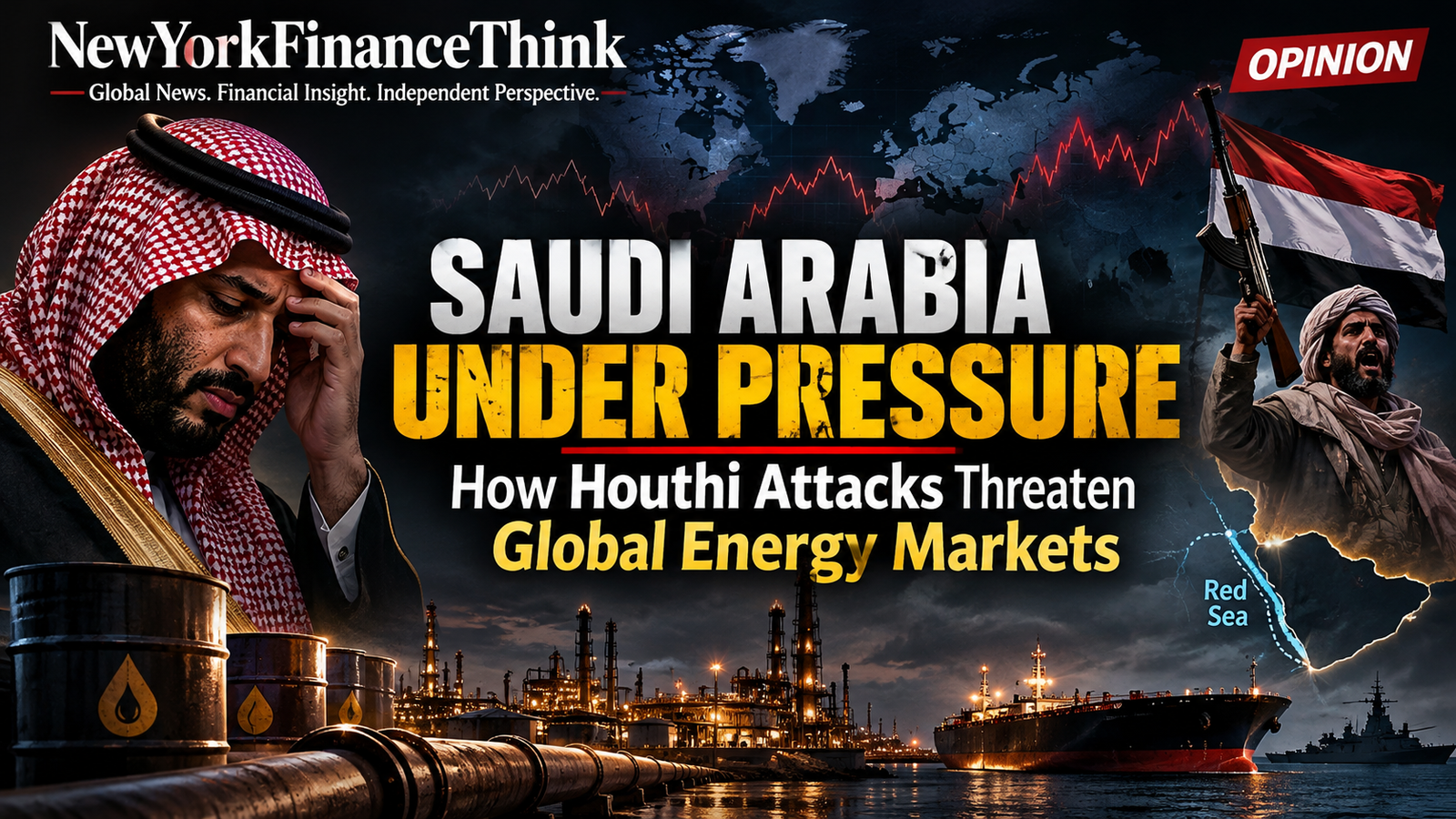
Saudi Arabia Under Pressure: How Houthi Attacks Threaten Global Energy Markets
An In-Depth Editorial on Middle East Security, Saudi Oil Infrastructure, Red Sea Shipping, Global Energy Supplies and the Economic Risks Facing the World
Publication Date: November 5, 2026
Publisher: NewYorkFinanceThink.com
Category / topics : World News | Energy Markets | Global Economy
Editorial Desk: NewYorkFinanceThink Editorial Team
Introduction: A Regional Conflict With Global Economic Consequences
Saudi Arabia is facing a security challenge that extends far beyond its southern border. Renewed attacks by Yemen’s Houthi movement, growing instability around the Red Sea and the wider confrontation involving Iran, the United States and other regional powers have placed the kingdom’s economic security under increasing pressure. What makes this situation particularly important is the position Saudi Arabia occupies in the international energy system. The country is one of the world’s largest oil producers and exporters, and its energy infrastructure is connected to international markets through an extensive network of production facilities, pipelines, refineries, ports and shipping routes. When those facilities become vulnerable, the consequences are not limited to Saudi Arabia. Oil traders, shipping companies, energy importers, airlines, manufacturers and households in distant countries can all become exposed to the uncertainty.
The latest developments illustrate how quickly a regional security problem can become an international economic concern. On November 2, Saudi civil defence issued alerts for several southern cities, including Khamis Mushait, Abha, Taif and Najran, before announcing that the immediate threat had passed. Reuters reported that the Saudi-led coalition said it had intercepted and destroyed a ballistic missile launched toward southern Saudi Arabia. These developments came amid renewed hostilities involving the Houthis and Saudi Arabia. They also followed earlier reports of attacks affecting Saudi energy facilities and claims by the Houthi movement that it had targeted important infrastructure. The distinction between confirmed official statements, military claims and independently verified damage matters. Nevertheless, the repeated appearance of Saudi energy infrastructure and transport routes in the conflict demonstrates the seriousness of the risks facing the region.
The central question is no longer simply whether Saudi Arabia can continue producing oil. It is whether the kingdom can maintain reliable production, secure export routes and investor confidence while regional military tensions remain elevated. Energy markets depend not only on the amount of oil available but also on whether buyers believe that oil can reach them safely, consistently and at a predictable cost. A country may possess enormous petroleum reserves and sophisticated infrastructure, but those advantages become less valuable when pipelines, ports, tankers and surrounding maritime corridors face repeated security threats. This is why the Houthi conflict deserves attention from anyone following global oil markets, inflation, international trade and the wider economic outlook.
Why Saudi Arabia Matters to the Global Energy System
Saudi Arabia occupies a distinctive position in global energy markets because its influence is based on more than the volume of oil it produces. The kingdom has major export infrastructure, substantial petroleum reserves, extensive refining operations and an established role in international energy diplomacy. Its decisions about production, exports and investment can influence expectations across the oil market. When traders assess global supply, they pay close attention to Saudi production capacity and the kingdom’s ability to move crude oil from producing regions to international customers.
This makes Saudi Arabia’s geographical position especially important. Much of the kingdom’s traditional oil-export infrastructure is connected to the Persian Gulf, where maritime traffic must navigate the Strait of Hormuz. That narrow waterway is one of the world’s most strategically important energy corridors. When tensions threaten shipping through Hormuz, Saudi Arabia has another important route available: its East-West pipeline, which carries crude oil across the Arabian Peninsula toward the Red Sea port of Yanbu. The pipeline was developed partly to provide an alternative export route when the Gulf shipping corridor becomes vulnerable.
However, an alternative route is not the same as complete protection. The East-West pipeline and the Red Sea export system also depend on secure infrastructure, functioning pumping stations, reliable electricity, operational ports and safe maritime access. If the Strait of Hormuz is disrupted at the same time that the Red Sea corridor faces threats, Saudi Arabia’s ability to redirect exports becomes more complicated. The country could find itself dealing with pressure on multiple parts of its energy transportation network rather than a single isolated security problem.
This is the larger strategic significance of the Houthi threat. The movement operates in Yemen, close to the Red Sea and the Bab el-Mandeb Strait, a maritime passage connecting the Red Sea with the Gulf of Aden and the wider Indian Ocean. Its geographical position gives it the ability to threaten shipping routes that are important to international commerce. When these threats occur alongside instability around Hormuz, energy traders must consider the possibility that multiple transportation corridors could become more expensive or less reliable.
The Houthi Threat: Why Saudi Arabia Is Under Pressure
The Houthi movement has become a major factor in the security calculations of Saudi Arabia and other Gulf states. The group controls significant areas of Yemen and has developed the ability to launch missiles and drones over considerable distances. Saudi Arabia has faced Houthi attacks for years, including strikes against military targets, airports and energy-related infrastructure. The renewed escalation in 2026 has brought these risks back to the centre of international attention.
Reuters reported in September that Houthi attacks on Saudi Arabia disrupted operations at several energy facilities and injured 73 people, according to Saudi authorities. The Houthi military spokesperson claimed that the group had carried out a wider operation using ballistic missiles and drones against Saudi targets, including facilities associated with Aramco. Saudi officials condemned the attacks, while damage assessments were still underway. These accounts demonstrate why a careful distinction between official Saudi statements, Houthi announcements and independently verified operational damage is necessary when reporting on the conflict.
The strategic problem for Riyadh is that the cost of defending a large, modern economy can be very different from the cost of launching relatively inexpensive weapons. A drone or missile may be much cheaper than the infrastructure it threatens. Even when air defences intercept an incoming weapon, the incident can create disruption, emergency procedures, security restrictions and uncertainty among workers and investors. The economic effect is therefore not limited to physical damage. The possibility of an attack can itself influence business decisions, insurance arrangements and financial expectations.
Saudi Arabia is also attempting to transform its economy through long-term investment, tourism, infrastructure development, industrial expansion and international business partnerships. Those ambitions require stability. Investors considering major projects generally want confidence that transportation networks will remain operational, employees can work safely and international visitors can travel without repeated security disruptions. Continued military escalation can complicate these expectations, even when most of the country’s commercial activities remain operational.
The kingdom therefore faces a difficult strategic calculation. A forceful military response may demonstrate its determination to defend national infrastructure, but it could also create opportunities for further escalation. A restrained response may reduce the immediate risk of a wider confrontation, but it could encourage the perception that repeated attacks can impose costs without producing a decisive response. Neither option is simple, and the economic consequences of a prolonged conflict could become increasingly significant.
The East-West Pipeline: Saudi Arabia’s Important Alternative Route
One of the most important pieces of infrastructure in this crisis is Saudi Arabia’s East-West pipeline. Stretching approximately 1,200 kilometres across the kingdom, it connects oil-producing areas in the east with export facilities on the Red Sea coast. Its strategic importance becomes especially clear when shipping through the Strait of Hormuz is threatened. Instead of relying entirely on Gulf export terminals, Saudi Arabia can move some crude oil toward Yanbu and send it to international buyers through the Red Sea.
The pipeline has become a central part of the discussion about Saudi energy security during the 2026 conflict. The U.S. Energy Information Administration’s October 2026 outlook reported that the pipeline had been shipping more than five million barrels per day before attacks temporarily halted flows in September. The agency said the disruption contributed to a sharp rise in daily Brent crude prices, which reached approximately $131 per barrel on September 15 as buyers reacted to the loss of Saudi export availability. The EIA also reported that the pipeline was repaired and partially resumed flows from September 22.
That episode demonstrated how sensitive the global oil market can be to the interruption of a major export route. Even when the disruption is temporary, buyers may immediately seek alternative supplies, refiners may adjust purchasing schedules and traders may increase the price they are willing to pay for prompt deliveries. The market does not wait for a crisis to become permanent before responding. It begins pricing the possibility that supplies could become unavailable.
The pipeline’s importance also explains why threats against it attract attention beyond Saudi Arabia. If the route becomes unavailable while Hormuz remains heavily disrupted, the kingdom may have fewer practical options for moving crude oil to international markets. A prolonged interruption could force changes in export schedules, increase pressure on storage facilities and create uncertainty for customers who depend on predictable deliveries.
There is an important distinction in the reporting of these incidents. Reuters reported in September that Saudi Arabia attributed a drone attack affecting the pipeline to an attack originating in Iraq, while the pipeline was shut as a precaution. Later, on October 26, the Houthis said they had attacked Saudi pumping stations and other infrastructure, but there was no immediate Saudi confirmation of those specific claims. These incidents should not be presented as one independently verified attack campaign against the pipeline. They nevertheless show how several regional threats can combine to make an important energy corridor more vulnerable.
Bab el-Mandeb: The Red Sea’s Strategic Pressure Point
The Bab el-Mandeb Strait is another important part of the energy-security equation. Located between Yemen and the Horn of Africa, this narrow passage connects the Red Sea with the Gulf of Aden. Ships travelling between Europe and Asia through the Suez Canal generally depend on this route. It is therefore important not only for oil and petroleum products but also for container shipping, manufactured goods, food supplies and other international cargo.
The location of Yemen makes the security of this passage particularly sensitive. Houthi forces have previously attacked commercial shipping in the Red Sea, creating concerns among shipping companies about the safety of vessels and crews. When maritime operators believe that a route carries a higher risk of attack, they may choose to delay voyages, change routes or pay additional insurance and security costs. A vessel that avoids the Red Sea may travel around the Cape of Good Hope instead, adding distance and time to its journey.
For oil markets, the implications can be serious. Longer shipping routes can increase fuel consumption, vessel operating expenses and delivery times. For other industries, delayed shipments can affect production schedules and inventory management. A company expecting components from Asia may have to hold more stock. A European importer waiting for goods may face longer delivery periods. A retailer may encounter higher transportation expenses before products reach warehouses and shops.
The most worrying possibility is that threats around Bab el-Mandeb and the Strait of Hormuz could occur simultaneously. These two passages serve different geographical purposes, but both are connected to the wider movement of Middle Eastern energy and international trade. If both become difficult to use, shipping companies and energy exporters may have fewer practical alternatives. That does not automatically mean global trade stops, but it can mean higher costs, longer delivery schedules and greater uncertainty.
Saudi Arabia’s economic exposure is therefore not confined to its own territory. The kingdom’s export system is connected to a wider maritime network, and the security of that network depends on developments across several countries and waterways.
How Houthi Attacks Can Influence Global Oil Prices
Oil prices are shaped by the balance between supply and demand, but geopolitical uncertainty can change that balance before physical shortages become visible. When traders receive reports of attacks on oil facilities, tanker incidents or threats against shipping corridors, they assess whether future deliveries could be disrupted. If they believe the probability of disruption is increasing, the market may demand a higher price for immediate supplies and future contracts.
This is one reason oil prices can rise even when global production has not yet fallen substantially. The market is pricing risk. A refinery or energy company does not necessarily need to experience a shortage today to become concerned about the possibility of one next week or next month. Buyers may arrange additional supplies, sellers may become more cautious and traders may adjust their positions in response to new security developments.
The October 2026 energy outlook from the EIA illustrates how quickly these concerns can affect prices. The agency reported that Brent crude averaged $114 per barrel in September, around $23 higher than in August. It connected the increase to attacks on energy infrastructure and tankers in the Middle East, including the interruption of the Saudi East-West pipeline. The EIA forecast an average Brent price of $105 per barrel in the fourth quarter of 2026 under its assumptions about constrained Middle Eastern oil flows. That was an agency forecast based on the conditions and assumptions available at the time, not a guaranteed future price.
It would be inaccurate to attribute every movement in oil prices to the Houthis alone. Crude prices also respond to decisions by major producers, global economic growth, refinery demand, inventories, sanctions, currency movements and diplomatic developments involving Iran and the United States. However, Houthi attacks add another layer of uncertainty to an already complicated market. Their importance comes partly from the fact that they can threaten infrastructure and maritime access in a region that is essential to global energy transportation.
For American consumers, the connection is relatively straightforward. Higher crude prices can increase the cost of producing gasoline, diesel, jet fuel and other petroleum products. The final price at the pump also depends on refining capacity, taxes, distribution expenses and regional supply conditions. As a result, an increase in crude oil prices does not translate into an identical increase in every American city. Nevertheless, sustained pressure on global oil prices can eventually affect household budgets.
The Impact on American Families
For a family living in the United States, the conflict in Yemen may seem geographically distant. But energy markets connect countries in ways that make distance less important than many consumers realise. Oil is traded internationally, and a disruption affecting a major exporting region can influence prices in markets far beyond the Middle East.
The first place many households notice energy-market pressure is gasoline. Commuters, delivery drivers, small-business owners and families who depend on cars for daily transportation are exposed to changes in fuel costs. A sustained increase in gasoline prices can reduce the amount of money available for groceries, savings, housing expenses and other household needs. Rural communities and workers with long daily commutes may feel the pressure more sharply because they have fewer transportation alternatives.
Diesel prices can also affect the wider cost of living. Trucks move goods between ports, distribution centres, warehouses, farms and retail stores. When diesel becomes more expensive, transportation companies may face higher operating costs. Some businesses absorb part of those expenses, while others may pass a portion of them on to customers. This process can contribute to higher prices for food, construction materials, household goods and other products.
Airlines are another potential channel of economic pressure. Jet fuel is an important operating expense, and sustained increases can affect airline profitability, ticket pricing and route decisions. Shipping companies may also introduce additional charges when vessels must travel longer routes or obtain more expensive insurance. These costs can reach businesses and consumers through international supply chains.
However, it is important not to suggest that every increase in American grocery prices, rent or household bills is caused by Middle East tensions. Food prices depend on agricultural conditions, labour expenses, transportation, processing, trade policy and domestic supply. Housing costs are influenced by construction, interest rates, local demand and the availability of homes. The Houthi conflict is one potential source of economic pressure, not a complete explanation for the cost-of-living challenges facing American families.
The more realistic concern is that higher energy and transportation costs could add pressure to household budgets at a time when many families are already managing housing expenses, credit-card debt and other financial obligations. Even a relatively modest increase in recurring expenses can become significant over several months.
Inflation and the Federal Reserve
Energy prices also matter because they can influence inflation expectations. If oil prices remain elevated, transportation and production costs may increase across several industries. Businesses may attempt to pass those costs on to consumers, while workers may demand higher wages to compensate for rising living expenses. The resulting effects can make the inflation outlook more difficult for policymakers to assess.
The Federal Reserve does not set interest rates in response to every oil-market movement. Its decisions depend on a wider assessment of inflation, employment, economic growth and financial conditions. A temporary increase in oil prices caused by geopolitical uncertainty may be treated differently from a persistent rise that spreads into other prices and wages.
For households, the distinction matters. If energy costs rise temporarily, the economic impact may be limited. If higher costs continue for an extended period and contribute to broader inflation, borrowing costs could remain under pressure for longer. Mortgage rates, credit-card interest rates, auto loans and business financing are influenced by several factors, including Treasury yields, Federal Reserve expectations and credit conditions. They should not be described as moving automatically in direct response to a Houthi attack.
The larger economic risk is that a prolonged energy shock could make the Federal Reserve’s task more complicated. Policymakers may face a situation in which inflation remains uncomfortable while economic activity weakens under the pressure of higher costs. This is one reason energy security matters not only to oil producers but also to central banks, financial institutions and ordinary borrowers.
Saudi Arabia’s Vision 2030 and Investor Confidence
Saudi Arabia is attempting to reshape its economy through Vision 2030, an ambitious programme intended to reduce dependence on oil revenue and expand sectors such as tourism, manufacturing, logistics, technology, entertainment and international investment. The programme requires large amounts of capital, long-term planning and confidence from global businesses.
Security concerns can affect that process in several ways. An international investor considering a major industrial project may look at the availability of electricity, port access, transportation reliability, insurance costs and the overall political environment. A company planning a conference or tourism investment may consider whether employees and visitors can travel safely. A shipping company may evaluate whether it can operate routes without repeated interruptions.
This does not mean investors will automatically abandon Saudi Arabia whenever tensions increase. The kingdom has substantial financial resources, major infrastructure and a central role in the global energy system. Many businesses may continue operating because the long-term commercial opportunities remain attractive. Nevertheless, repeated security incidents can raise the cost of doing business and make investors more cautious about projects that require long periods to generate returns.
Reuters reported in October that Houthi attacks were creating pressure on Saudi economic ambitions and disrupting high-profile investment and energy events. The report described the conflict as part of a wider strategic confrontation involving Saudi Arabia, Iran and the United States. The Houthi movement rejected the idea that its actions were simply directed by Iran and said its demands were connected to longstanding issues involving Yemen. These competing explanations underline the political complexity of the crisis.
For Saudi Arabia, the challenge is to demonstrate that its economic transformation can continue despite regional instability. The kingdom’s ability to protect infrastructure, maintain business operations and pursue diplomatic solutions will be important to how international investors assess its long-term prospects.
Why the United States and Other Countries Are Watching Closely
The United States has several interests in the stability of the Gulf and Red Sea region. These include the security of commercial shipping, the reliability of global energy supplies, the safety of regional partners and the prevention of a wider military confrontation. Even though the United States produces substantial quantities of oil and natural gas, it is not isolated from international energy markets. Crude oil is traded globally, and disruptions in one major region can influence prices elsewhere.
American policymakers must also consider the political consequences of higher energy costs. Gasoline prices are highly visible to consumers, and sustained increases can influence public confidence in the economy. If energy prices rise while households are already concerned about inflation and borrowing costs, the issue can become politically sensitive.
European and Asian economies may have different vulnerabilities. Countries that depend heavily on imported oil and gas can be particularly exposed to higher transportation and energy costs. Manufacturing economies may face pressure through electricity prices, petrochemical inputs and shipping expenses. For Asian importers, the security of energy routes from the Gulf is especially important because the region supplies a substantial share of the oil consumed across Asia.
The conflict therefore cannot be understood as a dispute affecting only Saudi Arabia and Yemen. It has implications for the wider international system, including the United States, Europe, China, India and other major energy-consuming economies.
The Humanitarian Cost Behind the Energy Crisis
A serious discussion of the Houthi conflict must also recognise the human consequences. Yemen has endured years of war, economic hardship, displacement and damage to public infrastructure. Renewed fighting risks making an already difficult humanitarian situation worse. Military operations can endanger civilians, disrupt essential services and restrict access to food, fuel, medicine and employment.
Saudi Arabia also faces the responsibility of protecting people living in areas exposed to missile and drone threats. Emergency alerts, interceptions and security operations are not merely market events. They affect residents, workers, families and communities. Energy infrastructure is important, but the people who operate it and live around it must remain central to any discussion of national security.
There is also a wider danger in treating the conflict only as an oil-price story. The global economy may focus on crude benchmarks, tanker movements and insurance premiums, but the consequences for Yemen’s population can be far more immediate and severe. A lasting solution will require attention to political grievances, humanitarian needs, security guarantees and the future governance of Yemen.
An editorial perspective must therefore hold two ideas together: the protection of international energy supplies matters, and the protection of civilian life matters even more.
Three Possible Scenarios for Global Energy Markets
The direction of the crisis will depend on military decisions, diplomatic engagement and the ability of regional governments to prevent further escalation. Several broad scenarios are possible.
Scenario One: Diplomatic De-escalation
In the first scenario, Saudi Arabia and regional partners pursue negotiations that reduce the frequency of attacks and restore confidence in shipping routes. A reduction in military activity could lower the security premium in oil prices, improve the operating environment for shipping companies and support investor confidence. Energy exporters could focus more attention on production, logistics and long-term investment rather than emergency security measures.
A diplomatic solution would not immediately eliminate every regional dispute. Yemen’s political future, the relationship between Iran and Gulf countries, and the security of the Red Sea would remain complicated. Nevertheless, even a limited reduction in attacks could provide important relief to energy markets.
Scenario Two: Prolonged Tension Without a Complete Energy Shutdown
The second scenario involves continued missile and drone threats, periodic security alerts and occasional disruptions without a complete collapse of Saudi oil exports. Under these conditions, energy companies may continue operating but face higher security expenses, more complicated logistics and increased insurance costs.
Oil prices could remain volatile because traders would repeatedly reassess the risk of a larger disruption. Shipping companies might continue using the Red Sea while maintaining contingency plans for longer routes. Investors could remain interested in Saudi Arabia but demand stronger evidence that major projects can operate securely.
This scenario may be particularly difficult because it combines continued economic activity with persistent uncertainty. Markets would have to operate around a conflict that is neither resolved nor severe enough to stop all trade.
Scenario Three: Wider Regional Escalation
The most dangerous scenario would involve a major escalation affecting Saudi oil infrastructure, Red Sea shipping and other important regional energy routes at the same time. A prolonged interruption of key pipelines, export terminals or maritime corridors could reduce the amount of oil reaching international buyers.
In such circumstances, refiners might compete more aggressively for available supplies. Shipping costs and insurance premiums could rise, while governments might consider emergency measures to protect energy security. Oil prices could experience another sharp increase, although the scale and duration would depend on the amount of supply lost, available inventories, alternative production and the speed of repairs.
This scenario could also create pressure on diplomatic relations and increase the risk of direct military involvement by outside powers. It would be a serious threat to regional stability and global economic confidence.
These scenarios are possibilities rather than predictions. The actual outcome will depend on developments that can change quickly.
What Investors and Energy Traders Should Monitor
For investors, the most important lesson is to follow physical energy flows rather than relying only on dramatic headlines. Reports of missile launches and military statements may move markets in the short term, but the longer-term economic impact depends on whether production, transportation and exports are actually affected.
The first indicator is the operational status of Saudi energy facilities. Investors should look for official updates from Saudi authorities and relevant energy companies about production, pipeline operations, refinery activity and export terminals. A reported attack does not automatically mean a major loss of oil supply. Independent confirmation of operational disruption is much more important.
The second indicator is the East-West pipeline. Its operating status provides important information about Saudi Arabia’s ability to move crude oil toward the Red Sea when Gulf routes face pressure. Any prolonged interruption could increase concern about export flexibility.
The third indicator is shipping activity around Bab el-Mandeb and the Red Sea. Changes in vessel movements, route diversions, insurance costs and port operations can reveal whether security concerns are affecting commercial trade.
The fourth indicator is the situation around the Strait of Hormuz. A simultaneous disruption of Hormuz and Red Sea export routes would represent a more serious challenge than pressure on either corridor alone.
The fifth indicator is the oil-price response. Brent crude, West Texas Intermediate, refined-product prices and regional price differences can help investors understand how the market is assessing supply risks. However, no single price movement should be interpreted as proof that a physical shortage has occurred.
Finally, investors should watch diplomatic statements and negotiations. Military developments may dominate headlines, but a credible reduction in tensions could change market expectations quickly. Energy markets can respond sharply to signs that the risk of escalation is declining.
The Larger Lesson: Energy Security Is About Routes, Not Just Reserves
The current situation exposes an important weakness in the way many people think about energy security. A country may have substantial oil reserves and the ability to produce millions of barrels per day, but those resources do not automatically guarantee reliable access to international customers. Oil must travel through pipelines, storage facilities, terminals, ports and shipping corridors. Every part of that network must function for the energy system to work efficiently.
Saudi Arabia’s experience demonstrates why alternative routes are valuable but not sufficient on their own. The East-West pipeline can reduce dependence on the Strait of Hormuz, but it does not remove the risks associated with the Red Sea. The Bab el-Mandeb corridor provides access to international markets, but its security depends on stability around Yemen and neighbouring coastal areas. The wider system remains interconnected.
This lesson applies to other countries as well. Governments, energy companies and investors must consider the resilience of transportation networks, the availability of alternative suppliers, the capacity to store critical commodities and the ability to respond when one route becomes unavailable. Diversification is not simply about buying oil from different countries. It also means ensuring that supplies can reach their destinations under difficult conditions.
For the United States, the crisis is another reminder that domestic energy production provides an important economic advantage but cannot completely protect consumers from international price movements. For Europe and Asia, the situation highlights the importance of diversified imports, strategic reserves and reliable shipping. For Saudi Arabia, it reinforces the need to protect infrastructure while continuing to develop a more diversified economy.
Editorial Conclusion: Saudi Arabia’s Security Is Becoming a Global Economic Issue
Saudi Arabia is under pressure because the risks surrounding its energy infrastructure are connected to a much larger regional conflict. The Houthi movement’s attacks and threats, instability around Yemen, tensions involving Iran and the United States, and insecurity in the Red Sea have created a difficult environment for one of the world’s most important energy exporters.
The immediate concern is the safety of people and infrastructure. The wider economic concern is whether oil can continue moving through the region without repeated interruptions. The consequences of a major disruption could reach international energy markets, shipping companies, manufacturers and households far beyond the Middle East. Higher oil prices could place additional pressure on transportation costs and inflation, while uncertainty could make investment decisions more difficult.
Yet the most important question is not whether oil prices will rise tomorrow or fall next week. It is whether the countries involved can prevent a series of regional confrontations from becoming a prolonged threat to the global energy system. Saudi Arabia needs security, but security cannot be achieved through military action alone. A lasting improvement will require diplomacy, regional cooperation, protection of civilian populations and a political framework that addresses the underlying conflict in Yemen.
The world should not wait for a complete energy shutdown before taking the threat seriously. The repeated targeting of infrastructure, the vulnerability of maritime corridors and the rising cost of uncertainty already demonstrate how connected global markets have become.
For American families, the crisis may appear distant, but energy prices, transportation expenses and inflation can carry its consequences into everyday life. For investors, it is a reminder that geopolitical risk can influence markets long before a shortage becomes visible. And for policymakers, it is a warning that global energy security depends not only on how much oil the world can produce, but also on whether that oil can reach the people and businesses that need it.
The central lesson is clear: Saudi Arabia’s security is no longer only a regional concern. In an interconnected energy economy, threats to the kingdom’s infrastructure and export routes can become risks for the entire world.
About This Editorial
This article is an independent editorial analysis prepared for NewYorkFinanceThink.com. It examines publicly reported developments and the potential economic consequences of Houthi attacks and wider Middle East tensions. Military claims and reports of damage should be distinguished from independently verified information. Economic scenarios discussed in this article are analytical possibilities, not guaranteed forecasts.
Editorial Disclaimer: This article is for news, educational and informational purposes. It is not investment advice or a recommendation to buy or sell any security or commodity.