
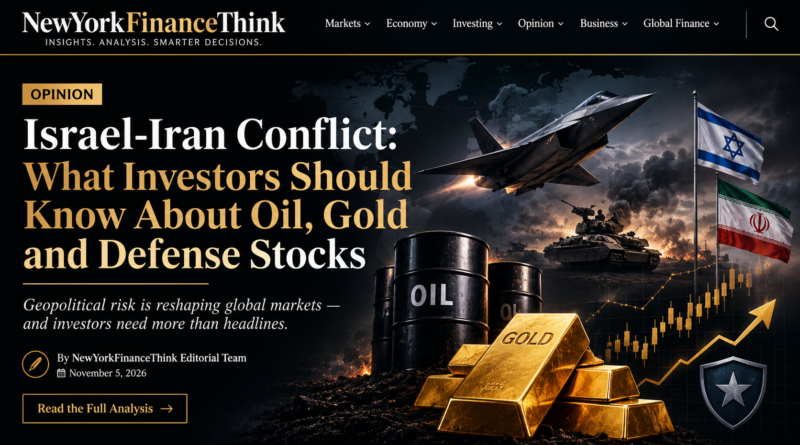
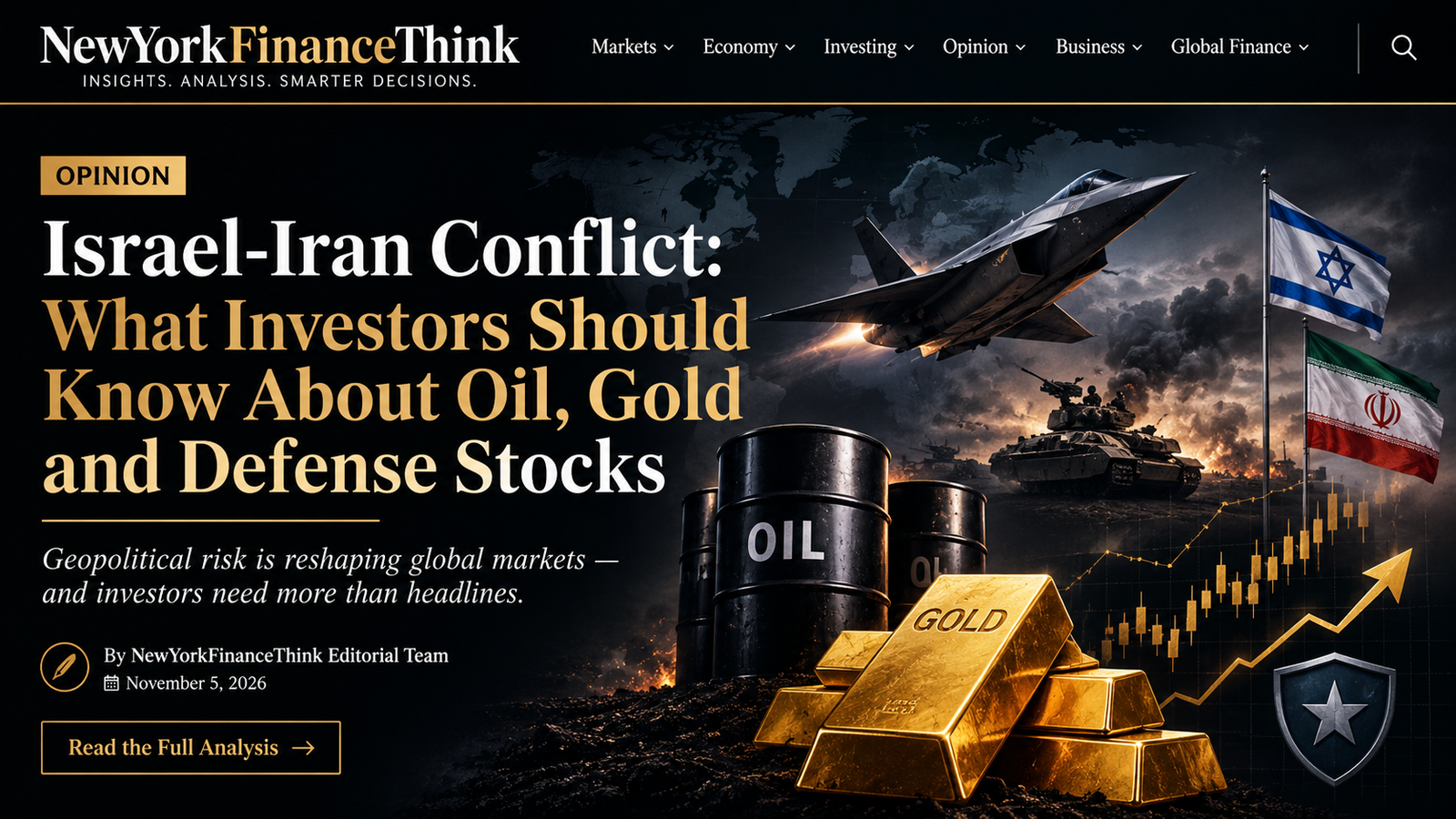
Israel-Iran Conflict: What Investors Should Know About Oil, Gold and Defense Stocks
An Independent Editorial and Financial Market Case Study
Published: November 5, 2026
By: NewYorkFinanceThink Editorial Team
Introduction: The Financial Markets Are Fighting a Different Kind of War
When military conflict expands across the Middle East, the consequences are not limited to the countries directly involved. The financial effects can travel through international oil markets, shipping routes, currency exchanges, government bond markets, stock exchanges and the everyday budgets of families living thousands of miles away. A military development in the region can influence the price of crude oil in London, the value of gold in international trading centers, the share prices of American defense contractors and the cost of transportation for businesses operating in Europe, Asia and the United States. This is the complicated relationship between geopolitics and the global economy: events that begin as security crises can eventually become financial, commercial and household economic problems.
The Israel-Iran conflict offers an important case study because it places several major economic interests under pressure at the same time. The region is strategically important to international energy transportation, and uncertainty surrounding the Strait of Hormuz can influence expectations about the availability of oil and petroleum products. Investors also have to consider the possibility of wider regional instability, the cost of military operations, changes in government spending and the effect of higher energy prices on inflation. At the same time, the market reaction is not always predictable. Oil can fall even when tensions remain serious. Gold can decline during a period of military escalation. Defense shares can lose value even when governments are increasing their security requirements. These developments may appear contradictory to people following the headlines, but they become easier to understand when markets are examined through the relationship between expectations, valuations, liquidity and actual economic conditions.
The central question for investors is therefore not simply whether the conflict will become more serious. It is whether the conflict will produce lasting changes in the global economy, whether those changes are already reflected in asset prices and whether the companies investors are considering can convert a geopolitical development into sustainable financial performance. A market price represents expectations about the future, not just a reaction to what happened yesterday. By the time a headline reaches the public, professional investors may already have adjusted their positions, and the opportunity that appeared obvious to a casual observer may already be reflected in the price.
This editorial examines the three financial areas most closely associated with the conflict: oil, gold and defense stocks. It also explores the broader consequences for inflation, American consumers, international trade, central-bank policy and long-term investment decisions.
1. Why the Israel-Iran Conflict Matters Beyond the Middle East
The economic importance of the Middle East is closely connected to its energy resources and geographical position. Several major oil and gas producers operate in the region, and international shipping routes connect their exports with consumers and industrial economies around the world. The Strait of Hormuz is particularly important because it provides a maritime passage between the Persian Gulf and the Gulf of Oman. When investors become concerned about the security of this route, they begin evaluating whether energy shipments could be delayed, diverted, insured at higher costs or interrupted entirely.
This concern matters even when the physical supply of oil has not immediately disappeared. Energy markets operate through expectations, and traders do not need to wait for an actual shortage before adjusting prices. If shipping companies face uncertainty, insurers reassess the risks of vessels entering the region, and oil buyers become concerned about future deliveries, the cost of moving energy can increase. Refiners may seek alternative suppliers, importers may build inventories and traders may purchase futures contracts to protect themselves against possible price increases. These decisions can influence the market before consumers see a change at the gasoline pump.
However, the existence of geopolitical risk does not mean that every possible disruption will occur. Producers may redirect shipments, pipelines may provide alternative transportation, strategic inventories may offer temporary support and diplomatic negotiations may reduce the risk of further escalation. These mechanisms can limit the economic damage, although they cannot guarantee that markets will remain stable. Investors must distinguish between a risk that exists, a disruption that has actually happened and a disruption that lasts long enough to change the global supply-demand balance.
That distinction is especially important in the current market environment. Reuters reported on November 5 that Brent crude was trading around $93.82 per barrel and U.S. West Texas Intermediate around $86.92, after both benchmarks had fallen sharply in the previous session. The report attributed the decline partly to changing expectations about the possibility of de-escalation and the restoration of disrupted Middle Eastern supplies. It also noted that uncertainty remained significant, demonstrating that a falling oil price does not necessarily mean that all geopolitical risks have disappeared. For investors, the price movement is evidence that expectations are changing, not proof that the underlying conflict has been resolved.
2. Oil: The Market Where Geopolitical Risk Becomes an Economic Cost
Oil is arguably the most direct connection between Middle East security and the global economy. It is not simply a commodity traded by financial institutions. It is an essential input into transportation, manufacturing, aviation, agriculture, construction and international logistics. A sustained change in crude oil prices can influence the operating expenses of businesses across multiple industries. When energy costs increase, companies must decide whether to absorb the additional expense, improve efficiency, reduce other costs or pass part of the increase to customers.
For investors, the first mistake is to assume that crude oil prices move only because of production decisions. Oil is influenced by a combination of supply, demand, inventories, transportation, refining capacity, currency movements, economic growth and market expectations. A geopolitical conflict can become a powerful influence, but it operates within this larger system. If global demand is weakening, an increase in geopolitical uncertainty may not produce a lasting rally. If inventories are already low and a major export route becomes unreliable, even a relatively short disruption may create significant price pressure.
The difference between a temporary risk premium and a genuine supply shock is fundamental. A risk premium is the additional amount traders are willing to pay because they believe future supply could become less reliable. A supply shock occurs when the availability of the commodity is actually reduced or when the market becomes convinced that the reduction will persist. A temporary increase in insurance costs or shipping delays can raise prices, but a prolonged loss of production or exports creates a more serious challenge because the market must find replacement supply.
Investors should also remember that oil prices can decline during a conflict. If diplomatic negotiations improve, if shipping begins returning to normal or if traders believe that the probability of a major supply interruption has decreased, the market may remove part of the geopolitical premium. This can happen even while political disagreements remain unresolved. The market is not necessarily saying that the region is peaceful; it may simply be saying that the expected disruption to oil supply is smaller than it previously feared.
The November 5 oil-price movement illustrates this distinction. Reuters reported a fourth consecutive daily decline in oil prices as traders assessed the possibility of lower escalation risks and a potential restoration of disrupted supplies. The report also described uncertainty around the diplomatic outlook and the possibility that renewed escalation could change the market picture again. Investors should therefore avoid treating one trading session as a permanent change in the energy outlook.
The impact on American consumers
For American households, the most visible effect of higher oil prices is often gasoline. But the wider economic impact can be more complicated. Trucking companies use diesel, airlines purchase aviation fuel, delivery networks depend on transportation and manufacturers require energy to operate factories. When fuel costs rise, the effects can spread through supply chains and eventually influence the prices of goods and services.
A family may not directly purchase crude oil, but it may experience the consequences through commuting expenses, airfare, delivery fees, heating costs and the prices of products transported across long distances. Small businesses can face particular pressure because they may have less bargaining power and fewer opportunities to absorb unexpected cost increases. A transportation company operating on narrow margins may have difficulty passing every increase to customers immediately, while a manufacturer may find that higher energy expenses arrive at the same time as rising labor and financing costs.
It is important not to attribute every increase in the cost of living to the Israel-Iran conflict. Food prices, housing expenses, wages, interest rates, insurance premiums and healthcare costs have their own drivers. The relevant economic question is whether a sustained energy shock adds another layer of pressure to household budgets and business operations.
3. Gold: The Safe-Haven Story Is More Complicated Than It Appears
Gold has a long history as a store of value, and investors frequently pay attention to it during periods of war, political uncertainty and financial instability. Unlike a company share, gold does not represent ownership in a business that must generate revenue and profits. It does not depend on a government fulfilling a particular contract, and it is not directly tied to the earnings of a single corporation. These characteristics can make gold attractive to investors who want to diversify their exposure to financial assets.
However, the idea that gold automatically rises whenever war begins is a misconception. Gold is influenced by the U.S. dollar, real interest rates, inflation expectations, central-bank purchases, investor positioning and liquidity conditions. During a period of uncertainty, some investors may purchase gold for protection. Others may sell it to raise cash, reduce borrowing or cover losses in other parts of their portfolios. The result depends on which forces dominate at a particular moment.
A strong U.S. dollar can create pressure on gold because the international price of the metal is commonly quoted in dollars. Higher real yields can also reduce the relative attraction of an asset that does not pay interest. If investors believe that inflation will force central banks to maintain restrictive monetary policy, gold may face pressure even when geopolitical risks remain elevated. Conversely, falling yields, a weaker dollar and renewed demand for portfolio protection can support the metal.
The 2026 conflict provides an important example of why the traditional safe-haven assumption needs to be examined carefully. Reuters reported in August that gold had initially fallen significantly during the wider Middle East conflict before rebounding later, while other traditional defensive assets also delivered mixed results. Reuters also reported on November 5 that gold had recovered around the $4,000 level during the previous session as oil prices declined and investors reassessed the outlook for inflation, interest rates and geopolitical tensions. The market reaction demonstrates that gold is influenced by a combination of forces rather than a single military headline.
Gold and the inflation question
One of the most important connections between oil and gold is inflation. If energy prices remain elevated for a prolonged period, businesses may face higher production and transportation costs. Some of those costs can eventually be reflected in consumer prices. Investors may then reconsider the outlook for inflation and monetary policy.
But the relationship is not automatic. A temporary increase in crude oil prices may not create a lasting inflation problem. If energy prices reverse quickly, the impact on broader inflation may be limited. If prices remain high and spread through transportation, industrial production and household expenses, the consequences can become more persistent.
Gold investors therefore need to monitor the direction of real interest rates and the dollar alongside geopolitical developments. Buying gold solely because a military headline appears serious may overlook the monetary conditions that have a major influence on its market value.
4. Defense Stocks: Why Military Spending and Stock Returns Are Not the Same Thing
Defense companies occupy a different position in the financial system. Their business models are connected to government procurement, military modernization, national security requirements and long-term contracts. During periods of heightened geopolitical tension, governments may reassess their defense capabilities, increase ammunition inventories, invest in missile defense, purchase surveillance systems or accelerate the development of advanced military technology.
This can create additional business opportunities for defense contractors. But investors must understand the difference between a government needing more equipment and a publicly traded company earning more money. A defense company does not receive immediate profits simply because a conflict becomes more serious. Government procurement takes time. Budgets must be approved, contracts must be awarded, production capacity must be available and equipment must be delivered according to agreed schedules.
The financial performance of a defense contractor also depends on its operating costs, supply chains, labor availability, research expenses and contract terms. A company may receive a large order but still face difficulty if it cannot produce the required equipment efficiently. If material costs rise or delivery schedules become more expensive, higher revenue may not translate into higher margins.
Investors should also consider valuation. A defense stock may already have risen substantially because the market expects military spending to increase. If the anticipated contracts fail to materialize or investors decide that the share price has become too expensive, the stock can decline even while the company’s industry outlook remains positive.
American defense companies investors follow
Lockheed Martin, RTX Corporation, Northrop Grumman, General Dynamics and L3Harris Technologies are prominent examples of U.S.-listed companies operating in the defense and aerospace industry. Their business activities include aircraft, missile systems, radar, communications, space technology, naval platforms and other military capabilities.
Lockheed Martin’s business is associated with major aircraft and missile-defense programs. Investors examining the company should pay attention to contract backlog, delivery schedules, production costs and the financial performance of its major programs.
RTX operates across aerospace and defense, including missile systems, sensors and aviation-related businesses. Its diversified activities mean that investors must examine more than military demand alone. Commercial aerospace conditions, supply-chain issues and the performance of individual business divisions also matter.
Northrop Grumman participates in advanced aircraft, space systems, strategic deterrence and other defense programs. Its long-term government contracts can provide visibility into future business activity, but contract execution and program costs remain important risks.
General Dynamics has operations in defense systems, naval shipbuilding, combat vehicles, technology and aerospace. Its business mix means that investors need to understand how different divisions contribute to revenue and cash flow.
L3Harris Technologies provides communications, electronic systems, surveillance and other defense-related technologies. Investors may examine demand for its products, contract awards, margins and its ability to deliver systems under government agreements.
These companies should not be treated as automatic winners from the Israel-Iran conflict. Their share prices depend on financial results, future expectations, contract economics and broader market conditions. A company can have a strong strategic position while its stock remains vulnerable to valuation declines.
A critical lesson from the defense-stock market
Reuters reported on November 4 that defense shares came under pressure as investors considered the possibility of greater congressional scrutiny of proposed military spending following the U.S. midterm elections. This is an important reminder that defense stocks are influenced by domestic politics and budget priorities as well as international security developments.
Military demand can increase while the political environment surrounding procurement becomes more complicated. Investors must therefore examine both sides of the business: the demand for defense equipment and the government’s willingness and ability to finance it.
5. Why Oil, Gold and Defense Stocks Can Move in Opposite Directions
Many investors expect oil, gold and defense stocks to rise together whenever geopolitical tensions increase. This expectation is understandable because all three assets are associated with different aspects of conflict. But financial markets do not operate through simple labels.
Oil is influenced by the expected availability of physical energy supplies. Gold is influenced by monetary conditions and investor demand for protection. Defense stocks are influenced by future government spending, contract awards, corporate earnings and valuations.
These forces can produce very different outcomes during the same news cycle.
Consider a situation in which military tensions remain high but investors become more confident that shipping routes will stay open. Oil may decline because the probability of a major supply disruption is considered lower. Gold may rise if the dollar weakens and Treasury yields fall. Defense stocks may decline if investors become concerned that political scrutiny will limit proposed spending.
This is not a contradiction. It is a reflection of different financial mechanisms operating at the same time.
A second example involves an actual energy shock. If oil exports are interrupted, crude prices may rise sharply. That increase can create inflation concerns and push interest-rate expectations higher. Gold might initially rise on safe-haven demand but later face pressure from higher yields or a stronger dollar. Defense companies might receive new orders but also face higher production expenses and supply-chain challenges.
The lesson is that investors should not buy an asset simply because it belongs to a category commonly associated with war. They should understand the economic reason for the investment and determine whether that reason is already reflected in the market price.
6. The Federal Reserve and the Risk of a New Inflation Problem
The Federal Reserve faces a difficult challenge when an external energy shock affects the American economy. It cannot directly control international crude oil production or the security of shipping routes. Its responsibility is to pursue its monetary-policy objectives while assessing how economic developments affect inflation, employment and financial conditions.
If oil prices rise temporarily, policymakers may look through some of the immediate volatility, particularly if longer-term inflation expectations remain stable. But a prolonged energy shock can create a more complicated situation. Higher fuel costs can affect transportation, business expenses and consumer prices. If those increases spread into other areas of the economy, the central bank may become more cautious about reducing interest rates.
For American families, the implications can reach beyond gasoline. Mortgage rates, credit-card costs, vehicle financing and small-business loans are influenced by wider financial conditions. Higher borrowing costs can make it harder for households to purchase homes, finance major expenses or manage existing debt.
For stock investors, interest-rate expectations influence the valuation of future corporate earnings. Companies that depend heavily on borrowing or that are valued on the basis of profits expected many years into the future can be particularly sensitive to changes in bond yields.
This creates a chain reaction: geopolitical uncertainty can influence energy prices, energy prices can influence inflation expectations, inflation expectations can influence interest-rate expectations, and interest rates can affect equity valuations and consumer borrowing costs.
However, the chain is not guaranteed to operate in the same way every time. The duration of the oil shock, the strength of the economy, the labor market and the behavior of inflation expectations all matter.
One of the most dangerous habits in financial markets is reacting to a dramatic headline without examining whether it changes the underlying economic outlook.
A military announcement may create a sudden price movement, but that movement does not necessarily establish a long-term trend. A reported attack may raise concerns about shipping, but investors must still determine whether vessels are actually being delayed, whether exports are affected and whether alternative routes or inventories can reduce the disruption.
The same discipline applies to defense stocks. An announcement about military spending may attract attention, but investors should ask whether the announcement represents a proposed budget, an approved appropriation, a signed contract or actual revenue. Each stage has a different financial meaning.
Gold requires similar care. A sharp rise may reflect temporary safe-haven buying, but it may also be driven by lower yields, currency movements or central-bank demand. Without understanding the reason, investors may mistake a temporary market reaction for a durable investment trend.
The difference between a headline and a fundamental change is often the difference between speculation and analysis.
8. Three Possible Economic Paths for Investors to Consider
Scenario One: Diplomatic Progress and Reduced Energy Risk
If negotiations make progress and the risk of further military escalation declines, energy markets may remove part of the geopolitical premium that has been reflected in crude prices. Shipping costs could become less volatile if insurers and operators gain confidence in regional routes.
Lower energy prices could provide relief to consumers and businesses, particularly in economies that depend heavily on imported petroleum. Inflation expectations might ease if the reduction is sustained and spreads through the energy supply chain.
Gold could experience changes in safe-haven demand, but its longer-term direction would still depend on interest rates, central-bank purchases and the dollar. Defense companies might face changes in short-term market expectations, although existing contracts and long-term modernization programs would not automatically disappear.
Scenario Two: Prolonged Tension Without a Complete Energy Shutdown
A prolonged period of uncertainty could create repeated market volatility without producing a permanent interruption of global oil supplies. Traders might respond sharply to new military developments, diplomatic announcements and shipping reports.
Oil could move within a wide range as the market repeatedly reassesses the probability of disruption. Gold might receive intermittent support from uncertainty, while remaining sensitive to monetary conditions. Defense companies could continue receiving investor attention as governments review security requirements.
This scenario would require investors to distinguish between temporary volatility and lasting changes in company earnings or commodity supply.
Scenario Three: A Major and Sustained Energy Disruption
A prolonged interruption to important energy infrastructure or shipping routes would represent a more serious economic shock. Oil prices could face substantial upward pressure if replacement supplies were insufficient or difficult to transport.
Higher energy costs could spread through transportation, manufacturing, agriculture and aviation. Inflation could become more difficult to control, and financial markets might reassess the outlook for interest rates and economic growth.
Gold could attract demand as investors seek portfolio protection, although the effect of higher yields and currency movements would remain important. Defense companies could see greater procurement interest, but they could also face production bottlenecks, higher input costs and political uncertainty around budgets.
This is a scenario for risk analysis, not a prediction that the outcome will occur.
9. What Serious Investors Should Monitor
Investors who want to understand the financial implications of the conflict should build a research routine around measurable developments rather than relying only on breaking news.
For oil, the most relevant indicators include Brent and WTI prices, OPEC+ production decisions, global inventories, export volumes, shipping activity, tanker insurance costs and refinery demand. These indicators help distinguish between market anxiety and a genuine change in supply conditions.
For gold, investors should monitor the U.S. dollar, Treasury yields, real interest rates, inflation expectations, central-bank purchases and investment flows. Gold can respond to geopolitical uncertainty, but the monetary environment often determines whether that demand is sustained.
For defense companies, investors should read quarterly earnings reports, examine contract backlogs, compare operating margins, review free cash flow and understand the company’s production commitments. Government budget announcements should be followed through to actual approvals and contracts.
For the wider economy, inflation reports, employment data, consumer spending, Federal Reserve communications and bond-market movements can help explain whether geopolitical pressure is spreading into domestic financial conditions.
The purpose of this monitoring process is not to predict every market movement. It is to understand whether the economic foundations behind an investment are improving, deteriorating or remaining largely unchanged.
10. The American Household Is Part of the Global Market Story
Financial market discussions can sometimes make war appear like an abstract exercise involving commodity prices, stock charts and investment portfolios. But the economic consequences eventually reach ordinary people.
A sustained increase in fuel prices can reduce the amount of money families have available for savings, housing, education and other expenses. Small businesses may have to spend more on transportation and electricity. Airlines and delivery companies may face higher operating expenses. Farmers and food producers may encounter additional costs associated with fuel, fertilizers and distribution.
The effects are not identical for every household or business. Some companies may be able to pass higher expenses to customers, while others may absorb them. Some families may have fixed-rate borrowing and stable employment, while others may be more exposed to changing interest rates and fuel costs.
The broader concern is that an external energy shock can arrive at a time when consumers are already managing housing costs, credit-card debt, insurance premiums and other financial pressures. If the shock lasts long enough, it can weaken purchasing power and confidence.
This is why geopolitical developments deserve attention from both institutional investors and ordinary households. The connection between international security and personal finances is not always immediate, but it can be meaningful when energy costs remain elevated.
11. The Editorial Conclusion: The Real Investment Opportunity Is Understanding Risk
The Israel-Iran conflict demonstrates that financial markets do not respond to war in a single predictable way. Oil responds to supply expectations and the reliability of transportation routes. Gold responds to a mixture of investor confidence, inflation, currencies and interest rates. Defense stocks respond to government procurement, corporate execution, contract economics and valuations.
The most important lesson is that the same geopolitical development can create opportunities for one business while increasing risks for another. A higher oil price may support some energy producers but hurt airlines and transportation companies. A rise in gold may benefit some gold-related investments but may not translate into equal returns across mining companies and exchange-traded products. An increase in defense spending may support future orders, but it does not guarantee that every defense contractor will generate stronger profits or that its shares are attractively valued.
Investors should be cautious about the temptation to turn a complex international conflict into a simple trading formula. The assumption that oil must rise, gold must rally and defense stocks must outperform can lead to decisions that ignore valuation, liquidity, supply-demand conditions and the possibility that expectations have already changed.
The more disciplined approach is to ask what has actually happened, what remains uncertain, which economic indicators have changed and whether the market price reflects those developments. It is also important to recognize that geopolitical situations can change rapidly and that no market scenario can be treated as certain.
For NewYorkFinanceThink.com, the central conclusion is clear: the Israel-Iran conflict is not simply a story about military power or regional diplomacy. It is also a case study in how energy security, monetary policy, corporate earnings and investor psychology interact in a connected global economy.
In uncertain markets, information matters more than emotion. A headline may move a price for a day, but lasting investment decisions should be based on evidence, business fundamentals and a realistic understanding of risk.
About This Editorial
This independent case study is prepared by the NewYorkFinanceThink.com Editorial Team. It is intended to explain the relationship between geopolitical developments and global financial markets, with particular attention to oil, gold, defense companies and the U.S. economy.
The article is educational and analytical. It does not provide individualized financial advice, guarantee investment returns or recommend the purchase or sale of any particular security or commodity. Market prices and geopolitical conditions can change quickly. Readers should verify current data and conduct their own research before making financial decisions.
Publisher: NewYorkFinanceThink.com
Editorial desk: Global Markets and Financial Analysis
Focus: Energy Markets | Gold | Defense Industry | Geopolitical Risk | U.S. Economy
