
Yemen War Since : Who Fought Whom? 2011
By Dr. Abhishek Bhatt, PhD
New York Finance Think
Introduction: Yemen’s War Was More Than a Saudi-Houthi Conflict
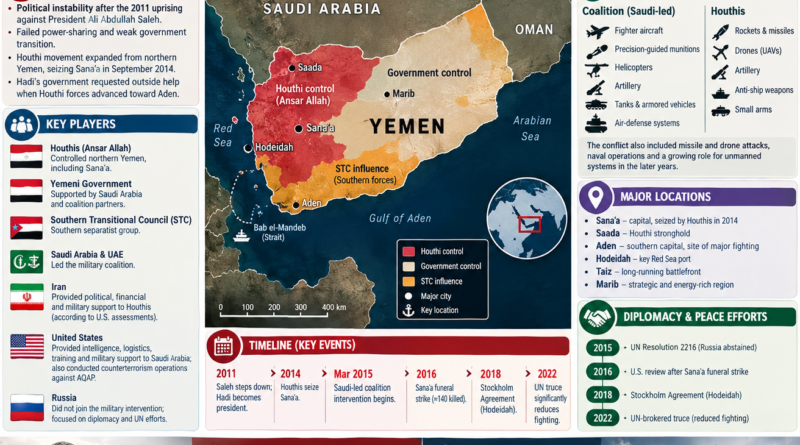
The Yemen War that erupted into a major regional conflict in 2015 was not created by a single event, a single country or a single military decision. It grew out of years of political instability, economic hardship, regional divisions, competing armed groups and the collapse of Yemen’s political transition. By 2014, the Houthi movement, formally known as Ansar Allah, had expanded from its northern base and entered Yemen’s capital, Sana’a. Forces loyal to former President Ali Abdullah Saleh also became aligned with the Houthis for a period, weakening the authority of President Abd Rabbuh Mansur Hadi. When the Houthis expanded their control and moved south toward Aden in early 2015, Hadi requested outside military assistance. On March 26, 2015, a coalition led by Saudi Arabia began military operations in Yemen in support of the internationally recognized Yemeni government. The United Nations describes the resulting conflict as a prolonged war that produced civilian casualties, destruction of infrastructure and a major humanitarian emergency.
For American readers, Yemen can sometimes appear to be a distant Middle Eastern conflict. In reality, the war became closely connected to U.S. foreign policy, Saudi Arabia’s security, Iran’s regional influence, Red Sea shipping, international arms sales, terrorism, oil and global humanitarian policy. The United States did not simply enter Yemen with a large American ground army. Instead, Washington initially supported the Saudi-led campaign through logistical and intelligence assistance, established a joint planning mechanism with Saudi Arabia and maintained a wider security relationship involving training, equipment and military cooperation. At the same time, U.S. officials repeatedly emphasized the need for a political settlement.
Chapter 1: Yemen Before the War
To understand the war, it is necessary to look at Yemen before 2015. Yemen had long experienced political divisions between its north and south, economic inequality, tribal competition, weak state institutions and periodic armed conflict. Ali Abdullah Saleh ruled Yemen for decades before protests during the 2011 Arab Spring forced a political transition. Saleh stepped down through a Gulf Cooperation Council-backed arrangement, and Abd Rabbuh Mansur Hadi became president in 2012 for a transitional period. The objective was to create a new political system through a national dialogue and constitutional process.
The transition, however, struggled to produce a stable political settlement. Yemen’s political factions disagreed over power-sharing, federal arrangements, regional representation and the distribution of political and economic resources. The Houthis, who had already fought several rounds of conflict with the Saleh government before 2011, became increasingly dissatisfied with the transition. Economic pressure also intensified. When the government reduced fuel subsidies in 2014, fuel prices rose sharply, creating another source of public anger and giving the Houthi movement an opportunity to mobilize protests. The political transition increasingly lost momentum, while armed groups expanded their influence. The UN records that fighting between government forces, the Houthis and other armed groups escalated in mid-2014.
Chapter 2: Who Were the Houthis?
The Houthis emerged from Yemen’s northern Saada region and developed from a religious, political and armed movement associated with the Zaidi Shia community. Their political and military organization became known as Ansar Allah. Abdul-Malik al-Houthi emerged as the movement’s principal leader.
The Houthis should not simply be described as an Iranian creation. They had domestic roots, their own political objectives and a long history of conflict inside Yemen. At the same time, Iran later became an important source of political, financial and military support for the movement. This combination of local roots and external assistance is important because it explains why the conflict cannot be understood only through the rivalry between Saudi Arabia and Iran.
Chapter 3: The Fall of Sana’a
The decisive political turning point came in September 2014, when Houthi forces and allied military units entered Sana’a and seized control of important government institutions. The government lost effective control over the capital, while negotiations failed to create a durable political settlement.
The Houthi expansion was helped by several factors, including the weakness of state institutions, divisions within the military, public dissatisfaction with the government and cooperation with forces loyal to former President Ali Abdullah Saleh. The situation became increasingly difficult for President Hadi, whose government was losing control over the country’s political and security institutions. The U.S. State Department’s historical account says the Houthis, allied with forces loyal to Saleh, entered the capital and subsequently seized government institutions, sending the Hadi government into exile in Saudi Arabia.
Chapter 4: Ali Abdullah Saleh and the Changing Alliance
One of the most unusual elements of the Yemen conflict was the temporary alliance between former President Ali Abdullah Saleh and the Houthis. Saleh had previously fought the Houthi movement, yet political and military interests later brought his supporters into cooperation with them against Hadi’s government.
This alliance demonstrated how Yemen’s conflict was not a simple two-sided ideological war. Former political rivals could become temporary military partners when their interests overlapped. The alliance eventually broke down. In December 2017, Saleh publicly moved away from the Houthis and was subsequently killed by Houthi forces. His death marked the end of one of the most important political alliances of the early war.
Chapter 5: Why Aden Became the Next Major Battlefield
After taking Sana’a, Houthi forces expanded southward. Aden became especially important because President Hadi established himself there after leaving Sana’a. Aden was also Yemen’s major southern political and maritime center.
When Houthi forces and their allies advanced toward Aden in March 2015, the crisis became much more serious. Hadi appealed to neighboring Arab states for military assistance. Saudi Arabia viewed the rapid expansion of the Houthis, combined with the possibility of an Iranian-aligned armed movement controlling large parts of Yemen, as a major regional security concern.
The result was the Saudi-led intervention that began on March 26, 2015. The intervention transformed Yemen’s internal political conflict into a regional military confrontation.
Chapter 6: Saudi Arabia Enters the War
Saudi Arabia assembled a coalition of Arab and other regional states and launched military operations against the Houthis and forces aligned with Saleh. The declared objective was to support the internationally recognized Yemeni government and prevent the further expansion of Houthi forces.
The initial campaign was dominated by air power. Saudi and coalition aircraft attacked military positions, weapons facilities, command centers and other targets associated with the Houthi-Saleh forces. Coalition-backed ground forces also became involved in fighting across different parts of Yemen.
Saudi Arabia’s involvement was shaped by geography as well as politics. Yemen shares a long border with Saudi Arabia, and missile and rocket attacks from Yemen later reached Saudi territory. Riyadh therefore viewed the conflict as a direct national-security issue rather than simply a foreign civil war.
Chapter 7: Which Countries Were in the Saudi-Led Coalition?
The coalition initially included Saudi Arabia and several Arab and regional partners. The United Arab Emirates became one of the most important military participants. Bahrain, Kuwait, Egypt, Jordan and other countries were also involved at different stages.
However, coalition membership did not mean every country contributed the same type of military force. Some provided aircraft, some political support, some logistical assistance and others participated in ground or maritime operations. The coalition itself also changed over time.
This distinction matters because describing every coalition member as a direct combatant would oversimplify the war.
Chapter 8: What Was the United States’ Position?
The United States supported the internationally recognized Yemeni government and worked closely with Saudi Arabia. When the Saudi-led intervention began in March 2015, the Obama administration announced that Washington would provide logistical and intelligence support but would not conduct direct U.S. military operations in Yemen in support of the coalition campaign. A joint U.S.-Saudi planning cell was subsequently established.
The American role therefore had several layers. Washington provided intelligence and logistical assistance, maintained a large defense relationship with Saudi Arabia and supplied military equipment under longstanding arms agreements. The United States also supported Saudi Arabia’s ability to defend itself against missile attacks.
At the same time, Washington faced growing criticism as reports of civilian casualties and infrastructure destruction increased. The U.S. government therefore found itself balancing its strategic relationship with Saudi Arabia against concerns about civilian protection and the laws governing armed conflict.
Chapter 9: Did the United States Provide Training?
Yes. U.S.-Saudi military training existed long before the Yemen War and continued during the conflict. U.S. security cooperation included training related to special operations, counterterrorism, air and missile defense, maritime security and military systems.
The State Department specifically reported that Saudi forces received U.S. training on the Law of Armed Conflict, air-to-ground targeting procedures and methods intended to reduce civilian casualties. This was presented as part of a broader effort to improve Saudi targeting processes and reduce collateral damage.
This is an important distinction. The United States did not create a new Saudi military force for Yemen. Rather, the war took place within a much older U.S.-Saudi defense relationship.
Chapter 10: What Weapons Were Used?
The war involved a wide range of conventional military systems. Saudi-led coalition forces relied heavily on fighter aircraft, guided air-to-ground weapons, helicopters, artillery, armored vehicles and air-defense systems. Saudi Arabia operated U.S.-supplied aircraft and other Western-origin military equipment.
Precision-guided munitions became an especially important part of the air campaign. The United States had longstanding arms relationships with Saudi Arabia involving aircraft, munitions, military vehicles and other defense systems. U.S. records also show that Washington continued to provide training and military support while attempting to improve targeting procedures.
The Houthi side used a different combination of weapons. Over the course of the conflict, Houthi forces employed rockets, ballistic missiles, drones, artillery, anti-ship weapons and other systems. U.S. officials and other international sources have documented Iranian assistance to the Houthis, including weapons and financial support. The precise origin of every individual weapon used in the war, however, cannot automatically be attributed to Iran or another country.
Chapter 11: The Air War
Air power became one of the defining features of the Yemen conflict. Saudi-led coalition aircraft conducted repeated strikes across Houthi-controlled areas. Sana’a, Saada, Taiz, Hodeidah and other locations experienced air operations.
Some strikes were directed at military targets. But international organizations and human-rights investigators also documented civilian casualties and damage to civilian infrastructure. The U.S. State Department’s human-rights reporting cited UN findings that the Yemeni government, Houthis, Saudi-led coalition and Southern Transitional Council were all implicated in serious human-rights violations during different phases of the conflict. It also reported allegations of disproportionate or indiscriminate use of force by multiple parties.
The air war therefore became one of the central international controversies surrounding Yemen. The coalition argued that it was striking military targets and responding to Houthi attacks. Human-rights organizations and UN investigators documented cases in which civilians and civilian infrastructure were affected. Understanding both sides of this record is essential for an accurate account.
Chapter 12: Sana’a and the 2016 Funeral Hall Strike
Sana’a remained one of the most heavily contested political and military centers of the war. One of the most internationally significant incidents occurred in October 2016, when a Saudi-led coalition airstrike hit a funeral gathering in Sana’a.
The U.S. Congressional Research Service reported that approximately 140 people were killed in the incident and that the Obama administration subsequently reviewed its security assistance to Saudi Arabia. Washington placed a hold on a planned sale of precision-guided munitions and reduced some intelligence sharing while maintaining other forms of counterterrorism cooperation and aircraft refueling support.
The incident became a major turning point in the U.S. debate over involvement in the Yemen war.
Chapter 13: Saada
Saada, in northern Yemen, was a major Houthi stronghold and one of the principal areas of coalition military activity. Because of its proximity to Saudi Arabia and its importance to the Houthi movement, the governorate became a major battlefield.
Human Rights Watch investigated several coalition airstrikes in Saada and reported civilian deaths and destruction of homes and other civilian structures. The organization argued that some attacks raised serious questions under international humanitarian law. These findings formed part of the broader international debate over coalition targeting practices.
Chapter 14: Taiz
Taiz became one of Yemen’s longest-running battlefronts. Its geographic position made it strategically important, while the city became divided among competing forces.
Fighting involved Houthi forces, government-aligned forces, local armed groups and coalition-backed formations. Airstrikes, artillery fire and ground fighting repeatedly affected the city. Taiz also became an important example of how Yemen’s conflict could become fragmented, with local actors pursuing their own political and territorial interests.
Chapter 15: Hodeidah
Hodeidah became one of the most strategically important locations because it is a major Red Sea port. The port was essential to the movement of food, fuel and humanitarian supplies into Yemen.
In 2018, coalition-backed forces launched a major offensive toward Hodeidah. International concern grew that a full-scale battle around the port could worsen Yemen’s already severe humanitarian crisis. UN diplomacy eventually produced the Stockholm Agreement in December 2018, which included arrangements concerning a ceasefire and redeployment around Hodeidah.
The battle for Hodeidah demonstrated that military geography and humanitarian logistics were closely connected in Yemen.
Chapter 16: Marib
Marib became another major battlefield because of its strategic location and energy resources. Government-aligned forces and Houthi forces fought over the region for years.
Marib was particularly important because it represented one of the last major strongholds of the internationally recognized government in northern Yemen. The area’s oil and gas infrastructure also gave it economic importance.
Chapter 17: The Southern Question
Another reason Yemen’s war became so complicated was the rise of southern political forces. Many southerners had long-standing grievances about political and economic power in a country unified in 1990.
The Southern Transitional Council, or STC, later emerged as a powerful southern actor. It was supported by the United Arab Emirates during important phases of the conflict and sometimes fought against forces aligned with the internationally recognized Yemeni government even though both opposed the Houthis.
This created a situation in which nominal allies could also become rivals. Yemen therefore developed multiple overlapping conflicts rather than one clean front line.
Chapter 18: Where Was Iran?
Iran became one of the most important external actors associated with the Houthi side. U.S. government reporting has stated that Iran provided significant financial and weapons support to the Houthis. The Houthis also developed their own military capabilities and domestic political networks, meaning the movement cannot simply be reduced to an Iranian proxy.
For Saudi Arabia, Iranian involvement was particularly sensitive because Riyadh and Tehran were competing for regional influence across the Middle East. Saudi officials increasingly viewed Houthi missile and drone capabilities as part of a wider Iranian regional security challenge.
Chapter 19: Where Was Russia?
Russia did not join the Saudi-led military coalition and did not conduct a Yemen air campaign comparable to Saudi Arabia’s.
Moscow’s role was primarily diplomatic. Russia maintained contact with different Yemeni political actors and emphasized negotiations, ceasefires and a political settlement. This approach allowed Moscow to maintain communication with multiple sides rather than becoming a direct military participant.
Russia’s Yemen policy therefore differed significantly from its military role in Syria. Yemen was not another Russian air war.
Chapter 20: Russia and the United Nations
The UN Security Council became a major diplomatic arena for the Yemen conflict. Russia sometimes supported resolutions concerning Yemen but also disagreed with parts of the Western and Gulf-backed approach.
One important example came in April 2015, when the Security Council adopted Resolution 2216. Russia abstained rather than voting for the resolution. The Russian position emphasized concerns about the resolution’s balance and called attention to the need for a political process and humanitarian considerations.
This demonstrated that the Yemen conflict was not only a battlefield. It was also a diplomatic contest involving the United States, Russia, Saudi Arabia, Iran and other international actors.
Chapter 21: The Missile War
The war eventually developed into a missile conflict extending beyond Yemen’s borders. Houthi forces launched missiles and rockets toward Saudi territory, while Saudi Arabia operated missile-defense systems to intercept threats.
Saudi cities and military installations came under repeated missile and drone threats. The development of longer-range Houthi capabilities transformed the war from a largely internal Yemeni conflict into a wider cross-border security problem.
The United States supported Saudi defensive capabilities and repeatedly condemned attacks against civilian areas.
Chapter 22: The Drone War
Drones became increasingly important as the conflict continued. Houthi forces used unmanned aerial systems for surveillance and later for attacks.
Drone warfare changed the economics of the conflict. Relatively inexpensive unmanned systems could threaten high-value military or energy infrastructure and force a technologically superior opponent to spend significant resources on detection and interception.
This development later became particularly important because Yemen’s location sits near major Red Sea shipping routes.
Chapter 23: The Maritime Dimension
Yemen’s position beside the Red Sea made the war an international maritime-security issue. Houthi forces later threatened or attacked shipping connected to regional tensions, while the coalition maintained naval capabilities around Yemen.
The Red Sea is a critical commercial route connecting the Indian Ocean with the Suez Canal and Europe. Therefore, instability around Yemen could have consequences far beyond the country’s borders.
This geographic reality is one reason the Yemen conflict became important to American, European and Asian governments.
Chapter 24: Terrorist Organizations
Yemen was also home to Al-Qaeda in the Arabian Peninsula, commonly known as AQAP. ISIS also developed a presence in Yemen.
These groups benefited from state weakness and the fragmentation of security institutions. While they were not simply part of the Houthi-versus-government war, their presence added another layer to the conflict.
The United States separately conducted counterterrorism operations against AQAP, meaning U.S. involvement in Yemen included a counterterrorism track in addition to its relationship with the Saudi-led coalition.
Chapter 25: The Humanitarian Crisis
The humanitarian consequences of the war became enormous. Years of fighting damaged health facilities, roads, schools, water systems and economic infrastructure. Food insecurity, disease outbreaks and displacement became major concerns.
The United States itself acknowledged that the conflict had created one of the world’s largest humanitarian crises. A 2022 State Department fact sheet said more than 23.4 million people in Yemen needed humanitarian assistance at that time, representing nearly three-quarters of the population.
The humanitarian crisis cannot be attributed to one event alone. Airstrikes, ground fighting, blockades and restrictions, economic collapse, displacement and the breakdown of public institutions all contributed to the deterioration.
Chapter 26: The U.S. Debate Over Saudi Arms
The Yemen War generated an unusually intense debate in Washington over arms sales to Saudi Arabia.
Supporters of the Saudi relationship argued that Riyadh needed military capabilities to defend itself from Houthi missile and drone attacks and that Saudi Arabia was an important U.S. security partner. Critics argued that continued arms transfers and military support risked making the United States associated with civilian harm caused by coalition operations.
The Obama administration’s 2016 review after the Sana’a funeral strike resulted in restrictions on some assistance, including a hold on a planned precision-guided munition sale. Later administrations changed the approach, demonstrating that U.S. Yemen policy was not static.
Chapter 27: The Stockholm Agreement
December 2018 brought an important diplomatic development. UN-mediated negotiations produced the Stockholm Agreement between the Yemeni government and the Houthis.
The agreement addressed Hodeidah, prisoner exchanges and other political and humanitarian issues. Although it did not end the broader war, it demonstrated that negotiations could produce limited agreements even when the major political dispute remained unresolved.
The Hodeidah arrangement was especially important because of the port’s role in humanitarian supply chains.
Chapter 28: The 2022 Truce
A significant reduction in fighting occurred in 2022 after a UN-brokered truce. The agreement initially lasted two months and was extended, contributing to a substantial reduction in large-scale hostilities and cross-border attacks.
The truce did not solve Yemen’s political conflict permanently, but it demonstrated the difference that a reduction in military activity could make to civilians.
The same year, President Hadi transferred his powers to an eight-member Presidential Leadership Council chaired by Rashad al-Alimi. This was another attempt to reorganize the anti-Houthi political camp.
Chapter 29: Why the War Did Not End Quickly
The central reason the war became so difficult to resolve was that Yemen had multiple conflicts operating simultaneously.
There was a Houthi-government struggle, a Saudi-Iranian regional rivalry, a northern-southern political dispute, competition among local armed groups, the presence of AQAP and ISIS, economic conflict, tribal politics and competition over territory and resources.
Every military victory therefore created another political problem. A force could capture a city without gaining a durable political settlement. An air campaign could destroy military infrastructure without removing the political grievances that had produced the conflict.
That is why the UN repeatedly emphasized a negotiated political process.
Chapter 30: What the Yemen War Changed
The Yemen conflict changed regional military strategy in several ways. It demonstrated the growing importance of drones, ballistic missiles, missile defense, precision air power and maritime security.
It also demonstrated the limitations of air power when the underlying political conflict remains unresolved. Saudi Arabia possessed sophisticated aircraft and extensive military resources, yet the war continued for years.
For the United States, Yemen became a case study in the difficulty of balancing alliance commitments, arms sales, counterterrorism, civilian protection and diplomatic objectives.
For Saudi Arabia, the conflict became a long-term border and national-security challenge.
For Iran, support for the Houthis became part of its broader regional strategy.
For Russia, Yemen provided another diplomatic arena where Moscow could maintain relationships with multiple regional actors without becoming a direct combatant.
For Yemen’s civilian population, the result was years of destruction, displacement and economic hardship.
Chapter 31: The Bigger U.S.-Saudi Connection
The Yemen War cannot be separated from the wider U.S.-Saudi security relationship. Saudi Arabia has been a major purchaser of American defense equipment for decades, and U.S. security cooperation has included equipment, training and follow-on support.
The State Department has specifically described U.S. cooperation with Saudi Arabia in areas including air and missile defense, special operations, counterterrorism, maritime security and training on air-to-ground targeting and the Law of Armed Conflict.
But the existence of that relationship does not mean Washington agreed with every Saudi military decision. The 2016 U.S. response to the Sana’a funeral strike demonstrates that American policy could change when civilian casualties and legal concerns became prominent.
Chapter 32: The Bigger Iran-Saudi Rivalry
The Yemen War also became part of a larger Middle Eastern competition between Saudi Arabia and Iran.
Saudi Arabia is predominantly Sunni and Iran’s political system is associated with Shia Islam, but the rivalry is not simply religious. It also involves regional power, security, political influence, military alliances and control over strategic areas.
Yemen became particularly sensitive because it sits directly on Saudi Arabia’s southern border and near the Bab el-Mandeb maritime passage.
That geography turned Yemen into a regional-security issue with consequences for shipping, energy markets and international trade.
Chapter 33: Was Yemen a Proxy War?
Calling Yemen a proxy war is useful but incomplete.
There were clearly external powers supporting different actors. Saudi Arabia and its partners backed the Yemeni government and various anti-Houthi forces, while Iran provided support to the Houthis. The United States supported Saudi Arabia in several military and security areas and also pursued its own counterterrorism objectives.
But Yemenis themselves remained the central actors in the conflict. The Houthis had domestic roots. Southern forces had their own political agenda. Local tribes and military commanders had their own interests. AQAP and ISIS pursued separate goals.
Therefore, Yemen was both an internal Yemeni conflict and a regional power struggle.
Chapter 34: What Happened to Yemen’s Economy?
Years of fighting severely damaged Yemen’s economy. Government institutions fragmented, public-sector salaries were disrupted, infrastructure was destroyed and businesses faced insecurity.
Currency instability and shortages of fuel and essential goods added pressure on ordinary families.
The economic consequences also fed back into the war. A weak economy reduced government capacity, while armed groups could gain influence by controlling checkpoints, resources, trade routes and local taxation.
The result was a cycle in which political conflict weakened the economy, and economic collapse made political stability even harder to achieve.
Chapter 35: What American Readers Should Understand
The Yemen War is often reduced in headlines to “Saudi Arabia versus the Houthis.” That description is too narrow.
A more accurate picture is:
Yemeni political collapse → Houthi expansion → Hadi government crisis → Saudi-led intervention → U.S. security support → Iranian support for Houthis → local and regional armed groups → air war and missile war → humanitarian crisis → UN diplomacy → partial truce.
Every arrow represents a different layer of the conflict.
The war cannot be understood correctly without looking at Yemen’s domestic political history, Saudi security concerns, Iranian regional policy, American alliance commitments and Russia’s diplomatic role together.
Chapter 36: Final Analysis
The Yemen War demonstrates how a domestic political crisis can become an international conflict when neighboring states, major powers and armed movements become involved.
The initial problem was Yemen’s political transition and the collapse of government authority. The Houthis’ seizure of Sana’a transformed that political crisis into a struggle for control of the state. Their advance toward Aden triggered Saudi-led military intervention. Saudi Arabia brought air power and a regional coalition. The United States provided important logistical, intelligence, training and defense support while maintaining its separate counterterrorism mission. Iran provided support to the Houthis, according to U.S. government assessments. Russia stayed outside the Saudi-led military campaign and focused largely on diplomatic engagement.
The war then developed into multiple overlapping conflicts: airstrikes, ground battles, missile attacks, drone warfare, maritime threats, terrorism, economic collapse and diplomatic negotiations.
The most important lesson is that military power alone did not produce a durable political settlement. The years of fighting showed that Yemen’s conflict could not be reduced to the question of who possessed more aircraft, missiles or soldiers. The deeper problem was political legitimacy: who should govern Yemen, how should power be divided, what role should the north and south play, and how could different armed and political groups be incorporated into a future state?
The UN’s continued involvement reflects that reality. Yemen’s war ultimately required diplomacy because the battlefield contained too many actors and too many competing interests for a simple military victory to resolve the country’s political crisis.
Conclusion: Yemen Was a War Inside a Larger Regional Conflict
The Yemen War that began with the Saudi-led intervention in March 2015 became one of the most complicated conflicts in the modern Middle East.
It began with Yemen’s political breakdown but quickly became connected to Saudi security, Iranian influence, U.S. military cooperation, Russian diplomacy, missile warfare, drone technology, Red Sea shipping and international humanitarian policy.
The United States supported Saudi Arabia in important military and security areas but also faced growing pressure to reduce civilian harm and encourage negotiations. Saudi Arabia fought to prevent a hostile armed movement from consolidating power along its southern border. Iran supported the Houthis as part of its regional strategy, while Russia maintained diplomatic relations with multiple parties rather than joining the coalition war.
For Yemen’s people, however, the strategic calculations of foreign governments were only one part of the story. The war meant destroyed homes, damaged infrastructure, economic hardship, displacement and years of uncertainty.
That is the central reality of Yemen’s conflict: what began as a political struggle inside Yemen became a regional war involving several governments, armed movements and international powers, while the civilian population paid much of the human cost.
Yemen War — Short Summary
The Yemen War grew out of a political crisis that followed the 2011 uprising against President Ali Abdullah Saleh. After Saleh stepped down, Abd Rabbuh Mansur Hadi became president in 2012, but Yemen’s political transition failed to produce a stable agreement among the country’s major political, tribal and regional groups.
The Houthi movement, also known as Ansar Allah, expanded from northern Yemen and captured the capital, Sana’a, in September 2014. Former President Ali Abdullah Saleh and forces loyal to him later cooperated with the Houthis for a period.
In early 2015, Houthi forces increased their control and advanced toward southern Yemen. President Hadi eventually moved to Aden and later Saudi Arabia. On March 26, 2015, Saudi Arabia and a coalition of Arab states launched a military intervention in Yemen in support of the internationally recognized Yemeni government.
The conflict soon became a wider regional war. Saudi Arabia and the United Arab Emirates became major military actors, while Iran provided political, financial and military support to the Houthis, according to U.S. government assessments. The United States supported Saudi Arabia and the Yemeni government through intelligence, logistics, training and other military assistance, while also conducting separate counterterrorism operations against al-Qaeda in the Arabian Peninsula.
Russia did not join the Saudi-led military intervention. Instead, Moscow mainly pursued diplomacy through the United Nations and maintained contacts with different Yemeni and regional actors.
The war involved airstrikes, ground battles, artillery, ballistic missiles, drones and naval operations. Major conflict areas included Sana’a, Saada, Taiz, Hodeidah and Marib. The fighting also caused extensive damage to infrastructure and contributed to a severe humanitarian crisis.
A UN-brokered truce in 2022 significantly reduced large-scale fighting, but it did not permanently resolve Yemen’s political and territorial disputes.
In short, the Yemen War began as a domestic political and power struggle but developed into a complex regional conflict involving Yemeni factions, Saudi Arabia, the UAE, Iran, the United States and other international powers.
Sources
- U.S. Department of State — U.S. Relations With Yemen
- U.S. Department of State — Yemen Country Information
- U.S. Department of State — Office of the Historian: Yemen
- Congressional Research Service — Yemen: Conflict, Maritime Attacks, and U.S. Policy
- United Nations — Special Envoy for Yemen
- United Nations Security Council — Yemen Records
