
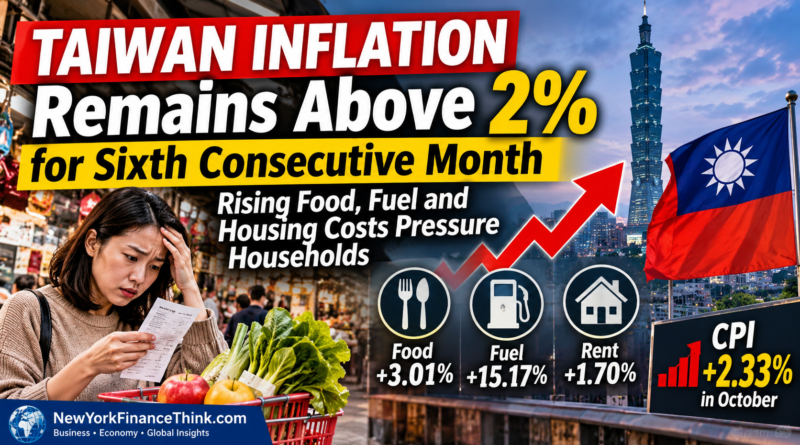
Taiwan Inflation Remains Above 2% for Sixth Consecutive Month: Rising Food, Fuel and Housing Costs Pressure Households
By NewYorkFinanceThink.com Editorial Desk
Date: November 5, 2026
Category: Economy and Inflation | Taiwan | Asia-Pacific Economy
Taiwan’s inflation challenge remains an important concern for households, businesses and economic policymakers after consumer prices continued rising above the government’s 2% warning threshold for the sixth consecutive month in October 2026. Official figures released on November 5 showed that the Consumer Price Index (CPI) increased 2.33% compared with the same month last year. Although the rate eased from September’s 2.74%, the latest figures indicate that the cost of everyday living has not returned to a level that households can comfortably ignore. Food, restaurant meals, fuel, transportation, housing and other essential expenses continue to influence family budgets, while businesses face pressure from higher operating and purchasing costs.
The October inflation report presents a complicated picture of Taiwan’s economy. On the surface, the decline from September’s 2.74% annual inflation rate to 2.33% suggests that some price pressures have moderated. However, the sixth consecutive month above 2% demonstrates that inflation remains persistent. The core CPI, which excludes fruit, vegetables and energy, increased 2.23% year over year. This measure is particularly important because it helps policymakers understand price movements beyond some of the more volatile categories. Its continued increase suggests that inflation is not limited to temporary changes in fuel or agricultural prices.
For ordinary families, the most important question is not simply whether the inflation rate has moved slightly higher or lower. It is whether salaries, savings and household income are keeping pace with the prices of goods and services that people purchase regularly. When restaurant meals, transportation, rent and household necessities become more expensive, families may have to adjust their spending even if the overall inflation rate appears moderate compared with previous periods. The October figures therefore deserve attention not only as an economic statistic but also as an indication of the financial pressures experienced by consumers.
October CPI rises 2.33% as inflation remains persistent
Taiwan’s Directorate-General of Budget, Accounting and Statistics (DGBAS) reported that the CPI rose 2.33% year over year in October. The increase was lower than the 2.74% recorded in September, but it remained above the 2% inflation warning threshold for the sixth consecutive month. On a month-to-month basis, the CPI increased 0.06%, or 0.20% after seasonal adjustment.
The moderation was partly connected to lower vegetable prices, smaller increases in electricity and personal goods prices, and changes in the timing of the Mid-Autumn Festival holiday. These factors helped reduce the annual inflation rate compared with September. However, the decline should not be interpreted as evidence that all areas of household spending are becoming cheaper.
Several important categories continued to record increases. Dining-out costs rose 3.01% year over year, marking the fifth consecutive month in which restaurant meal inflation exceeded 3%. Fuel costs, international airfares, travel expenses, eggs, seafood and housing-related costs also contributed to the increase in consumer prices.
The distinction between slower inflation and falling prices is essential. Inflation slowing from 2.74% to 2.33% means prices are increasing at a slower annual rate. It does not mean that the overall price level has returned to where it was a year earlier. Consumers may continue paying more for everyday products even when the inflation rate begins to decline.
Food and restaurant prices remain a concern for households
Food inflation is one of the most visible parts of the cost-of-living challenge because families purchase groceries and meals frequently. Unlike some large expenses that occur only occasionally, food spending is part of everyday life. Even relatively small price increases can become noticeable when repeated throughout the month.
Taiwan’s October figures showed that dining-out costs increased 3.01% compared with the same period last year. This marked the fifth consecutive month of annual restaurant meal inflation above 3%. The continued increase is particularly relevant for employees, students, office workers and families who regularly purchase breakfast, lunch or dinner outside their homes.
Restaurant businesses face several cost pressures at the same time. Ingredients, electricity, rent, transportation, wages, packaging and other operating expenses can all influence menu prices. When several of these costs rise together, restaurant operators may have limited options other than adjusting prices, reducing margins or changing their business models.
Egg prices and seafood prices also increased, adding to food-related pressure. Vegetable prices, however, declined by 3.89% year over year, helping offset some of the increases elsewhere. This difference demonstrates why the overall food inflation picture can vary significantly between individual products.
For consumers, the practical impact depends on what they regularly purchase. A household that spends a significant amount on restaurant meals may experience a different inflation rate from a family that cooks most meals at home. The official CPI represents an average across a broad basket of goods and services, while individual household experiences depend on spending patterns.
Fuel prices and international transportation increase costs
Transportation was another important source of inflation in October. Fuel prices increased 15.17% year over year, reflecting higher international oil prices and a relatively low comparison base from October 2025. Global energy markets remain sensitive to geopolitical developments, supply conditions and expectations about future demand.
Higher fuel prices can affect household budgets directly through gasoline and transportation expenses. They can also influence businesses indirectly because companies depend on fuel for deliveries, logistics, manufacturing operations and the movement of goods between suppliers and customers.
International airfares increased 12.53% year over year, while overseas package tour prices rose 6.85%. Higher fuel surcharges and airport service fees contributed to the increase in airfare costs. For families planning international travel, these changes can make holidays more expensive and encourage consumers to reconsider travel budgets.
Transportation and communications recorded the largest annual increase among Taiwan’s seven major consumer spending categories, rising 4.36%. The figure illustrates how energy prices and international travel costs can influence the wider inflation environment.
Fuel-related inflation is especially difficult for businesses to manage because energy is an input used across multiple sectors. A logistics company may experience higher delivery expenses, while a manufacturer may face additional costs for transporting materials and finished products. Some businesses absorb these increases temporarily, but sustained cost pressure can eventually affect consumer prices.
Housing costs and rent continue to influence family budgets
Housing remains one of the most important components of household financial security. Rent, utilities, maintenance and household expenses can take a substantial share of monthly income, particularly for younger workers and families living in major urban areas.
Taiwan’s housing-related consumer prices increased 2.07% year over year in October, while rents rose 1.7%. These increases may appear relatively moderate compared with fuel prices, but housing costs are recurring expenses. A family paying rent every month can feel the cumulative impact of gradual increases over time.
Higher housing expenses also affect consumer spending in other areas. When households devote more income to accommodation, they may have less money available for restaurants, entertainment, education, transportation, savings and discretionary purchases.
The relationship between housing and inflation is particularly important for younger workers entering the labor market. If rent increases faster than income, building savings for emergencies, education or home ownership can become more difficult. Families may respond by sharing accommodation, moving farther from employment centers or reducing non-essential expenses.
However, inflation statistics alone do not explain the full housing affordability situation. Household income, local property prices, mortgage costs, housing supply and employment opportunities also influence whether accommodation is affordable.
Imported prices create another challenge for Taiwan’s economy
One of the most significant developments in the October report was the sharp increase in import prices. Taiwan’s import price index, measured in New Taiwan dollars, rose 33.32% year over year, while the US dollar-denominated index increased 26.72%.
The increases reflected higher prices for minerals, machinery, electrical equipment and related components. Mineral prices rose 58.35%, while machinery, electrical equipment and related parts increased 31.7%. Basic metals and related products rose 19.1%.
Higher global crude oil prices contributed to the increase in mineral prices. Meanwhile, strong demand connected with artificial intelligence and advanced technology contributed to higher prices for machinery, electrical equipment and electronic components.
These figures are important because Taiwan is deeply integrated into international manufacturing and technology supply chains. The island imports energy, raw materials, machinery and components that support domestic production and exports. Changes in international prices can therefore influence the costs faced by manufacturers.
However, a sharp increase in import prices does not automatically translate into an equally large increase in consumer inflation. The effect depends on which products are imported, whether they are used domestically or exported, the exchange rate, business margins and the ability of companies to absorb higher costs.
DGBAS officials indicated that many of the imported electronic components affected by rising prices were intended for export production, limiting the immediate effect on domestic consumers. The government also said it had taken measures to stabilize prices amid international oil market fluctuations.
Artificial intelligence demand and the changing cost of technology
Taiwan’s importance in semiconductor and electronics manufacturing creates an additional connection between inflation and the global artificial intelligence investment cycle.
Demand for data centers, advanced computing equipment, memory products and electronic components has expanded as companies invest in artificial intelligence infrastructure. This demand can influence prices for machinery, electrical equipment and specialized components.
The October import price figures suggest that higher technology-related costs are becoming an important feature of Taiwan’s trade environment. Machinery and electrical equipment prices increased 31.7% year over year, while electronic and related components were among the products affected by stronger demand.
For technology manufacturers, higher component prices can create both opportunities and challenges. Companies supplying advanced components may benefit from stronger demand and higher selling prices. However, manufacturers that depend on imported materials may experience increased production costs.
For consumers, the impact could eventually appear in the prices of computers, mobile phones and other electronic products. The timing and size of any price changes will depend on inventories, production contracts, competition, exchange rates and the extent to which businesses pass costs on to customers.
This is an important example of how an industry experiencing rapid technological growth can also contribute to cost pressures in parts of the wider economy.
Producer prices show pressure deeper in the supply chain
Consumer inflation is only one part of the economic picture. Producer prices provide another indication of cost pressures affecting businesses before those costs potentially reach final consumers.
Taiwan’s Producer Price Index (PPI) increased 19.66% year over year in October. This was a substantial rise and reflected higher prices in areas including petroleum and coal products, computers, electronic products and optical equipment.
The increase in producer prices matters because manufacturers often face rising costs before consumers see changes in retail prices. Businesses may initially absorb some of the increase to remain competitive. Others may renegotiate supplier agreements, adjust production schedules or raise selling prices.
The effect varies by industry. A business with strong pricing power may be able to pass on higher input costs more easily than a small company competing in a market where customers are highly price-sensitive.
If producer prices remain elevated for an extended period, companies may face difficult decisions about investment, staffing, expansion and profitability. Smaller businesses can be particularly vulnerable because they may have less financial flexibility and fewer opportunities to negotiate lower input prices.
What persistent inflation means for Taiwan’s central bank
Inflation remains an important consideration for Taiwan’s monetary policymakers. The central bank must evaluate price stability alongside economic growth, employment, financial conditions and exchange-rate developments.
The October CPI result of 2.33%, combined with core inflation of 2.23%, suggests that price pressures remain relevant to monetary policy discussions. However, one monthly report does not determine the direction of future interest-rate decisions.
Policymakers must examine whether inflation is being driven mainly by temporary factors such as fuel and food prices or whether price increases are becoming more widespread across services and other categories. They must also consider the impact of global economic conditions and domestic demand.
If inflation remains persistent, policymakers may be cautious about easing financial conditions too quickly. On the other hand, tighter monetary policy can increase borrowing costs for households and businesses. Mortgage borrowers, companies seeking investment capital and consumers using credit may all be affected by interest-rate changes.
The challenge is to prevent inflation from becoming entrenched without placing unnecessary pressure on economic activity. A balanced approach requires careful monitoring of wages, consumption, business investment, housing costs and international commodity prices.
How inflation affects small businesses and employment
Small and medium-sized businesses are an important part of Taiwan’s economy. Restaurants, retailers, transport companies, service providers and local manufacturers must manage operating expenses while maintaining relationships with customers.
Higher inflation can affect these businesses through several channels. Ingredient costs may rise for restaurants, electricity expenses may increase for retailers, and fuel costs may affect transport companies. Businesses may also face higher costs for rent, equipment, maintenance and imported materials.
Passing all these expenses on to customers is not always possible. If a restaurant raises prices too sharply, customers may reduce visits or choose cheaper alternatives. If a retailer increases prices, it may lose sales to competitors. Businesses therefore have to balance profitability with customer demand.
Some companies may respond by improving inventory management, negotiating supplier contracts, reducing energy consumption or adopting technology to improve efficiency. These measures can help, but they cannot eliminate every source of cost pressure.
Employment decisions may also be influenced by inflation. If operating expenses rise faster than revenue, some businesses may delay hiring, reduce overtime or reconsider expansion plans. These are potential responses rather than confirmed outcomes across Taiwan’s economy, but they demonstrate why persistent inflation matters beyond the household price index.
Household purchasing power and the savings challenge
Inflation is ultimately a question of purchasing power. When prices rise faster than income, the same salary buys fewer goods and services. Households may find themselves spending more money without necessarily improving their standard of living.
Families often respond to inflation by reviewing monthly budgets. They may reduce restaurant visits, compare grocery prices, delay major purchases or limit entertainment expenses. Some households may also reduce savings contributions to cover higher essential bills.
The impact is not equal across income groups. Lower-income households often devote a larger share of their income to essential goods and services, making them more exposed to increases in food, transportation and housing costs. Households with higher savings or more flexible spending may have greater ability to absorb temporary increases.
The official inflation rate is an average and should not be interpreted as the exact cost-of-living increase experienced by every family. Individual circumstances matter. A household with a long commute may be particularly sensitive to fuel prices, while a renter may be more affected by housing costs.
For policymakers, this means that inflation analysis should be combined with information about wages, household income, employment and the distribution of living expenses.
What to expect from Taiwan’s inflation outlook in November
Taiwan’s statistics officials indicated that annual CPI growth could remain above 2% in November and may exceed October’s 2.33%. The comparison base is an important factor. October 2025 included the Mid-Autumn Festival holiday, which affected certain prices and helped moderate the annual comparison in October 2026.
With no similar long holiday expected to influence November’s figures in the same way, the annual inflation rate could rise. However, this is an official outlook based on current information, not a guaranteed result.
The next inflation report will be important for understanding whether price pressures are stabilizing or becoming more persistent. Consumers and businesses will be watching food costs, restaurant prices, fuel expenses, rents, transportation and imported goods.
International energy markets will also remain important. Changes in crude oil prices can influence fuel expenses and production costs. Geopolitical developments may affect supply expectations, while global demand and currency movements can influence the price Taiwan pays for imported goods.
Technology demand will be another factor to monitor. Continued investment in artificial intelligence infrastructure could support export activity while also influencing prices for certain electronic components and industrial equipment.
Three economic scenarios for Taiwan
Taiwan’s inflation outlook can be considered through three broad scenarios. These are analytical possibilities, not confirmed forecasts.
First: Inflation gradually moderates. If international energy prices stabilize, food supply conditions improve and domestic service-price increases become more moderate, inflation could gradually move closer to the government’s warning threshold. This would help households and businesses plan their spending with greater confidence.
Second: Inflation remains above 2% for an extended period. If restaurant prices, rents, transportation costs and other service expenses continue increasing, inflation may remain elevated even if some volatile categories decline. In this situation, households could continue facing pressure on purchasing power, while policymakers would need to monitor underlying inflation carefully.
Third: External cost pressures increase. A further rise in oil prices, imported materials or technology-related components could increase costs for businesses. The effect on consumer inflation would depend on how much companies absorb and how much they pass on to customers. A sustained increase could complicate the economic outlook.
These scenarios underline why Taiwan’s inflation outlook cannot be judged by one CPI figure alone. The direction of prices across different sectors will matter just as much as the headline number.
Editorial analysis: A lower inflation rate does not mean life is becoming cheaper
Taiwan’s October inflation report offers a mixed message. The annual CPI rate eased from 2.74% in September to 2.33% in October, providing some evidence that the pace of price increases has moderated. Yet the fact that inflation remained above 2% for six consecutive months demonstrates that the cost-of-living challenge has not disappeared.
For households, the most important pressure points remain familiar: food, restaurant meals, fuel, rent and transportation. These are expenses that people cannot always avoid. Even when some prices decline, other categories may continue increasing, leaving families with limited room to adjust their budgets.
For businesses, the combination of rising producer prices and sharply higher import prices deserves attention. Companies connected to electronics, machinery, energy and international supply chains must manage changing input costs while remaining competitive. Strong demand in technology markets can create commercial opportunities, but it can also increase the cost of certain materials and equipment.
The policy challenge is equally important. Taiwan must protect household purchasing power without weakening economic activity or damaging the competitiveness of its export industries. The central bank and government agencies will need to monitor both headline and core inflation, while considering the impact of global energy markets and domestic service prices.
The November inflation report may provide further evidence about the direction of price pressures. Until then, the October figures suggest that Taiwan’s inflation problem is moderating in some areas but remains persistent in others.
The broader lesson is that economic stability is measured not only by growth in exports, technology investment or industrial production. It is also measured by whether ordinary households can afford food, housing, transportation and essential services without continually sacrificing their savings and financial security.
NewYorkFinanceThink.com Editorial Note: This article is an independent economic analysis based on official Taiwan inflation statistics and publicly reported information available on November 5, 2026. Inflation forecasts and possible economic scenarios are analytical assessments, not guaranteed outcomes.
Sources and Further Reading:
- Taiwan Directorate-General of Budget, Accounting and Statistics (DGBAS) — October 2026 Price Indices.
- Focus Taiwan / Central News Agency — Taiwan’s October CPI rises 2.33%, remaining above 2% for the sixth month.
- Taiwan News — October inflation, fuel costs and household price pressures.
- Central News Agency — October import price increases and the impact of global energy and technology demand.
