
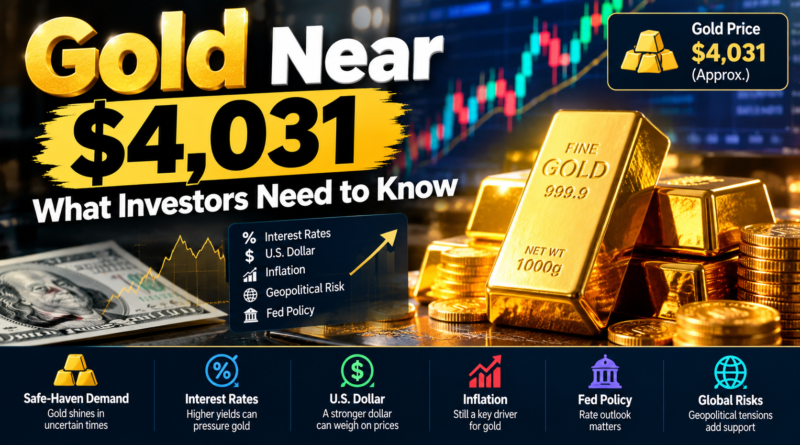
Gold Near $4,031: Why Investors Are Watching Gold, Rates and the Dollar

Gold remains one of the most closely watched assets in global financial markets, and the precious metal is once again sitting at a level that has investors paying close attention.
The market snapshot places gold near $4,031 an ounce, keeping the metal around the psychologically important $4,000 area. Live market sources on October 27 showed spot gold trading close to $4,000, while other market quotes were around the low-$4,000s. Reuters reported spot gold at about $4,000.52 during Tuesday trading.
The exact price can change throughout the trading session, but the bigger story is what is happening around gold.
Investors are watching the U.S. dollar, Treasury yields, Federal Reserve policy, inflation expectations and geopolitical risks. All of these factors can influence the direction of gold.
For much of the year, gold has attracted enormous attention as investors looked for protection from uncertainty. But gold is not immune to pressure. When the dollar strengthens and bond yields rise, the metal can struggle because gold does not pay interest.
That relationship is especially important right now.
The 10-Year Treasury yield is around the 5% area, while markets are closely watching expectations for Federal Reserve policy. At the same time, oil prices remain elevated, adding another layer of uncertainty to the inflation outlook.
So, is gold near $4,031 still a sign of strength, or is the market entering a period of consolidation?
The answer depends on what happens next with interest rates, inflation, the dollar and investor demand.
Gold Around $4,031 Keeps the Market Focused
The $4,000 area has become an important psychological reference point for gold traders.
When an asset trades at a large round number, investors often pay extra attention to whether the price can remain above that level.
Gold’s recent trading shows why that matters.
Market data shows gold moving sharply during October. The metal traded above $4,200 earlier in the month before falling back toward the $4,000 area. One market-data source showed gold closing at $4,038.40 on October 26 and around $4,008 on October 27 during the session.
That decline does not automatically mean the long-term gold story has changed.
Markets rarely move in a straight line.
After a strong rally, investors often take profits. Traders also adjust positions when interest-rate expectations change.
The important question is whether gold can build support around the $4,000 area.
If buyers continue stepping in near that level, it could become an important reference point for the market.
If prices fall decisively below it, traders may start looking toward lower support levels.
Why Gold Is So Sensitive to Interest Rates
One of the most important relationships in the gold market is the relationship between bullion and interest rates.
Gold does not generate interest income.
A Treasury bond, savings account or other interest-bearing asset can provide a return simply for holding it.
When interest rates and Treasury yields rise, the opportunity cost of holding gold can become higher.
That does not mean gold must fall whenever yields rise.
It simply means investors have another reason to consider interest-bearing assets.
This is why the 10-Year Treasury yield matters.
With the 10-year yield around 5%, investors have to compare the potential benefits of holding gold with the income available from government bonds.
That comparison becomes particularly important when inflation expectations are also changing.
If investors believe inflation will remain high, gold can retain its appeal even when yields are elevated.
If investors believe inflation will fall and real interest rates will remain attractive, gold can face more pressure.
The Federal Reserve Remains a Major Driver
The Federal Reserve is another major influence on gold.
Markets constantly try to predict what the central bank will do next.
Will rates remain high?
Could inflation force the Fed to keep policy tight for longer?
Or could economic weakness eventually encourage a more accommodative stance?
These questions can move gold prices quickly.
Reuters reported on October 27 that gold was under pressure from a stronger U.S. dollar and elevated Treasury yields ahead of the Federal Reserve’s policy meeting. The report also noted that markets were considering the possibility of future tightening because of persistent inflation concerns.
That is an important development for gold investors.
A more hawkish Fed can support the dollar and push yields higher.
Both can create headwinds for gold.
On the other hand, if the Fed signals that inflation is becoming manageable and monetary policy could become less restrictive, gold could receive support.
Inflation Still Matters
Gold has traditionally been viewed as a potential hedge against inflation.
The idea is simple.
If the purchasing power of paper currency declines over time, investors may want to own an asset that is not directly tied to the financial system.
But the relationship between inflation and gold is not always straightforward.
Gold can sometimes decline even while inflation remains elevated if interest rates rise faster than inflation.
That is because investors care about real returns as well as headline inflation.
For example, if inflation remains high but Treasury yields rise even faster, bonds may become more attractive relative to gold.
That is why gold investors should not watch inflation numbers alone.
The better approach is to look at inflation together with Treasury yields, the dollar and Federal Reserve expectations.
The U.S. Dollar Is Another Key Factor
Gold is priced internationally in U.S. dollars.
That makes the dollar’s value an important part of the gold equation.
When the dollar strengthens, gold can become more expensive for buyers using other currencies.
That can reduce demand at the margin.
When the dollar weakens, gold can become relatively cheaper for international buyers.
This can provide support for the metal.
Reuters reported that the dollar was stronger on October 27, reaching a roughly two-week high, while gold was under pressure.
The relationship is not perfect, but it is one of the most useful indicators for investors following gold.
If the dollar continues strengthening, gold may have to work harder to maintain its price.
If the dollar starts weakening, the metal could find additional support.
Gold and Treasury Yields Are Moving Into Focus Together
Gold investors cannot afford to ignore the bond market.
The 10-Year Treasury yield near 5% is an important part of the current market picture.
When Treasury yields rise, investors receive more income from government bonds.
That can make non-yielding gold relatively less attractive.
But there is another side to the story.
If Treasury yields are rising because investors are worried about inflation or government debt, gold can sometimes benefit from the same concerns.
This creates a complicated relationship.
Gold may struggle when yields rise because of stronger economic growth and expectations for tighter monetary policy.
But it may hold up better when yields rise because investors are worried about inflation, fiscal risks or currency stability.
Understanding the reason behind the yield move is therefore more important than simply watching the number.
Why the $4,000 Level Could Matter
Round numbers often attract attention in financial markets.
The $4,000 level is particularly important because gold has traded at dramatically higher levels than investors were accustomed to seeing in previous years.
A sustained hold above $4,000 could encourage buyers who believe the broader uptrend remains intact.
A sustained break below $4,000 could have the opposite effect.
It could encourage traders to reduce positions or wait for a lower entry point.
That does not mean a break below $4,000 would automatically signal a major collapse.
Markets frequently break psychological levels and then recover.
Technical traders will therefore watch price action, volume and follow-through rather than focusing on one intraday move.
Gold Has Already Shown Significant Volatility
The recent trading range demonstrates how quickly sentiment can change.
One market-data source shows gold closing above $4,200 earlier in October before moving down toward the $4,000 area.
That is a meaningful move for an asset that is often considered defensive.
It tells investors that gold is not simply a one-way safe-haven trade.
When positioning becomes crowded, profit-taking can be aggressive.
When yields move sharply or the dollar changes direction, gold can react quickly.
For ordinary investors, this is an important reminder that gold can experience substantial short-term volatility even when the long-term investment thesis remains unchanged.
Geopolitical Risk Could Support Gold
Geopolitical uncertainty is another reason investors continue to monitor gold.
When markets become nervous about wars, political instability, trade disruptions or financial-system risks, some investors increase exposure to traditional safe-haven assets.
Gold has historically been one of those assets.
However, geopolitical risk does not guarantee higher gold prices.
The market response depends on what happens to the dollar, Treasury yields, oil prices and expectations for monetary policy.
For example, a geopolitical shock that sends oil prices sharply higher could increase inflation expectations.
That might push bond yields higher.
Higher yields could then offset some of the safe-haven demand for gold.
This is why today’s market is interconnected.
Gold cannot be analyzed in isolation.
Oil Prices Add Another Layer of Complexity
Crude oil is another major part of the story.
WTI crude has been trading around the $100 area in the market snapshot, while more recent reports have shown significant volatility in energy markets.
Higher oil prices can increase inflation pressure.
That can create a difficult environment for central banks.
If inflation rises because of energy costs, policymakers may be less willing to cut interest rates.
That can strengthen the dollar and support bond yields.
Both developments can create pressure on gold.
At the same time, geopolitical concerns behind higher oil prices can increase demand for safe-haven assets.
Gold therefore receives conflicting signals.
This is one reason investors should watch oil and gold together rather than treating them as separate markets.
What Gold’s Recent Pullback Tells Investors
A pullback does not necessarily mean the gold story is finished.
Markets need periods of consolidation after strong rallies.
Investors who bought gold at lower prices may decide to lock in profits.
Other traders may wait for a clearer signal before buying again.
The key issue is how the market behaves around important support levels.
If gold remains above major support and buyers return, the recent decline could simply be a normal correction.
If selling continues and the metal breaks several support levels, the market could enter a deeper correction.
For now, the $4,000 area is one of the levels attracting attention.
Central Banks Remain Important Buyers
Central-bank demand is one of the longer-term factors supporting the gold market.
Central banks hold gold as part of their reserves, and their buying decisions can influence global demand.
Unlike short-term traders, central banks generally have a much longer investment horizon.
That can provide an underlying source of demand during periods when other investors are reducing exposure.
Reuters’ October 27 gold outlook survey highlighted central-bank demand as an important source of support, even while stronger dollar conditions and high yields were identified as pressures on gold.
This creates an interesting balance.
Short-term traders may focus on interest rates and the dollar.
Long-term investors may focus more heavily on reserve diversification and global economic uncertainty.
Gold Demand Is Not Only About Investment
Investment demand is important, but gold also has significant physical demand.
Jewelry remains a major source of global gold consumption.
Technology and industrial applications also use gold because of its physical and electrical properties.
Central banks represent another important category.
This diversity means gold demand does not depend entirely on financial-market investors.
However, investment flows can still have a powerful effect on prices because financial markets can move much faster than physical demand.
What Happens If the Fed Stays Hawkish?
A hawkish Federal Reserve would likely create a challenging environment for gold.
If policymakers indicate that interest rates need to stay higher for longer, Treasury yields could remain elevated.
The dollar could also strengthen.
Higher real yields and a stronger dollar can weigh on bullion.
In this scenario, gold could struggle to remain above major psychological levels.
The market would likely pay close attention to whether gold can hold the $4,000 region.
A failure to hold that level could increase selling pressure.
But even in a hawkish environment, geopolitical risk and central-bank demand could provide a cushion.
What Happens If the Fed Turns More Dovish?
The picture would be different if the Federal Reserve signaled that monetary policy could become easier.
Lower expected rates can reduce Treasury yields.
A softer dollar could also improve the appeal of gold for international buyers.
That combination could give gold a fresh boost.
Investors would then start watching previous highs and resistance levels.
The market would also look at inflation.
If inflation remains relatively high while monetary policy becomes less restrictive, gold could receive particularly strong attention.
Could Gold Move Back Toward Its Highs?
That depends on several factors.
Gold would need stronger demand from investors, supportive monetary-policy expectations and a favorable relationship between yields and the dollar.
A renewed wave of geopolitical uncertainty could also help.
But investors should be careful about assuming that past performance guarantees another rally.
Gold has already experienced significant gains over the longer term, and high prices can create periods of heavy profit-taking.
The better question is not simply whether gold will rise.
The more useful question is what conditions would make another major move higher more likely.
What Could Push Gold Lower?
Several risks could pressure gold.
Stronger U.S. dollar
A stronger dollar can make gold more expensive for international buyers.
Higher real yields
If Treasury yields remain high after adjusting for inflation, investors may prefer income-producing assets.
Lower geopolitical risk
If global tensions decline, some safe-haven demand could disappear.
Weak investment demand
If investors reduce gold holdings, prices can fall even when physical demand remains healthy.
Profit-taking
After a major rally, investors may sell to lock in gains.
These factors can work together.
A stronger dollar combined with rising Treasury yields would generally be a particularly challenging combination for gold.
What Could Push Gold Higher?
The bullish case also has several potential drivers.
Falling interest rates
Lower yields can reduce the opportunity cost of holding gold.
A weaker dollar
A weaker U.S. currency can support international gold demand.
Persistent inflation
Investors may look for assets that can help preserve purchasing power.
Geopolitical uncertainty
Periods of heightened risk can increase safe-haven demand.
Central-bank buying
Continued reserve accumulation can provide long-term demand.
Financial-market stress
If investors become concerned about stocks, credit markets or the broader economy, gold can attract additional interest.
The strongest gold rallies often occur when several of these factors appear at the same time.
What Should Stock Investors Watch?
Stock investors may wonder why they should care about gold.
The answer is that gold can provide clues about the broader market environment.
A rapidly rising gold price can sometimes signal increased concern about inflation, currency weakness or geopolitical risk.
A falling gold price alongside rising Treasury yields may indicate that investors are favoring interest-bearing assets.
Neither signal should be used alone.
But gold can be useful as part of a broader market dashboard.
Investors can watch gold alongside the S&P 500, Nasdaq, Treasury yields, crude oil and the dollar.
Together, these markets can provide a better picture of investor sentiment.
What Does Gold Mean for the U.S. Economy?
Gold does not directly determine the health of the U.S. economy.
But its price can reflect changing expectations.
When investors are confident about economic growth and comfortable with financial markets, demand for defensive assets may decrease.
When uncertainty rises, demand for gold can increase.
That makes gold something of a market sentiment indicator.
However, investors should avoid reading too much into one day’s movement.
Economic trends develop over weeks and months.
The same is true for inflation and interest-rate expectations.
Gold and the Consumer
For ordinary Americans, gold prices may seem far removed from everyday life.
But changes in gold can reflect broader financial conditions.
If gold rises because investors are worried about inflation, consumers may also be dealing with higher prices for goods and services.
If gold rises because the dollar is weakening, imported products can become more expensive.
Gold itself does not cause inflation.
Instead, the relationship works in the other direction: changes in inflation, currencies and monetary policy can influence gold.
What About Gold ETFs?
Gold exchange-traded funds are another important part of the market.
ETFs give investors a way to gain exposure to gold prices without storing physical bars or coins.
When money flows into gold ETFs, it can increase investment demand.
When investors withdraw money, selling pressure can increase.
ETF flows therefore provide another indicator for market watchers.
A sustained rise in gold accompanied by strong ETF inflows can suggest that investment demand is returning.
A price rally without strong investment flows may tell a different story.
Physical Gold vs. Financial Gold
There is an important difference between owning physical gold and gaining financial exposure to gold.
Physical gold can include bars and coins.
Financial exposure can come through ETFs, futures contracts and other investment products.
Physical buyers often focus on long-term wealth preservation.
Futures traders may be much more focused on short-term price movements.
That difference can explain why gold markets sometimes experience sharp swings even when physical demand remains relatively stable.
Is $4,031 a Good Price for Gold?
There is no universal answer.
Whether gold at $4,031 is attractive depends on an investor’s objectives, time horizon, risk tolerance and portfolio.
Someone looking for short-term trading opportunities may focus on technical levels and momentum.
A long-term investor may care more about diversification and the role of gold within an overall portfolio.
Investors should also remember that the spot price is not necessarily the price they pay for physical gold.
Coins and bars can carry premiums over the spot market price.
Those premiums can vary depending on the product, dealer and market conditions.
Why Investors Should Avoid Chasing Short-Term Moves
Gold can move quickly.
That can create fear of missing out when prices rise.
It can also create panic when prices fall.
Both reactions can lead investors to make decisions based on emotion rather than a clear strategy.
A better approach is to decide in advance how much exposure to gold makes sense within a diversified portfolio.
The goal should not necessarily be to predict every move.
The goal is to build a portfolio that can handle different market environments.
The Bigger Gold Story
The gold market is currently sitting at the intersection of several major financial themes.
Interest rates are high enough to matter.
The 10-Year Treasury yield is around 5%.
Oil prices remain elevated.
Inflation remains an important concern.
The U.S. dollar is influencing global financial conditions.
The Federal Reserve remains central to market expectations.
Geopolitical risks have not disappeared.
And central banks continue to be an important part of gold demand.
That combination explains why gold remains such a closely watched asset.
The market is not simply asking whether gold can rise.
Investors are trying to understand which economic forces will dominate next.
Key Levels Investors Are Watching
The first major reference point is the $4,000 area.
Holding above that level could help stabilize sentiment.
A sustained move below it could increase the focus on lower support areas.
On the upside, traders will watch previous recent highs around the low-$4,000s and beyond.
Because gold has been volatile, these levels can change quickly.
Technical traders may use moving averages, previous highs and lows, momentum indicators and volume to determine whether a trend is strengthening or weakening.
Fundamental investors may focus more on the Fed, inflation and the dollar.
Both approaches can provide useful information.
What to Watch in the Coming Sessions
Investors following gold should keep several indicators on their screens.
Federal Reserve: Any change in interest-rate expectations can quickly affect gold.
Treasury yields: Higher real yields can pressure bullion.
U.S. dollar: A stronger dollar can create headwinds.
Inflation: Hotter inflation can change expectations for monetary policy.
Oil: Higher energy prices can influence inflation expectations.
Geopolitical developments: New risks can increase safe-haven demand.
Central-bank purchases: Continued demand can support the longer-term market.
ETF flows: Investment demand can provide clues about sentiment.
No single indicator tells the whole story.
The strongest analysis comes from looking at the pieces together.
Gold Outlook: Stability or Another Correction?
Gold’s next major move is likely to depend on the balance between safe-haven demand and pressure from higher yields.
If investors become more concerned about geopolitical risks or inflation, gold could find buyers around current levels.
If the dollar continues strengthening and Treasury yields remain elevated, the metal could face additional pressure.
This creates a market where both bulls and bears have reasonable arguments.
That is often when volatility increases.
For investors, patience may be more useful than trying to predict the exact next move.
Final Takeaway
Gold near $4,031 remains a major talking point for financial markets, although live prices on October 27 were moving closer to the $4,000 area. Reuters reported spot gold around $4,000.52 during Tuesday trading, while other live market sources showed prices fluctuating around the low-$4,000s.
The important story is not simply the exact gold price.
The bigger story is the battle between several forces.
Higher Treasury yields and a stronger dollar can make it harder for gold to move higher.
Persistent inflation, geopolitical uncertainty and central-bank demand can provide support.
The Federal Reserve’s next signals will therefore matter enormously.
For investors, the $4,000 level is worth watching closely. A stable hold above that area could keep the market constructive, while a sustained break below it could signal that the recent correction has further room to run.
Gold remains one of the world’s most closely watched financial assets because it sits at the center of several major market themes: inflation, interest rates, currencies, geopolitical risk and investor confidence.
As those forces continue to change, gold is likely to remain a key part of the daily market conversation.
