
Wall Street Rebounds as AI Stocks Recover, but Weekly Losses Reveal Deep Investor Anxiety
WASHINGTON, November 6, 2026 — U.S. financial markets ended Friday’s trading session with a mixed performance as technology and artificial-intelligence shares recovered part of their recent losses. The rebound offered some relief after a difficult week for investors, but it did not erase the damage caused by a sharp sell-off that exposed growing uncertainty about the future of the AI investment boom.
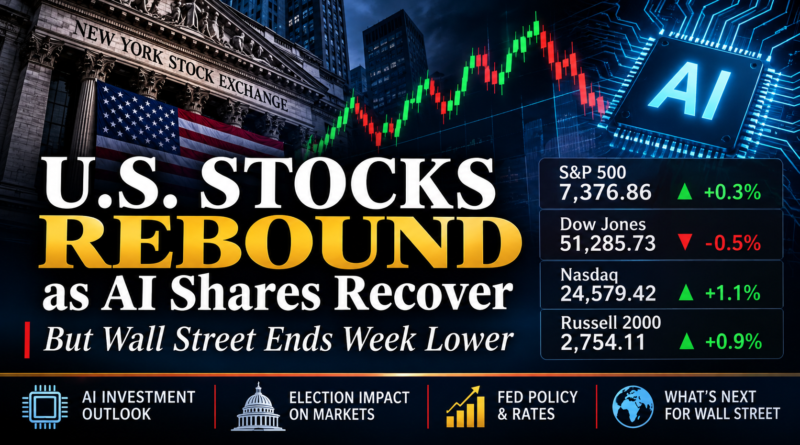
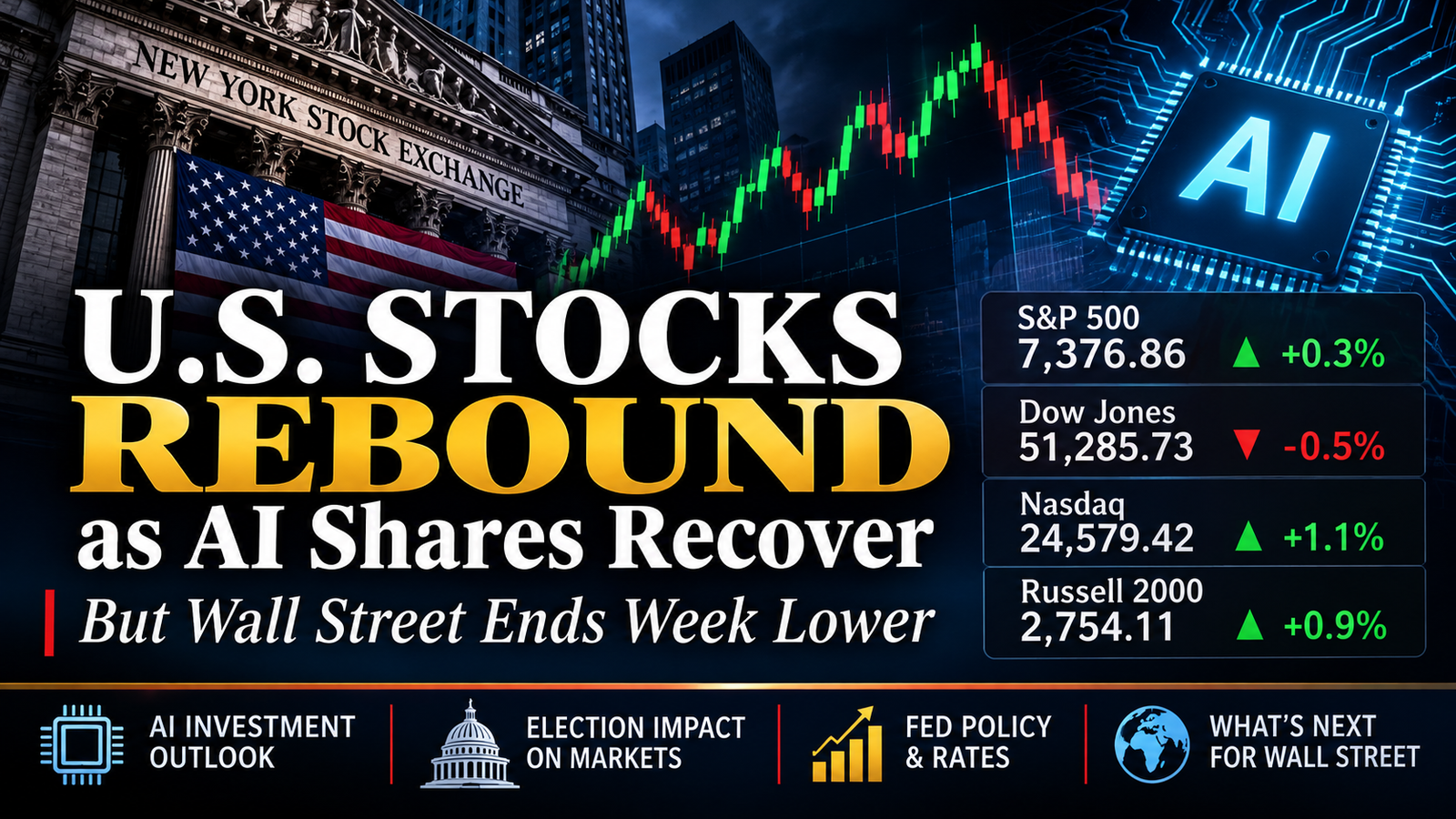
The Nasdaq Composite led Friday’s recovery, rising 1.1% to close at 24,579.42. The S&P 500 advanced 0.3% to 7,376.86, while the Russell 2000 gained 0.9% to finish at 2,754.11. The Dow Jones Industrial Average moved in the opposite direction, falling 0.5% to 51,285.73.
The mixed closing figures tell an important story about the current state of the American stock market. Investors were willing to return to some technology and growth stocks after heavy selling, but they were not prepared to treat one positive session as evidence that the market had returned to stability.
All four major U.S. indexes finished the week lower. The Nasdaq recorded the largest weekly decline, falling 3.4%. The S&P 500 lost 2.7%, the Russell 2000 declined 2.1%, and the Dow dropped 0.9%, according to Associated Press market data.
The immediate recovery was encouraging. The broader message from the week, however, was more complicated: investors are reassessing technology valuations, the economics of artificial intelligence, the financing of data-centre construction and the potential policy consequences of the 2026 midterm elections.
Wall Street’s November 6 closing figures
Friday’s trading session produced gains for three of the four major indexes, with technology-heavy shares helping lift the Nasdaq.
| Major index | November 6 closing level | Daily change |
|---|---|---|
| S&P 500 | 7,376.86 | +0.3% |
| Dow Jones Industrial Average | 51,285.73 | -0.5% |
| Nasdaq Composite | 24,579.42 | +1.1% |
| Russell 2000 | 2,754.11 | +0.9% |
The Nasdaq’s stronger performance reflected renewed demand for technology and AI-related stocks. The S&P 500 also moved higher, although its gain was considerably smaller. The Russell 2000’s advance suggested that buying interest was not limited entirely to the largest technology companies.
The Dow’s decline demonstrated that the recovery was not broad enough to lift every major section of the market. Different industries and companies are facing different pressures, and investors are increasingly separating businesses with established earnings and cash flow from companies whose valuations depend heavily on future growth expectations.
The closing figures should therefore be viewed as a snapshot of a market attempting to stabilize, rather than proof that the recent volatility has ended.
Technology stocks were at the centre of Friday’s rebound. Shares connected to artificial intelligence, semiconductor production and the broader technology supply chain attracted renewed buying after suffering substantial losses earlier in the week.
Investors had been concerned about the enormous amount of capital being directed toward AI infrastructure. The development of advanced computing systems requires large investments in semiconductor chips, servers, data centres, cooling equipment, electricity supply and high-capacity networks.
For several years, expectations of continued AI adoption helped support substantial valuations across the technology sector. Companies supplying the equipment and infrastructure behind artificial intelligence became important drivers of market performance.
That optimism has not disappeared. What has changed is the level of scrutiny investors are applying to the business models supporting the boom.
Investors increasingly want evidence that enormous infrastructure investments can produce sustainable revenue and profits. A company may announce plans to build additional computing capacity, but shareholders eventually need to understand who will pay for that capacity, how quickly it will be used and whether the returns will justify the cost.
This distinction is becoming increasingly important.
A recovery in semiconductor shares may indicate that some investors believe the recent declines were excessive. It does not necessarily mean that concerns about the long-term economics of AI have been resolved.
The market is moving from a period when enthusiasm about technological possibilities could support valuations toward one in which investors are demanding more detailed financial evidence.
The AI investment boom faces a new political environment
One of the biggest questions facing Wall Street is how the Democratic Party’s midterm election victories could influence the future of artificial-intelligence infrastructure investment.
The election results have created expectations of a different political environment for technology companies. Investors are assessing whether Democratic gains could lead to greater scrutiny of data-centre construction, electricity consumption, environmental impacts and the responsibilities of large technology companies.
The political debate is particularly significant because data centres have become essential to the expansion of artificial intelligence.
These facilities require substantial electricity, water and land. They also place new demands on local infrastructure, including power transmission networks, roads and utility systems.
As technology companies expand their AI operations, local governments and communities are increasingly being asked to consider the costs and benefits of hosting large data-centre developments.
Supporters argue that these projects can attract investment, create construction and technical jobs, strengthen regional economies and improve the technological competitiveness of the United States.
Critics raise concerns about electricity costs, water consumption, environmental effects and the possibility that local communities may bear infrastructure costs while the largest financial benefits flow to private companies.
These disagreements are becoming more important for investors because political decisions can affect the speed, location and cost of infrastructure development.
If regulatory requirements become more demanding, some projects could face additional expenses or longer approval periods. Companies building data centres may need to reconsider their construction schedules, financing arrangements or regional expansion strategies.
That possibility does not mean the AI industry will stop growing. It does mean that the assumptions behind some investment plans may need to be examined more carefully.
Why data centres have become a major Wall Street concern
Artificial intelligence is not simply a software business. Its expansion depends on a physical infrastructure system that requires enormous quantities of capital.
Modern AI models rely on powerful processors and large computing clusters. These systems operate in data centres that must maintain reliable electricity, advanced cooling systems and high-speed connections.
The financial implications extend far beyond the companies developing AI applications.
A data-centre project can involve semiconductor manufacturers, server producers, electrical equipment suppliers, construction companies, engineering contractors, utilities, energy providers and telecommunications businesses.
This creates a wide investment network. When expectations for AI infrastructure growth improve, several industries may benefit. When those expectations weaken, the pressure can spread across the same network.
Investors are therefore examining the possibility that a slowdown in data-centre construction could affect companies that do not directly develop artificial-intelligence software.
The concern is not limited to whether demand for AI will exist. The more difficult question is whether the pace of infrastructure spending will remain as aggressive as investors previously expected.
There is also a difference between long-term demand and short-term profitability.
Artificial intelligence could become a major part of the global economy over the coming decade, while individual companies may still struggle to earn adequate returns on their current investments.
That distinction is essential when evaluating technology stocks. A promising technology does not automatically make every company connected to it a profitable investment.
Investors are reconsidering technology valuations
The latest market volatility has also raised questions about how much investors are willing to pay for future growth.
Technology companies often trade at higher valuation multiples than businesses in more mature industries. Investors accept those valuations when they expect revenue and earnings to expand rapidly over several years.
However, high valuations can become vulnerable when the outlook changes.
If investors begin to expect slower growth, higher financing costs or greater regulatory uncertainty, they may reduce the price they are willing to pay for future earnings.
This can produce substantial share-price movements even when a company’s immediate financial performance has not changed dramatically.
AI-related businesses face an additional challenge: expectations have become extremely high.
Companies that were once valued primarily on their established products are increasingly being judged on their ability to participate in the next stage of AI development. Their valuations may therefore reflect expectations about future markets that have not yet fully developed.
If those expectations become less certain, investors may demand stronger evidence of profitability before supporting previous valuations.
Friday’s rebound suggests that buyers were prepared to return to some technology stocks after the earlier decline. But the weekly performance indicates that many investors remain cautious.
The Dow’s decline shows that the recovery was uneven
The Dow Jones Industrial Average fell 237.33 points, or approximately 0.5%, on Friday.
Its decline was an important reminder that the U.S. stock market is not a single investment story.
The Dow contains companies from a range of established industries, including financial services, healthcare, consumer businesses, industrial companies and technology.
These businesses respond differently to changes in economic expectations, borrowing costs, consumer demand and political policy.
A rally concentrated in technology shares can lift the Nasdaq substantially without producing the same result for the Dow.
The S&P 500 occupies a broader position, reflecting a wider range of major American companies. Its modest advance showed that the technology rebound provided support to the broader market, but not enough to produce a powerful rally across every sector.
For investors, the divergence between the indexes is worth monitoring. It can indicate whether market participation is broadening or whether gains are concentrated in a relatively small group of companies.
A sustainable recovery generally requires more than a few large technology stocks moving higher.
Russell 2000 gains as smaller companies attract buyers
The Russell 2000 advanced 0.9% to close at 2,754.11, making it the second-strongest performer among the four major indexes on Friday.
The index tracks smaller publicly traded U.S. companies and is often monitored as an indicator of investor confidence in domestic businesses.
Smaller companies can be particularly sensitive to borrowing costs because they may have less access to inexpensive financing than large multinational corporations.
They can also be more exposed to changes in domestic consumer demand, wages, operating expenses and regional economic conditions.
Friday’s advance was a positive development, but it should not be interpreted as a decisive change in the outlook for smaller businesses.
The Russell 2000 still finished the week down 2.1%. That decline shows that investors remained cautious even after Friday’s buying activity.
For a sustained improvement, smaller companies will need a supportive economic environment, manageable financing costs and sufficient demand for their products and services.
Federal Reserve policy remains a critical market factor
The Federal Reserve’s interest-rate outlook is another important part of the current market discussion.
Investors are balancing two competing economic considerations.
A strong labour market can support household income, consumer spending and corporate revenue. At the same time, strong economic activity can make it more difficult for inflation to return to the Federal Reserve’s target.
If inflation remains persistent, policymakers may have less room to reduce interest rates.
Higher interest rates can affect stock valuations in several ways. They increase the cost of borrowing, raise the return investors can earn from relatively safer assets and can reduce the present value of future corporate earnings.
Growth-oriented technology companies can be particularly sensitive because a significant portion of their valuation may depend on profits expected years into the future.
A higher discount rate can reduce the present value of those expected earnings.
The relationship between employment, inflation and interest rates is therefore important for the technology sector as well as for the broader economy.
Investors will continue to monitor inflation reports, employment figures, Federal Reserve statements and Treasury-market movements for clues about the direction of monetary policy.
A strong economy can support corporate earnings, but it does not automatically guarantee lower interest rates or higher stock prices.
What the midterm election results could mean for businesses
The 2026 midterm election results have introduced another source of uncertainty into the investment outlook.
Investors are examining how changes in congressional power could affect legislation, federal oversight, technology policy, taxation, energy development and government spending.
For technology companies, the central question is how policymakers will balance innovation and economic competitiveness against concerns about the consequences of rapid infrastructure expansion.
The United States has a strategic interest in maintaining its position in advanced computing and artificial intelligence. AI development is connected to national security, productivity, scientific research and competition with other major economies.
At the same time, the expansion of data centres creates practical challenges that cannot be ignored.
Electricity demand, grid capacity, environmental standards and local planning decisions are becoming central issues for policymakers.
Congressional oversight could also increase attention on the conduct of major technology companies, their market influence and the broader economic consequences of AI adoption.
However, political change does not automatically translate into immediate regulatory restrictions.
New legislation must move through the appropriate political and administrative processes. State and local governments also have separate responsibilities for land use, electricity infrastructure and project approvals.
Investors should therefore distinguish between political expectations, proposals under discussion and policies that have actually been adopted.
Markets can react quickly to the possibility of regulatory changes, even when the final policy details remain uncertain.
The wider economic consequences of a technology sell-off
A prolonged decline in major technology shares could have consequences beyond brokerage accounts and retirement portfolios.
The technology sector has become a significant part of the U.S. economy. Large technology companies influence business investment, employment, research spending, advertising, cloud computing and consumer confidence.
When their market valuations rise, households with exposure through retirement accounts and investment funds may feel wealthier. That can support spending and confidence.
When share prices fall sharply, the opposite effect may occur.
Households may become more cautious about major purchases, while companies may reconsider expansion plans or delay investment decisions.
The relationship is not automatic, and stock-market movements do not translate directly into changes in economic growth. Nevertheless, a sustained market downturn can influence financial conditions and business sentiment.
There is also a potential impact on the technology investment supply chain.
If companies become less confident about future AI revenue, they may slow orders for computing equipment or reconsider planned data-centre projects.
That could affect semiconductor manufacturers, equipment suppliers, construction contractors and utility providers.
On the other hand, lower share prices may create opportunities for companies with strong balance sheets and established customer demand.
The eventual economic impact will depend on whether the current adjustment remains concentrated in financial markets or begins to change real investment and hiring decisions.
Why Friday’s rebound does not erase the weekly losses
Friday’s recovery was significant because it interrupted a period of intense selling pressure.
But the weekly figures show why investors should be careful about interpreting a single session.
The Nasdaq fell 3.4% for the week, the S&P 500 declined 2.7%, the Russell 2000 lost 2.1% and the Dow dropped 0.9%.
The Nasdaq’s larger decline reflects the pressure placed on technology and growth-oriented shares.
The S&P 500’s weekly loss demonstrates that the weakness was not restricted to a narrow group of speculative companies.
The Russell 2000’s decline indicates that smaller businesses also faced investor caution.
The Dow’s smaller weekly decline suggests that the selling pressure was not distributed equally across all parts of the market.
This pattern is consistent with a market in which investors are reassessing risk rather than abandoning equities altogether.
Friday’s gains could represent bargain buying, short-term positioning or a genuine improvement in sentiment. It is too early to determine which explanation will prove most important.
A stronger recovery would require investors to see evidence that corporate earnings remain resilient, AI spending can generate attractive returns and political uncertainty is not likely to derail major infrastructure projects.
What investors should watch next week
The next phase of trading will depend on whether Friday’s recovery attracts further buying or is followed by renewed selling.
Several developments deserve attention.
1. Technology and semiconductor earnings
Investors will continue to examine revenue growth, profit margins, capital expenditure and guidance from companies involved in AI infrastructure.
The key question is whether demand for chips, servers and computing services is strong enough to justify current investment levels.
2. Data-centre construction and electricity supply
Announcements involving new data-centre projects, power agreements, construction schedules and regulatory reviews could influence investor expectations.
Companies that can secure reliable electricity and manage infrastructure costs may have an advantage.
3. Federal Reserve communications
Investors will watch for indications of how policymakers interpret the labour market, inflation and economic growth.
Any change in expectations for interest rates could affect technology valuations and borrowing costs across the economy.
4. Congressional policy direction
The new political environment could bring greater attention to AI regulation, energy infrastructure and the economic effects of data-centre expansion.
Markets may respond to proposals and political signals, but investors should wait for concrete policy developments before assuming that specific restrictions will be implemented.
The performance of smaller companies, industrial businesses, financial stocks and consumer shares will help indicate whether a recovery is spreading beyond major technology names.
A rally led by a handful of large companies would provide a weaker signal of broad market confidence than a recovery involving multiple sectors.
6. Treasury yields and financing conditions
Changes in Treasury yields can affect borrowing costs and the valuation of future corporate earnings.
For companies planning large infrastructure projects, financing conditions may be as important as demand forecasts.
What Friday’s market performance means for American households
For ordinary American households, the stock market’s volatility is not just a financial headline.
Millions of workers have exposure to the market through employer-sponsored retirement plans, individual retirement accounts, mutual funds and other investment products.
A sharp decline can reduce the reported value of retirement savings, although the impact depends on each person’s investments, time horizon and portfolio allocation.
The effects can also reach households indirectly.
If businesses become less confident about future demand, they may reconsider hiring, expansion and spending. If financial conditions tighten, borrowing can become more expensive for businesses and consumers.
However, one difficult week in the stock market does not mean that the U.S. economy has entered a recession.
Stock prices reflect expectations about future corporate performance, interest rates and risk. They can move sharply even when the underlying economy continues to expand.
Households should avoid making major long-term financial decisions solely in response to a few days of market volatility. Investment choices depend on individual circumstances, financial goals, risk tolerance and the time available before money is needed.
The more important issue is whether market weakness becomes persistent enough to influence employment, business investment and consumer confidence.
The bigger question: Can AI spending deliver the returns investors expect?
The most important long-term issue emerging from this week’s trading is the financial sustainability of the artificial-intelligence boom.
The technology has attracted enormous investment because of its potential to transform industries, improve productivity and create new commercial opportunities.
But building the infrastructure required to support AI is expensive.
Companies must spend on chips, computing facilities, electricity, cooling systems, networking equipment and software. These investments can take years to generate sufficient returns.
Investors are beginning to ask more demanding questions.
How quickly will businesses adopt AI tools? Will customers pay enough to support the cost of computing? Can technology companies maintain high margins while investing heavily in infrastructure? Will electricity and construction costs limit expansion? And will new regulation change where or how data centres are built?
These questions do not challenge the existence of AI as an important technology. They challenge assumptions about the speed and profitability of its commercial expansion.
That is a meaningful difference.
A technology can transform the economy while some companies investing in it still fail to generate attractive returns. The stock market must eventually distinguish between technological potential and financial performance.
Wall Street enters the new week with uncertainty still unresolved
Friday’s session delivered a measure of relief to U.S. investors. The Nasdaq’s 1.1% advance, the S&P 500’s 0.3% gain and the Russell 2000’s 0.9% rise showed that buyers were willing to return to parts of the market after a difficult period.
But the Dow’s decline and the weekly losses across all four major indexes made clear that confidence remains fragile.
The market is now facing several overlapping questions: whether AI infrastructure investment can continue at its previous pace, how the new political environment will affect technology regulation, whether interest rates will remain restrictive and whether corporate earnings can justify elevated valuations.
The answers will not arrive in a single trading session.
For investors, the coming weeks will be about separating short-term market movements from longer-term changes in the economic and political environment. Companies with sustainable revenue, strong balance sheets, disciplined spending and credible earnings prospects may attract greater attention as investors become more selective.
The broader U.S. economy still has important sources of support, but the stock market is showing that optimism about future technology growth cannot remain disconnected from the costs and risks of delivering it.
Friday’s rebound was a welcome interruption to a difficult week. It was not yet a declaration that the market storm had passed.
For Wall Street, the next test is whether technology shares can sustain their recovery while investors demand clearer evidence that the artificial-intelligence boom can produce lasting economic returns.
Market data: Associated Press, November 6, 2026. This article is for news and informational purposes and does not constitute investment advice.
