

U.S. Stock Market Analysis October 28, 2026: Wall Street Rises as Fed Holds Rates Steady
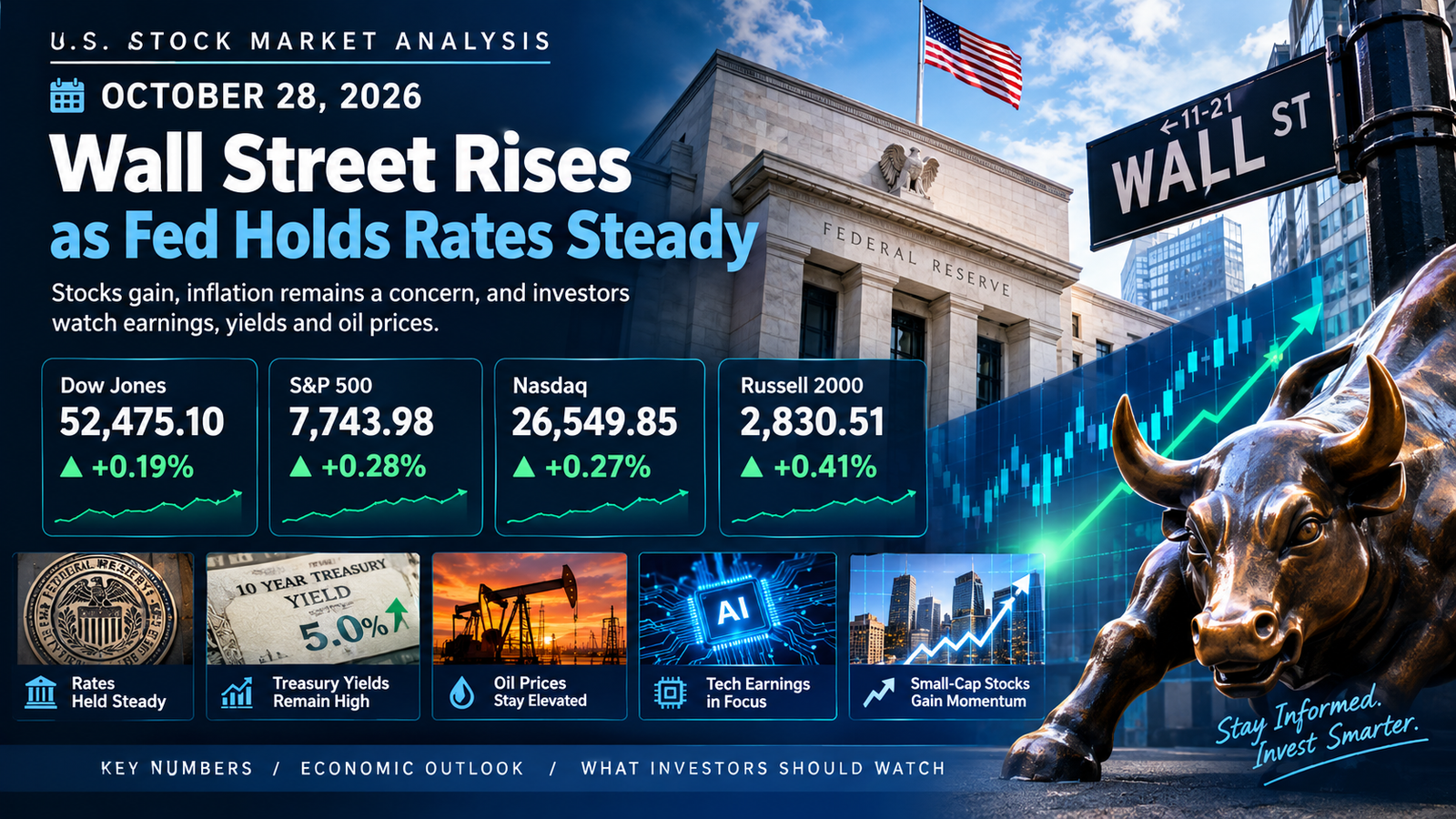
The U.S. stock market finished higher on Wednesday, October 28, 2026, after the Federal Reserve kept interest rates unchanged. Investors welcomed the expected decision, but the outlook remained complicated by persistent inflation concerns, elevated Treasury yields, rising oil prices, and the next round of major technology earnings.
The S&P 500, Dow Jones Industrial Average, and Nasdaq Composite all closed in positive territory. However, the relatively modest gains suggest that investors were not treating the Fed’s decision as a signal that borrowing costs would fall quickly. Attention is now turning to corporate earnings, artificial intelligence spending, inflation data, and the possibility that interest rates could remain restrictive for longer than some investors had hoped.
For American households, businesses, and long-term investors, Wednesday’s session highlighted a familiar market challenge: stocks can rise even when the economic outlook remains uncertain.
U.S. Stock Market Snapshot: October 28, 2026
Here are the reported closing figures for the major U.S. stock market indexes.
| Market index | Closing level | Daily change |
|---|---|---|
| Dow Jones Industrial Average | 52,475.10 | +0.19% |
| S&P 500 | 7,743.98 | +0.28% |
| Nasdaq Composite | 26,549.85 | +0.27% |
| Russell 2000 | 2,830.51 | +0.41% |
Source: Associated Press market recap for October 28, 2026.
The Russell 2000, which tracks smaller U.S. companies, outperformed the three larger indexes on the day. That is worth watching because smaller businesses can be particularly sensitive to borrowing costs, credit availability, and changes in domestic demand.
Still, a single day’s performance does not establish a lasting shift toward small-cap stocks. Investors need to see whether that relative strength continues over several sessions.
The broader picture was positive but restrained. All four indexes advanced, yet the gains were not large enough to suggest that investors had put concerns about inflation and interest rates behind them.
1. Federal Reserve Holds Interest Rates Steady
The Federal Reserve kept its benchmark federal funds target range at 3.75% to 4.00% on October 28. The decision passed by a 10–2 vote, according to Reuters.
Leaving rates unchanged was widely expected. That meant the market’s reaction depended not only on the decision itself but also on the Fed’s assessment of the economy and inflation.
The central bank upgraded its economic assessment while acknowledging that inflation remained elevated. The message left investors weighing two competing possibilities: the economy may be holding up better than expected, but persistent price pressures could prevent policymakers from easing monetary conditions soon.
For investors, an unchanged interest rate is not automatically good news or bad news. The impact depends on what markets had anticipated and what the central bank signals about its next moves.
When investors expect rate cuts, a prolonged pause can disappoint. When they fear another increase, a pause may provide relief. On Wednesday, the decision helped support stocks, but it did not remove uncertainty about the future path of policy.
Read the Reuters report on the Fed decision and global markets.
Why interest rates matter to everyday Americans
The federal funds rate does not directly determine every consumer’s borrowing rate, but it influences financial conditions across the economy.
- Credit cards: Many credit card rates are variable, so higher interest rates can contribute to expensive outstanding balances.
- Mortgages: Fixed mortgage rates are influenced by longer-term bond yields and other market factors, not just the Fed’s policy rate.
- Auto loans: Financing costs can affect monthly payments and the total cost of buying a vehicle.
- Small businesses: Companies that depend on credit may face higher costs when refinancing loans or funding expansion.
- Savings accounts: Some deposit products may offer attractive yields when interest rates are elevated, although banks do not pass policy changes through uniformly.
For families managing debt, the practical issue is the cost of borrowing rather than the stock market’s daily direction. For businesses, it is whether expected revenue can justify the cost of financing new equipment, staff, inventory, or expansion.
2. Treasury Yields Remain a Key Market Risk
Bond yields were another important part of Wednesday’s story. Reports placed the U.S. 10-year Treasury yield around 5.0% to 5.05%, depending on the reporting time and measurement used.
That is a significant level for financial markets because Treasury yields influence the returns investors demand from other assets. They also help shape mortgage pricing, corporate financing costs, and the valuation of future corporate earnings.
When longer-term yields rise, investors may become less willing to pay high prices for stocks whose expected profits lie far in the future. This can be especially important for technology companies, where a substantial portion of a company’s perceived value may depend on future growth.
Higher yields can also make government bonds more competitive with dividend-paying stocks and other investments. Some investors may choose to hold more bonds if the potential return looks attractive relative to the risks of equities.
However, Treasury yields do not move for one reason alone. Inflation expectations, government borrowing, bond supply and demand, economic growth expectations, and expectations for future Federal Reserve policy can all influence them.
What investors should watch next
A sustained increase in Treasury yields could put pressure on richly valued stocks even if corporate earnings remain healthy. Conversely, a decline in yields could support stock valuations, provided it does not reflect a sudden deterioration in economic conditions.
Investors should also distinguish between short-term and long-term yields. Shorter maturities tend to respond more directly to expected central bank policy, while longer-term yields reflect a broader mix of inflation, growth, and debt-market considerations.
For anyone following the U.S. stock market, bond yields are not a side story. They are an important part of understanding why shares may rise or fall even when corporate news appears positive.
3. Technology Stocks and AI Spending Remain in Focus
Technology continued to attract attention as investors evaluated earnings and spending plans from major companies involved in cloud computing and artificial intelligence.
Microsoft shares gained after its cloud revenue exceeded estimates, while Alphabet shares declined after reporting results, according to Reuters’ October 28 market coverage. The different reactions show why investors look beyond headline earnings figures.
A company can report strong revenue growth and still disappoint investors if its results fall short of expectations, its profit margins weaken, or management signals that future spending will be higher than anticipated.
Artificial intelligence has become a major investment theme because companies are spending on data centers, specialized chips, cloud infrastructure, software, and new AI-enabled services. The investment opportunity is substantial, but the financial payoff is not guaranteed for every company.
The question behind the AI rally
Investors increasingly need to ask whether AI-related spending is translating into measurable business results.
Relevant indicators include:
- Growth in cloud and software revenue.
- Demand for AI services from paying customers.
- Changes in operating margins and capital expenditure.
- Cash flow after infrastructure investment.
- Evidence that new products are improving customer retention or productivity.
- The amount of time required for major investments to generate acceptable returns.
The issue is not whether artificial intelligence will have an economic impact. The investment question is which companies can turn demand into durable earnings and which may struggle to justify the cost of building their AI infrastructure.
That distinction matters because expectations are already an important part of technology-stock valuations. Even a growing company can see its share price fall if investors believe future growth will be slower or more expensive than previously expected.
Why earnings reactions can differ
Consider two hypothetical cloud businesses. Company A increases sales while controlling infrastructure costs and improving cash flow. Company B reports similar sales growth but must spend substantially more on equipment and data centers.
Both companies may benefit from AI demand, but their financial outcomes can differ considerably. Investors may reward the first business for demonstrating a clearer path to profitability while questioning the second company’s returns on investment.
This is why the latest earnings season deserves attention beyond the largest headline numbers. Revenue, margins, capital spending, and management’s outlook all help explain whether the AI investment cycle is creating sustainable value.
4. Small-Cap Stocks Show Relative Strength
The Russell 2000 rose 0.41% on October 28, ahead of the Dow, S&P 500, and Nasdaq.
The index’s performance offers a useful additional perspective because smaller companies often have different financial characteristics from the largest publicly traded corporations.
Many small businesses and smaller listed companies depend more heavily on bank financing, domestic consumers, and the health of the U.S. economy. Some also have less financial flexibility than large companies with substantial cash reserves.
A high interest-rate environment can therefore create challenges for smaller firms, especially those that need to refinance debt or fund expansion. At the same time, small-cap stocks may benefit if investors become more confident about economic growth and future financing conditions.
Wednesday’s gain is encouraging for market breadth, but it should not be overinterpreted. A single session does not prove that small-cap stocks are entering a sustained period of outperformance.
Investors following this segment should watch credit conditions, earnings revisions, loan costs, consumer spending, and the performance of small-cap indexes over several weeks.
For individual companies, balance-sheet strength may be just as important as revenue growth. A business with manageable debt and consistent cash generation may be better positioned to navigate high borrowing costs than a similar company that needs frequent access to external financing.
5. Oil Prices Add to the Inflation Debate
Oil prices also remained on investors’ radar. Reuters reported renewed concerns about potential supply disruptions, while market data placed West Texas Intermediate crude futures around $101.99 per barrel at settlement on October 28.
Energy prices matter because crude oil is connected to transportation, manufacturing, shipping, agriculture, and household fuel costs. A sustained increase can raise expenses across multiple parts of the economy.
For consumers, higher energy prices may leave less money available for restaurants, retail purchases, travel, and other discretionary spending. For businesses, they can raise distribution costs and squeeze profit margins if companies cannot pass those costs on to customers.
Higher oil prices can also complicate the Federal Reserve’s efforts to bring inflation under control. If energy costs rise and remain elevated, inflation may take longer to ease, depending on how the increase affects other prices and wages.
There is an important distinction, however, between a short-lived oil-price spike and a persistent increase. Temporary changes may have a limited impact on broader inflation, while sustained increases can be more difficult for households, companies, and policymakers to absorb.
Investors should monitor oil prices alongside inflation reports, consumer spending, and company guidance. Energy producers may benefit from higher selling prices, but other industries can face additional operating pressure.
6. What the Market’s Modest Gain Really Means
All four major indexes finished higher, but the gains were relatively small. That pattern is consistent with a market balancing supportive news against unresolved risks.
The Fed’s decision removed one source of immediate uncertainty. At the same time, investors still needed to assess the central bank’s inflation outlook, bond yields, energy prices, and corporate earnings.
A positive close should not be confused with proof that the market’s risks have disappeared. Nor does a modest gain mean investors have lost confidence altogether. Daily stock movements reflect changes in expectations, positioning, and new information, often before the longer-term economic consequences become clear.
For long-term investors, the more useful questions are whether corporate profits are growing, valuations remain reasonable, debt levels are manageable, and portfolios can withstand periods of volatility.
A market can continue rising while some sectors struggle. It can also experience short-term declines without undermining the long-term prospects of every business. Looking at the full picture is more useful than reacting to a single trading session.
7. What October 28 Means for U.S. Consumers
Stock market news can feel distant from everyday life, but the underlying economic forces have direct consequences for households.
Borrowing costs and household budgets
If interest rates remain high, people carrying variable-rate debt may continue to face expensive monthly payments. Anyone considering a mortgage, auto loan, or other major purchase should evaluate the actual borrowing rate, fees, repayment schedule, and affordability rather than relying on predictions about future Fed decisions.
Energy and living expenses
Higher oil prices can eventually affect gasoline, transportation, and some consumer goods, although the timing and size of the effect vary. Households may want to leave room in their budgets for changes in essential expenses.
Retirement and investment accounts
People with retirement accounts may see their balances move with the market. Short-term fluctuations are normal, but their significance depends on investment goals, time horizon, risk tolerance, and when the money will be needed.
A person close to retirement may have different cash-flow needs from someone investing for several decades. Neither should make a major financial decision based solely on one day’s stock market performance.
Employment and business confidence
Companies may continue investing when they see durable customer demand and a reasonable path to profits. But if borrowing costs, energy prices, or operating expenses rise faster than sales, some firms may delay hiring or expansion.
The market’s performance is one source of information, not a complete picture of the economy. Employment, wages, household finances, and business investment also matter.
8. What October 28 Means for Small Businesses
Small businesses face a different set of challenges from large public companies. They may not benefit directly from rising stock prices, but they are affected by interest rates, customer demand, fuel costs, and financing availability.
Businesses planning to expand should calculate whether expected revenue can cover additional costs under several economic scenarios.
For example, a retailer considering a new location should examine rent, wages, inventory financing, energy expenses, and likely customer traffic. A transportation business should test whether it can absorb higher fuel costs without damaging cash flow. A service company considering new technology should estimate the time needed for productivity gains to outweigh implementation and subscription costs.
Practical steps include:
- Review loan terms and upcoming refinancing dates.
- Maintain a realistic cash-flow forecast.
- Stress-test budgets against higher fuel and supplier costs.
- Avoid assuming that revenue growth automatically means stronger profits.
- Compare major investments against measurable business outcomes.
- Keep enough financial flexibility to handle a slower sales period.
The broader lesson is that businesses should plan around the cost of capital and operating conditions they can realistically face, not just the most optimistic economic forecast.
9. Three Market Scenarios Investors Should Consider
The direction of the U.S. market will depend on future data and corporate results. Rather than treating any single outcome as certain, investors can consider several possible scenarios.
Scenario A: Inflation eases and earnings remain strong
If inflation moderates while companies continue to produce healthy earnings, investors could become more comfortable with stock valuations. Stable or falling bond yields could provide additional support, particularly for growth-oriented sectors.
This scenario would still depend on valuations and whether positive developments are already reflected in stock prices.
Scenario B: Inflation stays persistent and yields remain elevated
If price pressures remain stubborn, the Federal Reserve may have less room to reduce rates and could keep financial conditions restrictive. Elevated bond yields may put pressure on expensive stocks and increase borrowing costs for businesses and consumers.
Companies with strong balance sheets and reliable cash generation could prove more resilient than those that rely heavily on debt or distant future profits.
Scenario C: Economic growth weakens
If consumer demand and business activity slow substantially, corporate earnings expectations could fall. The market might then focus less on the current policy rate and more on the risk of weaker profits and employment.
Lower rates would not automatically offset the damage from a serious economic slowdown. The reason yields fall matters just as much as the size of the decline.
These are analytical scenarios, not forecasts or guarantees. New economic data, geopolitical developments, policy decisions, and earnings announcements can change the balance of risks quickly.
10. What Investors Should Watch Next
After the October 28 session, several indicators deserve attention.
Federal Reserve communications: Investors will continue evaluating whether policymakers see inflation as persistent and what conditions might justify a future rate change.
Treasury yields: The 10-year yield remains important for stock valuations, mortgage rates, and corporate financing.
Inflation reports: Consumer and producer price data can help show whether price pressures are easing or proving more persistent.
Technology earnings: Revenue growth, cloud demand, AI-related capital expenditure, margins, and cash flow may influence the direction of major technology stocks.
Oil prices: Supply developments and energy-market volatility can affect inflation expectations and company costs.
Small-cap performance: Continued strength in the Russell 2000 could indicate broader participation, while renewed weakness may point to concerns about financing conditions or domestic growth.
Consumer spending and employment: These indicators help investors evaluate whether economic resilience is translating into sustainable demand.
Investors should check the latest official releases and company filings before making decisions. Expectations can change rapidly as new information becomes available.
Conclusion: Wall Street Ends Higher, but the Economic Questions Remain
The U.S. stock market closed higher on October 28, 2026, after the Federal Reserve held its benchmark interest rate steady. The S&P 500 advanced 0.28%, the Dow Jones Industrial Average gained 0.19%, the Nasdaq Composite rose 0.27%, and the Russell 2000 climbed 0.41%.
The session offered a positive headline, but the bigger story was the balance between market optimism and continuing economic pressure. Investors still need to assess inflation, Treasury yields, energy costs, technology-company spending, and the durability of corporate earnings.
For American households, the practical concerns are borrowing costs, living expenses, employment, and the stability of personal finances. For businesses, the focus is on credit costs, customer demand, and protecting cash flow. For long-term investors, the priority remains evaluating fundamentals rather than treating a single day’s gains as a reliable prediction of what comes next.
The market’s next move will depend on new information. A careful approach is to follow verified economic data, understand the risks in individual investments, and avoid making financial decisions based only on daily market headlines.
Disclaimer: This article is for informational and educational purposes only. It is not personalized investment, tax, or financial advice. Market conditions and data can change, and investors should conduct their own research or consult a qualified professional before making financial decisions.
Sources and Further Reading
- Reuters: Global stocks hold gains after Fed decision, oil prices rise
- Reuters: Wall Street ends higher as Fed holds key rate steady, focus turns to earnings
- Associated Press: How major US stock indexes fared Wednesday, October 28, 2026
- Federal Reserve: Monetary policy and FOMC information
- U.S. Treasury: Daily Treasury par yield curve rates
