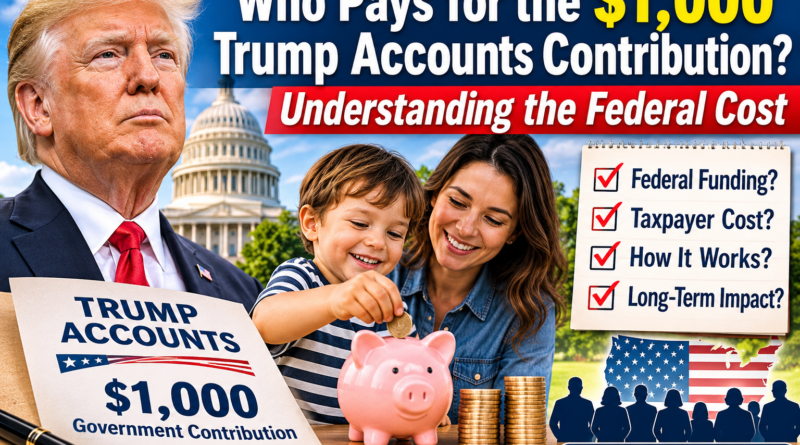
Who Pays for the $1,000 Trump Accounts Contribution? Understanding the Federal Cost
By NewYorkFinanceThink.com News & Financial Research Desk
Publication Date: November 1, 2026
Category: U.S. Economy | Federal Budget | Personal Finance | Government Policy
Reporting Style: Financial Ground Reporting and Policy Analysis
Primary Focus topics : Who Pays for the $1,000 Trump Accounts Contribution
Live Description
The new Trump Accounts program has raised an important question for millions of American families: How can parents use the government’s $1,000 contribution for their children’s future?
In this video, we explore how Trump Accounts work, what the $1,000 contribution means, how the money is invested, and why families should understand the rules before making financial decisions.
Is this money something parents can spend today, or is it designed for long-term financial growth? Watch the video to understand the details.
🎥 Watch the full video:
https://youtu.be/N3-lazJDvEg?si=rEmACw2-XsaR0NbG
🌐 More U.S. finance news and analysis:
https://newyorkfinancethink.com/
#TrumpAccounts #TrumpAccounts2026 #1000Dollars #ChildrensSavings #USFinance #AmericanFamilies #FinancialEducation #InvestingForKids #PersonalFinance #NewYorkFinanceThink
Who actually pays for the $1,000 Trump Accounts contribution? The federal government is providing eligible American children with a one-time $1,000 investment deposit through the Trump Accounts pilot program. But the money does not come from a private donation or a personal payment by President Donald Trump. It is a federal government expenditure authorized under the Working Families Tax Cuts legislation enacted in July 2025.
This NewYorkFinanceThink.com investigation examines how the contribution is funded, how it affects the federal budget, what taxpayers should understand, and why the program’s long-term financial cost deserves attention. We also examine the estimated government expense, the difference between federal seed money and private donations, and the potential economic implications for American families.
Reporting note: This article is based on published federal legislation, IRS guidance, Treasury announcements, government budget documents and independent fiscal analysis. It does not present unverified interviews or claim to have conducted physical on-the-ground interviews.
Introduction: The $1,000 Question Behind America’s New Children’s Investment Program
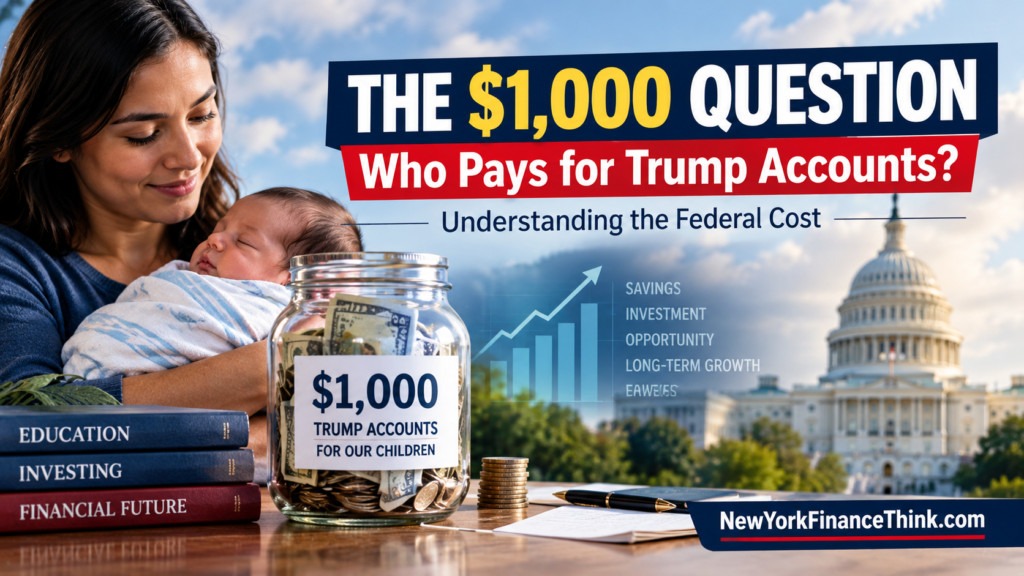
A $1,000 investment contribution can look relatively small when viewed from the perspective of one American family.
For a newborn child, that money could become the beginning of a long-term investment account. If it remains invested for many years, market growth could potentially increase its value. Parents may see it as an opportunity to introduce their children to investing before they are old enough to understand the stock market themselves.
But the financial picture changes when the same contribution is multiplied across millions of eligible children.
A single $1,000 deposit is one thing. Millions of $1,000 deposits represent a significant government financial commitment.
That leads to a question American taxpayers have a legitimate reason to ask:
Who pays for the $1,000 Trump Accounts contribution?
The answer is the federal government.
Under the Trump Accounts contribution pilot program, the U.S. Treasury is responsible for making a one-time $1,000 contribution to the account of each eligible child whose contribution election is approved.
The program was established under the Working Families Tax Cuts legislation, signed into law on July 4, 2025. The relevant provisions added Sections 530A and 6434 to the Internal Revenue Code.
The $1,000 contribution is not a check written personally by the president. It is not a donation from a bank, an investment company, or a billionaire. It is a government-funded contribution created through federal law.
That distinction matters because public money ultimately has to be accounted for in the federal budget.
The government can finance its spending through federal revenue, borrowing and other Treasury financing operations. The Trump Accounts pilot contribution is a federal budget responsibility, not a separate personal payment by the president.
The question is therefore larger than the amount appearing in a child’s investment account.
It concerns the relationship between government spending, public revenue, federal borrowing, financial markets and the long-term obligations of American taxpayers.
This investigation examines those issues in detail.
1. What Exactly Is the $1,000 Trump Accounts Contribution?
A new financial initiative could give eligible American children a $1,000 investment starting point.
But an important question remains: Who actually pays for this contribution? Is it funded by taxpayers, the federal government, or private donors?
Watch this video to understand how Trump Accounts work, where the money comes from, and what the program could mean for America’s financial future.
🎥 Watch the full video:
https://youtu.be/ncUKZhAm-IY
🌐 Read more financial analysis:
https://newyorkfinancethink.com/
#TrumpAccounts #USFinance #FederalBudget #AmericanEconomy #USTreasury #ChildrensSavings #FinancialNews #GovernmentSpending #NewYorkFinanceThink
Trump Accounts are a new type of tax-advantaged individual retirement account designed for eligible American children.
The federal government created the accounts to give children an opportunity to accumulate investment assets during their early years.
The program has two important components:
- The creation of an investment account for an eligible child.
- A separate one-time federal contribution of $1,000 for qualifying children.
These two provisions should not be confused.
A child may qualify for a Trump Account without qualifying for the federal $1,000 pilot contribution.
According to current IRS guidance, the federal contribution is available to eligible U.S. citizens born between January 1, 2025, and December 31, 2028, provided they have a valid Social Security number and satisfy the other applicable requirements.
The contribution must be elected through the official process.
The money is deposited into the child’s Trump Account rather than handed directly to the parents as ordinary cash.
This is important because the program is structured as an investment contribution, not an unrestricted household payment.
The account is intended to remain invested during the child’s growth period, subject to the program’s rules.
The IRS identifies the contribution as a one-time payment from the U.S. Treasury.
Official reference:
https://www.irs.gov/trumpaccounts
2. Who Pays the $1,000? The Federal Government, Not Donald Trump Personally
The most direct answer is that the United States federal government pays the contribution.
However, understanding that answer requires looking at how federal finances work.
The federal government receives money from several sources, including:
- Individual income taxes.
- Payroll taxes.
- Corporate income taxes.
- Excise taxes.
- Customs duties and other federal receipts.
- Borrowing through Treasury securities.
These revenues and financing operations support a wide range of federal responsibilities.
They include Social Security, Medicare, national defense, interest on federal debt, public services, government administration and other authorized spending.
The Trump Accounts pilot contribution is another federal financial commitment.
It is not funded by a special personal account belonging to the president.
It is also not accurate to say that every American taxpayer has been individually charged exactly $1,000 or that the government deducts $1,000 from each family’s tax refund.
Instead, the government makes the payment under the authority provided by federal law.
The financial responsibility belongs to the federal budget.
Why this distinction matters
Consider two different situations.
Situation A: A private donation
A wealthy individual gives $1,000 to a child. The donor provides the money from personal or business assets.
Situation B: A federal government contribution
The government authorizes a $1,000 payment under legislation. The payment becomes a public financial obligation.
Trump Accounts fall under the second situation.
This is why taxpayers, budget analysts and financial journalists are examining the program’s total cost rather than focusing only on the amount received by each child.
3. The Law Behind the Payment: Working Families Tax Cuts
The legal foundation for Trump Accounts is the Working Families Tax Cuts legislation, commonly referred to as the One Big Beautiful Bill Act.
The legislation was signed on July 4, 2025.
Section 70204 established the framework for Trump Accounts.
It added Section 530A to the Internal Revenue Code, which establishes the account structure, and Section 6434, which creates the $1,000 contribution pilot program.
Section 6434 is particularly important for understanding who pays.
Under this provision, an eligible child is treated as having made a $1,000 payment against federal income tax. The Secretary of the Treasury then pays that amount into the child’s Trump Account.
This legal structure is different from a conventional government grant paid directly to a family’s checking account.
The child receives the benefit through the investment account, while the Treasury Department is responsible for making the payment.
The IRS issued guidance explaining the contribution process and eligibility requirements.
The relevant federal law is available through the U.S. House of Representatives’ publication of the Internal Revenue Code.
Official legal reference:
https://usc-cdn.house.gov/view.xhtml?edition=prelim&num=0&req=granuleid%3AUSC-prelim-title26-section6434
4. How Much Could the Program Cost American Taxpayers?
This is where the discussion becomes particularly important.
The $1,000 contribution is a fixed amount per qualifying child. But the total federal expense depends on how many eligible children receive the payment.
The basic calculation is straightforward:
Number of qualifying children × $1,000 = Total federal seed contributions.
Consider the following hypothetical examples.
| Eligible children receiving payment | Federal contribution |
|---|---|
| 1 million | $1 billion |
| 5 million | $5 billion |
| 10 million | $10 billion |
| 15 million | $15 billion |
| 17 million | $17 billion |
| 20 million | $20 billion |
| 25 million | $25 billion |
These figures are illustrations, not confirmed enrollment totals or final government spending figures.
They show why a relatively modest payment to an individual family can become a substantial public expenditure.
Independent fiscal analysis has also highlighted the potential cost.
The Committee for a Responsible Federal Budget has been cited in reporting by FactCheck.org as estimating that the $1,000 contributions could cost approximately $17 billion through 2028.
Separately, the Joint Committee on Taxation estimate cited by the Bipartisan Policy Center placed the broader Trump Accounts provisions at approximately $14.6 billion over ten years.
These estimates should not be treated as interchangeable.
They cover different analytical periods and may reflect different assumptions or components of the legislation. A final assessment should distinguish the cost of the pilot contributions from the broader tax and account provisions.
For taxpayers, the central point is clear: the federal government is making a multi-billion-dollar financial commitment, not simply distributing a few isolated $1,000 payments.
Sources:
- FactCheck.org: https://www.factcheck.org/2026/07/the-dubious-rags-to-riches-promise-of-trump-accounts/
- Bipartisan Policy Center: https://bipartisanpolicy.org/explainer/the-2025-reconciliation-debate-trump-accounts/
5. The Federal Budget: Where Does the Money Come From?
The United States does not operate its federal budget like a household bank account in which every government program has a separate collection of money sitting in a dedicated savings account.
Federal spending is authorized through legislation and recorded through government budget and accounting systems.
When the Treasury makes an authorized payment, that payment becomes part of federal financial activity.
The federal government finances its overall operations through revenue and borrowing.
Individual income taxes
Individual income taxes are one of the largest sources of federal receipts.
Workers, business owners and other taxpayers contribute through the federal income tax system.
Payroll taxes
Payroll taxes help finance programs such as Social Security and Medicare.
These receipts are subject to specific legal and accounting rules and should not automatically be described as the direct source of Trump Account payments.
Corporate taxes
Corporations pay federal taxes on taxable income under applicable rules.
These receipts contribute to federal government revenue.
Federal borrowing
When federal spending exceeds receipts, the government generally finances the deficit by borrowing.
Treasury securities are a major instrument used to finance federal borrowing.
It is therefore reasonable to explain that government-funded programs contribute to the overall federal spending picture, which can affect borrowing requirements when spending is not covered by receipts.
However, it would be misleading to claim that every $1,000 Trump Account deposit is financed by a newly issued Treasury bond.
The government does not identify every individual payment with one particular taxpayer or one specific bond issuance.
The accurate explanation is that the program is a federal expenditure financed within the government’s broader fiscal system.
6. Does Every American Taxpayer Pay $1,000?
No.
This is one of the most important misunderstandings to avoid.
The $1,000 amount belongs to the qualifying child’s account. It is not a $1,000 tax bill for every American.
A taxpayer who has no eligible child is not automatically required to pay an additional $1,000.
Likewise, the government is not taking $1,000 from every parent’s annual income tax refund.
The federal government is making a payment under a statutory program.
The economic cost is distributed through the overall federal budget rather than through an individual $1,000 charge to each citizen.
Nevertheless, public spending has broader implications.
When government spending increases, the country must consider the relationship between expenditure, tax revenue, borrowing and debt.
Those costs can affect taxpayers and the wider economy over time.
That is the difference between an individual tax bill and the overall fiscal cost of a government program.
7. Why Did the Government Choose a $1,000 Contribution?
The policy design focuses on giving children an early financial starting point.
A child born in 2025 could have many years before reaching adulthood.
If the initial $1,000 remains invested, its future value will depend on investment performance, fees, inflation and the length of time it remains in the account.
The concept is based on the potential benefit of long-term compounding.
For example, consider an illustrative investment calculation.
If $1,000 grows at an average annual return of 7% for 18 years, without additional contributions or withdrawals, the account could grow to approximately $3,380.
That is a mathematical illustration, not a guaranteed investment outcome.
Actual market returns can be higher or lower, and an investment can lose value.
The government contribution therefore provides an initial amount of capital, but it does not promise that every child will become wealthy.
The long-term result depends on market conditions and account rules.
8. Who Controls the Money and Who Manages the Accounts?
The federal government established the program, but private financial institutions also play a role in administration.
The Treasury Department designated The Bank of New York Mellon, commonly known as BNY, as a financial agent to support the program.
Treasury announced that BNY would support account administration and the development of the official Trump Accounts platform.
Robinhood Securities LLC serves as the brokerage provider and initial trustee, according to the Treasury announcement.
These responsibilities should be distinguished:
- Congress establishes the legal framework.
- Treasury administers the federal program.
- The IRS provides tax and election guidance.
- Financial institutions provide designated account and brokerage services.
- Parents or authorized individuals claim and manage eligible children’s accounts under the applicable rules.
The use of private financial institutions does not mean those companies are personally financing the federal $1,000 contribution.
The source of the pilot contribution remains the U.S. Treasury.
Treasury reference:
https://home.treasury.gov/news/press-releases/sb0433
9. What Happens When Millions of Children Receive $1,000?
The economic significance of the program becomes clearer when the numbers are examined at scale.
Suppose 10 million eligible children receive the federal contribution.
The total initial government payment would be $10 billion.
Suppose the number reaches 17 million.
The total would become $17 billion.
These are simple arithmetic examples.
The actual number of paid accounts depends on eligibility, valid elections and processing.
The money is not necessarily spent by families immediately. It is placed in investment accounts under specific restrictions.
That means the program also has an investment-market dimension.
If the contributions are invested in eligible index-tracking mutual funds or exchange-traded funds, the money may eventually flow into securities representing large groups of U.S. companies.
This could connect children’s long-term savings with the performance of the American stock market.
However, it would be incorrect to claim that the program will automatically push stock prices higher by a predictable amount.
Investment flows are only one part of the much larger financial market.
The effect depends on the total assets invested, the timing of contributions, fund structures and broader market conditions.
10. Are Trump Accounts Funded by Michael Dell’s $6.25 Billion Commitment?
This question deserves particular attention because the Trump Accounts program has also attracted philanthropic attention.
Michael Dell and his wife Susan Dell announced a $6.25 billion commitment intended to support eligible children through a separate philanthropic contribution initiative.
That money should not be confused with the federal $1,000 pilot contribution.
There are two different funding arrangements:
Federal contribution
- Paid by the U.S. Treasury.
- Authorized under federal legislation.
- One-time $1,000 payment for eligible children.
- Financed as part of the federal government’s fiscal responsibilities.
Private philanthropic contribution
- Comes from private philanthropic funding.
- Has its own eligibility and distribution conditions.
- Is separate from the Treasury’s $1,000 pilot payment.
A private donation can increase the financial support available to qualifying children without changing the legal source of the federal seed contribution.
This distinction is essential for accurate financial reporting.
A headline that suggests Michael Dell personally pays the government’s $1,000 contribution would be misleading.
The two initiatives can operate within the broader Trump Accounts framework while remaining financially distinct.
11. What Are the Potential Benefits for American Families?
The program could offer several potential benefits.
First, it gives eligible children an initial investment contribution without requiring parents to provide the entire starting amount themselves.
Second, it introduces families to long-term investment concepts.
Third, it may encourage parents, relatives and employers to contribute additional funds.
Fourth, it could give children exposure to diversified investments through eligible index-tracking funds.
Fifth, it creates an opportunity to discuss financial education at an early age.
But the program should not be presented as a replacement for household savings, emergency funds, education savings or retirement planning.
A $1,000 investment account does not resolve the financial pressures facing American families.
Housing costs, childcare expenses, healthcare, student debt and everyday living costs remain important issues.
The value of the program will depend partly on whether families can understand the account rules and make informed decisions about additional contributions.
12. What Are the Financial Risks and Limitations?
A government-funded contribution is not the same as a guaranteed financial return.
Trump Accounts are investment accounts.
Their value can rise or fall.
If the investments perform poorly, the account balance may decline.
If markets perform well over many years, the balance may increase.
There are also important access restrictions.
Generally, funds cannot be freely withdrawn during the growth period. Once the child reaches the applicable age, most traditional IRA rules generally become relevant.
Potential account holders should understand the tax treatment of withdrawals before making decisions.
Another consideration is inflation.
A fixed $1,000 contribution may have different purchasing power depending on when the child uses the money.
A future account balance of several thousand dollars could still buy less than the same amount would buy today.
These factors are important when evaluating the actual economic benefit.
13. The Federal Cost Is Not the Same as the Cost to One Family
One of the most common mistakes in public-policy discussions is confusing a program’s total federal cost with its benefit to an individual.
For an eligible child, the initial contribution is $1,000.
For the government, the total cost is determined by the number of eligible contributions.
For an individual taxpayer, the financial impact is indirect and connected to the government’s overall fiscal position.
This distinction matters because the federal government finances many programs simultaneously.
A family may receive a benefit from one program while contributing to the public revenue system through taxes.
Another family may not qualify for that particular benefit but still participates in the wider tax system.
The same principle applies to Trump Accounts.
The $1,000 benefit is directed toward qualifying children, while the federal budget carries the financial responsibility.
14. What Does the Official Federal Budget Tell Us?
The federal budget provides another way to examine the program.
The fiscal year 2027 budget appendix contains a separate section for Section 530A Trump Accounts.
The published budget table includes figures of approximately $5.829 billion and $3.649 billion in its budget authority and outlay presentation for the relevant fiscal years.
These figures must be read in their proper budget context.
They should not simply be described as the final total cost of the $1,000 pilot program alone. The budget account concerns the broader Trump Accounts provision, and budget estimates can change as implementation progresses.
The underlying budget document is useful because it shows that the program is being treated as a federal budget responsibility.
For a financial journalist, that is more meaningful than relying only on promotional descriptions of the program.
Official source:
https://www.whitehouse.gov/wp-content/uploads/2026/04/appendix_fy2027.pdf
15. The Bigger Question: Can the Federal Government Afford the Commitment?
There is no responsible way to evaluate a government program simply by asking whether its individual benefit sounds attractive.
The broader fiscal question is how the program fits into the federal government’s total spending commitments.
The United States already has substantial obligations, including:
- Social Security.
- Medicare and Medicaid.
- National defense.
- Interest payments on federal debt.
- Infrastructure.
- Federal employee compensation.
- Other mandatory and discretionary spending.
A new program must be considered alongside these existing responsibilities.
Supporters of early investment accounts may emphasize financial education, long-term savings and the potential benefits of compounding.
Fiscal analysts may focus on the budget cost, opportunity cost, eligibility design and the long-term implications of expanding federal commitments.
Both perspectives are relevant.
A fair analysis should recognize that the $1,000 payment may provide a meaningful starting point for an individual child while also representing a substantial expenditure when delivered across a large population.
The policy question is not simply whether $1,000 is a lot of money.
It is whether the program’s long-term public benefits justify its total fiscal cost and how those costs compare with other possible uses of federal resources.
16. What American Taxpayers Should Watch Next
There are several developments worth monitoring.
First: Actual contribution totals.
The number of approved elections and completed deposits will help determine the real federal spending requirement.
Second: Treasury payment schedules.
The timing of deposits and account activation affects when federal expenditures are recorded.
Third: Updated budget estimates.
Future federal budget documents and independent fiscal analysis may provide a clearer picture of the total cost.
Fourth: Investment performance.
The long-term experience of the accounts will help show whether the investment structure delivers the intended benefits.
Fifth: Administrative costs.
Account administration, financial-agent services, compliance and reporting are important parts of implementation, even though they should be distinguished from the $1,000 principal contribution.
Sixth: Private contributions.
Additional philanthropic, employer and family contributions should be tracked separately from federal payments.
These figures will help the public distinguish the amount deposited into children’s accounts from the broader cost of operating the program.
17. Final Analysis: A $1,000 Benefit, a Federal Financial Responsibility
The Trump Accounts program raises an important question about the role of the federal government in helping children build long-term financial assets.
For an eligible child, the $1,000 contribution can provide an initial investment balance.
For the Treasury Department, it creates a payment obligation under federal law.
For taxpayers, it represents another item within the government’s broader spending and financing system.
The contribution is not personally funded by President Donald Trump. It is not the same as Michael Dell’s philanthropic commitment. And it is not a $1,000 tax bill imposed on every American household.
It is a one-time federal contribution funded through the public budget.
The wider financial debate concerns the program’s total cost, its long-term value, the investment risks and the opportunity cost of public spending.
Those questions deserve transparent reporting.
As the program develops, American families should pay attention not only to the amount deposited into individual accounts but also to how much the federal government ultimately spends, how the investments perform and what the program delivers over time.
The most important measure will not be the announcement of a $1,000 contribution.
It will be the evidence showing what that contribution achieves for children and what it costs the country.
NewYorkFinanceThink.com will continue following federal budget developments, Treasury announcements, IRS guidance and the financial implications of Trump Accounts.
Frequently Asked Questions
1. Who pays the $1,000 Trump Accounts contribution?
The U.S. federal government pays the one-time contribution through the Treasury Department under Section 6434 of the Internal Revenue Code.
2. Does Donald Trump personally pay the $1,000?
No. The payment is a federal government contribution authorized by legislation, not a personal payment by the president.
3. Does every American taxpayer pay $1,000?
No. The $1,000 is deposited into the account of each eligible child who receives the pilot contribution. It is not an individual $1,000 tax assessment on every taxpayer.
4. Which children qualify?
The federal pilot contribution is for eligible U.S. citizens born between January 1, 2025, and December 31, 2028, with valid Social Security numbers and the other required qualifications.
5. Is the $1,000 a private donation?
No. The pilot contribution is funded by the federal government. Private philanthropic contributions are separate.
6. How much could the program cost?
The total depends on the number of eligible children receiving contributions. For example, 10 million payments would equal $10 billion. Independent fiscal estimates have put the potential cost of the pilot contribution at approximately $17 billion through 2028.
7. Can parents withdraw the $1,000 immediately?
Generally, no. Trump Accounts have restrictions during the child’s growth period, and traditional IRA rules generally become relevant after that period.
8. Is the $1,000 contribution guaranteed to grow?
No. The money is invested, and investment returns are not guaranteed. Market losses are possible.
9. Is Michael Dell funding the federal contribution?
No. Michael and Susan Dell’s philanthropic commitment is a separate funding initiative and should not be confused with the federal Treasury payment.
10. Where can families find official information?
The IRS provides official eligibility, election and account guidance:
https://www.irs.gov/trumpaccounts
Sources & References
This article is based on official U.S. government information, federal legislation, Treasury announcements, IRS guidance and independent fiscal research.
Official Government Sources
- Internal Revenue Service (IRS) – Trump Accounts
https://www.irs.gov/trumpaccounts - IRS – Trump Accounts Frequently Asked Questions
https://www.irs.gov/trumpaccounts/faq - U.S. Congress – Internal Revenue Code, Section 6434
https://uscode.house.gov/view.xhtml?req=granuleid:USC-prelim-title26-section6434 - U.S. Department of the Treasury – Trump Accounts Program
https://home.treasury.gov/ - White House – FY 2027 Federal Budget Appendix
https://www.whitehouse.gov/wp-content/uploads/2026/04/appendix_fy2027.pdf
Independent Financial Research
- FactCheck.org – Trump Accounts Cost and Financial Analysis
https://www.factcheck.org/2026/07/the-dubious-rags-to-riches-promise-of-trump-accounts/ - Bipartisan Policy Center – Trump Accounts Policy and Fiscal Analysis
https://bipartisanpolicy.org/explainer/the-2025-reconciliation-debate-trump-accounts/
Editorial Note
Federal cost estimates discussed in this article are estimates, not final audited expenditures. Different estimates may cover different periods and provisions. Readers should consult the original government documents for the latest eligibility requirements, contribution rules and budget information.
Published by: NewYorkFinanceThink.com
Coverage: U.S. Economy | Federal Budget | Government Spending | Personal Finance
This article is intended for informational and educational purposes and does not constitute tax, legal or investment advice.
Editorial Disclosure
This article is for financial education and public-policy information. It is not tax, legal or investment advice. Budget estimates are estimates, not confirmed final expenditures. Readers should consult official federal documents for the latest eligibility, contribution and tax information.
Published by: NewYorkFinanceThink.com
Coverage: U.S. Federal Budget, Government Finance, Personal Finance and Economic Policy.